

Posted on 01/23/2006 10:42:54 AM PST by Republicanprofessor
Finally, what with a snow day and all, I have time to write one more installment of the history of art. Today’s “lesson” is Baroque art.
Baroque art dates from 1600-1715 or so. (The dates are different with different media. The end of Baroque art coincides with the death of King Louis XIV in 1715; Baroque music ends with the death of Bach in 1750.) The expansion in Baroque artistic space reflects the expansion of political empires (into the New World) and the expansion of scientific knowledge (the invention of microscopes and telescopes: with space expanding outward and contracting inward).
Thus in art, we see a dynamic use of space and light, dramatic energy, and diagonals in three main styles:
1) naturalistic style: Caravaggio, Rembrandt, Vermeer and others.
2) dynamic illusionistic style: very busy, mix of different painting, sculpture, architecture, seen in the work of Rubens, Bernini and others.
3) classicizing, classical Baroque: Greco-Roman mythology, togas, drapes, etc. In architecture we have classical columns, pediments, seen at Versailles. In painting, Poussin rules.
In Italy, Caravaggio reacts against weird Mannerism and returns to a dynamic realism. Quite often his works jut dramatically into our space. He wanted to bring the Catholic faith down to earth, and uses real people and often peasants as his models. The church was shocked by the bare feet and did not appreciate his work at all. (The church preferred the more fancy, dynamic ceiling paintings we’ll see soon.)
Bronzino’s strange Mannerist Venus, Cupid, Folly and Time mid 16th century; and reacting against such odd Mannerism is Caravaggio’s Conversion of St. Paul early 17th century
Note the strong diagonals, dynamic and dramatic light. Also, note what takes up most of the composition: the rear end of a horse!! No wonder the church did not like Caravaggio’s work much. (He also led a rowdy life: hanging out in bars, once stabbing a waiter when he was dissatisfied with his meal, not to mention his gay proclivities.)
Also worth mentioning is Artemesia Gentileschi, whom I see as the first great woman artist. She was inspired by Caravaggio but reflects female power in her image of the Beheading of Holofernes. The power (and revengeful feeling?) in this piece may come from Gentileschi’s rape at the age of 19 by her art teacher.

Note how the maidservant leans back to avoid getting splattered with blood, and that Judith has strong, powerful arms; she is no mild weakling.
Up in Holland, Rembrandt was inspired by the light and down-to-earth realism of Caravaggio. He had a more Protestant, touch, however, and also a warmth and personal depth of characters in his work. I’ve already discussed the love and yet marital differences in The Jewish Bride in another thread (http://www.freerepublic.com/focus/f-chat/1552989/posts). What I also admire is Rembrandt’s Prodigal Son. Notice the great love and forgiveness of the father, yet the towering brother (who stayed behind to help his dad and did not go off and waste his fortune) resounds with resentment.


Rembrandt was also one of the first with a life long series of self-portraits that show increasing internal anxiety as he aged.


There are many other great naturalistic Baroque painters of the seventeenth century, especially Vermeer and van Ruisdael. Instead of the Catholic church as a sponsor, these painters had to market their pieces to the public, and, as a result, often specialized (in landscapes, seascapes, still lifes, etc.) for better sales.
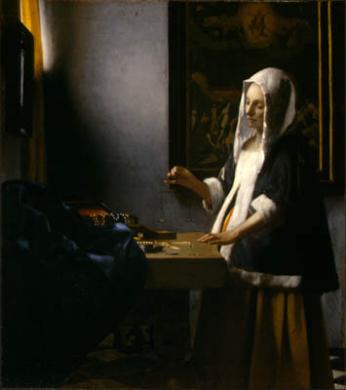

As a mother, I particularly love the Vermeer: Woman with a Balance. I see her as weighing the importance of the jewels (on the left) with the imminent birth of her child and how that will change her life. It is hard to see the balance; there is actually nothing in it.
Now the dynamic illusionistic style is best seen in the Flemish style of Peter Paul Rubens. (Flemish refers to the country of Flanders, now Belgium. It remained strongly Catholic in the religious wars which swept Europe in the 16th century.)


Here we have Rubens famous Daughters of Leuicippus being abducted (“raped”) by Castor and Pollux and his ecstatically religious Assumption of the Virgin. I think he is either an artist one likes strongly or dislikes strongly. As I am learning in the (fabulous) Rape of the Masters: How Political Correctness Sabotages Art by Roger Kimball, Rubens was actually a model of self-control in his personal life (despite his “over the top” paintings).
In Italy, Bernini was another dynamic illusionistic, “over the top” artist. He was the sculptor of the Trevi Fountain, the interior “church furniture” of the Basilica of St. Peter’s, and the famous Ecstasy of St. Theresa shown below.


Then there are the many ceiling paintings of the Italian and Austrian Baroque, where one is almost sucked up into a swirling heaven of bodies. This, too, can be too much for some viewers. I think, however, that the effect is somewhat lost if you are not standing in the very church itself.


Finally, no Baroque art lecture is complete without a consideration of Versailles. This “hunting lodge” was expanded by Louis the XIV, the notorious absolute monarch, who brought his entire court to Versailles so that he could control them. And control he did; he ruled from 1665-1715. It is his death that ends the Baroque art style, as there is a lightening and relaxation of form and content after his death (see below).
The French Baroque is more classical and controlled on the exterior of the building, but just as dynamically busy on the interior. The gardens also extend for miles, with a typically tight French control.


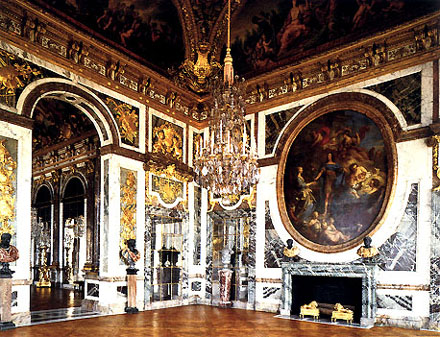
It was under Louis XIV that the third Baroque style blossomed. This is the classical Baroque style and under Poussin it really thrived. Here we see an almost Renaissance kind of restraint. The forms are balanced but not symmetrical. Poussin established the French Academy, and all its rules, against which the Impressionists would rebel 150 years later.

Now, just one slide from the Rococo period, which followed the Baroque period. Forms become lighter and “fluffier.” My favorite is The Swing by Fragonnard. What’s that man doing in the lower left? Can you see him looking up her skirt? Has anything changed in 275 years? What is interesting is the oblivious priest who pushes her swing. The foliage is more like the down from pillows than it is like real trees. Nothing is “realistic” and it appears more dream like. Love themes predominated during the Rococo(movies like Valmont and Dangerous Liaisons come to mind).

The next period is the Neoclassical period, beginning about 1787 with David’s paintings such as Oath of the Horatii, which erases all the light and fluffy aristocratic love themes with a return to Greco-Roman morality and heroism.

At this point, I have just one more of these basic “lectures” to write: on Neoclassicism and Romanticism. Stay tuned.
Art Appreciation/Education ping list.
It's been a while since I had a chance to do another "lecture" on art history. So here goes.
Let me know if you want on or off this ping list.
I find Rembrandts works very pleasing. I love his use of color and light. His works have a softness about them that is very calming and sedate to me.
There seems so much passion in the subjects also.
If it's not baroque, don't fix it!
Note: I'm not an art appreciater, but at least I'm not stupid enough to say "That looks like crap" or "I could do that". I just don't "get" most art.
Art tends to break into three groups for me:
1. Stuff I just don't understand. Modern Art, Mondrian, Picasso, stuff like that. I don't know what I'm supposed to look at, or experience. I get nothin' (but at least I know I couldn't do that).
2. Stuff where I do understand and have endless questions I don't have any way of getting an answer to - "That's interesting. I wonder if the shark ate that lady, and why was she in the water anyway." "What happend to that kid? Were they poor, or did everyone live like that? What season was it? How many hours did they work? Why wasn't the kid in school? Did they even have a school? Could he read?"
3. Rubens, Renoir, guys who painted a significant amount of female nudes. Those I like 'cause I think the female body is beautiful, but somehow, maybe more is supposed to be going on there.
That's why I sort of like Dali, Man Ray, Duchamp, those guys. At least when I see a painting of a spoon or a bottle rack, I know what I'm looking at.
JRBC, what are your thoughts (and anyone else who doesn't feel the need to point out that I don't know anything about art. I already know that.)
Owl_Eagle
(If what I just wrote makes you sad or angry,
First off, I love all things Baroque. From the music, to the architecture to the jewelry making of the period. The detail, the lush colors, the gilding and pomp all appeal to me.
And both Rubens Leucippus and Judgment of Paris are favorites of mine. For many reasons, but mostly, because the women look like normal women. Bodies that are mocked now-a-days were considered goddesses then (I was so born in the wrong era).
I've become a fan of Vemeer in the last few years. I guess a light went on in my head (no pun intended) about how precious light was in a pre-electrical era. With long, cloudy winters, and windows kept shut to ward off drafts, art that seemed to shine from within appeared to be magical.
Some of what is going on is that these artists often are drawing from myth, legend and story you may not be familiar with..plus for religious figures in particular, there is an old tradition of certain figures being associated with certain symbols, like a fuller's club for St. James the lesser, musical instruments, especially the organ, with St. Cecelia, eyes with St. Lucy, and so on.
If you aren't getting some of it, it's probably because you need someone to give you not just an interesting picture, but the background to the subject to get the most out of it.
Those are good questions you ask. Sometimes, the background will give the answers, and sometimes, you are just supposed to wonder about it and come to your own conclusions, I believe.
I like Rembrandt and Vermeer a lot. Rembrandt runs from highly dramatic pieces like Nightwatch to a lot of really pleasant still lives, and lots and lots of portraits. Some of his best work though, revolves around his religious scenes, imho. Vermeer is beautiful, pleasant, skillful and relaxing to look at.
Rubens does do delightful, intimate pictures, but he does so many of the big pictures that you can study for hours they're so rich with detail and you often need to know the type of symbolism or background story behind it to get it all.
Nice lecture, but why are the Versailles gardens so rigid and constrained? Why aren't they more exhuberant and ... well "baroque"?
Could you add me to your list please? Very interesting.
I do see the answer now -- the different styles of the Baroque -- but it does make things a little confusing. The lines between Baroque and neoclassicism or rococco don't seem to be too strict.
But re your point 1, knowledge of modern art, you might be interested in the previous "classes" I've done. These are all clickable on my home page.
class #10: Postmodernism http://www.freerepublic.com/focus/chat/1473061/posts?page=17
class #9: Pop and Minimal Art http://www.freerepublic.com/focus/chat/1470726/posts?page=2
class 8: Pollock and Abstract Expressionism: http://www.freerepublic.com/focus/f-chat/1468241/posts
class 7: American Modernism: http://www.freerepublic.com/focus/f-chat/1440373/posts
class 6: Surrealism: http://www.freerepublic.com/focus/f-chat/1427099/posts
class 5: Cubism: http://www.freerepublic.com/focus/f-chat/1427099/posts
class 4: Expressionism: http://www.freerepublic.com/focus/f-chat/1424087/posts
class 3: Cezanne and van Gogh; http://www.freerepublic.com/focus/f-chat/1419876/posts
class 2: Impressionism and Post-Impressionism; http://www.freerepublic.com/focus/f-chat/1414727/posts
class 1: Realism: Manet and Homer; http://www.freerepublic.com/focus/f-news/1410117/posts
A new series of art history "lectures" designed chronologically from Egyptian art onward:
Art Appreciation/Education series II class #1: Greco-Roman Realism and Early Christian Abstraction http://www.freerepublic.com/focus/f-chat/1491050/posts
Art Appreciation/Education Series II class #2: Romanesque and Gothic Art and Architecture http://www.freerepublic.com/focus/f-chat/1498966/posts
Art Appreciation/Education series II class #3: Art of the Renaissance http://www.freerepublic.com/focus/f-chat/1528015/posts
I have also begun a series on Visits to NYC and the art seen there:
Art Appreciation/Education: Visit to NYC I: Robert Smithson and James Turrell: http://www.freerepublic.com/focus/f-chat/1507874/posts
Blue Moon by John Haber: A review of Oscar Bluemner's retrospective at the Whitney (I wanted to write about Bluemner's work as my Visit to NY II, but I decided to post Haber's great article instead.) http://www.freerepublic.com/focus/f-chat/1507684/posts
Art Appreciation/Education: Visit to NY III: Elizabeth Murray: Return to Color and Energy http://www.freerepublic.com/focus/f-chat/1512127/posts
One other essay I wrote on Christo and his orange gates in NYC: http://www.freerepublic.com/focus/f-news/1348194/posts
You don't have to read them all! But maybe some will peak your interest. (I thought Millee might also be interested, just in case. Millee is now on the ping list.)
(I just hate to repeat myself from thread to thread, so that's why I list what I've already written.)
Thank you both for your responses.
Sometimes, the background will give the answers, and sometimes, you are just supposed to wonder about it and come to your own conclusions, I believe.
Do either of you (or anyone else) know of a book, or probably a series of books that have not only the pictures, but an explanation of what's going on in them? I have several art books, but the texts always seem to give insight into what was going on in the artist's development rather than what's in the picture.
Owl_Eagle
(If what I just wrote makes you sad or angry,
Well, Louis XIV wanted control and not exuberance (at least on the exterior of his palace). That's why it is the third style of the Baroque (and one with which we are perhaps the least familiar). England also had stiff, classical Baroque forms, (but they did enjoy a looser, "English" garden that was actually modeled after gardens in the Far East.)


The last image shows the "English" gardens of Stourhead in England.
Thus St. Paul's in London, by Sir Christopher Wren, has much that is solid and classical. Only the twisting, curved towers have the exuberance true of the Italian dynamic illusionistic style seen in Borromini's Church of St. Agnese. (I like the way the facade--the front part of the second church--actually curves inward. Very unusual.)
Does that answer your question, in a roundabout way? The French under Louis XIV wanted a classical, controlling style, from facades to gardens.
Nice insights about Vermeer and light. Thanks.
Actually, I know a very good book and meant to recommend it in the previous post. It is by Patrick de Rynck and is called How to read a painting: Lessons from the Old Masters. There are many details in there and explanations of symbolism, odd myths, etc. Some of the Dutch paintings are a bit obscure, but I expect amny of our American paintings would seem obscure to a Dutch author.
I have some great ideas on how to write a similar book for abstract art, but I'm still searching for the right publisher.
I grew up reading the Time-Life series of books on famous authors, which in my memory from way back, seemed to explain a lot.
You might want to go to a college bookstore and see what books they are using for their art appreciation course as well.
I do recommend, if you don't have them yet, a copy of Bulfinch's Mythology, including the Age of Fable, because that's a great place to look up a lot of the background stories from myth and legend.
I'm an art and literary junkie, but not up to date on who's good for art reference. But literary reference, come and ask!
Bulfinch's Mythology was one of my favorite books growing up. It and Grimm's Fairy Tales :)
He does a neat retelling of the Arthurian and the Roland stories as well as the greek myths. His idea was to create a source where people who may not have had a chance to read all these legendary works what all the hubbub was about. Very useful reference when we might not even heard of some of this stuff...like the stories about Roland have just about died into obscurity, although the King Arthur stuff still lives - but they are worth knowing!
In this first picture, some kid is feeling up a naked lady.
In this picture, some guy is on his back, waiting for his horse to consummate the marriage.
Islam is born.
I hope this helps in your quest for art appreciation.
Disclaimer: Opinions posted on Free Republic are those of the individual posters and do not necessarily represent the opinion of Free Republic or its management. All materials posted herein are protected by copyright law and the exemption for fair use of copyrighted works.