Skip to comments.
Eucharistic Miracle: 2009?
NC Register ^
| October 15, 2009
| TIM DRAKE
Posted on 10/16/2009 2:11:04 PM PDT by NYer
If reports from Poland are true, an alleged Eucharistic miracle that took place a year ago may have merit.
According to a Polish blog, the Metropolitan Curia of Bialystok has announced the results of the investigation of an Ecclesial Commission appointed by Archbishop Edward Ozorowski on March 30, 2009. The original post (in Polish) can be found here.
Father Andrzej Kakareko, Chancellor, writes that on October 12, 2008, a consecrated Host fell out of the hands of the priest distributing Holy Communion. The priest had it picked up and placed in the vasculum in the Tabernacle. After Mass, the vasculum and its contents were transferred to the safe in the sacristy.
Seven days later, after opening the safe, a red stain was seen on the Host. Ten days afer that, the vessel with the Host was transferred to the Tabernacle in the chapel of the rectory. The next day, the Host was removed from the water and placed on the corporal in the Tabernacle.
On January 7, 2009 a sample from the host was sent to the University in Bialystok for analysis. According to two medical professionals, professor Maria Sobaniec-Lotowska and professor Stanislaw Sulkowski, the sample, in their opinion, most resembled the myocardial (heart) tissue of a living organism.
As part of its investigation, the Commission interviewed witnesses and pathomorphology experts. The Commission determined that there was no third-party intervention. The case has been forwarded to the Apostolic Nunciature in Warsaw.
While unusual in this day and age, the Church has a long history of Eucharistic miracles. The Vatican International Exhibition’s “Eucharistic Miracles of the World” documents more than 130 worldwide miracles of the Eucharist, demonstrating that Jesus Christ in the Eucharist – Body, Blood, Soul and Divinity – continues to make his presence manifest at unique times and places in history.
Perhaps the most famous and well-known, is the Miracle of Lanciano, which occurred about 750 A.D. It bears repeating as it closely resembles the alleged Polish miracle. During Mass, the celebrant doubted the Real Presence of Christ in the Eucharist. During the consecration, the Host transformed into flesh and blood. Subsequent investigations confirmed the authenticity of the human tissue. An investigation, as late as 1970, found the flesh to be cardiac tissue and the blood to be type AB.
TOPICS: Apologetics; Catholic; Current Events; Theology
KEYWORDS: eucharist; myocardil; pathomorphology; poland
Navigation: use the links below to view more comments.
first 1-20, 21-40, 41-42 next last
1
posted on
10/16/2009 2:11:05 PM PDT
by
NYer
To: NYer
2
posted on
10/16/2009 2:13:06 PM PDT
by
GOP Poet
(Obama is an OLYMPIC failure.)
To: NYer
Simple test:
Extraordinary claims require extraordinary evidence.
3
posted on
10/16/2009 2:14:35 PM PDT
by
RobRoy
(The US today: Revelation 18:4)
To: Salvation; narses; SMEDLEYBUTLER; redhead; Notwithstanding; nickcarraway; Romulus; ...
Eucharistic Miracle
Lanciano, Italy 8th Century A.D.
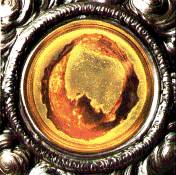
Ancient Anxanum, the city of the Frentanese, has contained for over twelve centuries the first and greatest Eucharistic Miracle of the Catholic Church. This wondrous Event took place in the 8th century A.D. in the little Church of St. Legontian, as a divine response to a Basilian monk's doubt about Jesus' Real Presence in the Eucharist.
During Holy Mass, after the two-fold consecration, the host was changed into live Flesh and the wine was changed into live Blood, which coagulated into five globules, irregular and differing in shape and size.
The Host-Flesh, as can be very distinctly observed today, has the same dimensions as the large host used today in the Latin church; it is light brown and appears rose-colored when lighted from the back.
The Blood is coagulated and has an earthy color resembling the yellow of ochre.
Various ecclesiastical investigation ("Recognitions") were conducted since 1574.
In 1970-'71 and taken up again partly in 1981 there took place a scientific investigation by the most illustrious scientist Prof. Odoardo Linoli, eminent Professor in Anatomy and Pathological Histology and in Chemistry and Clinical Microscopy. He was assisted by Prof. Ruggero Bertelli of the University of Siena.
The analyses were conducted with absolute and unquestionable scientific precision and they were documented with a series of microscopic photographs.
These analyses sustained the following conclusions:
- The Flesh is real Flesh. The Blood is real Blood.
- The Flesh and the Blood belong to the human species.
- The Flesh consists of the muscular tissue of the heart.
- In the Flesh we see present in section: the myocardium, the endocardium, the vagus nerve and also the left ventricle of the heart for the large thickness of the myocardium.
- The Flesh is a "HEART" complete in its essential structure.
- The Flesh and the Blood have the same blood-type: AB (Blood-type identical to that which Prof. Baima Bollone uncovered in the Holy Shroud of Turin).
- In the Blood there were found proteins in the same normal proportions (percentage-wise) as are found in the sero-proteic make-up of the fresh normal blood.
- In the Blood there were also found these minerals: chlorides, phosphorus, magnesium, potassium, sodium and calcium.
- The preservation of the Flesh and of the Blood, which were left in their natural state for twelve centuries and exposed to the action of atmospheric and biological agents, remains an extraordinary phenomenon.
 |
Fig. 1 - Eosine x 200. Overall histological aspect of a Flesh sample with fibers collected in bundles with longitudinal orientation as it occurs in the outer surface layers of the heart.
|
 |
Fig. 2 - Miracle Heart in Lanciano. Mallory x 250. An artery and, very close, a branch of the vagal nerve.
|
 |
Fig. 3 - Miracle Heart in Lanciano. Mallory x 400. Evidence of the "Rough" aspect of the endocardium; the syncytoid structure of the myocardial tissue
|
 |
Fig. 4 - Elution-absorption test x 80. Above: Hemagglutination test on blood sample in Lanciano: on the left, anti A serum used; on the right, anti-B serum. Below: hemoagglutination test on a Flesh sample in Lanciano: left, with anti-A serum, right,with anti-B serum. It appears thus that the Flesh and the Blood in Lanciano belong to AB blood group.
|
 |
Fig. 5 - Electro-phoretic pattern of Blood proteins (Cromoscan photometer). The profile of serum fractions is normal and superimposable to that of a fresh serum sample.
|
In conclusion, it may be said that Science, when called upon to testify, has given a certain and thorough response as regards the authenticity of the Eucharistic Miracle of Lanciano.
4
posted on
10/16/2009 2:14:42 PM PDT
by
NYer
( "One Who Prays Is Not Afraid; One Who Prays Is Never Alone"- Benedict XVI)
To: NYer
We need Jesus now more than ever.
This world is going to Hell in a handbasket.
5
posted on
10/16/2009 2:18:13 PM PDT
by
Infidel Heather
(In God I trust, not the Government.)
To: NYer
News you won’t see in the mainstream media. I pray for Christians to hear about this and use it to strengthen their faith.
6
posted on
10/16/2009 2:18:19 PM PDT
by
Bryanw92
(Question O-thority!)
To: NYer
the Host was removed from the water Translation issue?
7
posted on
10/16/2009 2:20:17 PM PDT
by
annalex
(http://www.catecheticsonline.com/CatenaAurea.php)
To: NYer
It seems to me that some hosts bleed because there has been a desecration. There are rules for disposing of a dropped host, plus I found this, don't have a book to look it up in.
"This is from the Diocese of Pittsburg: "• Mishaps: If a particle of the Eucharistic bread should fall, it is picked up reverently and consumed or allowed to dissolve completely in water and then poured into the sacrarium. If any of the Precious Blood spills, the area of the spill should be covered if necessary. As soon as possible, the spot should be washed and the water poured into the sacrarium."
It sounds like maybe they didn't handle it right. One I remember happened when the priest had doubts; another happened when the altar was wood, can't remember about some of the others I've read about.
8
posted on
10/16/2009 2:24:53 PM PDT
by
Aliska
To: RobRoy
Extraordinary claims require extraordinary evidence. See post #4.
9
posted on
10/16/2009 2:25:45 PM PDT
by
NYer
( "One Who Prays Is Not Afraid; One Who Prays Is Never Alone"- Benedict XVI)
To: Aliska
I hope this doesn’t sound ignorant, but is there anything wrong with a wooden altar?
10
posted on
10/16/2009 2:27:48 PM PDT
by
Infidel Heather
(In God I trust, not the Government.)
To: Bryanw92; annalex
I pray for Christians to hear about this and use it to strengthen their faith.>
As humans, we are often deceived by our 5 senses. In the Apostles Creed, we affirm our faith "in all that is seen and unseen". By faith, we believe the words of our Lord "This is my Body" while, on a human level, our senses cry out for proof. We trust in Christ who promised that He is the way, the truth and the life.
11
posted on
10/16/2009 2:31:40 PM PDT
by
NYer
( "One Who Prays Is Not Afraid; One Who Prays Is Never Alone"- Benedict XVI)
To: Infidel Heather
I hope this doesn’t sound ignorant, but is there anything wrong with a wooden altar? To be honest, I'm not sure. This one I read about in that "Eucharistic Miracles" book and happened a couple hundred years ago.
I thought the altar was supposed to be stone or marble.
Obviously there are other sacrileges where nothing happens (that I know about).
12
posted on
10/16/2009 2:32:02 PM PDT
by
Aliska
To: NYer
Goosebumps.
How blessed we Catholics are to be able to partake of this beautiful and extraordinary sacrament!! God is so good to us!
13
posted on
10/16/2009 2:32:46 PM PDT
by
diamond6
(Is SIDS preventable? www.Stopsidsnow.com)
To: NYer
>>By faith, we believe the words of our Lord “This is my Body” while, on a human level, our senses cry out for proof.
Very true. What I meant was that I pray that Christians hear of this and immediately say, “This must be real”, rather than taking the cynical view of “Show me the proof”.
I don’t care about the proof in this case. When I read it, I felt the Holy Spirit very strongly.
14
posted on
10/16/2009 2:37:23 PM PDT
by
Bryanw92
(Question O-thority!)
To: Aliska; annalex
It sounds like maybe they didn't handle it right. The next paragraph reads:
On January 7, 2009 a sample from the host was sent to the University in Bialystok for analysis. According to two medical professionals, professor Maria Sobaniec-Lotowska and professor Stanislaw Sulkowski, the sample, in their opinion, most resembled the myocardial (heart) tissue of a living organism.
Improper handling? Even after 10 days in water, the host did not dissolve.
15
posted on
10/16/2009 2:37:54 PM PDT
by
NYer
( "One Who Prays Is Not Afraid; One Who Prays Is Never Alone"- Benedict XVI)
To: Infidel Heather; Aliska
I hope this doesn’t sound ignorant, but is there anything wrong with a wooden altar? Yes! Wood is temporary. The Vatican is asking all Catholic Churches to replace their wooden altars with a more permanent material such as marble. Why? Because the altar represents Christ.
16
posted on
10/16/2009 2:41:47 PM PDT
by
NYer
( "One Who Prays Is Not Afraid; One Who Prays Is Never Alone"- Benedict XVI)
To: diamond6
How blessed we Catholics are to be able to partake of this beautiful and extraordinary sacrament!! God is so good to us! As I commented on an earlier post, we humans are too often prey to our 5 senses. We are challenged to believe what we cannot "see, smell, hear, taste".
17
posted on
10/16/2009 2:44:43 PM PDT
by
NYer
( "One Who Prays Is Not Afraid; One Who Prays Is Never Alone"- Benedict XVI)
To: Aliska
allowed to dissolve completely in water I didn't know that. That explains "wyjęto z wody", "taken from the water". Thanks.
18
posted on
10/16/2009 2:49:50 PM PDT
by
annalex
(http://www.catecheticsonline.com/CatenaAurea.php)
To: NYer
There is a second, more urgent reason. Wood is porous. If the blood is spilled on it, recovery becomes an issue. I know in highly polished or sealed wood that becomes less of an issue, and I also know that marble and the like are also somewhat porous, but, imagine an unsealed piece of wood soaking up the precious blood like a sponge. No way to recover it and it could be open to descecration....
To: NYer
That post inspires more questions than answers. “Extraordinary” would be an “end to end” proof. If that exact same post was the evidence offered for a UFO encounter from the same period, it would not be nearly enough for me to be convinced. I’m not saying the event did or didn’t happen. I’m just saying it is not enough evidence to convince.
20
posted on
10/16/2009 3:30:30 PM PDT
by
RobRoy
(The US today: Revelation 18:4)
Navigation: use the links below to view more comments.
first 1-20, 21-40, 41-42 next last
Disclaimer:
Opinions posted on Free Republic are those of the individual
posters and do not necessarily represent the opinion of Free Republic or its
management. All materials posted herein are protected by copyright law and the
exemption for fair use of copyrighted works.
FreeRepublic.com is powered by software copyright 2000-2008 John Robinson