Posted on 08/27/2002 4:10:55 PM PDT by Lady In Blue

Saint Monica
align=left>Few mothers have had as great a biographer as Saint Monica, but few sons have had as great a mother as Saint Augustine. In fact everything we know about Monica comes from her son and most of it in the context of his own biography. The odyssey of their lives was closely intertwined for over thirty years. Some have seen her intervention in Augustine's life and her steadfastness as typical of a domineering mother, but Augustine in retrospect chronicles her heroic struggle to bring him not to herself but to Christ.
Monica was born a Christian at Thagaste, North Africa, around the year 331, the daughter of devout parents who educated her in the faith. Augustine gives only one incident from her youth, obviously relayed to him by Monica herself, of how she was in danger of becoming a wine bibber, but was corrected when her secret sips in the wine cellar were discovered and a maid, in a moment of anger, called her a "drunkard." This stinging rebuke prompted her to change her behavior and develop perseverence. Perhaps this is why recovering alcoholics are among the many groups who intercede to Saint Monica.
 Her marriage to Patricius, a pagan Roman official, does not appear to have been a particularly happy one, but it was peaceful and stable due mainly to the patience and prudence of Monica. Patricius was often a volatile man, and though he was often unfaithful to Monica, at heart he was a good father to Augustine and, with Monica, made many personal sacrifices to educate their promising son. This cooperative effort probably brought them together and we know that Patricius became a Christian before he died. When her circle of friends asked her how she lived with such an excitable man and not be battered, Monica replied that there were two things necessary for domestic peace: firstly, she recalled the matrimonial contract which they agreed to; secondly, she counseled silence when the husband was in a bad mood. Augustine adds that those women who took her advice found peace and better treatment from their husbands.
Monica had two other children, Navigius, who appears occasionally in Augustine's writings, and a daughter, Perpetua, who became the superior of a convent of nuns. Augustine in the Confessions dwells more on his own inner experiences than on the factual data of his life. His preoccupation with his mother's long concern for his spiritual rebirth is a natural because it plays an important role in his final turning to Christ in the year 386.
Monica was a woman of great inner resources buoyed up by a profound faith, but it did not go untested. She never abandoned the desire to see her talented but wayward son a Christian. For almost eighteen years this preoccupied much of her thinking and action. She had persuaded Patricius to have Augustine enrolled as a catechumen, but it seems that neither she nor her husband was overly concerned about baptism. She was rightly indignant, however, when Augustine was unfaithful to the catechumenate, having joined the Manicheans. She stoutly refused him entrance into her home, until after a dream where she was assured that one day Augustine would be a Christian.
Monica's whole life, as well as her sanctification, "was inextricably bound up with Augustine's, her faith, hope, and love were heroically tested and proved pure in the crucible of suffering." One bishop told her that she should be consoled because the son of so many tears could not be lost to Christ. Such occasional consolations gave her new courage to press on. Augustine was strong-willed, stubborn, and not infrequently deceitful with his mother, Monica. It is understandable that Augustine at the age of twenty-nine did not relish having his mother accompany him to Rome, where he was to teach rhetoric. But one cannot excuse the deceitful way in which he escaped. He intimated that she should go back to the inn, because he wanted to say goodbye to a friend. Instead, he sailed away. When this became known to Monica, she wept; she continued to pray for Augustine's conversion. Later, she followed him and joined him in Milan, and it was here in 386, due in great part to Saint Ambrose's preaching, that Augustine finally converted and was baptized in the spring of 387.
Monica knew here a double and unexpected joy. Not only did Augustine become a Christian but also he decided to devote his life to the service of God. The latter did not happen immediately, but the little group of Augustine and his friends, gathered at Cassiciacum in the fall of 386 with Monica as housemother, was a type of community that held an immense attraction for Augustine. At any rate, there Monica manifested a new and surprising facet of character.
Augstine and his friends were one day discussing what made for happiness in life (the dialogue is recorded in Augustine's book The Happy Life). Monica happened to come in during the discussion and gave it focus, at the same time showing her own depths. The group had resolved that to be happy a person must have the things he desires. Monica made an important distinction: "If he wishes to possess good things, his is happy; if he desires evil things, no matter if he possesses them, he is wretched." Augustine rightly told her that she was a masterful philosopher and compared her to Cicero himself.
 Monica did not live long after Augustine's baptism. They had already decided to return to Africa. After a time in Ostia, near Rome, while waiting for passage to Africa, Augustine tells of the moving spiritual experience they shared as they sat at the window overlooking the garden. It was here that Monica expressed the profound peace she enjoyed and her conviction that her life's task had been completed. Very shortly afterward, she fell ill with a fever. She died two days later and was buried at Ostia. Friends told Augustine that she would not grieve over dying and being buried in a foreign land, and she had added, with a touch of humor, that she was sure God would remember where she was buried and raise her up. She had previously told Augustine and his brother Navigius: "Lay this body anywhere, and take no trouble over it. One thing only do I ask of you, that you remember me at the altar of the Lord wherever you may be." Such consummate trust in God's providence was a characteristic virtue of this great fourth century lady. St. Monica's remains are venerated in the church of St. Augustine, Rome, Italy.
Like all God's saints Monica is a woman "for all seasons." Her advice and her powerful example as a wife can be an inspiratio and a model for domestic peace and stability. Monica's eighteen years of caring and crying, coupled with continual prayer, speak eloquently of her perseverance and trust in God's providence. Monica did not plead for a miracle; she prayed and sacrificed for the conversion of her son. Her prayers, disappointments, and tears were all means of drawing her closer to God. In her heroic efforts for her son's conversion, she herself became a saint.
Her feast is celebrated on 27 August, the day before that of her son, Augustine.
Rotelle, John, Book of Augustinian Saints, Augustinian Press 2000.
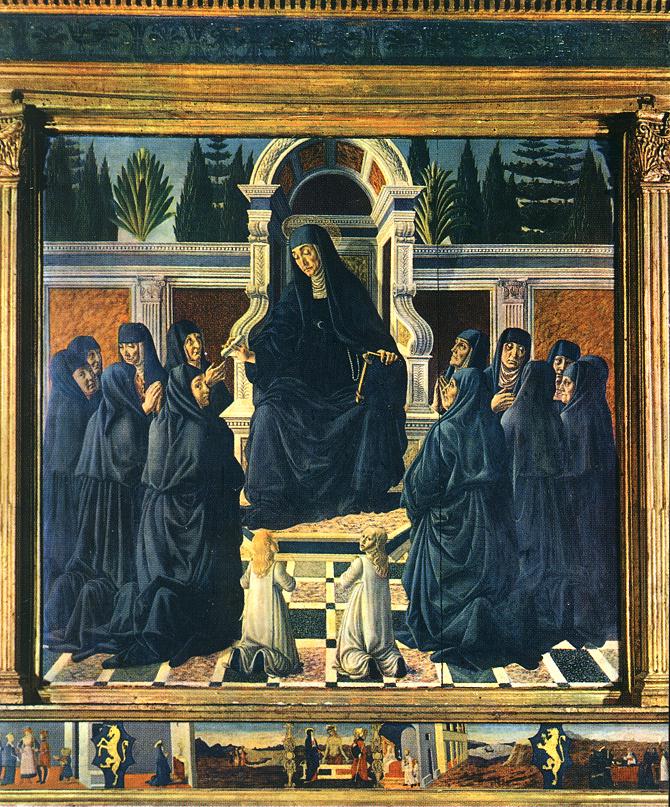
Icon of Saint Monica by Lu Bro.
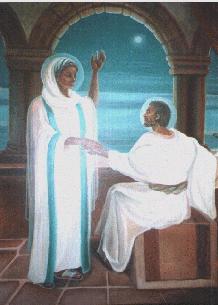
The Vision of Ostia by Álvarez Sotomajor.

From the Confessions of Saint Augustine, bishop
Let us gain eternal wisdom
The day was now approaching when my mother Monica would depart from this life; you knew that day,Lord,though we did not. She and I happened to be standing byourselves at a window that overlooked the garden in the courtyard of the house. At the time we were in Ostia on the Tiber. We had gone there after a long and wearisome journey to get away from the noisy crowd, and to rest and prepare for our sea voyage. I believe that you, Lord, caused all this to happen in your own mysterious ways. And so the two of us, all alone, were enjoying a very pleasant conversation,for getting the past and pushing on the what is ahead. We were asking one another in the presence of the Truth-for you are the Truth-What it would be like to share the eternal life enjoyed by the saints, which eye has not seen,nor ear heard, which has not even entered into the heart of man. We desired with all our hearts to drink from the streams of your heavenly fountain, the fountain of life.
That was the substnace of our talk, though not the exact words. But you know, O Lord, that in the course of our conversation that day, the world and its pleasures lost all their attraction for us. My mother said: "Son, as far as I am concerned, nothin in this life now gives me any pleasure. I do not know why I am still here, since I have no further hopes in this world. I did have one reason for wanting to live a little longer: to see you become a Catholic Christian before I died. God has lavished his gifts on me in that respect, for I know that you have even renounced earthly happiness to be his servant. So what am I doing here?"
I do not remember how I answered her. Shortly, within five days or thereabouts, she fell sick with a fever. Then one day during the course of her illness she became unconscious and for a while she was unaware of her surroundings.My brother and I rushed to her side but she regained conscousness quickly. She looked at us as we stood there and asked in a puzzled voice: "Where was I?"
We were overwhelmed with grief, but she held her gase steadily upon us and spoke further:"Here you shall bury your mother." I remained silent as I held back my tears.However, my brother haltingly expressed his hope that she might not die in a strange country but in her own land, since her end would be happier there. When she heard this, her face was filled with anxiety, and she reproached him with a glance because he had entertained such earthly thoughts. Then she looked at me and spoke:"Look what he is saying."Thereupon she said to both of us:"Bury my body wherever you will;let not care of it cause you any concern. One thing only I ask you, that you remember me at the altar of the Lord wherever you may be." Once our mother had expressed this desire as best she could, she fell silent as the pain of her illness increased.
Saint Monica, Patron Saint of mothers and widows, pray for us.
Another saint for our days!! Lady In Blue, you are on a roll! That's two for two.
I pray to St. Monica constantly, to watch over my teenage daughter, who, like many others, shuns anything to do with the church and religion. Deep in my heart, I know that she will be okay. I began bringing her to mass the week she was born. She's been through catholic school and will make her confirmation next Spring. I draw on the patience of St. Monica to keep me going through this phase of her life.
 |
St. Monica is one of my favorite saints because of her example of perserverance and trust. |
Thank you both for your prayers. My daughter is adopted. She is the answer to a prayer that lasted 20 years. Recognizing that, she is named for Christ and St. Francis of Assisi (the prayer to Christ was answered in the Porziuncola of St. Francis).
As a young child, she would ALWAYS stop at the statue of Mary, just outside our parish church, and look up at her. It was as if they were having a conversation. She would bring Mary flowers from her garden or a rock she found along the way. In 2nd grade, the class prepared for First Holy Communion; she was so impatient. One Sunday morning, I found her in the kitchen with a slice of bread on the cutting board. She cut out small circles and made a cross on each. She then packed these into her pocket book to take to church. When we went up for communion, she would retrieve the homemade "hosts" and take one in church.
Please pray for her godfather, as well. He was raised and educated in the catholic faith, attended Francis Xavier Academy for Boys (run by the Jesuits) and is also a lost soul. He hasn't been to mass in years but my daughter thinks the world of him and he has agreed to be her sponsor.
I am keeping St. Monica quite busy right now! LOL.
There's a great new book that Tan Books just put out.

I've just started reading it this week.It's very readable and understandable without being dry.It's a great refresher book.We all need to be refreshed about the Faith from time to time.
Now it's my time to ask your prayers - for my brother.I just mailed him a copy of this book this week.I'm hoping and praying that he'll read it.You know how guys are generally about reading books on religion,but like I said,I'm hoping and praying that he'll read it.It's also a great book for folks who are interested in the Catholic Church and who respects it enough to ask questions about it.
Very wise words from St. Monica.
Once again, Lady in Blue, you have done a splendid job! Thanks and God bless!
Disclaimer: Opinions posted on Free Republic are those of the individual posters and do not necessarily represent the opinion of Free Republic or its management. All materials posted herein are protected by copyright law and the exemption for fair use of copyrighted works.