Skip to comments.
The FReeper Foxhole Remembers The Battle of New Orleans - Jan. 9th, 2003
http://www.galafilm.com/1812/e/events/orl_battle2.html ^
Posted on 01/09/2003 5:35:46 AM PST by SAMWolf
|
U.S. Military History, Current Events and Veterans Issues
 Where Duty, Honor and Country
are acknowledged, affirmed and commemorated.
|

| Our Mission: The FReeper Foxhole is dedicated to Veterans of our Nation's military forces and to others who are affected in their relationships with Veterans. We hope to provide an ongoing source of information about issues and problems that are specific to Veterans and resources that are available to Veterans and their families. In the FReeper Foxhole, Veterans or their family members should feel free to address their specific circumstances or whatever issues concern them in an atmosphere of peace, understanding, brotherhood and support.
|
|
Resource Links For Veterans 
Click on the pix
|
The Battle of New Orleans
The Attack at the Villere Plantation
On the swampy grounds of the Villere Plantation, hundreds of weary British soldiers are huddled around campfires trying to keep warm. The past two days have been exhausting for this advance party under the command of Major General John Keane and Colonel William Thornton. They have had to row themselves, along with tons of guns and equipment, thirty miles from their camp on Pine Island, and up the sluggish Bayou Bienvenu. In addition to this, numerous relays occur in dragging the provisions to camp across two miles of nearly impassable swamps and thick cypress forests.
To the left of the British, the Mississippi is covered in a thick evening fog. It is so thick that the British patrols do not see the American schooner Carolina before it is too late and it sends roundshot flying into the camp. Keane and Thornton are taken completely by surprise, but they scramble to get the men into fighting order. Jumping from the schooner, Jackson’s men storm the riverbank and push toward the camp.
For nearly an hour, the British regulars struggle fiercely with Jackson’s impromptu brigade of regulars, militia and dozens Choctaw warriors. The sides are equally matched with about 2000 men, but Jackson finds that he won’t be able to maintain order long among his militia who are facing seasoned British soldiers. His begins to falter and he pulls back. As he is withdrawing, the British in pursuit are distracted by another attack on their left flank.
Using local planters as guides, General John Coffee has slipped through the woods and around to the British far-right. His Tennessee riflemen dismount their horses and descend on Thornton’s men. This British line is broken, but the experienced soldiers shield their officers and meet the riflemen head-on in small groups.

A close pitched battle in the dark ensues, as knives, swords, fists and gun butt’s are used to inflict damage. British captain George Gleig later remembered that, “many a sword which till tonight had not drunk blood, became in a few minutes crimson enough.” Finally, Thornton has managed to form up a line and drive Coffee’s men back into the woods where they retire to meet up with Jackson.
The Americans withdraw leaving 45 British dead and another 170 wounded. Jackson’s men don’t fare much better, but the attack has consequences that would eventually work in favour of the Americans. The intensity of Jackson’s raid leads John Keane to believe that he had been attacked by a force more than twice that of his own.
In a decision that would prove costly for the British, the apprehensive Keane decides he will not advance immediately on New Orleans. Instead, he will concentrate on getting more troops and equipment ashore, and hope General Pakenham’s reinforcements will arrive soon.
The British Arrive at New Orleans
The shocking news of Major General Ross’s death at Baltimore in mid-September, reached England a month later. In addition to the British Army losing a bright young commander, his death put the planned New Orleans campaign in jeopardy. A replacement for its overall command had to found.
It was quickly decided that Major General Edward Pakenham would fill the position. There were misgivings about the appointment; Pakenham, though a brave and intelligent officer, had no experience commanding large operations. Before these objections could be addressed, however, he was already sailing to Jamaica for his rendez-vous with Alexander Cochrane.

Admiral Cochrane decided not to wait for Pakenham, and thought it better to leave with his own force, as well as that of John Keane's, to commence preparations off the Gulf Coast. Cochrane had spent most of November mulling over which of New Orleans' many access points he would penetrate.
Thanks to his network of well paid informants, Cochrane knew that the Americans had only five small gunboats on Lake Borgne and that otherwise it was not fortified. Knowing that his navy could easily take care of these, his main concern would be the efficient transfer of men and supplies across the lake (which was too shallow for his large warships), up one of the many bayous and over the swampy terrain leading to the city. If there was strict and speedy execution of the plan, he felt it would work. Having been informed that Jackson hadn't yet fortified the city, Cochrane's fleet left Jamaica on November 27, 1814, hoping to catch Jackson off-guard.
Cochrane reached the entrance to Lake Borgne two weeks later and wasted no time in sending a flotilla of 45 boats, generously laden with cannon, out to meet the American gunships. After a day and a half of rowing across the windless lake, British Captain Lockyer's men cornered the Americans.
After a fierce battle, the British added five gunboats to their fleet and Cochrane began scouting out a base of operations. It was finally decided that Pine Island, at the lake's north end, would be the staging area. Over four cold and wet days, the British make several trips relaying men and equipment from the warships at the lake's entrance 30 miles across the water to Pine Island.
During this period the British did their best to assess the American state of affairs. Andrew Jackson sent out a truce party to inquire into the Americans captured after the lake battle, and Cochrane, dispensing of any formalities, drilled the emissaries as to the strength of the U.S. forces at New Orleans. Undoubtedly hoping to scare the British, one of the party put them at over 15,000. Cochrane didn't believe them, but it was all he could get from the Americans. More promising developments however, were soon reported.
Advance scouts had located a village of Spanish fishermen just inside the Bayou Bienvenu. They were happy to reveal what they knew of American movements in the area, and which of the waterways leading inland were undisturbed by defensive measures. As soon as the scouts confirmed that the Villere Canal off the Bienvenu led to the lightly garrisoned Villere Plantation, Cochrane ordered Keane to prepare an advance force to leave from Pine Island.
The boats could only accommodate about 2000 men at a time but the transport progressed steadily across the lake and up the sluggish bayou despite cold and darkness. The British even captured some American pickets posted in the fishing village. Much to Keane's concern, when questioned, they also estimated the U.S. forces around New Orleans to be 15,000. Undaunted, Keane moved his men up the Villere Canal hoping that Pakenham would soon make an appearance with his and General Lambert's reinforcements.
On December 23, 1814, the British captured another small American advance party quartered at the Villere Plantation. The commander of these Americans was so embarrasses of his failure to secure the area that he made a desperate, but successful, attempt to escape in order to inform Jackson of the proximity of the British.

Keane's second-in-command, the aggressive Colonel Thornton, insisted that a immediate advance on the city would be the only way to catch the Americans by surprise. Keane, more cautious by nature, having only two thousand men and no artillery, decided to wait for the reinforcements which were to arrive the next day. This hesitation by the British would soon undermine their plans.
The British operation took a turn for the worse on the evening of December 23, when they were attacked by the Americans. Although they eventually drove them off, the incident blackened the mood of the exasperated British regulars even more. Pakenham finally arrived on Christmas day with more reinforcements and his men began the arduous task of shifting the heavy artillery 75 miles from Pine Island to the swampy Villere Plantation. Pakenham did little in the way of reconnaissance and three days later, the British advance ran straight into a strong American defensive line, no more than a mile and a half away.
With grueling effort and determination, the British scattered their guns along a line only 1000 yards from Jackson's position. On January 1, 1815, the British commenced a cannonade hoping to weaken the enormous breastwork behind which the Americans sheltered. Without proper blocks to secure the huge guns, the British could not fire with accuracy and the American artillery finally drove them back. Pakenham had come too far to turn back now. He set about devising a new plan, which his men knew would involve a perilous frontal assault on the American line.
Night Before the Battle:
Early Evening January 7, 1815
Major General Edward Pakenham is greatly disturbed with the beating his artillery has taken from the American guns. The cannon protecting Jackson's line have proven far more effective than his own, throughout the numerous exchanges over the past few days. Of greater concern is the battery of guns Jackson has placed on the west side of the Mississippi River, which are positioned to fire directly into a British advance on the American line. But Pakenham is confident that the plan he and his officers have put into motion will solve this problem, and Jackson's men will soon be on the run.
Pakenham's plan is a brilliant, in theory. He has ordered his men to extend the Villere Canal by breaking through the levee along the riverbank so that it meets the Mississippi. This way, the British can move by water all the way from the Bayou Bienvenu to the river. Under the cover of darkness, this first wave of 1500 will land on the west bank of the river and seize the American guns. After this is accomplished, the cannon can then be turned on the Americans and used to support the 5000-strong assault on Jackson's line by the main army who will have moved forward, obscured by the morning fog.

The intrepid Colonel Thornton, who will lead the early morning attack on the west bank, oversees the slow process of loading equipment onto his shallow boats. Due to long days of backbreaking labour by the regulars, there are now over forty vessels assembled in the new portion of the canal. Most of the men have had no sleep in the past days. The cold and damp are taking their toll as sickness creeps through the camp. They have been here too long; like Thornton, a number of the men believe they missed a chance to seize New Orleans after they first took the Villere Plantation.
Only a short distance away, also suffering from a lingering fever, Andrew Jackson surveys his defenses and wonders if they will be enough to stop a massive, well-trained British Army. For the past twelve days the Americans have been working to fortify this position along the north side of the Rodriguez Canal. Jackson has commandeered as many as 900 black slaves from local plantations to construct the massive earthen breastwork that runs 1000 yards from the dense swampy forest to the banks of the Mississippi. These same men are now completing a second line of defense a mile and a half back in case the Americans have to retreat.
Anchored on the great river to Jackson's right rest the big vessels, the Carolina and the Louisiana, recently outfitted as ships of war. Both have been useful in keeping the British active dodging their cannonballs over the past few days. Having caught wind of a possible British attack on the batteries on the river's west bank, Jackson has had to transfer cannon from the Louisiana, along with an additional 400 militia under General David B. Morgan, to strengthen that position. Even this small drain of men away from Jackson's main line makes him anxious.
Jackson's greatest fear over is whether or not he has enough men to stop the British. Reports about their numbers have been high, perhaps as many as 12,000. The American general still harbours worries about the British invading the city from the north, so he has had to move men to the banks Lake Pontchartrain to prevent a possible disaster. This has left him with less than 4000 men lining the Rodriguez Canal, many of them sparsely trained and poorly armed volunteers.
Shivering on this damp patch of Louisiana terrain, neither army has any way of knowing that a treaty of peace was finalized two weeks earlier in the quiet Chartreux convent in Ghent, Belgium. Barely two months ago, the British government was so sure of Pakenham's success at New Orleans that they sent him off with a document which officially recognizes him as Louisiana's governor, and lists the members of the joint British-Spanish civil government that would be set up in that territory. Edward Pakenham has no idea that the sunset he watches melt into the Mississippi, will be his last.
|
TOPICS: VetsCoR
KEYWORDS: andrewjackson; battleofneworleans; freeperfoxhole; johnnyhorton; neworleans; oldhickory; warof1812
Navigation: use the links below to view more comments.
first 1-20, 21-40, 41-60, 61-80, 81-86 next last
The Americans Devastate the British
At 5:00 am on January 8, 1815, British General Edward Pakenham moves to the east bank of the Mississippi; he doesn’t like what he sees. Colonel Thornton’s troops should be across the river and moving on the American guns. Instead, most of his men are waist-deep in mud, clearing away sections of the levee that have caved in on the canal passage and made it too shallow for the boats to cross. Only a few of the regiments are boarded and ready to move out.
Pakenham is adamant that his own attack force will move on the American line before first light. He orders Thornton to proceed with the advance with the men he has. As they shove off, it's obvious that no one has anticipated the river, which is flowing faster than normal. Thornton’s men will eventually make it across, but they land well below their target and lose precious time.

Pakenham rides back to his line through the fog and orders his officers to make the final preparations among their units. The officers are uneasy as they realize that their general is sending them forward before Thornton has successfully secured the American guns. This is a sign of Pakenham’s lack of experience as a commander that, at this crucial stage, he changes his original plan rather than sticking to it fully or devising a new one. But with the men form up, and with the day about to break, the officers hope that the capable Colonel Thornton makes short work of his opponents.
The fog that is supposed to help the British in their advance is creating more problems than anticipated. It is thick enough to create problems for the artillery units, who are having trouble finding their positions and setting up. One regiment should have brought up ladders to bridge the Rodriguez Canal and storm the Americans, but they’ve left them behind so they must break formation and fumble towards the rear to retrieve them. As the artillery opens up to signal the advance, British regiments on opposite ends of the field head out to capture and silence the gun batteries in front of the American lines. Suddenly, the fog begins to lift.
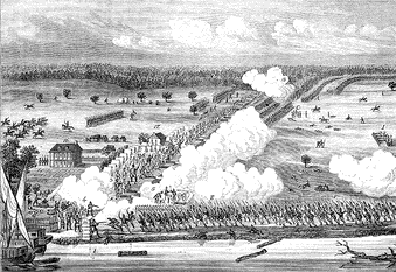
As the morning mist disappears, Andrew Jackson has a clear view of the enemy army that has plagued him for weeks. The artillery from Jackson’s line and the ships on the river commence a relentless shower of grapeshot and cannonballs. The exposed British are helpless since they are too far away to respond with their muskets.

The U.S. gunners watch incredulously, as the British maintain an advance despite the scores of men falling as bombs tear into their columns. British captain George Gleig recalls watching his comrades falling as the American guns kept up a “a sweeping fire which cut them down by whole companies.” As the British struggle closer, the Kentucky snipers, along with Choctaws and rest of the militia, add to the carnage as they open up a steady fire.
It has been less than an hour and the British attack is unraveling quickly. Pakenham realizes Thornton has not yet succeeded on the west bank. In what will prove to be a costly mistake, Pakenham diverts troops which were to reinforce the capture of the gun battery on Jackson’s right to the center of the field. The regiment that breaks through and takes them is left without support and suffers greatly under the Kentucky rifles and the nearby gunboats.
Moving toward the left flank General John Keane’s regiment of Highlanders is decimated by the American barrage. Three out of four men are killed; Keane is shot through the neck. Elsewhere at the front, officers as well as regulars are dying in the canal as they try to penetrate the American line.

Pakenham misses these developments. He is frantically trying to maintain order as his officers bring forward all of the remaining troops. Rallying his troops, some of whom are running for the rear, Pakenham leads a charge but he has his horse shot out from under him. His aide offers him his horse, but as the general mounts, two bullets rip through his throat and chest. As he is brought to the rear, he gasps out a final order to bring up the reserves under General John Lambert. Pakenham dies within minutes. Lambert drives forward but makes little progress since, with few commanders to lead the offensive, many British are now in full retreat. With Pakenham dead, and command falling to him, Lambert decides to take up a defensive position rather than continue the advance.
Unaware that it is all but over on the east side of the river, Thornton is finally in position to move on the American guns under General Morgan. The US militia puts up a fierce resistance but it is not enough for an experienced battle commander like Thornton. His men deal one blow after another to the American right flank until Morgan’s men spike the guns and retreat.
Thornton is badly wounded and stays with a group of British regulars to secure the position while the rest pursue the Americans. As they push more than a mile up the riverbank, an order from Lambert to fall back is received; the position has been deemed to difficult to hold under the circumstances. Destroying what guns they can, the British cross the river and get their first glimpse at the carnage on the battlefield. Sergeant David Brown of the British 21st Foot remembered how, “many a gallant man and officer wiped the tears from their eyes when they looked back and on their comrades lying in the field.”
The British lost at least 300 men on the battlefield, many of the more than 1200 wounded would die later or be maimed for life. The US casualties amounted to only 13 killed and 52 wounded or missing. The Americans took 500 prisoners, but it was the sight of those on the field that made the deepest impression. William Lawrence, an American militiaman, later claimed, “I could have walked on the dead bodies of the British for one quarter of a mile without stepping on the ground.”
1
posted on
01/09/2003 5:35:46 AM PST
by
SAMWolf
To: souris; SpookBrat; Victoria Delsoul; MistyCA; AntiJen; SassyMom; bentfeather; GatorGirl; radu
Confusion on the Battlefield at New Orleans
Gleig makes special mention of the American artillerymen and their part in the stonewalling of the British advance. The American’s effective use of artillery, along with steady support from the volunteer riflemen, clinched the U.S. victory.
"But that danger was indeed near, they were quickly taught; for scarcely had the head of the column passed the houses, when a deadly fire was opened from both the battery and the shipping. That the Americans are excellent marksmen, as well with artillery as with rifles, we have had frequent cause to acknowledge; but, perhaps, on no occasion did they assert their claim to the title of good artillerymen more effectually than on the present. Scarce a ball passed over, or fell short of its mark, but all striking full into the midst of our ranks, occasioned terrible havoc.
"The shrieks of the wounded, therefore, the crash of firelocks, and the fall of such as were killed, caused at first some little confusion; and what added to the panic, was, that from the houses beside which we stood bright flames suddenly burst out. The Americans, expecting this attack, had filled them with combustibles for the purpose; and directing against them one or two guns, loaded with red-hot shot, in an instant set them on fire. The scene was altogether very sublime. A tremendous cannonade mowed down our ranks, and deafened us with its roar; whilst two large chateaux and their out-buildings almost scorched us with the flames, and blinded us with the smoke which they emitted."
2
posted on
01/09/2003 5:36:20 AM PST
by
SAMWolf
(To look into the eyes of the wolf is to see your soul)
To: All
Andrew Jackson's letter to the British after their defeat at New Orleans Andrew Jackson wrote this letter to the British commander Major General John Lambert only a few hours after the British defeat on the battlefield below New Orleans.
Head Quarters 7h. M. District
Lines below New Orleans
8h Jany 1815. 3 Oclock
Sir,
I have recd. your dispatch of this date. The Army which I have the honor to command have used every exertion to afford relief to the wounded of your Army, even at the constant risque of their lives, your men, never intermitting their fire during such exertions. The wounded now on the field beyond my lines, if you think proper may be taken beyond a line to be designated by my Adjt. General, and be paroled; Otherwise they may be taken to my hospital and treated with every care and attention. The flag sent by Commodore Patterson at my request, has been detained by the Admiral; leaveing him uninformed of the fate of his comand that was taken in the gunboats - The dead on the field beyond the line, above alluded to, you can inter, Those within that line shall be interred by my troops.
When a return is made of the wounded and prisoners taken on board the Gun boats, and the few men taken on the night of the 23d. it shall be returned by a similar one on my part.
If you should think proper to accede to the above propositions, you will lease suggest any arrangement which you may think best for their Accomplishment. I am respectfully
A Jackson M G Cg
3
posted on
01/09/2003 5:36:46 AM PST
by
SAMWolf
(To look into the eyes of the wolf is to see your soul)
To: All
'Prompted by curiosity, I mounted my horse and rode to the front; but of all the sights I ever witnessed, that which met me there was beyond comparison the most shocking and the most humiliating. Within the narrow compass of a few hundred yards, were gathered together nearly a thousand bodies, all of them arrayed in British uniforms.
Not a single American was among them; all were English; and they were thrown by dozens into shallow holes, scarcely deep enough to furnish them with a slight covering of earth. Nor was this all. An American officer stood by smoking a cigar, and apparently counting the slain with a look of savage exultation; and repeating over and over to each individual that approached him, that their loss amounted only to eight men killed, and fourteen wounded.' -- Captain George Gleig
recounting the scene of devastation as hundreds of his British comrades lie scattered in the field after the Battle of New Orleans. |
4
posted on
01/09/2003 5:37:16 AM PST
by
SAMWolf
(To look into the eyes of the wolf is to see your soul)
To: All
Battle of New Orleans
by Jimmy Driftwood
In 1814 we took a little trip,
along with Colonel Jackson down the mighty Mississip.
We took a little bacon and we took a little beans,
and we fought the bloody British in the town of New Orleans.
We fired our guns and the British kept a comin',
There wasn't 'bout as many as there was awhile ago.
We fired once more and they began to runnin'
On down the Mississippi to the Gulf of Mexico.
They ran thru the briars and they ran thru the brambles and
they ran thru the bushes where a rabbit wouldn't go.
They ran so fast that the hounds couldn't catch 'em on down
the Mississippi to the Gulf of Mexico.
Oh we looked down the river and we seen the British come.
There must have been a hundred of 'em beatin' on a drum.
They stepped so high and they made their bugles ring.
We stood behind our cotton bales and didn¹t say a thing.
Old Hickory said we could take 'em by surprise,
if we didn¹t fire our muskets till we looked 'em in the eyes.
We held our fire till we seen their faces well,
then we opened up our squirrel guns and gave 'em Well....we...
....fired our guns and the British kept a comin',
There wasn't 'bout as many as there was awhile ago.
We fired once more and they began to runnin'
On down the Mississippi to the Gulf of Mexico.
They ran thru the briars and they ran thru the brambles and
they ran thru the bushes where a rabbit wouldn't go.
They ran so fast that the hounds couldn't catch 'em on down
the Mississippi to the Gulf of Mexico.
We fired our cannons till the barrels melted down,
then we grabbed an alligator and we fired another round.
We filled his head with cannonballs and powdered his behind,
and when we touched the powder off, the gator lost his mind.
We fired our guns and the British kept a comin',
There wasn't 'bout as many as there was awhile ago.
We fired once more and they began to runnin'
On down the Mississippi to the Gulf of Mexico.
They ran thru the briars and they ran thru the brambles and
they ran thru the bushes where a rabbit wouldn't go.
They ran so fast that the hounds couldn't catch 'em on down
the Mississippi to the Gulf of Mexico.
5
posted on
01/09/2003 5:37:42 AM PST
by
SAMWolf
(To look into the eyes of the wolf is to see your soul)
To: SAMWolf

Thanks, Doughty!
6
posted on
01/09/2003 5:38:17 AM PST
by
SAMWolf
(To look into the eyes of the wolf is to see your soul)
To: All

<P
7
posted on
01/09/2003 5:38:48 AM PST
by
SAMWolf
(To look into the eyes of the wolf is to see your soul)
To: SAMWolf

Today's classic warship, USS Hughes (DD-410)
Sims class destroyer
Displacement. 1,570 t.
Lenght. 348'2"
Beam. 36'1"
Draft. 17'4"
Speed. 35 k.
Complement. 450
Armament. 4 5", 8 21" tt.
USS Hughes (DD-410) was laid down 15 September 1937 by Bath Iron Works, Bath, Maine; launched 17 June 1939 sponsored by Mrs. Edward M. Hughes, widow of Commander Hughes; and commissioned at Boston Navy Yard 21 September 1939, Lt. Comdr. Donald J. Ramsay in command.
Following shakedown in the Gulf of Mexico, Hughes joined the Atlantic Fleet. From July 1940 through December 1941, Hughes served in the Atlantic, first on patrol off Martinique to watch Vichy controlled French Forces there and then on Neutrality patrol off Iceland. During this time, she became the first American destroyer to escort a British convoy all the way to England.
Following the attack on Pearl Harbor, warships were urgently needed in the Pacific and Hughes sailed from Norfolk 18 December 1941, arriving San Diego in company with Yorktown (CV-5), 30 December. She departed San Diego 12 January 1942 as an escort for ships bringing reinforcements to Samoa. Hughes then sailed from Samoa as part of a carrier striking force built around carrier Yorktown. She screened the carrier in strikes on Jaluit, Makin, Mili, and Canton Islands; then supported the combined Lexington,Yorktown Task Force 17, as it attacked Japanese bases at Lae and Salamana, 10 March 1942. Missing the Battle of the Coral Sea while escorting a tanker carrying fuel to Noumea, Hughes reached Pearl Harbor in time to participate in the Battle of Midway.
Hughes, while protecting carrier Yorktown during this action, shot down two torpedo planes and assisted in shooting down two others. After Yorktown was hit 4 June, Hughes continued an all-night vigil to prevent her capture. When the carrier was torpedoed by a submarine 6 June, Hughes helped damage the attacker with depth charges, and rescued the survivors when Yorktown sank the next day.
After a brief time as convoy escort, she joined American Forces at Guadalcanal, where she screened the carrier Hornet (CV-8) throughout the campaign. During the Battle of Santa Cruz. Hughes splashed one Japanese plane and assisted in downing two more. Despite her valiant efforts, Hornet was hit and sunk 27 October 1942. Joining Task Force 16, 10 November 1942 Hughes participated in the Naval Battle of Guadalcanal; by screening Enterprise (CV-6). Hughes continued screening operations until the end of February 1943.
Following a refit and brief convoy duty, Hughes was detached from the South Pacific and sailed to Pearl Harbor, departing 18 April for the Aleutian Islands and arrived on the 24th. Bombardments of Kiska on 6 and 22 July were high points of her months in northern waters. After Kiska was occupied, Hughes departed the Aleutians for overhaul 25 August in San Francisco.
Following overhaul, Hughes sailed for Pearl Harbor 26 October to prepare for the invasion of the Gilbert Islands. She sailed 10 November as part of the screen for the escort carriers covering the invasion of Makin Atoll. When Liscombe Bay (CVE 56) was sunk 24 November, Hughes rescued 152 of the survivors. She began screening the transport group 27 November. and 2 days later departed for Pearl Harbor, and arrived there, 7 December 1943. On 13 January 1944, Hughes joined Task Force 53 for the invasion of the Marshall Islands. She joined in the preinvasion, 3 to 11 February 1944. The destroyer continued to support the escort carriers during the strikes against Palaus 31 March.
Hughes took part in the invasion of Hollandia, New Guinea, 23 April, acting as a screen for the CVE group which provided air cover for the landings at Aitape and Tanahmerah Bay. Then Hughes remained off New Guinea as a convoy escort and fire-support ship of the 7th Fleet, until 25 September when she departed for the invasion of the Philippines. During this time, Hughes participated in the invasions of Biak, Noemfoor, Cape Sensapor, and Morotai, serving as flagship of Rear Adm. William M. Flechteler during the latter campaign.
During the invasion of Leyte, Hughes was the flagship of Rear Adm. Arthur D. Struble commanding the tiny task group detailed to capture the small islands of Dinigat and Homohon guarding the entrance to Leyte Gulf. Following the successful conclusion of this operation, Hughes screened Philippine bound convoys, making frequent trips to and from New Guinea until 6 December 1944 when she reembarked Admiral Struble and departed for the invasion of Ormoc Bay, Leyte. Following this operation, Hughes was serving as a picket destroyer off the southern tip of Leyte when she was hit by a kamikaze 10 December 1944. Badly damaged with one engine room demolished and much of her other machinery destroyed, Hughes was towed to San Pedro Bay, Leyte where, after temporary repairs, she departed for Humboldt Bay, New Guinea, 19 December en route to Pearl Harbor, where she arrived 23 January 1945. Following more repairs she sailed for San Francisco, arriving Hunter's Point Naval Drydocks 2 February. Hughes remained there for the next 3 months undergoing extensive overhaul.
After a long testing period, Hughes was declared combat ready and departed for Adak in the Aleutians 4 June 1945. Assigned to the Northern Pacific Force, she remained in the Aleutians until the end of the war, harassing enemy shipping and bombarding Japanese bases. Hughes then served as part of the patrol force off Northern Honshu until relieved 20 October. She sailed for the United States 10 days later with Destroyer Squadron 2.
Her last active service was as part of the target group during the Bikini Atomic Tests in July 1946. Decommissioned 28 August 1946, USS Hughes was sunk as a target in October 1948.
Hughes earned 14 battle stars for World War II service.
8
posted on
01/09/2003 7:13:46 AM PST
by
aomagrat
To: aomagrat
Hughes earned 14 battle stars for World War II service.
USS Hughes was sunk as a target in October 1948
An honorable end for the Hughes, better than the scrap yard.
9
posted on
01/09/2003 7:19:29 AM PST
by
SAMWolf
(To look into the eyes of the wolf is to see your soul)
To: SAMWolf
The Battle of New Orleans
The fighting in Louisiana was really a series of battles for New Orleans, lasting from December 1814 through January 1815. On the Chalmette battleground , just below the city, a diverse force of soldiers, sailors, and militia, including Indians and African Americans, defeated Britain's finest white and black troops drawn from Europe and the West Indies.
The American victory in the Gulf region forced the British to recognize United States claims to Louisiana and West Florida and to ratify the Treaty of Ghent, which ended the war. The Battle of New Orleans also marked the state's political incorporation into the Union.
The Key Players
Britain sent between 11,000 and 14,450 troops under the command of Major General Sir Edward Pakenham to fight in the Louisiana campaign. These included army and navy men fresh from campaigns fought against Napoleon in Europe, as well as veterans of other theaters in the War of 1812. Vice-Admiral Alexander Cochrane had charge of the British navy in American waters and directed naval skirmishes in the gulf.
Among the British forces were the First and Fifth West India Regiments, made up of about one thousand black soldiers from Jamaica, Barbados, and the Bahamas. Some of these units recruited and trained American slaves who escaped to British lines, attracted by the promise of freedom.
United States forces at the time of the Battle of New Orleans were much smaller--somewhere between 3,500 and 5,000. This detachment was composed of United States army troops; Kentucky, Tennessee, Mississippi, and Louisiana militia; Baratarian pirates; Choctaw warriors; and free black soldiers.
Major General Andrew Jackson, commander of the Seventh Military District, led United States forces in the Gulf campaign against Britain. An ardent expansionist and charismatic leader, Jackson inspired his men and the local populace to fight and defeat the British.
For more
http://lsm.crt.state.la.us/cabildo/cab6.htm
(snip) Now a little something I (at least) never knew.
Jordan Noble
Jordan Noble was a free black drummer famous for beating the long roll at the Battle of New Orleans. Born in 1800 in Georgia, Noble came to New Orleans in 1811 and joined the United States army one year later. He participated in several engagements of the Louisiana campaign. At the Battle of New Orleans, he opened with reveille and closed with taps. He later served as a drummer in the Mexican War of 1846-1848 and rallied New Orleans free men of color to form militia companies on behalf of the Confederacy at the outbreak of the Civil War.
And again
To: Valin
My great great grandfather, Francis Smith, was a 1st Sergeant with Gen. Billy Carroll's West Tennessee Militia during that battle. Smith's company lost 24% of its' strength in the series of battles leading up to Jan 8th. Granddad Smith picked up a powder flask off a dead British soldier, and the flask remains in the family to this day.
Frank Smith lived to be almost 90 years old, and each Jan 8th, he took his Tennessee long rifle and his "jug" and went to the woods to remember his lost comrades. When he grew too old to leave the house, he'd just go upstairs with the jug, and did so every Jan 8th til his death in 1868.
The seventh generation of his family still lives on the land he bought with his discharge bounty, and each year, two of his great grandsons take a pint of Jack Daniels to the Presbyterian church graveyard, drink a toast to Frank, and pour the rest of the bottle over his grave, whose marker reads: Frank Smith, Veteran, Battle of New Orleans.
Thanks for the reminder
26 posted on 01/08/2003 10:04 AM CST by okchemyst
10
posted on
01/09/2003 7:24:46 AM PST
by
Valin
(Good Luck!)
To: SAMWolf
Good Morning Everybody.
Coffee & Donuts J
11
posted on
01/09/2003 7:26:28 AM PST
by
Fiddlstix
(This Space Available for Rent or Lease by the Day, Week, or Month. Reasonable Rates. Inquire within.)
To: SAMWolf
On This Day In History
Birthdates which occurred on January 09:
1554 Gregory XV [Alessandro Ludovisi], Roman Catholic pope (1621-23)
1574 Christoph Buel composer
1620 Johann Weichmann composer
1695 John E Loovens lawyer
1699 Robert J Pothier French lawyer
1728 Thomas Warton poet laureate of England (Pleasures of Melancholy)
1748 Stefan Paluselli composer
1790 Per Daniel Amadeus Atterbom Swedish poet (Lycksalighetens)
1803 Christopher Gustavus Memminger Secretary Treasurer (Confederacy) died in 1888
1815 William Jackson composer
1816 John Palmer Usher Secretary Interior (Union) died in 1889
1820 Pavel Krizkovsky composer
1822 John Porter Hatch volunteers Bvt Major General (Union), died in 1901
1829 Thomas William Robertson England, playwright (Caste)
1829 Adolf von Schlagintweit German explorer (Tarimbekken)
1832 Esquire Maurits A de Savornin Lohman Dutch Governor of Suriname
1839 John Knowles Paine Portland ME, composer
1843 Christiaan A Ulder Curaçao, composer (waltzes/tumbas)
1851 Giuseppi Gallignani composer
1851 Luis Coloma Spanish jesuit/writer/theologian (Pequeñeces, Boy)
1856 Anton Askerc Slavic priest/poet (Primoz Trubar)
1856 Lizette Woodworth Reese US poet (Branch of May, Tears)
1856 Stevan Mokranjac composer
1857 Henry B Fuller American writer (Under the Skylights)
1859 Carrie Lane Chapman Catt women's rights leader/founder (League of Women Voters)
1859 Frederik Pijper Dutch vicar/church historian (The Monasteries)
1866 Albert Baertsoen Flemish painter/etcher
1867 Jacques Urlus Dutch tenor (Opera of Leipzig, Song of the Earth)
1870 Joseph B Strauss civil engineer/builder (Golden Gate Bridge)
1871 Charles Kortright British cricket player
1873 Hayyim Nahman Bialik Rädi Ukraine, Hebrew poet/translator
1876 Hans Bethge writer
1879 John Broadus Watson behaviorist psychologist
1881 Lascelles Abercrombie English poet/critic (Revaluations)
1881 Giovanni Papini Italy, writer (Il Diavolo)
1890 Karel Capek Czechoslovakia, writer (R U R ); coined the word "robot"
1890 Kurt Tucholsky German journalist/writer (Panther Tiger & Co)
1891 August Gailit Estonia, writer (Ekke Moor)
1894 Henryk Stazewski Polish abstract painter/graphic artist
1897 Luis Gianneo composer
1898 Gracie Fields [Stansfield], England, music hall/vaudeville performer
1898 Vilma Banky Budapest Hungary, silent screen actress (Eagle, Rebel)
1899 Alexander Tcherepnin St Petersburg Russia, composer
19-- Melissa Morgan actress (Brittany-Young & Restless)
19-- Pat Dunbar heavy metal rocker (Mind Funk-Sugar Ain't So Sweet, Fire)
1900 Joseph Frederick Wagner composer
1901 Chic Young cartoonist (Blondie)
1902 Rudolph Bing opera manager (New York Metropolitan Opera)
1902 Jose Maria Escrivá de Balaguer y Albás Spanish priest (Opus Dei)
1904 George Balanchine dancer/choreographer/ballet producer
1908 Simone de Beauvoir France, author (Mandarins, 2nd Sex)
1909 Herva Nelli soprano
1910 Dick Henry Jurgen bandleader
1911 Richard Selwyn Francis Schiling professor of occupational health
1911 Stafford William Somerfield British newspaper editor
1912 Ralph Tubbs architect
1913 Richard Milhouse Nixon Yorba Linda CA, (R) 37th President (1969-74)
1913 Lavad "Dr Hepcat" Durst vocal/piano
1913 Peter John Norton naval diplomat/artist
1914 Derek Allhusen England, equestrian (Olympics-gold-1968)
1914 Kenny (Klook) Clarke Pittsburgh PA, jazz/drummer, composer (Epistrop)
1914 Gypsy Rose Lee [Rose Hovick], Seattle, burlesque actress (Gypsy)
1915 Anita Louise New York City NY, actress (My Friend Flicka)
1915 Fernando Lamas Buenos Aires Argentina, actor ("You look marvelous")
1915 Les Paul guitarist/inventor (Les Paul Guitar)
1916 Vic Mizzy Brooklyn NY, orchestra leader (Don Rickles Show)
1916 Alain Bernardin impressario (Crazy Horse Saloon)
1917 Herbert Lom Czech, actor (Pink Panther Strikes Again, Dorian Gray)
1921 Seymour Barab composer
1922 Ahmed Sékou Touré President of Guinea (1957-84)
1922 Har G Khorana India/Canada bio-chemist (Nobel 1968)
1924 Julián B Coco Curaçao guitarist/bassist (Utrecht Symphony Orchestra)
1925 Lee Van Cleef New Jersey, actor (For a Few Dollars More, Escape from New York)
1925 Abdelhamid Benhadugah novelist
1928 Judith Krantz New York New York, author (Scruples, I'll Take Manhattan, Princess Daisy, Dazzle)
1928 Domenico Modugno Italy, rocker (Polignano A Mare)
1928 Fernand J St Germain (Representative-D-RI, 1961- )
1929 Heiner Muller dramatist
1931 Algi[rda]s [Jonas] Budrys Prussia, sci-fi author (Man of Earth)
1931 Geoffrey Wragg British reorganizer
1933 Robert Garcia (Representative-D-New York, 1978- )
1933 Sonia Garmers [Justina], Curaçao, author (Dear Queen)
1934 Bart Starr NFL quarterback/coach (Green Bay)
1935 Bob Denver New Rochelle NY, actor (Dobie Gillis, Gilligan's Island)
1935 Dick Enberg Mt Clemens MI, sportscaster (Where's Huddles)
1935 Kenneth "Buddy" Scott blues guitarist/Singer
1936 Peter Fletcher music teacher
1937 K Schlesinger writer
1938 Aad Kosto Dutch theologist/actor/assistant secretary of Justice
1940 Jimmy Boyd McComb MO, actor/singer (Howard-Bachelor Father)
1940 Barbara Buczek composer
1941 Joan Baez Staten Island, folk singer/human rights advocate
1941 Susannah York London, actress (A Man for All Seasons, Tom Jones)
1942 K Callan Dallas TX, actress (This House Possessed, Splendor in the Grass, Martha-Lois & Clark)
1943 Dick Yount rocker (Harpers Bizarre)
1943 Kathryn Walker Philadelphia PA, actress (Beacon Hill, Barbara-Another World)
1943 Kenneth Kelley US singer (Manhattans, One Life to Live)
1943 Rob Hoeke Dutch pianist/singer (Drinking on My Bed)
1944 Scott Engel vocalist (Walker Brothers-Sun Ain't Gonna Shine Anymore)
1944 Jimmy Page London England, rock guitarist (Led Zeppelin-Stairway to Heaven)
1945 Frank J Biondi Jr president (HBO)
1945 Harun Farocki actor/director (Nicht loeschbares Feur)
1946 Leo Gullotta actor (Sinbad of the 7 Seas)
1948 William Cowsill Newport RI, rock guitarist/vocals (Cowsills-We Can Fly)
1948 Paul King rocker (Blue Oyster Cult)
195- Margaret Klenck actress (One Life to Live, As The World Turns)
1950 David Johansen [Buster Poindexter], NY, singer (Hot! Hot! Hot!)
1950 Rio Reiser rock singer
1951 Crystal Gayle Kentucky, country singer (Don't it make my brown eyes blue)
1951 Rosalyn Kind Brooklyn, singer (½ sister of Barbra Streisand)
1952 Eveline L Herfkens Dutch MP (PvdA)
1954 Lance Hoppens rocker (Orleans-Still the One, Dance With Me)
1956 Kimberly Beck Hilton Glendale CA, actress (Kim-Peyton Place)
1956 David Smith cricketer (England lefty batsman in 2 Tests vs West Indies 1986)
1959 Otis Nixon US baseball outfielder (Boston Red Sox, Texas Rangers)
1960 David Peoples Augusta ME, Nike golfer (1991 Buick Southern Open)
1960 Lisa Walters Prince Rupert BC, LPGA golfer (Itoki Hawaiian-1992, 93)
1962 Phil Lewis London England, rock vocalist (LA Guns-It's Over Now)
1964 Stan Javier S P de Macoris Dominican Republic, outfielder (Oakland A's, San Francisco Giants)
1965 [Tyrone] Muggsy Bogues NBA guard (Charlotte Hornets, San Francisco Warriors, Washington Bullets)
1965 Atsuo Kudo hockey defenseman (Team Japan 1998)
1965 Carin Garbarra East Orange NJ, soccer forward (Olympics-96)
1965 Cindy Brooks East Hampton CT, rower (Olympics-96)
1965 Darren Bennett NFL punter (San Diego Chargers)
1965 Georg Franz Straubing Germany, hockey forward (Team Germany, Landshut)
1965 Vincent Brown NFL inside linebacker (New England Patriots)
1966 Jimmie Jones defensive end/defensive tackle (Philadelphia Eagles)
1967 Dave Matthews singer/musician (Dave Matthews Band)
1967 Dave Mcllwain Seaforth, NHL center (Pittsburgh Penguins)
1967 Jamie Huscroft Creston, NHL defenseman (Calgary Flames)
1968 Jimmy Adams cricketer (prolific West Indian lefty bat since 1992)
1968 Katie Anderson Kingston Jamaica, Canada 100m hurdler (Olympics-7th-92, 96)
1968 Mardi Lunn Liverpool Sydney Australia, golfer (1991 Thailand Open)
1969 Domingo Jean Dominican/US baseball pitcher (Houston Astros)
1969 Johanna Ikonen ice hockey defenseman (Finland, Olympics-98)
1970 Graciela Schutt El Paso TX, WPVA volleyballer (Deerfield-25th-1995)
1971 Bill Schroeder NFL wide receiver (Green Bay Packers-Super Bowl XXXI)
1971 Elizabeth Punsalan Syracuse NY, dance skater (& Swallow, Olympics-15-94)
1971 Scott Thornton London, NHL left wing (Edmonton Oilers)
1972 Eddie Mason NFL linebacker (New York Jets)
1972 Jay Powell Meridian MS, pitcher (Florida Marlins)
1972 Kristie Hicks Bardstown KY, Miss Kentucky-America (1995)
1973 Aaron Holbert US baseball infielder (St Louis Cardinals)
1973 Ronald Hamming soccer player (FC Groningen, Fortuna Sittard)
1974 Craig Wishart cricketer (Zimbabwe Test batsman vs South Africa 1995)
1974 Jamain Stephens NFL offensive tackle (Pittsburgh Steelers)
1975 Justin Huish Fountain Valley CA, archer (Olympics-gold-1996)
1975 Mariano Friedick Tarzana CA, pursuit cyclist (Olympics-96)
1976 Amy Safe Australian rower (Olympics-96)
1976 Radek Bonk Koprivnice Czechoslovakia, NHL center (Ottawa Senators, Team Czechoslovakia)
1979 Lavinia Magruder Miss Vermont Teen-USA (1996)
Deaths which occurred on January 09:
1324 Marco Polo Italian explorer, dies
1499 Johan Cicero elector of (Brandenburg, 1486-99), dies at 43
1514 Anna de Bretagne wife of Maximilian, dies at 36
1677 Aernout "Aert" van der Neer cartoonist/landscape painter, dies at 73
1679 Werner Fabricius composer, dies at 45
1798 Pedro Pablo Abarca d Bolea Earl of Aranda Spanish officer, dies at 79
1828 Pieter Hoen Dutch journalist/patriot (Neder-Rhijn), dies at 83
1843 Caroline Herschel "1st lady of astronomy", dies at 98 in Germany
1849 Jan Kops Dutch agriculturist/vicar, dies at 83
1853 Juan N Gallego Spanish poet/interpreter (El dos de Mayo), dies at 75
1854 Filippo Traetta [Philip Trajetta], Italian composer, dies at 77
1863 Ferdinand Huber composer, dies at 71
1878 Victor Emmanuel II king of Sardinia (1849-61)/Italy (1861-78), dies at 57
1879 Don Joaquin BF Espartero fieldmarshall/viceroy of Navarra, dies at 86
1886 Jakob Eduard Schmolzer composer, dies at 73
1893 Mohara Arab ivory/slave trader, dies in battle & is eaten
1902 Gustaaf Rolin-Jaequemyns Belgian lawyer/Interior minister, dies at 66
1904 Alfred Richard cricketer (6 & 0 in only Test for South Africa 1895-96), dies
1908 Abraham Goldfaden US Yiddish stage performer (Shulamis), dies at 67
1908 Wilhelm Busch writer, dies
1911 Edwin Arthur Jones composer, dies at 57
1923 Katherine Mansfield New Zealand/British writer (Dove's Nest), dies at 34
1927 Houston S Chamberlain British/German race theorist, dies at 71
1929 Heiner Müller writer, dies
1930 Edward W Buck Dutch/US editor (Ladies Home Journal), dies at 66
1931 Claude Anet [Jean Schopfer] French writer (La fille perdue), dies
1936 John Gilbert actor (Love, Downstairs), dies at 40
1939 Johann Strauss Austrian conductor/Royal ball director, dies at 72
1941 Ko Boezeman Dutch resistance fighter, dies
1943 Robin G Collingwood English philosopher (Roman Britain), dies at 53
1946 Countee Cullen US poet (Black Christ, One Way to Heaven), dies in New York City NY at 42
1947 Karl Mannheim sociologist (Diagnosis of Our Time), dies at 53
1947 Lambertus Zijl sculptor (Merchant Exchange-Amsterdam), dies at 80
1949 Amilcare Zanella composer, dies at 75
1953 Hans Aanrud Norwegian author (Storken), dies at 89
1957 Mary Carr Moore composer, dies at 83
1958 Paul Fechter German writer/historian (God's Magician), dies
1959 Paul Malengreau composer, dies at 71
1962 LeRoy B Shield US pianist/composer (Union Pacific Suite), dies at 68
1964 Halide Edib Adevar/Salih Turkish feminist (Handan), dies at about 80
1966 Haro Levoni Step'anyan composer, dies at 68
1968 Kokichi Tsuburaya Japanese marathoner (Olympics-bronze-1964), commits suicide
1968 Louis-François-Marie Aubert French composer (Habanera), dies at 90
1969 Ladislav Vycpalek composer, dies at 86
1972 Ted Shawn US dancer, dies at 80
1975 John Slater actor (Deadlock, 3 on a Spree), dies at 58
1975 Pierre Fresnay French actor (Monsieur Vincent), dies at 77
1977 Hal Sawyer TV host (Sawyer Views Hollywood), dies at 62
1977 Alexey Kozlovsky composer, dies at 71
1978 Eddie Gilbert cricket (Aboriginal Queensland quick got Don for a duck), dies
1979 Avery Claflin composer, dies at 80
1979 Sara Carter vocalist/guitarist (Carter Family), dies at 80
1981 Kazimierz Serocki composer, dies at 58
1984 Wolfgang Staudte German director (Ciske de Rat), dies at 77
1985 Don Brennan cricket wicketkeeper (England in 2 Tests 1951), dies
1987 Arthur Lake actor (Dagwood-Blondie), dies at 81
1992 Steve Brodie actor (Desperate, Bodyguard), dies of cancer at 72
1992 William JF "Bill" Naughton Irish/British playwright (Alfie), dies at 81
1993 Alois Brunner German/Syrian commandant of KZ-Lower Drancy, dies
1993 Felix Grucci fireworks expert, dies of Alzheimer's disease at 87
1994 Silas Hogan blues singer/guitarist, dies at 82
1995 Peter Cook English comic/actor (Peter n' Dud, Bedazzled), dies at 57
1995 Souphanouvong [Red Prince], President of Laos (1975-87), dies at 85
1996 Fearless Mary Nadia Wadia actress, dies at 88
1996 Kurt Schmucker German RFA minister of Economy (1963-66), dies
1996 Michael Lynn Synar politician, dies at 45
1997 Edward Osobka-Morawski prime minister of Poland (1945-47), dies
1997 Jesse [Marc Weidenfeld] White actor (Maytag repairman, Bedtime for Bonzo), dies at 77
1997 Junaidu ibn Buhari scholar, dies at 90
1998 Kenichi Fukui Japanese Nobel Prize for Chemistry (1981) dies at 79
1998 Michael Tippett British composer (Royal College of Music), dies at 93
On this day...
1296 Earl Floris V signs accord with French king
1317 Phillips V, the Tall, crowned king of France
1349 700 Jews of Basel Switzerland, burned alive in their houses
1428 Pope Martinus V declares Jacoba van Beierens marriage invalid
1464 1st meeting of States-General of Netherlands
1493 1st sight of manatees (by Christopher Columbus)
1522 Adriaan F Boeyens of Utrecht elected only Dutch/last non-Italian pope (Adrian VI)
1558 Geneva becomes independent from Berne canton, Switzerland
1570 Tsar Ivan the terrible kills 1000-2000 residents of Novgorod
1718 France declares war on Spain
1760 Afghans defeat Marathas in battle of Barari Ghat
1788 Connecticut becomes 5th state
1792 Russia & Turkey sign Peace of Jassy
1793 Jean Pierre Blanchard makes 1st balloon flight in North America (Philadelphia)
1793 Dutch Prince Willem V establishes 2 brigades Drive Artillery
1799 Income Tax introduced in UK
1811 1st Women's Golf Tournament held
1812 Swedish Pomerania (Germany) seized by Napoleon
1834 HMS Beagle/Charles Darwin arrives in Port San Julian, Patagonia
1839 Daguerrotype photo process announced at French Academy of Science
1839 Thomas Henderson measures 1st stellar parallax (Alpha Centauri)
1847 1st San Francisco newspaper published (California Star)
1848 1st commercial bank in San Francisco established
1848 People's uprising in Palermo Sicily
1854 Astor Library opens in New York City NY
1855 Clipper Guiding Star disappears in Atlantic, 480 dies
1857 7.9 earthquake shakes Fort Tejon CA
1861 1st hostile act of Civil War; Star of the West fired on, Sumter SC
1861 Mississippi becomes 2nd state to secede
1863 -Jan 11th] Battle of Arkansas Post AR (Fort Hindman)
1866 Fisk University establishes
1879 Cheyenne prisoners led by Dull Knife revolt at Fort Robinson
1879 Kirland Warbler discovered on Andros Island in Bahamas
1880 6' (1.8 meters) of snow falls in Seattle in 5 days
1894 "Edison Kinetoscopic Record of a Sneeze" released in movie theaters
1894 Georges Feydeau's "Un à la Patte" premieres in Paris
1901 New South Wales (918) defeat S Australia (157 & 156) by innings & 605
1903 Baseball's National & American Leagues make peace
1903 Wind Cave National Park, South Dakota established
1903 Frank Farrell & Bill Devery purchase AL Baltimore franchise for $18,000 & move it to New York City NY (Yankees)
1905 Bloody Sunday-demonstrators fired on by tsarist troops
1908 Muir Woods National Monument, California established
1908 Frans Schollaert succeeds De Trooz as premier of Belgium
1909 Ernest Shackleton reaches 88º23' south
1912 US marines invade Honduras
1915 Exposition (now Civic) Auditorium dedicated, San Francisco
1922 KQV-AM in Pittsburgh PA begins radio transmissions
1922 Rotterdam metal strike ends
1923 Juan de la Cierva makes 1st autogiro (helicopter) flight, Spain
1925 German Postal Minister A Höfle resigns due to corruption
1927 Dmitri Shostakovich's Octet opus 11, premieres in Moscow
1927 Fire in Laurier Palace cinema in Montréal, 78 children died
1928 Eugene O'Neill's "Marco Millions" premieres in New York City NY
1929 KDB-AM in Santa Barbara CA begins radio transmissions
1929 BG DeSylva & Lew Brown's musical "Follow Thru" premieres in New York City NY
1930 Boston Bruins wins then NHL record 14th straight game
1933 Amsterdam confectionery worker go on strike against wage reduction
1936 Semi-automatic rifles adopted by US army
1936 Noël Coward's "Astonished Heart" premieres in London
1937 Italian regime bans marriages between Italians & Abyssinians
1937 Maxwell Anderson's "High Tor" premieres in New York City NY
1940 2 German officers make emergency landing in Belgium
1940 J Thurber & E Nugent's "Male Animal" premieres in New York City NY
1941 Maiden flight by Canada's Avro Lancaster military plane
1941 6,000 Jews exterminated in pogrom in Bucharest Romania
1942 Joe Louis KOs Buddy Baer in 1 for heavyweight boxing title
1942 US Joint Chiefs of Staff created
1943 Japanese government in Java limits sale & use of motorcars
1945 US soldiers led by General Douglas MacArthur invade Philippines
1946 "Would-Be Gentleman" opens at Booth Theater New York City NY for 77 performances
1947 "Street Scene" opens at Adelphi Theater New York City NY for 148 performances
1947 Roger Sessions' 2nd Symphony, premieres in San Francisco
1948 Walter Piston's 3rd Symphony in E, premieres in Boston
1951 Washington Capitals NBA club folds
1951 Life After Tomorrow, 1st film to receive an "X" rating, premieres
1952 Belgian Pholien government resigns
1952 Karel Sys wins European heavyweight boxing title
1952 Marines give notice that they will recall Ted Williams to active duty
1953 Bevo Francis, Rio Grande College, scores 116 points in basketball game
1953 Korean ferryboat "Chang Tyong-Ho" sank off Pusan killing 249
1954 Bert Olmstead, Montréal Canadiens, ties NHL record of 8 points in game
1954 -87ºF (-66ºC), Northice Station, Greenland (Greenland record)
1954 Bollingen Prize for poetry awarded to Louise Bogan & Leonie Adams
1956 Abigail Van Buren's "Dear Abby" column 1st appears in newspapers
1956 Samir el-Rifai forms government in Jordan
1957 Checheno-Ingush ASSR reformed in RSFSR
1957 Karachayevo-Cherkess Autonomous Region reestablished in RSFSR
1957 British premier Anthony Eden resigns
1957 Dutch Newspaper Society expels communist daily paper "Truth"
1958 In basketball Oscar Robertson (Cincinnati OH) scores 56, Seton Hall team 54
1959 "Rawhide" with Clint Eastwood premieres on CBS TV
1959 Dam across Tera River collapses after heavy winter rains, 135 die
1959 Pat O'Connor beats Dick Hutton in St Louis MO, to become NWA champ
1960 Building of Aswan dam in Egypt, begins
1961 Twins agree on $500,000 payment to AA for Minneapolis/St Paul territory
1962 NFL prohibits grabbing of face masks
1962 Mister M (Dr X) beats Verne Gagne in Minnesota, to become NWA champ
1962 US performs nuclear test at Nevada Test Site
1963 Mao Tse-tung writes his poem "Reply to Comrade Kuo Mo-jo"
1964 Anti-US rioting breaks out in the Panama Canal Zone
1965 "Beatles' '65" album goes #1 & stays #1 for 9 weeks
1966 Polish government denies exit visa to Cardinal Wyszynski revisionism
1967 Georgia legislature seats Representative Julian Bond
1967 The NFL New Orleans franchise takes the name "Saints"
1968 Surveyor 7 space probe soft lands on the Moon
1968 1st ABA All-Star Game East 126 beats West 120 at Indiana
1969 Concorde jetliner's 1st test flight (Bristol England)
1970 Constitution of Singapore enacted
1971 "Lovely Ladies, Kind Gentlemen" closes at Majestic New York City NY after 19 performances
1972 Billionaire Howard Hughes said Clifford Irving's biography is a fake
1972 Marlene Hagge wins LPGA Burdine's Golf Invitational
1972 Passenger ship Queen Elizabeth destroyed by fire
1973 Luna 21 launched, to Moon
1975 600 employees of Royal Canadian Mint go on strike
1975 Australia beat England by 171 runs in 4th Test to regain Ashes
1976 Bryan Trottier failed in 4th Islander penalty shot
1976 Ringo releases "Oh My My" in UK
1976 CW McCall CB song "Convoy" hit #1 on the country music charts
1977 Super Bowl XI Oakland Raiders defeat Minnesota Vikings, 32-14, in Pasadena; Super Bowl MVP Fred Biletnikoff, Oakland, Wide Receiver
1977 "Porgy & Bess" closes at Uris Theater New York City NY after 122 performances
1978 Commonwealth of Northern Marianas established
1979 High-school player Daryl Moreau makes 126th consecutive free throws
1979 Supreme Court strikes down (6-3) PA law requiring doctors performing an abortion to try to preserve lives of potentially viable fetuses
1979 Bollingen Prize for poetry awarded to WS Merwin
1979 K-Mart pulls Steve Martin's "Let's Get Small" for being in "bad taste"
1980 63 beheaded in Mecca, Saudi Arabia
1981 Francisco Balsamao elected President of Portugal
1982 5.9 earthquake in New England & Canada; 1st since 1855
1982 Steve D'Innocenzo scores 3 hockey goals in 12 seconds in Massachusetts high school game
1983 British PM Margaret Thatcher visits the Falkland Islands
1984 "TV's Bloopers & Practical Jokes" premieres on NBC TV (Whoops)
1984 EAA moves operations to Oshkosh
1984 John Lennon's "Nobody Told Me" is released
1984 Braves pitcher Pascual Perez is arrested for cocaine possession
1985 Flames set NHL record 264th regular season game without being shut-out
1986 New York Islanders greatest shutout margin (9-0) vs Pittsburgh Penguins
1987 New Nicaraguan constitution takes effect
1987 Sir Rudolf Bing (of New York Met Opera) marries Lady Carroll Douglass
1987 Chinese/Vietnamese border fights, 1500 killed
1988 August Wilson's "Piano Lesson" premieres in Boston
1988 English Earl of St Andrews marries Sylvana Tomaselli
1988 US male Figure Skating championship won by Brian Boitano
1989 "Pat Sajak Show" premieres on CBS
1989 Johnny Bench & Carl Yastrzemski elected to Baseball Hall of Fame
1990 64th US manned space mission STS 32 (Columbia 10) launches into orbit
1990 Boston Celtics worst-ever (6 points in 2nd vs New Jersey Nets) & lose 87-78
1990 Supreme Court strikes down Dallas' ordinance imposing strict zoning on sexually oriented businesses
1990 Jim Palmer & Joe Morgan elected to Baseball Hall of Fame
1991 Baker & Aziz meet in Geneva; talks fail to defuse the gulf crisis
1991 Baseball officially bans Pete Rose from being elected to Hall of Fame
1991 Dean Smith of North Carolina is 6th to win 700 career coaching basketball games
1993 Franziska van Almsick swims world record 100 meter free style (53.33)
1994 14th United Negro College Fund raises $11,000,000
1994 Gunda Niemann skates world record (167.282 points)
1994 Rintje Ritsma skates world record (156.201 points)
1995 Ecuador & Peru involve in boundary fight
1995 Worker accidentally cuts electrical wires at Newark Airport
1997 Heart attacks sends Frank Sinatra back to hospital
1998 Anatoly Karpov defeats Viswanathan Anand to retain chess title
1998 Anatoly Solovyov & Pavel Vinogradov spacewalk record 3 hours 8 minutes
1998 Boston Red Sox Mo Vaughn pleads not guilty to drunken driving
1998 Decapitated head of Danish Little Mermaid is returned
1998 Hockey News selects Wayne Gretzky best NHL player ever
Holidays
Note: Some Holidays are only applicable on a given "day of the week"
Connecticut : Ratification Day (1788)
Panama, Canal Zone : Martyrs' Day/Dia de los Martires
Switzerland : Meitlisunntig Festival-Woman in Villmergen War (1712) - - - - - ( Sunday )
Religious Observances
Roman Catholic : Feast of St Adrian
Roman Catholic : Commemoration of St Julian the Hospitaller & companions
Religious History
1569 St. Philip of Moscow, primate of the Russian Orthodox Church, was murdered by Czar Ivan IV ("Ivan the Terrible").
1777 Pioneer American Methodist bishop Francis Asbury wrote in his journal: 'My soul lives constantly as in the presence of God, and enjoys much of His divine favor. His love is better than life!'
1836 The first Roman Catholic college to be founded in the Deep South, Spring Hill College was established in Spring Hill, Arkansas.
1924 Death of British Armenian scholar F. C. Conybeare, 68. His researches did much to relate the Armenian language and culture to the Greek Old Testament (the Septuagint).
1970 After 140 years of unofficial racial discrimination, the Mormons issued an official statement declaring that blacks were not yet to receive the priesthood "for reasons which we believe are known to God, but which He has not made fully known to man."
Thought for the day :
"The reason there are so few female politicians is that it is too much trouble to put makeup on two faces."
12
posted on
01/09/2003 7:28:07 AM PST
by
Valin
(Good Luck!)
To: Valin; okchemyst
Thanks for reposting okchemyst's story about his great great grandfather.
13
posted on
01/09/2003 7:30:38 AM PST
by
SAMWolf
(To look into the eyes of the wolf is to see your soul)
To: Fiddlstix
Good morning fiddlstix. Thanks for provuding breakfast every morning.
14
posted on
01/09/2003 7:31:43 AM PST
by
SAMWolf
(To look into the eyes of the wolf is to see your soul)
To: SAMWolf
She was a tough ship alright. Two atom bombs couldn't sink her.
From the book Operation Crossroads: Another group of sailord boarded the target destroyer Hughes just one day after [shot] Baker. "Out of the four hours we spent on her," recalled one of them, "two were spent vomiting and retching as we all became violently ill."
15
posted on
01/09/2003 7:32:32 AM PST
by
aomagrat
To: SAMWolf
You're welcome J
16
posted on
01/09/2003 7:40:59 AM PST
by
Fiddlstix
(This Space Available for Rent or Lease by the Day, Week, or Month. Reasonable Rates. Inquire within.)
To: SAMWolf
The Bucaneer In 1814, we took a little trip
Along with Colonel Jackson
Down the mighty Missip
We took a little bacon
And we took a little beans
And we fought the bloody British
At a town called New Orleans...
To: top of the world ma
I saw that one. Thanks top of the world ma for being the Foxhole's movie link.
18
posted on
01/09/2003 7:55:34 AM PST
by
SAMWolf
(To look into the eyes of the wolf is to see your soul)
To: Valin; SAMWolf; The Real Deal
wonderful post, Valin...thanks! And thanks for the thread today, Sam. I read the comments of yourself and realdeal last night and I appreciate them. :)
19
posted on
01/09/2003 8:28:43 AM PST
by
MistyCA
(It's a state of mind.......)
To: Fiddlstix
Thanks! I needed that! :) These battles wear me out!!!!

20
posted on
01/09/2003 8:31:15 AM PST
by
MistyCA
(It's a state of mind.......)
Navigation: use the links below to view more comments.
first 1-20, 21-40, 41-60, 61-80, 81-86 next last
Disclaimer:
Opinions posted on Free Republic are those of the individual
posters and do not necessarily represent the opinion of Free Republic or its
management. All materials posted herein are protected by copyright law and the
exemption for fair use of copyrighted works.
FreeRepublic.com is powered by software copyright 2000-2008 John Robinson