Skip to comments.
The FReeper Foxhole Remembers John Waldron and The Battle of Midway (6/4/1942) - June 4th, 2003
http://www.history.navy.mil/photos/pers-us/uspers-w/j-waldrn.htm ^
Posted on 06/04/2003 5:33:59 AM PDT by SAMWolf
|

Dear Lord,
There's a young man far from home,
called to serve his nation in time of war;
sent to defend our freedom
on some distant foreign shore.
We pray You keep him safe,
we pray You keep him strong,
we pray You send him safely home ...
for he's been away so long.
There's a young woman far from home,
serving her nation with pride.
Her step is strong, her step is sure,
there is courage in every stride.
We pray You keep her safe,
we pray You keep her strong,
we pray You send her safely home ...
for she's been away too long.
Bless those who await their safe return.
Bless those who mourn the lost.
Bless those who serve this country well,
no matter what the cost.
Author Unknown
.
FReepers from the The Foxhole
join in prayer for all those serving their country at this time.
.

................................................................................................................................. |
|
|
|
|
|
|
U.S. Military History, Current Events and Veterans Issues
 Where Duty, Honor and Country
are acknowledged, affirmed and commemorated.
|

| Our Mission: The FReeper Foxhole is dedicated to Veterans of our Nation's military forces and to others who are affected in their relationships with Veterans.
Welcome to "Warrior Wednesday"
Where the Freeper Foxhole introduces a different veteran each Wednesday. The "ordinary" Soldier, Sailor, Airman or Marine who participated in the events in our Country's history. We hope to present events as seen through their eyes. To give you a glimpse into the life of those who sacrificed for all of us - Our Veterans.
To read previous Foxhole threads or
to add the Foxhole to your sidebar,
click on the books below.
|
|
|
|
|
|
Resource Links For Veterans 
Click on the pix
|
Lt. Commander John Waldron
Torpedo 8 at The Battle of Midway
John C. Waldron was born at Fort Pierre, South Dakota, on 24 August 1900. Graduated from the U.S. Naval Academy in 1924, he became a Naval Aviator in 1927. During the years prior to World War II, he served in several air units, was an instructor at the Naval Academy and at Pensacola, Florida, and performed other duties connected with aviation. In 1941, LCdr. Waldron became Commanding Officer of Torpedo Squadron Eight (VT-8), which was to serve on the new aircraft carrier Hornet (CV-8). He led that unit during the Battle of Midway, when all fifteen of its planes were lost to overwhelming enemy fighter opposition while making an unsupported attack on the Japanese aircraft carrier force. Lieutenant Commander John C. Waldron was killed during that action.

Lieutenant Commander John Charles Waldron, USN (1900-1942)
John Waldron was commanding officer of Torpedo Squadron 8 which the lost the entire squadron of 15 TBD's at the Battle of Midway on June 4, 1942. His body was not recovered.
As reported in Captain M. A. Mitscher's report to the Commander in Chief, U. S. Pacific Fleet on June 13, 1942: "Torpedo 8 led by Lieutenant Commander John C. Waldron was lost in its entirety. This squadron flew at 100 knots below the clouds while the remainder of the group flew at 110 knots, climbing to 19,000 feet. Lieutenant Commander Waldron, a highly aggressive officer, leading a well trained squadron, found his target and attacked.... This squadron is deserving of the highest honors for finding the enemy, pressing home the attack, without fighter protection and without diverting dive bomber attacks to draw the enemy fire. Ensign G. H. Gay, A-V (N), U. S. N. R. is worthy of additional praise for making a torpedo hit and for the presence of mind he showed in hiding under his seat cushion, after being shot down, for several hours, thereby probably saving his own life and giving us an excellent eye-witness picture of the damage caused by the attack on the enemy carriers".

The last of Torpedo Eight's TBDs, T-16 (BuNo 1506), flown by LCDR John C. Waldron with Horace Franklin Dobbs, CRMP, in the rear seat, taking off Hornet on 4 June 1942. Notice the unstowed twin .30 cal. Photo courtesy Mark Horan
Captain Mitscher later added in his report the following , making reference to recommended awards: "In particular, the Commanding Officer feels that the conduct of Torpedo Squadron Eight, led by an indomitable Squadron Commander, is one of the most outstanding exhibitions of personal bravery and gallantry that has ever come to his attention in the records of the past or present".
Commander Waldron was awarded the Navy Cross for heroism posthumously. The Battle of Midway has been termed the turning point in the Pacific Theatre in WW II and was the subject of an epic motion picture film.

Waldron Field was named 5 March 1943, prior to establishing of station, in honor of Lieutenant Commander John C. Waldron, killed in action leading the attack of Torpedo Squadron 8 in the Battle of Midway; 4 June 1942. The former NAAS now an OLF to NAS Corpus Christi.
On August 10, 1941, Waldron became commander of Torpedo Squadron 8, based on the USS Hornet. Waldron was forty-one when he was killed in the Battle of Midway, the turning point of the war in the Pacific. Flying without fighter protection and without sufficient fuel in which to make it back to his carrier, Waldron, leading the rest of his Torpedo Squadron 8, delivered an attack against the Japanese on June 4, 1942. Battling fierce Japanese fire, Waldron’s squadron had little chance. He and others tried to escape their planes as they were hit, but few were successful. Of the fifteen planes and thirty men, only one officer lived to tell of the heroic leadership of Lt. Cmdr. Waldron. It is apparent that Waldron’s outstanding leadership motivated his men to die for him and with him and the cause for which they stood.

John Waldron (left), and Horace Dobbs (right) during Coral Sea
An airfield at Corpus Christi, Texas, was named for Cmdr. Waldron in April of 1943. A destroyer, USS Waldron, also became his namesake. In addition, a street in Ft. Pierre, South Dakota is named for John Waldron, WW II hero.
|
TOPICS: VetsCoR
KEYWORDS: freeperfoxhole; japan; johnwaldron; michaeldobbs; midway; pacific; torpedo8; veterans; warriorwednesday
Navigation: use the links below to view more comments.
first 1-20, 21-40, 41-60, 61-80 ... 121-122 next last
The American Aircraft Carriers Search for Nagumo's Carriers
At about 8.00 a.m. on 4 June 1942, Rear Admiral Fletcher had reduced the distance between his carrier task forces and the Japanese carriers to about 150 miles (240 km). Fletcher and Spruance intended to operate their task forces separately, but never far apart.

A TBD from the ill-fated Torpedo Eight begins its take off run off Hornet. This plane was the twelfth of fifteen TBD's (probably ENS W. R. Evans, Jr., A-V(N) USNR and R. E. Bibb, Jr., ARM3c in T-4, BuNo 0321) launched by VT-8 on the morning of 4. Photo courtesy Mark Horan
Although he would have preferred to reduce the range still further, Rear Admiral Spruance had already launched thirty-three of his Douglas SBD-3 Dauntless dive bombers from USS Enterprise . Spruance knew that the first wave of Japanese carrier aircraft had struck Midway about 6.30 a.m., and he believed that these aircraft would be likely to return to their carriers about 8.30 a.m. He was so eager to catch the Japanese by surprise, while their flight decks were congested with aircraft landing, and being refuelled and rearmed, that he ordered his airborne dive bombers to head for the Japanese carriers without waiting for their Wildcat fighter escorts to take off from the carrier. If the American aircrews had been as superbly trained and as battle-toughened as their Japanese opponents, it would not have been a risky decision. The American torpedo and dive bombers aboard the carriers at Midway were underpowered and painfully slow and, in theory at least, the Wildcat fighters should have been able to overtake and escort their bombers to the Japanese carriers.
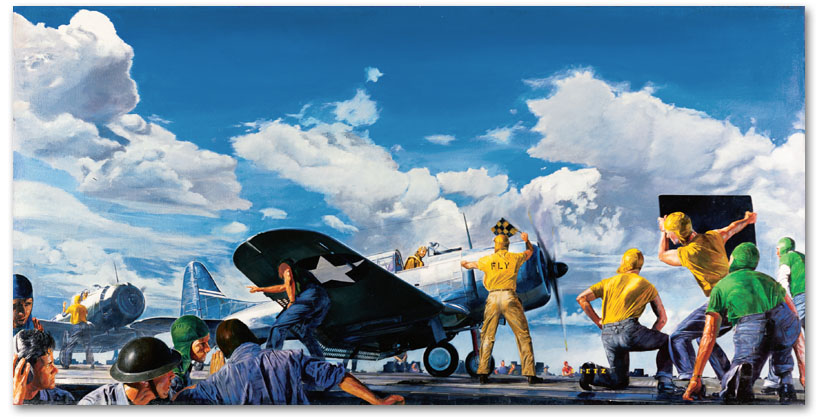
Dauntless dive bombers and escorting Wildcat fighters were then launched from USS Hornet , and they were followed by a third wave of dive bombers and fighters from Enterprise. The attack groups from Enterprise and Hornet set course for the anticipated position of Nagumo's carriers on the assumption that he was unaware of the presence of American carriers so close to him, and was continuing on his south-easterly course for Midway. However, after recovering all of his Midway strike aircraft shortly after 8.30 a.m., Nagumo had turned north to engage the American carriers. The dive bombers and fighters from Hornet failed to locate the Japanese carriers, and either flew on to Midway or returned to their carrier.
While it was clearly imperative for the Americans to strike, if possible, before Vice Admiral Nagumo was able to launch his own air strike at their carriers, the American Navy had a history of problems in coordinating torpedo, dive bomber and fighter strikes, even when these aircraft were all launched from the same carrier. This flaw in American naval aviation training, when combined with obsolete aircraft, defective torpedoes, lack of combat experience, and rushed aircraft launches on this particular day, would all combine to produce tragic consequences for American torpedo bomber aircrews and bring the United States very close to a major defeat on this morning of 4 June 1942.
The Courage of American Pilots
Proves A Match for Japan's Overwhelming Naval Power
Guided by instinct rather than reason, Lieutenant Commander John Waldron, leading his squadron of fifteen obsolete Douglas TBD Devastator torpedo bombers from Hornet (Torpedo Squadron VT-8), responded to the absence of the Japanese carriers at their anticipated position by diverting his bombers in a north-westerly direction. He was troubled by the fact that his torpedo squadron had not been joined by its Wildcat fighter escorts from Hornet. He knew that the Devastator was slow and very vulnerable to attack by Japanese Zero fighters. However, his duty was to find the Japanese carriers and sink them if he could, and he pressed on. Waldron found Nagumo's carriers at 9.20 a.m., and ordered his aircraft to attack even though they had no fighter escorts. Although the attack was pressed home with great courage, the Japanese Zero fighters guarding the carriers overwhelmed the low-flying American torpedo bombers and shot them all down before any torpedoes could be launched. Only one American airman survived this attack. Although no damage was done to the Japanese carriers, the sacrifice by Waldron and his aircrews was not in vain. The Americans now knew the location of the Japanese carriers.

Two further waves of American TBD Devastator torpedo bombers followed Waldron in low-altitude attacks on the Japanese carriers, and although these attacks were also pressed home with great courage, most of the American bombers were shot down by the swarming Zeros or by intense anti-aircraft fire.
Torpedo Squadron VT-6 from Enterprise, led by Lieutenant Commander Eugene E. Lindsay, attacked the carrier Kaga with fourteen TBDs. Nine were shot down and no hits on Kaga were registered. Torpedo Squadron VT-3 from USS Yorktown, led by Lieutenant Commander Lance E. Massey, lost all but two TBDs in its attack. Massey's TBDs were escorted by six Wildcat fighters, but the Wildcats were so outnumbered by Zeros that they were forced to defend themselves while Massey's TBDs pressed home their hopeless attack. Again, no damage was done to the Japanese carriers. Even the Japanese were impressed by the bravery, discipline and self-sacrifice of the American airmen whom they had been taught to despise as lacking courage and discipline.

The few torpedoes that were launched from American aircraft at the Battle of Midway were either evaded by skilful handling of the Japanese ships or failed to explode on impact.
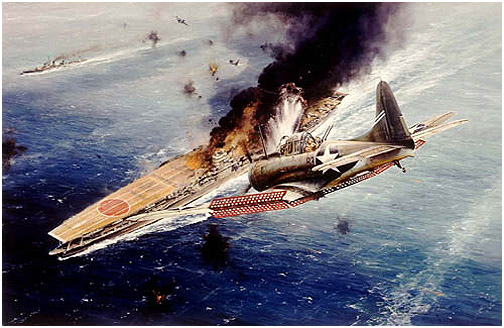
However, the sacrifices of these gallant American aircrews had also not been in vain. They had forced the Japanese carriers to take evasive action and delayed preparations by Admiral Nagumo to launch his own air strike at the American carriers. The flight decks of the Japanese carriers were crowded with aircraft loaded with fuel, torpedoes and bombs, when at 10.25 a.m. a thunderbolt struck the Japanese carriers in the form of the thirty-three Dauntless dive bombers which had been the first aircraft launched from Enterprise by Admiral Spruance. They were joined by Dauntless dive bombers from Yorktown. The Japanese Zeros guarding the carriers had been drawn down close to sea level while attacking the low-flying American torpedo bombers, and the American dive bombers hurtling down from a great height on the Japanese carriers had only to be concerned about intense anti-aircraft fire. The American bombs struck the flight decks of Akagi, Kaga, and Soryu, and produced massive chain reaction explosions fuelled by the fully armed Japanese bombers and fighters. Within minutes all three carriers were reduced to fiercely burning wrecks. Kaga and Soryu sank late that afternoon. Akagi sank before dawn on 5 June.

The thirty-three Dauntless dive bombers from Enterprise were led by Lieutenant Commander Clarence W. McCluskey, who found Admiral Nagumo's carriers by an extraordinary stroke of luck. He had been engaged in a fruitless search for the Japanese carriers when he observed a Japanese destroyer speeding in a north-easterly direction. McCluskey suspected that the destroyer was part of Nagumo's carrier force and decided to follow it. If McCluskey's dive bombers had not arrived over the Japanese carriers at the same time as the single dive bomber squadron from Yorktown, and joined the Yorktown squadron in well-coordinated attacks on Akagi, Kaga, and Soryu, it is likely that the Battle of Midway would have ended quite differently. In great battles, luck can often be as important as sound planning.

Unfortunately for the Americans, Admiral Nagumo's fourth fleet carrier Hiryu was steaming ahead of the other three Japanese carriers and escaped the American dive bomber attack. Aboard Hiryu at this time was the commander of Carrier Division 2 of the First Carrier Striking Force, Rear Admiral Tamon Yamaguchi. Yamaguchi was one of Japan's most able and daring commanders of carrier air operations. Undeterred by the fate of Akagi, Kaga, and Soryu, Yamaguchi held course for the expected location of the American carriers, and prepared to launch his own air strike against them. At this stage, he only believed that he was facing Enterprise and Hornet. The Japanese would not have expected that Yorktown could have been repaired in time to participate in the battle at Midway.
1
posted on
06/04/2003 5:33:59 AM PDT
by
SAMWolf
To: AntiJen; snippy_about_it; Victoria Delsoul; SassyMom; bentfeather; MistyCA; GatorGirl; radu; ...
Preparations for Battle,
March 1942 to 4 June 1942
By March 1942, Japanese Navy strategists had achieved their initial war goals much more easily than expected. They had therefore abandoned the prewar plan to then transition to a strategic defensive posture, but there was still dispute on how to maintain the offensive. Moving further south in the Pacific would isolate Australia, and possibly remove that nation as a threat to the freshly-expanded Japanese Empire.

However, the American island base at Midway was also an attractive target, and the Doolittle Raid on Japan prompted a decision to attack there as the next major offensive goal. Midway was a vital "sentry for Hawaii", and a serious assault on it would almost certainly produce a major naval battle, a battle that the Japanese confidently expected to win. That victory would eliminate the U.S. Pacific fleet as an important threat, perhaps leading to the negotiated peace that was Japan's "exit strategy".
The Japanese planned a three-pronged attack to capture Midway in early June, plus a simultaneous operation in the North Pacific's Aleutian Islands that might provide a useful strategic diversion. In the van of the assault would be Vice Admiral Chuichi Nagumo's aircraft carrier force, which would approach from the northwest, supress Midway's defenses and provide long-range striking power for dealing with American warships. A few hundred miles behind Nagumo would come a battleship force under Admiral Isoroku Yamamoto that would contain most of the operation's heavy gun power. Coming in from the West and Southwest, forces under Vice Admiral Nobutake Kondo would actually capture Midway. Kondo's battleships and cruisers represented additional capabilities for fighting a surface action.

Unfortunately for the Japanese, two things went wrong even before the Midway operation began. Two of Nagumo's six carriers were sent on a mission that resulted in the Battle of Coral Sea. One was badly damaged, and the other suffered heavy casualties to her air group. Neither would be available for Midway.
Even more importantly, thanks to an historic feat of radio communications interception and codebreaking, the United States knew its enemy's plans in detail: his target, his order of battle and his schedule. When the battle opened, the U.S. Pacific fleet would have three carriers waiting, plus a strong air force and reinforced ground defenses at the Midway Base
Japanese Air Attack on Midway,
4 June 1942
At 0430 in the morning of 4 June 1942, while 240 miles northwest of Midway, Vice Admiral Chuichi Nagumo's four carriers began launching 108 planes to attack the U.S. base there. Unknown to the Japanese, three U.S. carriers were steaming 215 miles to the east. The two opposing fleets sent out search planes, the Americans to locate an enemy they knew was there and the Japanese as a matter of operational prudence. Seaplanes from Midway were also patrolling along the expected enemy course. One of these spotted, and reported, the Japanese carrier striking force at about 0530.

That seaplane also reported the incoming Japanese planes, and radar confirmed the approaching attack shortly thereafter. Midway launched its own planes. Navy, Marine and Army bombers headed off to attack the Japanese fleet. Midway's Marine Corps Fighting Squadron 221 (VMF-221) intercepted the enemy formation at about 0615. However, the Marines were immediately engaged by an overwhelming force of the very superior Japanese "Zero" fighters and were able to shoot down only a few of the enemy bombers, while suffering great losses themselves.
The Japanese planes hit Midway's two inhabited islands at 0630. Twenty minutes of bombing and straffing knocked out some facilities on Eastern Island, but did not disable the airfield there. Sand Island's oil tanks, seaplane hangar and other buildings were set afire or otherwise damaged. As the Japanese flew back toward their carriers the attack commander, Lieutenant Joichi Tomonaga, radioed ahead that another air strike was required to adequately soften up Midway's defenses for invasion.
 U.S. Attacks on the Japanese Carrier Striking Force,
4 June 1942
While their aviators flew back from Midway, the Japanese carriers received several counterstrikes from Midway's own planes. Faced with overwhelming fighter opposition, these uncoordinated efforts suffered severe losses and hit nothing but sea water. Shortly after 0700, torpedo attacks were made by six Navy TBF-1s and four Army Air Force B-26s. Between 0755 and 0820, two groups of Marine Corps bombers and a formation of Army B-17s came in. The only positive results were photographs of three Japanese carriers taken by the high-flying B-17s, the sole surviving photos of the day's attacks on the Japanese carriers.
Meanwhile, a tardy Japanese scout plane had spotted the U.S. fleet and, just as Midway's counterattacks were ending, reported the presence of a carrier. Japanese commander Vice Admiral Chuichi Nagumo had begun rearming his second group of planes for another strike on Midway. He now had to reorganize that, recover the planes returning from Midway and respot his flight decks to launch an attack on the U.S. ships. Nagumo's force barely missed having enough time.

In the hour after about 0930, U.S. Navy planes from the carriers Hornet (CV-8), Enterprise (CV-6) and Yorktown (CV-5) made a series of attacks, initially by three squadrons of TBD torpedo planes that, despite nearly total losses, made no hits. The sacrifice of the TBDs did slow Japanese preparations for their own strike and disorganized the defending fighters. Then, at about 1025, everything changed. Three squadrons of SBD scout bombers, two from Enterprise and one from Yorktown, almost simultaneously dove on three of the four Japanese carriers, whose decks were crowded with fully armed and fueled planes that were just starting to take off. In a few minutes, Akagi, Kaga and Soryu were ablaze and out of action.

Of the once-overwhelming Japanese carrier force, only Hiryu remained operational. A few hours later, her planes crippled USS Yorktown. By the end of the day, though, U.S. carrier planes found and bombed Hiryu. Deprived of useful air cover, and after several hours of shocked indecision, Combined Fleet commander Admiral Isoroku Yamamoto called off the Midway operation and retreated. Six months after it began, the great Japanese Pacific War offensive was over.
Japanese Attacks on USS Yorktown,
4 June 1942
After the 4 June mid-morning U.S. Navy attacks on the Japanese carrier force, only the Hiryu remained operational. Shortly before 1100 she launched eighteen dive bombers, escorted by six fighters, to strike a retaliatory blow. At about noon, as these planes approached USS Yorktown (CV-5), the most exposed of the three American aircraft carriers, they were intercepted by the U.S. combat air patrol, which shot down most of the bombers. Seven, however, survived to attack, hitting Yorktown with three bombs and stopping her.

While Yorktown's crew worked to repair damage and get their ship underway, a second force left Hiryu, this one consisting of ten torpedo planes and six fighters. Though the U.S. carrier was moving again by 1430, and even launched more fighters, the Japanese aircraft penetrated heavy air and gunfire opposition to hit Yorktown with two torpedoes, opening a huge hole on her midships port side. The stricken ship again went dead in the water and took on a severe list. Concerned that she was about to roll over, her Captain ordered his crew to abandon ship.
Actions and Activities after 4 June 1942
Following the 4 June attack on Midway's facilities and the day's great battles between opposing aircraft carrier forces, the Japanese briefly considered continuing their campaign. However, as the full extent of their disaster became clear, they began a general retreat. After a brief withdrawal to avoid the risk of a night action, the two remaining U.S. carriers pursued the enemy forces, unsuccessfully attacking a destroyer on the 5th.

On 6 June, U.S. planes found and attacked two Japanese cruisers, sinking the Mikuma. Meanwhile, USS Yorktown had remained afloat. A salvage party returned to try to save her, but this effort was thwarted on the afternoon of the 6th, when a Japanese submarine found and torpedoed the carrier and the accompanying destroyer Hammann. The battered, gallant Yorktown sank the following morning.
As Battle of Midway combat activities gradually wound down, PBY patrol seaplanes and ships busied themselves rescuing downed aviators, the last of whom was recovered on 21 June. A U.S. submarine found two Mikuma survivors, and 35 of Hiryu's crewmen were picked up on 19 June. Earlier, men from Yorktown and Hammann had been taken to Pearl Harbor, where reinforcements were being forwarded to Midway and the nearby carriers. USS Saratoga (CV-3) arrived from the west coast on 6 June with a full load of aircraft. She quickly returned to sea, en route to join Enterprise and Hornet. Later in the month, fresh Marines were landed at Midway, which remained an important U.S. base for the rest of World War II, and beyond.
Additional Sources: www.stjohnshistoriccemetery.com
www.globalsecurity.org
www.users.bigpond.com
www.strategypage.com
www.history.navy.mil
www.wwiitech.net
www.centurytel.net
www.walldrawn.com
www.brooksart.com
www.military-art.com
www.history.navy.mil
library.nps.navy.mil
www.psns.navy.mil
www.turkishnavy.com
2
posted on
06/04/2003 5:34:53 AM PDT
by
SAMWolf
(Experience varies directly with equipment ruined.)
To: SAMWolf
Remembering Torpedo Squadron 8
June 4, 1942: Torpedo Squadron 8, off the USS HORNET, attacked the Japanese carriers off Midway. Flying old, slow aircraft armed with defective torpedoes and lacking fighter cover, they were all shot down without inflicting any damage on the enemy. But by attracting the attention of the Japanese combat air patrol, their sacrifice made possible the success of the American dive bombers that arrived overhead minutes later, to devastate the Japanese carriers Akagi, Kaga, and Soryu, bringing victory at Midway
| Lt. Commander John C. Waldron |
KIA |
| Lt. Raymond A. Moore |
KIA |
| Lt. James C. Owens |
KIA |
| Lt.(jg) George M. Campbell |
KIA |
| Lt.(jg) John P. Gray |
KIA |
| Lt.(jg) Jeff D. Woodson |
KIA |
| Ens. William W. Abercrombie |
KIA |
| Ens. William W. Creamer |
KIA |
| Ens. Harold J. Ellison |
KIA |
| Ens. William R. Evans |
KIA |
| Ens. George H. Gay |
WIA |
| Ens. Henry R. Kenyon |
KIA |
| Ens. Ulvert M. Moore |
KIA |
| Ens. Grant W. Teats |
KIA |
| Robert B. Miles, Aviation Pilot 1c |
KIA |
| Horace F. Dobbs, Chief Radioman |
KIA |
| Amelio Maffei, Radioman 1 |
KIA |
| Tom H. Pettry, Radioman 1 |
KIA |
| Otway D. Creasy, Jr. Radioman 2 |
KIA |
| Ross H. Bibb, Jr., Radioman 2 |
KIA |
| Darwin L. Clark, Radioman 2 |
KIA |
| Ronald J. Fisher, Radioman 2 |
KIA |
| Hollis Martin, Radioman 2 |
KIA |
| Bernerd P. Phelps Radioman 2 |
KIA |
| Aswell L. Picou, Seaman 2 |
KIA |
| Francis S. Polston, Seaman 2 |
KIA |
| Max A. Calkins, Radioman 3 |
KIA |
| George A. Field, Radioman 3 |
KIA |
| Robert K. Huntington, Radioman 3 |
KIA |
| William F. Sawhill, Radioman 3 |
KIA |
|
3
posted on
06/04/2003 5:35:24 AM PDT
by
SAMWolf
(Experience varies directly with equipment ruined.)
To: All
4
posted on
06/04/2003 5:35:50 AM PDT
by
SAMWolf
(Experience varies directly with equipment ruined.)
To: 4.1O dana super trac pak; 4integrity; Al B.; Alberta's Child; Alkhin; Alouette; AnAmericanMother; ..
 .......FALL IN
 to the FReeper Foxhole!
Good Morning Everyone!
If you would like added or removed from our ping list let me know.
To: SAMWolf
Good Morn'n Sam. Great job on today's foxhole, sir!
To: SAMWolf; snippy_about_it; *all
Good morning SAM, snippy, everyone!
Great new day today!
To: snippy_about_it
8
posted on
06/04/2003 6:03:42 AM PDT
by
GailA
(Millington Rally for America after action http://www.freerepublic.com/focus/f-news/872519/posts)
To: bentfeather
Good morning feather.
To: GailA
Good morning Gail, nice graphic today as always. You're early today. :)
To: SAMWolf
An amazing story today. When you think of the degree of luck involved in our victory at Midway, you can't help but credit Divine providence. If those dive bombers had not found the Japanese fleet at precisely that time, Midway would be remembered as a tremendous US defeat, and the US Navy could have been eliminated as a contender in the Pacific for a very long time.
We would have prevailed eventually, but at an even higher cost.
11
posted on
06/04/2003 6:22:25 AM PDT
by
gridlock
To: snippy_about_it
Good Morning Snippy.
12
posted on
06/04/2003 6:26:49 AM PDT
by
SAMWolf
(Experience varies directly with equipment ruined.)
To: SAMWolf
Good Morning SAM.
To: stainlessbanner
Thanks stainlessbanner.
The Battle of Midway is a facsinating one to study but the sacrifice of Torpedo 8 is just amazing. The bravery of those men is aweinspiring, knowing they had little chance but pressing the attack without aircover anyway.
14
posted on
06/04/2003 6:30:11 AM PDT
by
SAMWolf
(Experience varies directly with equipment ruined.)
To: bentfeather
HI Feather.
15
posted on
06/04/2003 6:30:37 AM PDT
by
SAMWolf
(Experience varies directly with equipment ruined.)
To: snippy_about_it
BTTT!!!!!!
16
posted on
06/04/2003 6:31:03 AM PDT
by
E.G.C.
To: GailA
Good Morning GAilA. Beautiful graphic! That would look great on my computer hutch.
17
posted on
06/04/2003 6:32:11 AM PDT
by
SAMWolf
(Experience varies directly with equipment ruined.)
To: E.G.C.
:)
To: gridlock
Yep. God was on our side that day. All the things that had to fall into place that day. The precise timeing of events, the dive bombers and torpedo bombers arriving at the same place at the same time, the Japanese scout plane failure, the loaded planes on deck, the straggler DD that lead the Dive bombers to the carriers. Nothing short of a miracle.
19
posted on
06/04/2003 6:35:50 AM PDT
by
SAMWolf
(Experience varies directly with equipment ruined.)
To: SAMWolf
On This Day In History
Birthdates which occurred on June 04:
1694 Fran‡ois Quesnay France, economist, leader of the Physiocrats
1738 George III English king during American Revolution (1760-1820)
1867 Carl Gustaf Mannerheim Finland, military hero, Pres (1944-46)
1877 Heinrich Wieland German chemist (bile acids-Nobel 1927)
1895 Dino Conte Grandi Italy, delegate to league of nations (1925-32)
19-- Lindsay Frost actress (As the World Turns)
19-- Priscilla Morrill Medford Mass, actress (Edie Grant-Mary Tyler Moore)
1902 Richard Allen India, field hockey goal tender (Olympic-gold-1928)
1908 Rosalind Russell actress (Mame, Take a Letter Darling)
1909 Paul Nordoff Philadelphia, composer (Frog Prince)
1917 Charles Collingwood Mich, news commentator (CBS, Chronicles)
1917 Howard Metzenbaum (Sen-D-Ohio)
1917 Robert Anderson author (Tea & Sympathy)
1917 Robert Merrill Bkln NY, baritone (NY Metropolitan Opera)
1922 Irwin Bazelon Evanston Illinois, composer (Duo for Viola)
1924 Dennis Weaver Joplin Mo, actor (Chester-Gunsmoke, Duel, Battered)
1926 Nan Leslie LA Calif, actress (Kings Row, The Californians)
1926 Robert Earl Hughes became heaviest known human (486 kg)
1932 John Barrymore Jr Beverly Hills Calif, actor (Pantomine Quiz)
1936 Bruce Dern Winnetka Ill, actor (Coming Home, Silent Running, Tatoo)
1937 Freddie Fender Mexico, country singer (Feelings)
1944 Michelle Phillips singer/actress (Mamas & Papas)
1944 Roger Ball saxophonist (Average White Band)
1945 Gordon Waller Scotland, singer (Peter & Gordon-World Without Love)
1945 Ivan "Ironman" Stewart Mickey Thompson off-road champ (1983, 84, 90)
1945 Margaret Impert Horseheads NY, actress (Maggie, Spencer's Pilots)
1946 Bettina Gregory newswoman (ABC-TV)
1948 Rosemary Joyce model/actress (Daphne Draper-Search For Tomorrow)
1950 Wayne Powers New Rochelle NY, actor (Laverne & Shirley, 13 East)
1952 Catherine Watkins Hartford Ct, actress (It's Not Easy, Mary)
1952 Parker Stevenson Phila Pa, actor (Falcon Crest, Stroker Ace)
1958 Julie Gholson Birmingham Ala, actress
1961 El Debarge rocker (Debarge-All this Love)
1963 Xavier McDaniel NBA forward (Seattle SuperSonics)
1964 Chris Kavanagh rocker (Sigue Sigue Sputnik-Love Missile F-111)
1965 Andrea Jaeger Chicago, tennis player (retired as a teenager)
1968 Stacy Leigh Arthur Naperville Ill, playmate (Jan, 1991)
Deaths which occurred on June 04:
1954 Harold Hoffman (Gov-NJ), dies at 58
1960 Lucien Littlefield actor (Mr Beasley-Blondie), dies at 64
1970 Menasha Skulnik comedian (Menasha the Magnificent), dies at 78
1973 Arna Bontemps writer/educator, dies at 72 in Nashville, Tenn
1973 Murray Wilson father of beachboys Brian, Carl & Dennis, dies at 55
1989 Ayatalloh Ruhullah Khomeini of Iran, dies at 86 of internal bleeding
1990 Jack Gilford comedic actor, dies at 82 of stomach cancer
Reported: MISSING in ACTION
1967 ROBINSON LEWIS M. SAGINAW MI.
[REMAINS IDENTIFIED 04/16/99]
1968 BRICE ERIC PARKER ROCKY MOUNT NC.
1970 HUGGINS BOBBY GENE TROY AL.
[REMAINS RETURNED 11/03/97]
1970 WILSON HARRY TRUMAN GRAND PRAIRIE TX.
1975 CONWAY ROSEMARY A.
[08/75 RELEASED]
POW / MIA Data & Bios supplied by
the P.O.W. NETWORK. Skidmore, MO. USA.
On this day...
780 -BC- 1st total solar eclipse reliably recorded by Chinese
1070 Roquefort cheese created in a cave near Roquefort, France
1647 British army seizes King Charles I as a prisoner
1745 Prussians defeat Austrians at Hohenfriedeberg
1783 Montgolfier brothers launch 1st hot-air balloon (unmanned)
1784 Mme Thible becomes 1st woman to fly (in a balloon)
1792 Capt George Vancouver claims Puget Sound for Britain
1805 Tripoli forced to conclude peace with US after war over tribute
1812 Louisiana Territory officially renamed "Missouri Territory"
1825 Unseasonable hurricane hits NYC
1832 3rd national black convention meets (Phila)
1850 Empire Engine Company No 1 organized
1862 Confederates evacuate Fort Pillow, Tenn
1878 Cyprus ceded by Turkey to Britain for administrative purposes
1896 Henry takes his 1st Ford through streets of Detroit
1900 M Wolf & A Schwassmann discovers asteroid #456 Abnoba
1912 Cone of Mount Katmai (Alaska) collapses
1912 Massachusetts passes 1st US minimum wage law
1918 M Wolf discovers asteroid #894 Erda
1919 Senate passes Women's Suffrage bill
1919 US marines invade Costa Rica
1927 1st Ryders Cup (Golf), US beats England 9«-2«
1929 George Eastman demonstrates 1st technicolor movie (Rochester NY)
1934 C Jackson discovers asteroid #2066 Palala
1940 1st night game at Forbes Field (Pirates 14, Braves 2)
1940 1st NL night game at Sportsman's Park (Dodgers 10, Cardinals 1)
1940 British complete miracle of Dunkirk by evacuating 300,000 troops
1940 German forces enter Paris
1942 Battle of Midway begins; Japan's 1st major defeat in WW II
1942 Capitol Record Co opens for business
1943 St Louis Card Mort Cooper pitches his 2nd consecutive 1 hitter
1944 1st submarine captured & boarded on high seas-U 505
1944 5th Army enters & liberates Rome from Mussolini's Fascist armies
1946 Largest solar prominence (300,000 mi/500,000 km) observed
1949 "Cavalcade of Stars" debuts (DuMont); Jackie Gleason made host in 1950
1951 Pirate's Gus Bell hits for the cycle helps beat Phillies 12-4
1954 Arthur Murray flies X-1A rocket plane to record 27,000 m
1956 Speech by Khrushchev blasting Stalin made public
1957 1st commercial coal pipeline placed in operation
1963 1st transmission of "Pop Go the Beatles" on BBC radio
1964 Beatles "World Tour" begins in Copenhagen Denmark
1964 LA Dodger Sandy Koufax 3rd no-hitter beats Phil Phillies, 3-0
1965 Rolling Stones release "Satisfaction"
1967 Emmy Awards-Monkees win for comedy series
1968 Don Drysdale pitches his 6th straight shutout, en route to 58 innings
1969 Nicky Hopkins quits rock & rolls, Jeff Beck Group
1970 Tonga gains independence from Britain (National Day)
1971 Oakland A's beat Wash Senators, 5-3, in 21 innings
1972 Angela Davis, black activist, acquitted of killing a white guard
1974 NFL grants franchise to Seattle Seahawks
1977 Violence during Puerto Rican Day in Chicago kills 2
1981 E Bowell discovers asteroids #2494 Inge, #2797 Teucer, #2870 Haupt, #3169 Ostro & #3726
1982 Israel attacks targets in south Lebanon
1984 Bruce Springsteen releases "Born in the USA"
1985 STS 51-G vehicle moves to the launch pad
1985 Supreme Court strikes down Alabama "moment of silence" law
1986 Jonathan Pollard, spy for Israel, pleads guilty in US court
1987 Danny Harris beats Edwin Moses, ends streak of 122 cons hurdle wins
1988 Longest game in Balt Memorial Stadium (5:46) 14 inn (beat NY 7-6)
1989 - 645 people were killed in the Soviet Union when a gas explosion engulfed two passing trains.
1998 - Terry Nichols received a life sentence for his role in the bombing of an Oklahoma City Federal Building.
1989 Beijing cop shoots & wounds Chinese priemer Li Ping
1989 Eastern Europe's 1st somewhat free election in 40 years held in Poland
1989 Largest parade in Bronx history honors 350th anniversary
1989 Red Sox lead Blue Jays 10-0 in 7th, but lose 12-11 in 12 for Blue Jays 12th consecutive victory at Fenway
1989, hundreds, possibly thousands of people died as Chinese army troops stormed Beijing to crush a pro-democracy movement.
1990 Greyhound Bus files bankruptcy
1990 NY Telephone company announces that it wants Bronx areacode 917
Holidays
Note: Some Holidays are only applicable on a given "day of the week"
Botswana : Commonwealth Day
Finland : Flag Day (1867)
International : Day of Innocent Children Victims of Aggression
Tonga : Independence Day
Massachusetts : Teachers' Day - - - - - ( Sunday )
Ireland : Bank Day - - - - - ( Monday )
Bahamas : Labour Day - - - - - ( Friday )
New Zealand : Queen's Birthday - - - - - ( Monday )
Western Australia : Foundation Day (1838) - - - - - ( Monday )
Religious Observances
Christian : Feast of SS Quirinus & Optatus
Christian : Feast of St Saturnine
Unification Church : Day of all things
RC : Commemoration of St Francis Caracciolo, confessor
Religious History
1820 Birth of Elvina M. Hall, American Methodist poet who authored the hymn, 'Jesus Paid It All' (a.k.a. 'I Hear the Savior Say').
1873 Birth of Charles F. Parham, American charismatic church pioneer. In 1898 he founded a Bible training school in Topeka, Kansas, where the modern Pentecostal movement began in 1901.
1878 Birth of Frank N. Buchman, American exponent of the social gospel. He founded the First Century Christian Movement (1921), the Oxford Group (1929) and the Moral Re-Armament Movement (1938).
1900 Birth of Nelson Glueck, American Jewish archaeologist. Director of the American School of Oriental Research in Jerusalem between 1932 and 1947, he explored and dated over 1,000 ancient sites in Palestine and the Near East.
1948 In Manilla, the first missionary radio station built in the Philippines by the Far East Broadcasting Company (FEBC) first went on the air.
Source: William D. Blake. ALMANAC OF THE CHRISTIAN CHURCH. Minneapolis: Bethany House, 1987.
Thought for the day :
"It is always the best policy to speak the truth--unless, of course, you are an exceptionally good liar."
20
posted on
06/04/2003 6:37:21 AM PDT
by
Valin
(Age and deceit beat youth and skill)
Navigation: use the links below to view more comments.
first 1-20, 21-40, 41-60, 61-80 ... 121-122 next last
Disclaimer:
Opinions posted on Free Republic are those of the individual
posters and do not necessarily represent the opinion of Free Republic or its
management. All materials posted herein are protected by copyright law and the
exemption for fair use of copyrighted works.
FreeRepublic.com is powered by software copyright 2000-2008 John Robinson

