Free Republic
Browse · Search
General/Chat
Topics · Post Article

Skip to comments.

Art Appreciation/Education Series II “class” #2: Romanesque and Gothic Art and Architecture
10/8/05 | republicanprofessor

Posted on 10/08/2005 8:08:00 AM PDT by Republicanprofessor

In our last “class” on Greco-Roman, Early Christian and Byzantine Art, we saw how the realism of Greece and Rome was repudiated for more spiritual abstraction. The Christians saw the soul as more important than the weighty, physical body, and thus their works were flat and filled with the gold of paradise. My connection to spiritual twentieth century abstraction received mixed results, but that’s fine.

Today, we’ll see how artists gradually added some bulk and realism to their work from 1000-1400. Then in the next “class,” we’ll study how the Italian Renaissance united a rebirth of Greco-Roman realism with Christian subject matter.

The Dark Ages, from 600-800 A.D., saw little in the way of new forms of art. There were some beautiful portable objects fashioned by the roaming tribes of Vandals and Goths, but we’ll skip ahead. There were also some fine things made under Charlemagne around 800 A.D and under the Ottonians in Germany in the tenth century. We begin to get some monumental architecture at this time. Charlemagne’s Palace Chapel at Aachen revived much of the Byzantine glory from San Vitale in Ravenna, Italy; but Charlemagne’s architect, Odo of Merz, made the palace chapel at Aachen more solid and overtly powerful. They are both octagonal structures, but there is a much more complex spirituality, use of space and mosaics in the earlier San Vitale.

Charlemagne’s Palace Chapel at Aachen c. 800 and Justinian’s San Vitale 526-47

Hildesheim Cathedral is a wonderful work of Ottonian architecture. The stripes from here and from Aachen may derive from Islamic architecture (such as the Cordova mosque in Spain). You may also notice that t Hildesheim the walls are mostly bare; there are no columns to connect the arches below to the windows above. This will change as time goes on, and the walls will get busier and busier. What I also love about Hildesheim are the first monumental bronze doors since antiquity. This image of Adam and Eve being admonished by God is a classic case of passing the buck. The little figures are not very realistic, but the narrative is very clear, and that’s what they were striving for. I love it.

The mosque at Cordova.

Hildesheim Cathedral of St. Michael, bronze doors thereof

Now we jump into the Romanesque age proper. Medieval people believed that the world would end in 1000. When it didn’t, they began building massive churches in thanksgiving. These monumental buildings were not only used for church services, but they were also places of fortified protection in case of barbarian attacks. They were fireproof, acoustically wonderful and roomy enough for the added pilgrims. (One of the most “popular” events of the Middle Ages was making a pilgrimage to one of many sites, including Santiago de Compostela in Spain.)

Church of Ste. Foy, in Conques, France: exterior, west façade, nave view

Now we have to look at the architecture carefully and use difficult vocabulary words. This is even more difficult because I can’t be in the front of the class motioning to the buildings themselves. This architecture is called Romanesque because of its use of rounded Roman arches. This is continued into three dimensions in the barrel vault across the nave, the wider central aisle. Often there are two stories: the main story (called the nave arcade because of those arches alongside the nave,) and the second story called the gallery. At this time, the gallery allowed additional space for the pilgrims (and others) to gather upstairs for the service. They could also walk around the ambulatory, or aisle around the choir (or central, most sacred section of the church). Thus if mass was going on, others could walk around the mass and light their candles in the chapels off the apse (the rounded east end of the church) or the transept (that part that makes a cross of the church). These churches often had relics from one or more saints in the forms of reliquaries. I particularly like this reliquary of Ste. Foy (Saint Faith) at this same church.
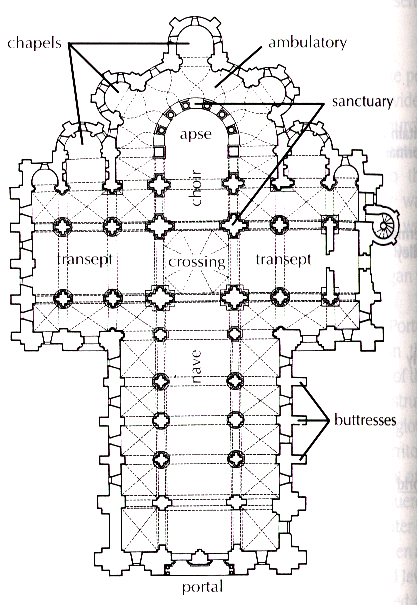
Now, a constant concern of the Romanesque time was how to create lighting in these buildings. One cannot put a window into a barrel vault, just as one cannot remove a stone from an arch without it collapsing. One solution was to develop the groin vault, an intersection of two barrel vaults. The lovely church of Ste. Madeleine at Vezelay, France has such groin vaults and thus an upper clerestory of light (in addition to the lovely Medieval striping we’ve seen before). It is hard sometimes to see the edges of the groin vaults; they look a great deal like a barrel vault, but they aren’t. (If you look even more closely, you’ll see the Vezelay choir is Gothic in style. These churches were built over many decades, and as their styles often changed accordingly.)

It is also fun to study the decoration on these churches. There is not a great deal of Romanesque sculpture that is not connected to a church, and most of the painting of this time is tied to illuminated manuscripts. The rounded entrance to most of the churches (the tympanum) is often decorated with sculpture of the Last Judgment. Can you tell which side is Heaven and which is Hell? The elongated, skinny and non-realistic figures tell the story very well, especially the imaginative depictions of Satan and hell.

One wonderful work of Romanesque embroidery is the Bayeux Tapestry, commemorating the French Norman Conquest of England in 1066. It is over 200’ long and has wonderful, imaginative and lively figures gesturing, fighting and even cooking.

This is also the time of castles, and of troubadours singing of their lost ladies. One can even visit many of these castles as a tourist in Europe, either for the day or overnight. They are not much more expensive than a normal hotel room and have much more atmosphere (and sometimes an accompanying medieval dinner).

So how did Gothic architecture develop? Well, there was an orphan boy outside of Paris who was adopted by the church. In time, he became an abbot: Abbot Suger, who once presided over France when King Louis VII went off on the second crusade. Abbott Suger saw rich, beautiful visual objects as a way to approximate the glory of heaven. When his church of St. Denis was being rebuilt, the new choir contained pointed arches, rib vaults, and stained glass windows. The space here is less compartmentalized than that of the Romanesque churches. The consecration of this new spacious choir in 1144 is what begins the Gothic age.

Each Gothic cathedral is wonderful and unique; but it is too much to detail their full development here. Suffice it to say that Chartres rivaled Notre Dame in Paris. Pointed arches replaced round arches, allowing more height and the development of pointed vaults with ribs. They grew ever higher and higher, until reaching 144’ to the top of the rib vaults at Amiens Cathedral. They developed six-part and four-part rib vaults. Instead of the wide gallery on the second level, they developed a shallow level called the triforium, first seen at Chartres. Flying buttresses channeled the weight and energy from the ceiling out to the pier buttresses, so that the walls could open up to stained glass windows. The upper clerestory at Chartres is as high as the nave arcade, probably over 45’, since the cathedral reaches to 120’ to the top of the vaults. At the smaller chapel of La Sainte Chapelle, the walls are 75% glass. (The only buildings to surpass this structure of glass are the skyscrapers of the twentieth century.)

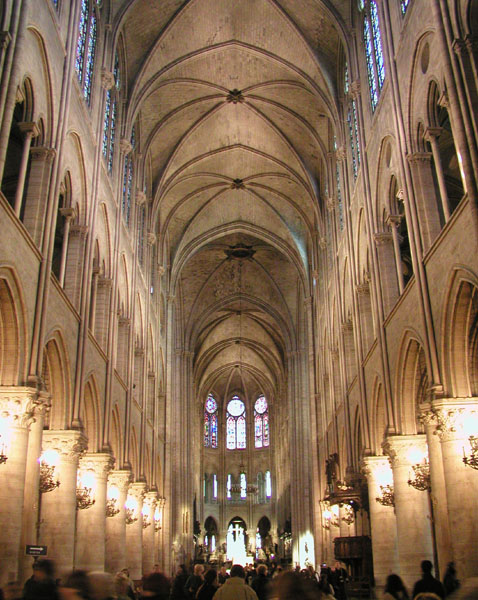
Notre Dame Paris with its matching towers and 6-part rib vaults

Chartres with its different towers, a higher clerestory and 4-part vaults;

Amiens with its 144’ vaults

La Ste-Chapelle with its 75% glass.

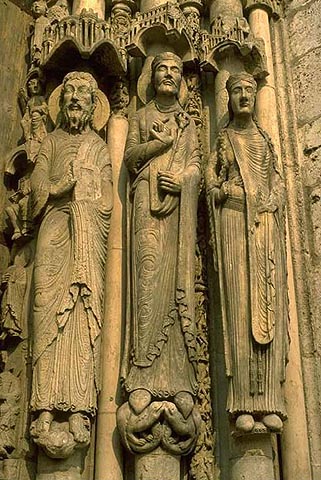
The Gothic was a time of new veneration for the Virgin Mary. The forgiveness of Christ took the place of the damning images from the Romanesque churches. Gothic sculpture became rounded and more realistic. In fact, as you walk right around Chartres Cathedral, you can see the development of sculpture from the 1194 west façade (or entrance) to the south portal (1205) and the north portal (1210). It’s really fun when you can recognize certain scenes: note Abraham and Isaac. I also love all the odd little sculpture under their feet, over their heads, etc. They had wonderful imaginations in the Middle Ages.
The great Gothic painter, from 1305, is actually called a proto-Renaissance artist because of the sense of weight and realism he ushered in. Giotto painted a series of frescos on the walls of the Arena Chapel in Padua that are wonderful in terms of color, composition and human content. His figures are well shaded (or modeled) and are no longer the flat, elongated figures of the Bayeaux Tapestry. For the first time since Roman times, he is actually looking at live models and drawing from them. His composition is simple and focused upon the simple gestures of Christ. For the first time, he uses the backs of figures and imbues them with emotion and character. His work is incredible and has inspired those as diverse as Masaccio, Michelangelo and Matisse (whose bright color and simplified compositions may be said to reflect some of Giotto’s work, however abstract they are in our eyes).
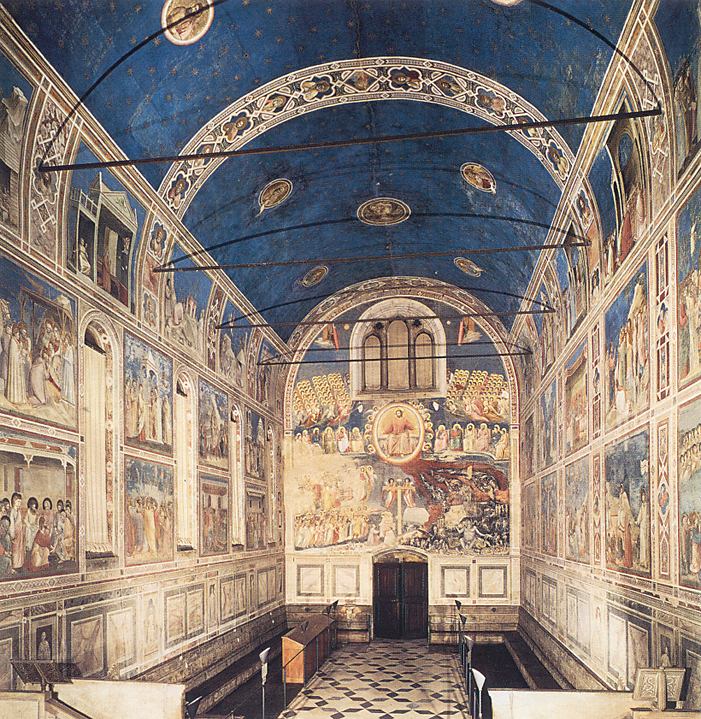
The Arena Chapel looking west toward the door.
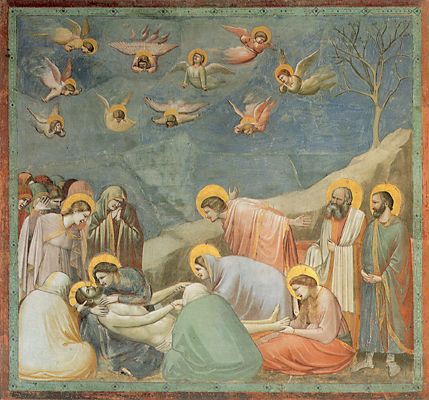
The famous Lamentation.

The meeting of Mary’s parents at the Golden Gate when they know that they will bear her. Such a tender embrace is rare in art history.
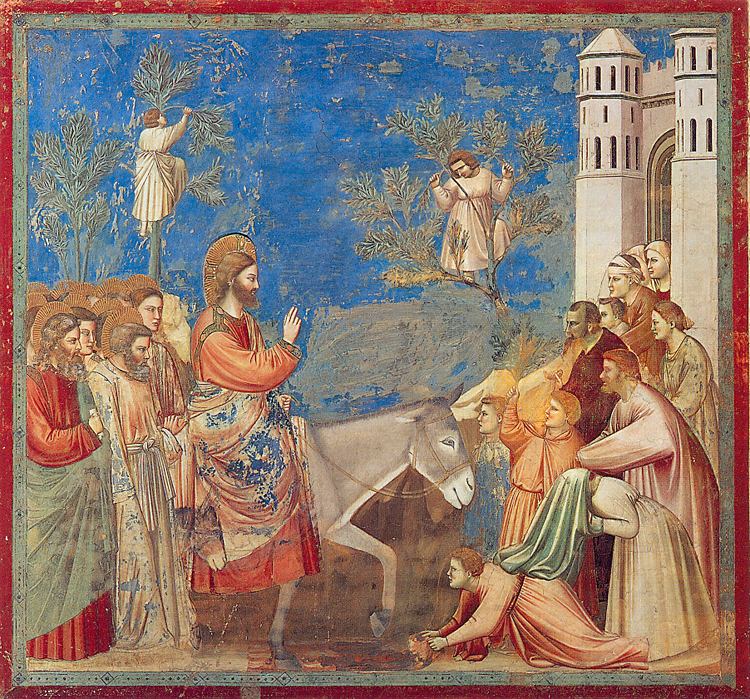
My favorite is the Entry into Jerusalem, with the little figure on the right stuck in his cloak. He wanted to lay it down for Jesus, but he’s going to miss the whole event because he’s stuck. It is those human touches that move me the most.


TOPICS: Arts/Photography; Education
KEYWORDS: amiens; appreciation; architecture; art; cathedrals; chartres; education; europeanchristians; giotto; godsgravesglyphs; gothic; notredame; romanesque; stechapelle; stefoy
Here we go again. This is the second in this new chronological series of art history, from the beginning of time on. I have made this pretty specific because I realize that some FReepers use this for home-schooling. (Although one should really have a real art history text to accompany this, and to see more great works of the time.)

Let me know what you like and why. This is probably one of the lectures that is least open to comment, but I hope that's not true. There are certainly no Mapplethorpe-type controversies. But I do hope you have questions and comments anyway.

1 posted on 10/08/2005 8:08:02 AM PDT by Republicanprofessor
[ Post Reply | Private Reply | View Replies]

To: Sam Cree; Liz; Joe 6-pack; woofie; vannrox; giotto; iceskater; Conspiracy Guy; Dolphy; ...

Art Appreciation/Education ping.

Let me know if you want on or off this list.


2 posted on 10/08/2005 8:09:58 AM PDT by Republicanprofessor
[ Post Reply | Private Reply | To 1 | View Replies]

To: Republicanprofessor

ping me please?


3 posted on 10/08/2005 8:15:21 AM PDT by bitt (THE PRESIDENT: "Ask the pollsters. My job is to lead and to solve problems. ")
[ Post Reply | Private Reply | To 2 | View Replies]

To: bitt
ping me please?

Happy to. You're on the list.

See my home page if you want the links to the other series I've done.

4 posted on 10/08/2005 8:18:31 AM PDT by Republicanprofessor
[ Post Reply | Private Reply | To 3 | View Replies]

To: Republicanprofessor

please add me to your ping list

I failed the art quizzes provided by the FReeper Liz.

Thanks for sharing with us.


5 posted on 10/08/2005 8:24:47 AM PDT by bert (K.E. ; N.P . I smell a dead rat in Baton Rouge!)
[ Post Reply | Private Reply | To 1 | View Replies]

To: bert
I failed the art quizzes provided by the FReeper Liz.

I didn't always do well on those quizzes myself; but I loved them. I got some grief when I tried that format myself to "test" the followers of my "classes."

I haven't heard from Liz, nor seen any of her posts, for a couple of months now. Any news of her? I worry sometimes.

6 posted on 10/08/2005 8:40:56 AM PDT by Republicanprofessor
[ Post Reply | Private Reply | To 5 | View Replies]

To: Republicanprofessor

Dunno if this qualifies as Romanesque art, but I know what I like.


7 posted on 10/08/2005 8:54:21 AM PDT by martin_fierro (< |:)~)
[ Post Reply | Private Reply | To 1 | View Replies]

To: martin_fierro
This is more my speed. (I'm a gal.)

Neither yours nor mine is Romanesque. But they are sexy.

8 posted on 10/08/2005 8:59:23 AM PDT by Republicanprofessor
[ Post Reply | Private Reply | To 7 | View Replies]

To: Republicanprofessor

I found this by accident, happily. Please put me on your list. I have been to some of the places you featured and am having a bout of nostalgia. I thoroughly enjoyed this lesson.


9 posted on 10/08/2005 9:08:22 AM PDT by Bahbah (Member of the Water Bucket Brigade)
[ Post Reply | Private Reply | To 1 | View Replies]

To: Republicanprofessor

How I missed the first installment of this, I don't know. I know I'm on your list.

I teach art to adults one night a week and what I have used of your summer series, has livened up the students quite a bit.

The students don't paint like the artists in your summer series and feel free to critque the work, in the meantime, learning more about their own.

Thank you very much for your generosity. I've told class that the lessons are from a phantom professor, but being in Mass, I couldn't tell them your firt name is "Republican". LOL!


10 posted on 10/08/2005 9:22:57 AM PDT by Lady Jag (Honor - Dignity - Courage - Troll Consumption)
[ Post Reply | Private Reply | To 2 | View Replies]

To: Lady Jag
I've told class that the lessons are from a phantom professor, but being in Mass, I couldn't tell them your firt name is "Republican". LOL!

Yes, I did get a chuckle from that. But the less they know about my politics, the better. I'm glad the series started some debate. Do you show them the images on line, or print it out, or show your own slides? I'm always interested in technology.

The first one in this new series is: Art Appreciation/Education series II class #1: Greco-Roman Realism and Early Christian Abstraction http://www.freerepublic.com/focus/f-chat/1498966/posts.

It is "clickable" on my home page, but I can't quite deal with all that HTML here.

11 posted on 10/08/2005 9:31:44 AM PDT by Republicanprofessor
[ Post Reply | Private Reply | To 10 | View Replies]

To: Republicanprofessor

bump


12 posted on 10/08/2005 9:55:59 AM PDT by gobucks (http://oncampus.richmond.edu/academics/classics/students/Ribeiro/Laocoon.htm)
[ Post Reply | Private Reply | To 1 | View Replies]

To: Republicanprofessor
Thank you!

My daughter made the pilgrimage to Santiago this summer. Unbelievable! I know it's supposed to be 12th century (at least the famous Gate of Glory) but it just looks different to me - almost Dutch in its elaboration.


13 posted on 10/08/2005 10:07:30 AM PDT by AnAmericanMother (. . . Ministrix of ye Chace (recess appointment), TTGC Ladies' Auxiliary . . .)
[ Post Reply | Private Reply | To 11 | View Replies]

To: AnAmericanMother
There's a strong Baroque element here. Then that confused me, so I looked up some info on line (I love Google).

Construction of the Cathedral started in 1075, when the town arrived to the climax of its importance. The chapel, Capilla del Salvador, is still conserved of this oldest epoch.

The second phase, after the wedding of Doña Urraca and Raimundo of Bourgogne, shows influences of french Romanesque style, as well as a style that is all Santiago's own, the so-called Románico Compostelano. The Obradoiro Facade (to which lateron were added Barroque elements) and the towers Torre de las Campanas and Torre

Through the Obradoiro Door you enter the so-called Old Cathedral, a Romanesque crypta with the first vaults of groined arches that were ever built in Spain.

The sculptures of the Portico de la Gloria, another entrance door, are considered some of the most important works of medieval art.

It has never played a large part in the medieval architecture courses I have taken and taught, perhaps because it is a mixture of styles. I'm also not a great fan of the busy Baroque style, so that's a second reason that I (probably unfairly) ignore it. I usually just use it to talk about the pilgrimage routes.

Did your daughter like her visit there?

14 posted on 10/08/2005 10:26:03 AM PDT by Republicanprofessor
[ Post Reply | Private Reply | To 13 | View Replies]

To: Bahbah
I have been to some of the places you featured and am having a bout of nostalgia.

Don't leave us hanging...tell us where you've been. My guess is Paris. I'm dying to go to Conques myself. I loved Vezelay; what a wonderful hill town (and great food, too. I can still taste those escargots!)

15 posted on 10/08/2005 10:28:05 AM PDT by Republicanprofessor
[ Post Reply | Private Reply | To 9 | View Replies]

To: Republicanprofessor; Liz

Thanks for the ping. Great class. (Has anyone seen Liz lately)


16 posted on 10/08/2005 10:33:54 AM PDT by PGalt
[ Post Reply | Private Reply | To 2 | View Replies]

To: Republicanprofessor

Aachen, Paris, Chartres. I do not eat escargot, even on New Years Eve. :)


17 posted on 10/08/2005 10:37:20 AM PDT by Bahbah (Member of the Water Bucket Brigade)
[ Post Reply | Private Reply | To 15 | View Replies]

To: Republicanprofessor

Please add me to your list.
My favorite Gothic structure is the Dom Cathedral in Cologne Germany.
My favorite artist of the time is Albrecht Durer. The amount of detail in his works are incredible.


18 posted on 10/08/2005 10:49:18 AM PDT by wolfhound89 (Are we Americans or American'ts?)
[ Post Reply | Private Reply | To 2 | View Replies]

To: Bahbah

Aachen...tell me what that is like. I'm hoping to get there sometime.

We loved Chartres, but Reims even more. Chartres Cathedral was very dark. Reims had stained glass windows even over the doors and was awesome. (And we stayed in a wonderful place in Reims; what a splurge. I'll never forget it.)

Glad you get to travel...even if you don't like snails.


19 posted on 10/08/2005 10:49:20 AM PDT by Republicanprofessor
[ Post Reply | Private Reply | To 17 | View Replies]

To: wolfhound89
My favorite Gothic structure is the Dom Cathedral in Cologne Germany.

My favorite artist of the time is Albrecht Durer.

I have never been to Germany; there will be much to see when I get there.

Durer is really of the High Renaissance of the 16th century. His figures are well proportioned (influenced by the Italians), even if his women are a bit Teutonic. His detail is amazing.

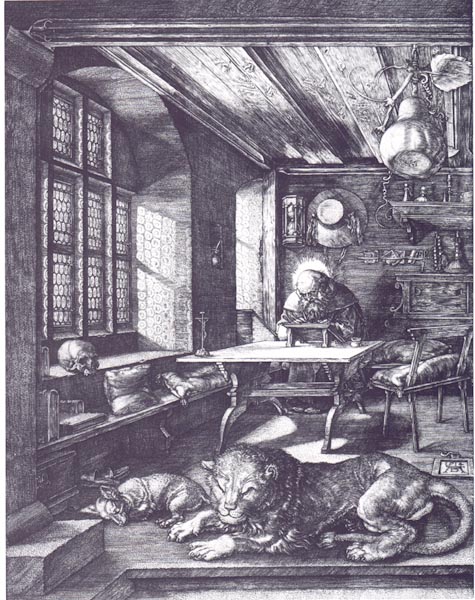
For those who don't know Durer, here is his Adam and Eve and St. Jerome in his Study.


20 posted on 10/08/2005 10:55:24 AM PDT by Republicanprofessor
[ Post Reply | Private Reply | To 18 | View Replies]

To: PGalt
(Has anyone seen Liz lately)

I'm curious, and even worried, about Liz. I hope she's just off on a long vacation. She hasn't posted in months, whether art or other political comments. Maybe she's just gotten really busy. If anyone knows anything, please let us know too.

21 posted on 10/08/2005 10:58:22 AM PDT by Republicanprofessor
[ Post Reply | Private Reply | To 16 | View Replies]

To: Republicanprofessor

Aachen was delightful. We stayed at a hotel right next to the old medieval gate to the city. It is very nice for walking around. They had a public art display that consisted of fiberglass horses decorated in various ways like the cows on parade in Chicago and Kansas City. You never knew when you would come upon one. We took the train from there down the Rhine to Heidelberg which I just adored.


22 posted on 10/08/2005 11:00:51 AM PDT by Bahbah (Member of the Water Bucket Brigade)
[ Post Reply | Private Reply | To 19 | View Replies]

To: Republicanprofessor

Had Dürer never seen a lion? He had clearly seen a Corgi or similar type European herding dog . . . but maybe there weren't any lions handy, or just a badly stuffed example?


23 posted on 10/08/2005 11:09:30 AM PDT by AnAmericanMother (. . . Ministrix of ye Chace (recess appointment), TTGC Ladies' Auxiliary . . .)
[ Post Reply | Private Reply | To 20 | View Replies]

To: Republicanprofessor

You're right about the time period. I guess I kind of lumped everything from the 1400's to 1500's as part of the Gothic era.
My personal fav engraving that he did is "The Knight, Death and The Devil". His self portraits and paintings of nobility and peasants were all hightly detailed.


24 posted on 10/08/2005 11:10:33 AM PDT by wolfhound89 (Are we Americans or American'ts?)
[ Post Reply | Private Reply | To 20 | View Replies]

To: Republicanprofessor
My daughter had a blast! She lived with a Spanish family, and then hiked the Camino . . . met tons of interesting people, took hundreds of pictures (we sent her with a tiny little digital camera that easily fit in her shirt pocket, and a BIG memory card), enjoyed herself very much.

I need to put her pics up because they're fabulous.

25 posted on 10/08/2005 11:11:24 AM PDT by AnAmericanMother (. . . Ministrix of ye Chace (recess appointment), TTGC Ladies' Auxiliary . . .)
[ Post Reply | Private Reply | To 14 | View Replies]

To: Republicanprofessor
I got the impression that Chartres also marked the transition between Romanesque and Gothic. The facade is part Romanesque, since (I believe) it may have been re-used from an earlier Romanesque church on the same site. Also unique to the sculptures on the outer walls of Chartes are the alleged clues to the location of the Ark of the Covenant, mentioned in Graham Hancock's book, The Sign and the Seal. When I was there a few years ago, much of the outside was not able to be viewed due to restoration scaffolding. However, the book checked out with what I could see of the sculptures. Also when driving to Chartres from Paris one sees it in the distance long before the other buildings in the town-- it is very prominent in its setting, no doubt reflecting its relative importance all the way back to medieval society.

At Notre Dame, it is interesting to visit the towers, where you can see that they are partially constructed of massive wooden beams (to save weight over stone).

I am under the impression that the difference between English Gothic and French Gothic is the color of the glass. The French used much more blues and reds than the English. In many French cathedrals, the glass was taken down during WWI and again during WWII to protect it from being destroyed by war.

St. Denis remains on my list of places to visit in the future when I get a chance.

26 posted on 10/08/2005 5:24:05 PM PDT by SteveH (First they ignore you. Then they laugh at you. Then they fight you. Then you win.)
[ Post Reply | Private Reply | To 1 | View Replies]

To: SteveH
I would also like to visit St. Denis, but I think the original choir is now completely overshadowed by the newer nave and clerestory of the High Gothic period.

I don't know that I would call Chartres Romanesque. The facade dates from before 1194, the date in which there was a fire that destroyed all but the facade and one bay of the cathedral. Since the Gothic style was born in 1144, I think the facade is still Gothic, but definitely Early Gothic. The arches are only barely pointed, and the facade is not nearly as busy as later cathedrals (like Amiens or Reims). The arches are also "recessed" into the wall, rathe than projecting out. But because of the rose window (even heavy as it is with stone) and the pointed arches, it is definitely early Gothic. But I don't know about any previous church on the site. It does dominate the sky line, but so did any of the cathedrals of the time. They showed how important God was to the town (vs. what our commercial skyscrapers say about what is important to us nowadays.)

Reims Cathedral, a busy High Gothic facade with stained glass at the tympanums instead of sculpture. Very lovely.

I haven't ever been up in Notre Dame's towers. Interesting point about the use of wood. They were originally to have pointed caps on them but, as was often true, they ran out of money.

It is true that they took the stained glass out of the churches for both world wars. Chartres is the only cathedral with all (or most) of its original stained glass.

There are actually three different styles of English Gothic: Early, Decorated and Perpendicular. English Gothic is more horizontal and, in its later styles, has some of the wildest vaulting I have ever seen.

Salisbury Cathedral, Early English Gothic. Note the more horizontal emphasis, inside and out.

Lincoln Cathedral, still Early English but with "crazy vaults"

Ely Cathedral, Decorated English style, with an awesome octagonal tower.

Chapel of Henry VII, Westminster Abbey, 16th century. The Gothic style lasted longer in England than anywhere else. This is now the perpendicular style; note the "stalactite" vaulting.

27 posted on 10/08/2005 7:28:28 PM PDT by Republicanprofessor
[ Post Reply | Private Reply | To 26 | View Replies]

To: Republicanprofessor

You posted some beautiful photographs, RP.

Yes, IMO, the analogy between Christian abstract and 20th century abstract is apt, ironic as it may seem.

I find a wonderful combination of delicacy, ethereality and solidity in Gothic architecture, I truly love it. Been to Winchester, Salisbury, Rheims, Notre Dame and Chartres, though it's been years. They left an impression on me. Knowing a little of the history of those places and the events and culture of the time makes them all the more fascinating.

OTOH, I'm just (re)learning Romanesque, after inadvertantly posting an example, so thank you so much for the thread!


28 posted on 10/08/2005 7:35:58 PM PDT by Sam Cree (absolute reality)
[ Post Reply | Private Reply | To 1 | View Replies]

To: Republicanprofessor
I made high quality prints of most of the paintings and printed your post out for me to read while students looked at the prints, and then we all discussed them.

Art appreciation, it turns out, is a great aid to reviewing the basics in a much more attention-keeping way than other themes I tried. Students are more interested in talking about composition, values, relationships, and elements of famous paintings, plus it all applies to their own work. It's been a lot more fun for them and me.

Why did you start with realism? That was the brilliant part, where you started.
29 posted on 10/08/2005 8:28:12 PM PDT by Lady Jag (I dreamed I surfed all day in my monthly donor wonder bra [https://secure.freerepublic.com/donate])
[ Post Reply | Private Reply | To 11 | View Replies]

To: Lady Jag

I started the summer series with the 19th century Realism of Manet in the 1860s because that's where the development of abstraction begins: with the flattening of the picture plane. (After all, after the invention of the camera in 1839, painters were freed to move away from realism.) I wanted to show the reasoning behind abstraction for those who dismiss it too quickly.

I was originally a little nervous about the series. Now I can't imagine that that was true. It's been so much fun.

I think that when one teaches art, you really need to add art history to the studio classes. One of my colleagues also adds studio projects to the art history classes (like drawing perspective) but I have so much to say about the art history that I just don't make time for it. But I do show cubist, expressionist and surrealist slides for my painting classes and a variety of other things for my drawing classes. As you noted, it makes their own art so much richer.


30 posted on 10/09/2005 6:41:23 AM PDT by Republicanprofessor
[ Post Reply | Private Reply | To 29 | View Replies]

To: Sam Cree
I'm just (re)learning Romanesque, after inadvertantly posting an example, so thank you so much for the thread!

Well, you were the inspiration for this post; I'm so glad you've enjoyed it.

It's been a few years since I was in Paris. Too many people miss La Ste-Chapelle, with all that lovely stained glass, and it's just a 10 minute walk from Notre Dame.

I am always amused by my trip to Notre Dame with a group from school when I was 14. I wanted to become Catholic! The mystery of confession and the huge cathedral, were overpowering. Of course, that's just the reaction they wanted in the Middle Ages. (I never did convert; I realize now that I fell in love with the art and architecture, and to that I've remained addicted.)

31 posted on 10/09/2005 6:48:56 AM PDT by Republicanprofessor
[ Post Reply | Private Reply | To 28 | View Replies]

To: Republicanprofessor
As with the sites of many if not most European cathedrals, the site of Chartres was previously known as a pagan (Druid) worship site. A sacred spring was believed to have run under the ground on which the Druid altar once stood. (It is also interesting to contemplate Chartres in relation to "ley lines".)

The earliest record of a cathedral on the site dates to 743. Fires struck then, in 858, in 962, and 1020.

Apparently the facade was built around 1155. I can't find my book on Chartres but I vaguely recall there being some Romanesque elements (cylindrical columns, round arches in the center) mixed with Gothic elements (Rose window, pointed arches under the towers).

However, even the rose window could be viewed as displaying the Romanesque cylindrical column theme between the interior "petals."

(Did you walk the labyrinth?)

I also liked the Sainte Chapelle church next to the Notre Dame in Paris for its stained glass windows. Much prettier than Salisbury or Westminster (to my taste)-- more fundamental colors, less pastels and yellows.

I would speculate that the use of wood in Gothic cathedral towers might be common and not just specific to Notre Dame in Paris, to save weight, but it would be nice to hear or read confirmation of that.

32 posted on 10/09/2005 3:54:32 PM PDT by SteveH (First they ignore you. Then they laugh at you. Then they fight you. Then you win.)
[ Post Reply | Private Reply | To 27 | View Replies]

To: Republicanprofessor

Please place me on the ping list.


33 posted on 10/31/2005 9:41:57 AM PST by Jane Austen
[ Post Reply | Private Reply | To 2 | View Replies]

To: Jane Austen

I've added you to two ping lists: my main Art Ap/Education ping list for these series of "lectures" and also to the general, fun art ping list.

I love your name. I've enjoyed "your" novels quite a bit.


34 posted on 10/31/2005 9:56:05 AM PST by Republicanprofessor
[ Post Reply | Private Reply | To 33 | View Replies]

To: Republicanprofessor

Thank you! What fantastic threads.


35 posted on 10/31/2005 11:10:00 AM PST by Jane Austen
[ Post Reply | Private Reply | To 34 | View Replies]

To: Republicanprofessor
I would also recommend the book Cathedral by David Macauley as well as his other books.
36 posted on 04/24/2006 6:25:11 AM PDT by TradicalRC (No longer to the right of the Pope...)
[ Post Reply | Private Reply | To 1 | View Replies]

To: TradicalRC

Indeed. MacCauley's books are my staples for teaching. Or at least the videos, especially when I am ill. Cathedral is one of my favorites. Pyramids is also good.


37 posted on 04/24/2006 6:36:04 AM PDT by Republicanprofessor
[ Post Reply | Private Reply | To 36 | View Replies]


· GGG managers are SunkenCiv, StayAt HomeMother, and Ernest_at_the_Beach ·
· join list or digest · view topics · view or post blog · bookmark · post a topic · subscribe ·

 
 Antiquity Journal
 & archive
 Archaeologica
 Archaeology
 Archaeology Channel
 BAR
 Bronze Age Forum
 Discover
 Dogpile
 Eurekalert
 Google
 LiveScience
 Mirabilis.ca
 Nat Geographic
 PhysOrg
 Science Daily
 Science News
 Texas AM
 Yahoo
 Excerpt, or Link only?


Note: this topic is from OCtober 8, 2005. Thanks Republicanprofessor.

Blast from the Past.

Just adding to the catalog, not sending a general distribution.

To all -- please ping me to other topics which are appropriate for the GGG list.
 

· History topic · history keyword · archaeology keyword · paleontology keyword ·
· Science topic · science keyword · Books/Literature topic · pages keyword ·


38 posted on 05/20/2011 6:56:57 PM PDT by SunkenCiv (Thanks Cincinna for this link -- http://www.friendsofitamar.org)
[ Post Reply | Private Reply | View Replies]

To: Republicanprofessor

Please add me too.


39 posted on 05/21/2011 12:49:39 PM PDT by 1010RD (First, Do No Harm)
[ Post Reply | Private Reply | To 4 | View Replies]

Disclaimer: Opinions posted on Free Republic are those of the individual posters and do not necessarily represent the opinion of Free Republic or its management. All materials posted herein are protected by copyright law and the exemption for fair use of copyrighted works.

Free Republic
Browse · Search
General/Chat
Topics · Post Article

FreeRepublic, LLC, PO BOX 9771, FRESNO, CA 93794
FreeRepublic.com is powered by software copyright 2000-2008 John Robinson