Posted on 06/25/2007 6:45:11 AM PDT by drzz
In Memoriam: Custer's Last Stand, June 25, 1876

Private William Slaper : «Each man had secreted himself behind a slain horse. »
Lieutenant Charles DeRudio: The horses were laying as if to suggest a barricade.
Lieutenant Luther Hare: The evidence on the Custer field indicated very hard fighting.
__
Reno court of Inquiry: In regard to the severity of the fighting on General Custers battlefield, did you see any evidences that there was hard fighting there, or the contrary?
Lieutenant Godfrey: I think there must have been a very hard fighting.
Reno court of Inquiry: You think there was a hard struggle?
Lieutenant Godfrey: Undoubtedly, there was a very hard struggle.
__
Lieutenant Edgerly: I believe Custer fought very desperately.
Lieutenant Edward McClernand, of Terrys column: Horse remains in a 30-foot diameter circle not badly done, evidently used as breastworks.
Lieutenant Edward McClernand, of Terrys column: (The Custer Hill stand) showed more care taken in deploying and placing men than was shown in any other part of the entire field including, of course, Renos several positions.
Thunder Hawks wife: It was quite a fight (on Custer Hill)
Wooden Leg could see that all the soldiers were killed except for a band that remained hidden behind their dead horses.
Flying By: (the stand) was made in the place where Custer would be killed, down at the end of the long ridge.
Flying Hawk: Custer made a stand on his hill.
Gall: Gall neared the end of the ridge where the last soldiers were making a stand. They were fighting good he said.
Lights: he could see the soldiers who had fled the Keogh fight joining those making the stand on the hill.
Two Eagles: The most stubborn stand the soldiers made was on Custer Hill. From his position a short way north and west of that point, Two Eagles noticed the hilltop was very level and the soldiers took the spot to continue their defense. ( ) They were killed on top of the ridge Two Eagles declared.
Red Hawk: The bluecoats were falling back steadily to Custer Hill where another stand was made, said Red Hawk. Here the soldiers made a desperate fight.
Two Moon: ( ) Two Moon turned back to watch the fight. ( ) The grey bunch" was still fighting.
Standing Bear: Moving north along the ridge to where he could see better, Standing Bear noticed dismounted soldiers holding their horses by the bridles. They were ready for us, he said, and they began to shoot, the bullets were just raining. ( ) Bear Horn rode up too close (to the last stand) and was himself shot down.
Iron Hawk: On Last Stand Hill, Iron Hawk saw about twenty men on horseback and about thirty men on foot. The Indians pressed and crowded right in and around them on Custer Hill But the soldiers werent ready to die. Said Iron Hawk,We stood there a long time.
Big Beaver: Big Beaver crawled back down the coulee to put a bit more distance between himself and the deadly soldiers bullets. ( ) The Indians were rushing toward the hill where the soldiers were making their desperate fight.

http://www.custerwest.org
Back in 1995, I had the opportunity to visit the Little Big Horn battlefield.
I was there in the late afternoon and early evening after many of the tourists had left.
It was incredibly interesting and a little errie to be standing alone on top of Last Stand Hill with just the wind blowing.
Here’s the score:
Indians 1
Custer 0
The real score is:
Custer : 3 (two battles of the Yellowstone, 1 Washita)
Indians : 1
I was there in about 1984, and you are right, it is a little spooky.
Hello
See the testimonies posted here - I was there in 2002 and thought about fighting behind a slain horse until the end... Heroic and scary.
An example of what happens when arrogance (Custer) meets determination (Indians).................
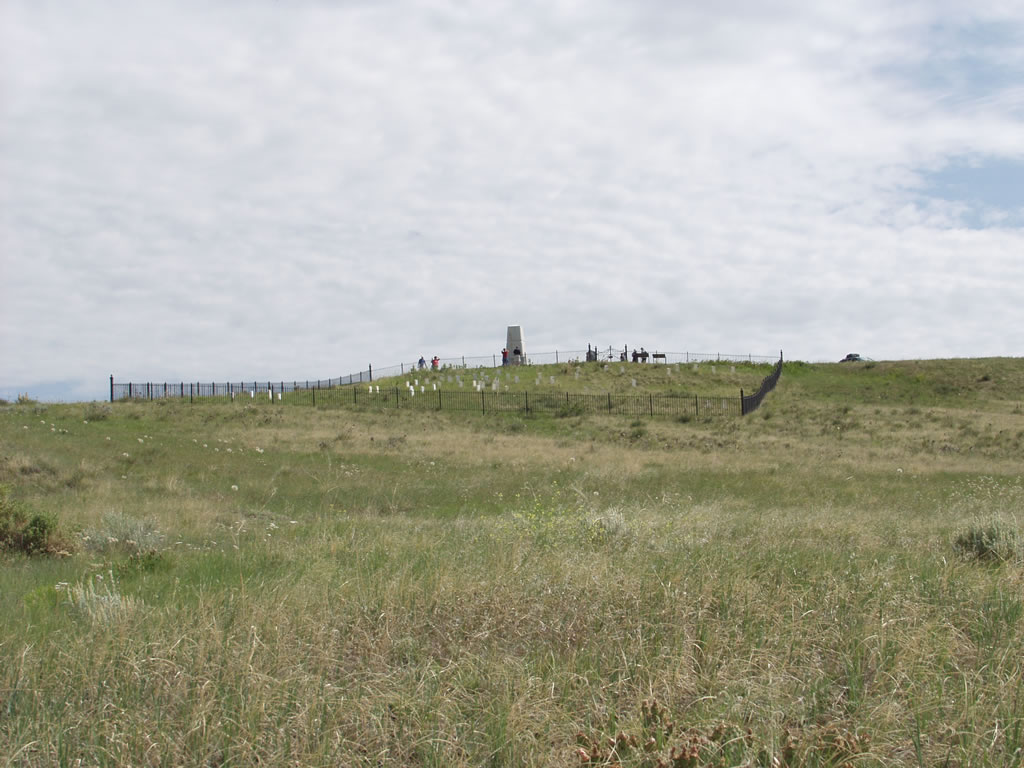
The last hill
Misunderestimating the enemy bump.
Hi Confederate
You should better see http://www.custerwest.org about what the witnesses and army officers really said about the battle.
You’ll be surprised. It’s known in the army circles at the time that the real story hadn’t been told to the American people. See the case on http://www.custerwest.org
Custer wanted to fight 1’500 warriors.
He fought 1’500 warriors.
Custer wanted to surprise the enemy.
He surprised the enemy.
Custer thought that the Indian organization was poor.
Indian testimonies talk about friendly fire and mess on the Indian side.
No underestimation here. see http://www.custerwest.org (English version)
Then I left for Glacier National, then Yellowstone.
I still have pictures, including those I took with that new invention - The Polaroid Swinger.
But that was in a different series...........
hehehe
yeah, it was the 1868 and 1873 years... Custer graduated in Indian fighting, but the Indians eventually disturbed the 1876 graduation day
Yeah except Little Big Horn was win or go home. Or in this case, die.
There is something wild, and lonely, in a day of cellphones, and, "we will be right there..."
The real score is:
Custer : 3 (two battles of the Yellowstone, 1 Washita)
Indians : 1
___________
Then to use the American football analogy, the score should be:
Indians: 8
Custer: 7
Custer scored 2 safeties and kicked a field goal, but on the last play of the game, the Indians scored a touchdown, and went for the win by going for a 2 point conversion, on which they were successful.
I’m not educated on this topic well enough to argue the merits of one side or the other, but given that Custer died on the battlefield, it would be hard to give him the winning score.
We went in 72. I don’t recall the fence. Is that new?
The most accurate portrayal of the last stand is this:
I agree.
Looking at the terrain and standing there you can literally see how the battle unfolded.
Okay, then he obviously overestimated his own prowess.
Something didn’t work out too well.
My wife and I were there on about June 10 1995. Were you the guy in the cowboy boots? We over stayed our time allotment and we were a several of hours for our next stop. I have photos somewhere. A few years after our visit the whole Battlefield burned all the vegetation and the Parks Service was able to find many hidden artifacts. The were documented and left in place I believe...
What’s impressive is if you go there, the mounds that were dug still exist! Apparently they shot their own horses and used them as cover while another trooper would scrape up a little earth mound for better protection. It’s a pretty cool battlefield. Also while a very good picture, the area they held was a lot larger and they did set up a casualty collection point. You can tell that they though hastily, found well suited terrain to fend off attacks.
I’ve read a number of stories about why Custer’s attack failed.
One was due to archeological evidence showing that many troopers’ carbines were affected by continual jamming.
This led to a slower rate of fire and the Indians took advantage of this by moving in closer than they were earlier in the battle.
The decline in overall rate of fire apparently also rattled many of the troopers which could be noted by how separated they became from one another along Battle Ridge Hill.
This, of course, is only one possible scenario.
Hello Red6,
I love the battlefield, I was there in 2002. If you go to http://www.custerwest.org, there are videos of the battlefield in 2007.
Medicine Tail Coulee, the coulee Custer got into to approach the village, is completely filled with water this year!
LOL!
No cowboy boots. Shorts, t-shirt and tennis shoes.
Thanx! I’m suffering from oldtimers disease.
Hello Steve,
The “jamming” only concerned 1% or less of the regiment. It’s a myth.
The real cause of the failure of the attack was that Custer didn’t have his full regiment in the battle. He divided his forces to attack the Indians by front and flank, but the other columns, led by Major Reno and Captain Benteen, never joined him.
see http://www.custerwest.org
hehehe you were just so impressed by the grave that you forgot to see the fence! :-)
and again
I also drove about 160 miles out of our way to go to Dodge City, where we saw plastic tombstones and a train station and turned around. I still hear about that from my kids. And yes, we saw the world's second largest ball of twine.
Custer was in charge. His plan failed, and he and all the men under his direct command at the time died.
That’s about as clear an example of poor military judgment as there can be.
Especially as he was attacking and chose the fight, it wasn’t one he was forced into.
Custer’s a very interesting guy. I’ve read a couple of books about him. But nobody ever accused of being prudent or careful. He was one of the very best Union cavalry officers, but only if you wanted a wild charge rather than cool, collected planning of an attack.
I find it very difficult to think that he would have tried such an attack against a similar number of Jeb Stuart’s men. To me this indicates that he underestimated the fighting ability of the Indians, and they killed him for it.
Excellent account of the travel! Visiting the West is so exciting - when I went to LBH, after visiting Mount Rushmore and the Black Hills, we traveled several miles without any building, just a road, a little fence and the Plains.
You just begin to feel like you’re John Wayne.
Hello
In fact, the repeating rifles had poor range and the Indians quickly began to use arrows and bows to protect themselves.
But as it’s shown on http://www.custerwest.org , the Indian casualties are today estimated as high as 200-250. The battle was hard, 210 men were fighting with Custer to the death, and 400 were out of the battle with Benteen and Reno.
We went about 10 miles on a dirt road to get closer to the Devil’s Tower. Had to see it after Close Encounters......
Custer wasn’t in charge of the men under his direct command.
400 men of his own regiment didn’t join him or support him during the combat.
As it turned out I think Custer did make a mistake in going in with a divided force, not that the division of itself would have been fatal but because Reno failed to hold a leg even if he couldnt skin.
__
Lieutenant Edward Godfrey, Company K, 7th cavalry, after Little Bighorn
(Sklenar, Larry, To Hell with Honor, p.262)
What was Custer doing leading his men into the Little Big Horn that day?
Starting his presidential campaign.
I have a nice story about the Devil’s Tower. We were still on the road at night and we didn’t find any hostel. We just passed near the Devil’s Tower on 1 a.m. and eventually found an excellent ranch after having thought of sleeping in the car.
When we came back to Switzerland, everybody was excited about our picture of the Devil’s Tower at night... :-)
The presidential theory is an hoax.
Custer had freedom to pursue the Indians and get them if he could.
What screwed up that day was Benteen’s and Reno’s behavior during the battle.
Let’s see. I have 650 men. The enemy has 1,500 (although Custer may not have known this).
My plan to deal with being outnumbered more than 2/1 is to split my men into three roughly equal-sized groups, inviting defeat in detail.
Sounds like an excellent plan to me.
It was my impression that Custer’s men were uniformly equipped with single shot carbines.
The Indians also had carbines too but not to the same extent as Custer’s men did. They made extensive use of the bow and arrow.
Here’s another good map (it’s from the NPS’s web site):
http://www.nps.gov/libi/planyourvisit/upload/LIBImap1.pdf
Front and flank attack, movement, offensive, surprise.
That’s the way to attack a force in the cavalry, and that’s what Custer did. As US general in chief Nelson Miles and Confederate cavalry general Rosser said, the plan was good.
The front columns didn’t do their job, and the flank column, with Custer, was left alone.
Disclaimer: Opinions posted on Free Republic are those of the individual posters and do not necessarily represent the opinion of Free Republic or its management. All materials posted herein are protected by copyright law and the exemption for fair use of copyrighted works.