Posted on 03/12/2011 3:14:43 PM PST by Nobel_1
Three of Fukushima Daiichi's six reactors were in operation when yesterday's quake hit, at which point they shut down automatically and commenced removal of residual heat with the help of emergency diesel generators. These suddenly stopped about an hour later, and this has been put down to tsunami flooding by the International Atomic Energy Agency (IAEA).
The loss of the diesels led the plant owners Tokyo Electric Power Company (Tepco) to immediately notify the government of a technical emergency situation, which allows officials to take additional precautionary measures.
For many hours the primary focus of work at the site was to connect enough portable power modules to fully replace the diesels and enable the full operation of cooling systems.
(Excerpt) Read more at zerohedge.com ...
I recommend you read the commentary at Zero Hedge via the source URL, then check out the schematics at the above URL.
For comparison from NukeWorker.com
Re: Japan’s Nukes Following Earthquake
« Reply #81 on: Today at 11:39 »
Nuclear Renaissance (poster)
You get to primary containment flooding if you have no other reliable injection source to the vessel. Continued station blackout gets you most of the way there - an explosion in secondary containment does the rest.
Earthquake causes loss of grid
Loss of offsite power causes scram, Main Steam Isolation, and diesel generator start
Tsunami wave trips diesels an hour later station blackout
Steam-driven systems are only means of injection it is necessary to stay at pressure to maintain motive force
No AC means no containment cooling HPCI should not be used due to its very high exhaust steam discharge into containment
Level is held low, in part to minimize injection (and resultant RCIC-exhaust containment heatup) and in part to stay on DC-powered level instruments
Containment venting becomes necessary to avoid overpressurizing containment they probably were considering venting early with uncertainty of quake damage to containment
8 hr battery coping time is exceeded RCIC becomes non-functional in auto
Local manual operation of RCIC becomes necessary (news reports said 4 operators were in the reactor building basement), meanwhile level continues to lower, challenging fuel
Hydrogen buildup in reactor building causes explosion, obliterating secondary containment and possibly damaging injection penetrations (most are AC-powered anyway). News reports said there were on Steam Condensing mode after the MSIV closure, which creates a direct vessel dome path to the RHR heat exchangers.
Enter containment flooding.
Bfl

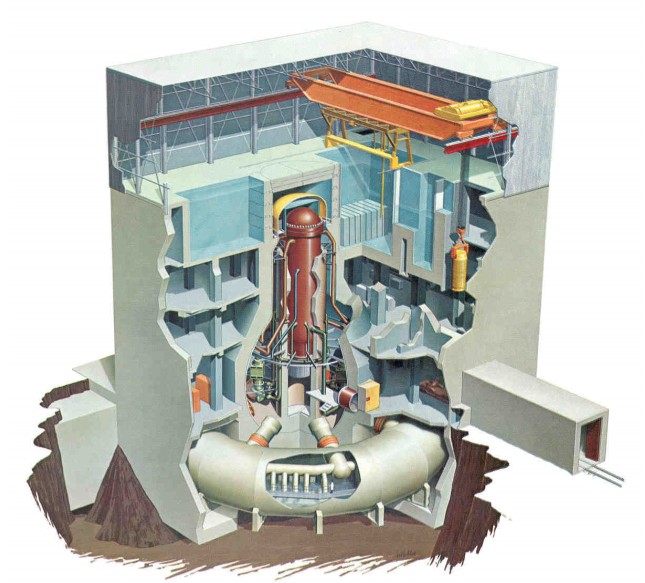
Cutaway diagram of the central reactor vessel and thick concrete containment in a typical boiling water reactor of the same era as Fukushima Daiichi 1
Yah beat me.
One thing I don't get about it. Where are the control rods?
Re: Pressure and releases
quote from the article’s analysis:
“Without enough power for cooling systems, decay heat from the reactor cores of units 1, 2 and 3 has gradually reduced coolant water levels through evaporation. The consequent increase in pressure in the coolant circuit can be managed via pressure release valves. However, this leads to an increase in pressure within the reactor building containment. Tepco has said that the pressure within the containment of Fukushima Daiichi 1 has reached around 840 kPa, compared to reference levels of 400 kPa.”
(840 kPa is approx 122 psi)
Easy to see why the top blew off.. looks like its made not nearly as strong as the rest of the building.

Generic schematic for this reactor type
Re: Summary status of the reactors earlier today
Fukushima Daiichi Unit 1
- 439 MWe BWR, 1971
- Automatically shut down
- Water level decreasing
- Pressure release implemented
- Explosion observed
- Containment believed intact
- Seawater injection has started
- Radiation levels did not rise after explosion
Unit 2
- 760 MWe BWR, 1974
- Automatically shut down
- Water level lower but steady
- Preparations for pressure release
Unit 3
- 760 MWe BWR, 1976
- Automatically shut down
- Preparations for pressure release
Unit 4
- 760 MWe BWR, 1978
- Shut for periodic inspection
Unit 5
- 760 MWe BWR, 1978
- Shut for periodic inspection
Unit 6
- 1067 MWe BWR, 1979
- Shut for periodic inspection
Fukushima Daini Unit 1
- 1067 MWe BWR, 1982
- Automatically shut down
- Offsite power available
- Water level stable
- Preparations for pressure release
Unit 2
- 1067 MWe BWR, 1984
- Automatically shut down
- Offsite power available
- Water level stable
- Preparations for pressure release
Unit 3
- 1067 MWe BWR, 1985
- Automatically shut down
- Offsite power available
- Water level stable
- Preparations for pressure release
Unit 4
- 1067 MWe BWR, 1987
- Automatically shut down
- Offsite power available
- Water level stable
- Preparations for pressure release
nice illustration
Thanks for all the good posts. If I hear one more time this is worse than Chernobyl, I am going to go ludicrously super critical.
Question...and I”m no scientist...but could they use supercooled items like Liquid Nitrogen or equvalent? Or would that not be a good combination with nuclear elements? and even if you were able to get LN02,how would you circulate it without power? I guess I just answered my own question but seawater doesn’t seem nearly cold enough all by iteslf. My prayers to the scientists and engineers obviously putting their lives on the line to control this.
Re: super critical
good one - CNN is in overdrive ...
Just found this latest status website:
http://www.tepco.co.jp/en/press/corp-com/release/11031301-e.html
A very-cold liquid like Liquid Nitrogen would flash to gaseous state immediately and cause an serious explosion. You want to use a coolant that stays in phase, a liquid that stays liquid or a gas.
Outstanding post, Thanks for putting this up. Best explanation of what’s going on that I have read yet.
There is no doubt that there are serious problems over there with these particular reactors, and the fact they are still relatively intact despite surviving both a magnitude 9.1 earthquake and the resultant tsunami is testament to the sound engineering that went into them in the first place.
It sound to me like some of the measures being taken, such as seawater injection for cooling, will probably destroy the internal workings of these reactors and likely require extensive replacement of a lot of expensive components. While it isn’t over yet, this accident is not anywhere near out of control and there still has not been a major radiation release; (and I mean something on the scale of a Chernobyl).
Hopefully this will help calm some of the chicken-little mentality....
ping
Nope. It would just explode the unit and throw the fuel inside everywhere. You have to ramp things down smoothly as reactors are basically atom bombs in super slow motion so they can be kept in a feedback loop.
Normally some plants can take days or even weeks to fully shutdown and that is with full power, full staff, no earthquake/tsunami damage.
Right now they are dealing with damaged systems operating way outside any normal environment with limited resources.
The seawater and boric acid is a last ditch effort to avoid some local, albeit serious, contamination.
“will probably destroy the internal workings of these reactors and likely require extensive replacement of a lot of expensive components”
From what I understand is that these are very old reactors that were due to be decommissioned rather soon anyways. Either way Japanese firms are extremely nationalistic and will almost always put country ahead of profit so I’m positive every decision is being made with safety solely in mind.
Thank you SO much for the ping and the pointer from the other thread. This thread is sorely needed on FR at this time. Like most people, I don’t understand the technology at all, but sure appreciate the opportunity to be more informed by those of you with real world education and experience.
In the early morning hours when this story was first breaking there were posters giving and taking internet medical advice about administering KI, and it was quite alarming to see. Your voice(s) are so important now and I hope some of you will have a lot of time to post over the next several days.
Thanks again!
Here are the official press releases from the company.
http://www.tepco.co.jp/en/press/corp-com/release/index-e.html
The initial 9.1 quake is down at number 42.
Thanks and bookmark
Any way this can be force-fed to CNN, Fox and all these other knee-jerk reactionaries who faint, then wake to go rabid about anything nuclear?
The drawing with the loops showing flow is of a PWR plant. instead of the BWR that was affected by the tsunami.
Control rods in a BWR enter from the bottom of the reactor.
Underneath.
Duly noted, I’ll get the mod to pull it.
As a former Senior Reactor Operator at a large PWR and with BWR experience. Yup. That is what happened (is happening). This scenario is the perfect storm. No Power, No way to get pre-planned Resources on board, No way to change crew perhaps.
I feel horrible for the operators there and wish to all my heart I could help them.
In 2007 I was in a special team assigned to figure out how to cope with scenarios EXACTLY like this. I knew it was going to Containment Flooding yesterday.
After Fukushima Unit 1 blew off the sheet metal building, Did anyone assess the Spent Fuel Pool? The Pool has to have sustained damage. Further, there has to be wreckage IN the Pool, impinging on Spent Fuel Assemblies in their racks. We don’t know if the explosion blew the water out of the pool either. HORRIBLE EVENTS.
GE reactors are upside down. The control rods penetrate the bottom of the reactor and move upward in order to insert negative reactivity. The motive force for this is, HCUs (Hydraulic Control Units). The fluid is Water (not oil). There are accumulators to ensure that there is pressure to move the Control Rods up into the Core.
When you pass Ridiculously Critical and start emitting plaid, we'll know to take cover.
/Spaceballs
It's nice that we have a broad enough user base that we have folks who're conversant in almost any given field for accessible, local expertise. TEPCO's website seems to be pretty forthcoming with frequent status updates, as well.
Driving home Friday evening, I heard an ABC Radio News' 'nuclear expert' state that the reactor 'might explode'. There wasn't much detail in the report, but the clear implication was that a weapons-type explosion was imminent. Nuc physics and engineering isn't my field, but even as an interested layman I know that that just isn't going to happen- even in a worst-case scenario. What passes for news coverage in this country is a national embarrassment.
I can't believe the hyperventilating going on over this, on CNN and by some here on FR.
Nuclear power seems to cause people to lose their ability to reason.
Additional analysis on Zero Hedge now ... why this does not look like Chernobyl:
“The explosion at No. 1 generating set of the Fukushima nuclear plant in Japan, which took place today, will not be a repetition of the Chernobyl nuclear disaster,” said Valeriy Hlyhalo, deputy director of the Chernobyl nuclear safety centre.
He was quoted by Interfax news agency as saying Japanese reactors were better protected than Chernobyl, where just over 30 firefighters were killed in the explosion. The world’s worst civilian nuclear disaster, Chernobyl has also been blamed for thousands of deaths due to radiation-linked illness.
“Apart from that, these reactors are designed to work at a high seismicity zone, although what has happened is beyond the impact the plants were designed to withstand,” Hlyhalo said.
“Therefore, the consequences should not be as serious as after the Chernobyl nuclear disaster.”
And I bet you didn’t have plans for a historic level earthquake and a tsunami at the same time.
Could the source of the cesium and iodine be from a compromised fuel pool and not the main reactor? The pool is up high in that cutaway.
Thanks for answering, much appreciated.
I wouldn’t be concerned about it.
“Driving home Friday evening, I heard an ABC Radio News’ ‘nuclear expert’ state that the reactor ‘might explode’.” I’d be more concerned about his head exploding. The reactor won’t.
My point exactly. Well, apart from a well-deserved mocking of ABC Radio News.
I had read that this was an older design but I didn’t realize they were that close to the end of useful life. Perhaps this will prove to be an opportunity to get a modern design built to replace this unit, if they can salvage it.
I also heard they were preparing to pump boric acid into one of the units to damp the nuclear reaction, and that implies near fatal damage to that unit. It will probably prove to be difficult to decommission but I do not think it will pose the risk of a major release, on the scale of a Chernobyl event.
I keep coming back to Chernobyl as the ultimate worst possible case accident for a nuclear reactor. The design of even these older model Japanese reactors are light-years beyond Chernobyl in safety and the chances of an extreme accident that exposes a burning core are extremely remote.
God,I feel so stupid when I read this stuff.
I think I’ll just go back to praying and crossing my fingers.
We need nuclear power now more than ever, and the fear-mongering that the lamestream media is doing just hurts any effort to expand construction of such plants in this country.
Disclaimer: Opinions posted on Free Republic are those of the individual posters and do not necessarily represent the opinion of Free Republic or its management. All materials posted herein are protected by copyright law and the exemption for fair use of copyrighted works.