Posted on 04/03/2011 7:56:18 AM PDT by Brandonmark
CNN) -- Sunday is the anniversary of something that undoubtedly has changed your life.
Whether for good or for bad is a question only you can answer.
On this day in 1973 -- on April 3 of that year -- a man did something no one had ever done before.
You may bless him for it or curse him for it. At this juncture, it hardly matters. The impact of what he did is so enormous that judging it now is almost beside the point.
The man's name was Martin Cooper. He was 44 at the time.
He made a cell phone call.
The world's first. At least the first public one; the cell phone had been tested in the lab, but never tried in the real world.
"As I walked down the street while talking on the phone," Cooper once told an interviewer, "sophisticated New Yorkers gaped at the sight of someone actually moving around while making a phone call."
There had been car phones before -- mobile radios, really. They were powered by heavy equipment that had to be stashed in the trunk of the automobile.
But Cooper, who was the general manager of Motorola's communications systems division, had the idea that people didn't want to be tethered to a stationary telephone, even if the phone could ride along with them in their car. He thought that the phone should be so portable that it could go anywhere they went.
(Excerpt) Read more at cnn.com ...
The first unit we ever used was IIRC, a Trimble. It was huge and was flown in for the week. The case was about 2’x2’x2’ and insulated so the equipment could survive a fall from a plane.
The Global Positioning System (GPS) is a satellite-based navigation system made up of a network of 24 satellites placed into orbit by the U.S. Department of Defense. GPS was originally intended for military applications, but in the 1980s, the government made the system available for civilian use. GPS works in any weather conditions, anywhere in the world, 24 hours a day. There are no subscription fees or setup charges to use GPS.
It’s better to play it with Relish.
The Cuban government wouldn’t permit us (the U.S. Interests Section in Havana) to operate a radio net as we do in most other diplomatic missions. For comms, we were restricted to using the Cuban cellphone system. They charged the Section exorbitant prices per unit. I don’t know if they’ve changed. This was in the mid 90s.
Wow! Not too suprising though.
¡Viva la Cuba!
So, the USA does have an offical presence in Cuba?
I did not know that. Thanks for the info.
LOL! That is TOO funny!
35K? Damn, you are old! :0) That there’s a 25U’s job these days.

http://en.wikipedia.org/wiki/Semaphore_line
In 1977, the US and Cuba agreed to open “Interests Sections” in each others’ capitols. Only smart thing Jimmah Carter ever did. The US is in Havana under the aegis of the Swiss and the Cubans in DC under the aegis of the Czech Republic (used to be Czechoslovakia before 1991). They’re embassies in everything but name. Each mission is headed by a Principal Officer, not an Ambassador. When I left in 1997, there were about 40 American civilians and eight or nine U S Marine Security Guards. We got along famously with the Cubans on the streets. With the Official Cubans: not so much.
HAHA! Well, yeeeeeessss,I AM old. Somebody has to be, and I decided to volunteer!
:-D
Some of that stuff was HEAVY. I followed a 50 lb RT down the stairs once. I landed on top, so I counted myself rather fortunate. :-D
I think it was several lifetimes ago—in a galaxy far, far away.
;-)
I get a sense of wonderful freedom when I leave my cell phone at home, unless it's a work day, then I freak out.
The “Wow, look at that!” factor must be pretty high for the phone. There are instructions on how to DIY out there.
Carter 1, Soetoro 0.
When you got the opportunity to mingle with the regular people, did you get a sense that they were aware that Cuba was led by a mass murdering schmuck? Did you sense any anti-American sentiment? How were the cigars?
I don't relish the thought.
It was sometime in the early ‘80s, I was 12 or 13, riding in a car with a friend (her dad was driving) and she said, “hey, do you want to call your mom?” She handed me this huge handset-thinga-ma-bob and I was like, “huh?” Anyway, I dialed and spoke to my mother while riding down a little suburban road. I remember asking her, “Guess where I am! In Mr. Z’s car!!!”
I can still remember the amazement.... have no idea who Mr. Z worked for, but that was one cool gadget.
I just read “The Victorian Internet.” There were 1,000 such telegraph stations in Europe.
Sometimes I really miss beepers. They told you when someone was trying to get ahold you and you could call them back at your leisure. If it was an emergency, they just added '911' to their callback number and you knew to call them sooner rather than later.
- May I speak to Carmen? - I believe you've got a wrong number. - Oh. Can you verify the number I dialed? - OK. (Sucker me.) - 555- 5678 - That's correct. - Sir, may I interest you in this program, which will blah blah, blah... - No!
Just do what Danny DeVito did in ‘Ruthless People’.
- May I speak to Debbie?
- Debbie can’t talk to you right now, my —— is in her -——. I’ll have her call you back, when I’m through.
*Hangs Up*
- I love wrong numbers.
Cell phones are great but this stupid text messaging will never catch on.
In my “to read” list.
http://spinroot.com/gerard/hist.html
The Early History of Data Networks by Gerard J. Holzmann and Bjorn Pehrson.
What was the bandwidth on that thing? About 6 letters a minute? 1 Kbps?
Thanks — added to my “to read” list, too.
You’d enjoy “The Victorian Internet” — the history of the telegraph in a short form. I also liked “A Thread Across the Ocean: The Heroic Story of the Transatlantic Cable” by John Steele Gordon.
Both of these weave the business history with the technology history. It’s always fascinating learning about the inventors and the people who made fortunes — and they are often not the same people.
Used a Motorola HT-200 with an added DTMF encoder to place "autopatch" calls in '77 after getting tech ham ticket.
Used WR5ABY 146.88 Dallas/DARC and WR5ABE 146.(don't recall freq) in Irving at the time to make those 'calls' ...
Motorola HT-200 portable radio (model run from 1960 - 1970 or so): mfwright.com/mikeht220/ht200.html
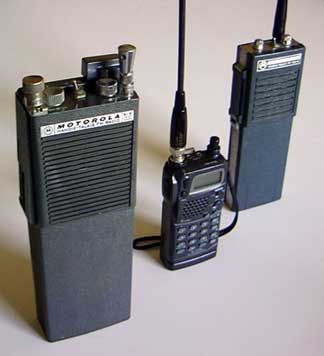
Motorola HT-220 shown in right-background ...
I have read “The Victorian Internet.” The Gordon book looks good.
Over the past 3 or 4 years, I’ve done extensive reading on the history of communications and news gathering.
Since I do my own newsblog and have no “formal journalistic training,” I thought some history of the craft would be helpful.
http://en.wikipedia.org/wiki/Semaphore_line
The Chappes carried out experiments during the next two years, and on two occasions their apparatus at Place de l’Étoile, Paris was destroyed by mobs who thought they were communicating with royalist forces. However in the summer of 1792 Claude was appointed Ingénieur-Télégraphiste and charged with establishing a line of stations between Paris and Lille, a distance of 230 kilometres (about 143 miles). It was used to carry dispatches for the war between France and Austria. In 1794, it brought news of a French capture of Condé-sur-l’Escaut from the Austrians less than an hour after it occurred. The first symbol of a message to Lille would pass through 15 stations in only nine minutes. The speed of the line varied with the weather, but the line to Lille typically transferred 36 symbols, a complete message, in about 32 minutes.
Actually, yes I do, because I am disabled after a gentleman ran a yield sign and tore off the front of my car and left me with RSD/CRPS a chronic pain issue. So surfing for info is a part time job now.
Disclaimer: Opinions posted on Free Republic are those of the individual posters and do not necessarily represent the opinion of Free Republic or its management. All materials posted herein are protected by copyright law and the exemption for fair use of copyrighted works.