Posted on 07/24/2009 10:25:33 AM PDT by NYer
CHICAGO — At a gathering of Church composers and musicians recently, Msgr. Anthony Sherman asked how many people had looked at the revised order of the Mass. Almost everyone raised a hand.
Msgr. Sherman, the executive director of the U.S. Conference of Catholic Bishops’ Secretariat of Divine Worship, might have predicted the reaction during his breakout session at the National Association of Pastoral Musicians Convention in Chicago. After all, new Mass texts require new music — and pastoral musicians are preparing to provide it.
“Given that music is integral to the celebration of liturgy, composers will have an important role to play in introducing worshippers to the revised translations of the order of Mass found in the forthcoming edition of the Roman Missal,” explained composer Steven Janco, who directs the church music and liturgy program at Saint Joseph’s College in Rensselaer, Ind. “Most current settings will require new music for the Gloria and new or adapted memorial acclamation settings. Only a few words of the Holy, Holy, Holy will change, so many existing settings will be adapted rather easily by composers.”
Janco has already begun revising his “Mass of the Angels and Saints” and “Mass of Redemption.” His publishers — World Library Publications and GIA Publications — have asked him for versions that use the revised order of the Mass. Starting fresh with the new translation, Janco is also composing a new setting he calls “Mass of Wisdom.”
Msgr. Sherman explained why the Gloria is garnering special attention: “When the initial translation of the Gloria was done, the Latin structure was abandoned and rearranged. In this new translation … it has been transposed to be closer to the original Latin text.” Changing that structure means the words no longer fit the music, and new musical settings are necessary.
The memorial acclamations will also require new music since three of those texts saw significant alteration in the translating process. Acclamation A, “Christ has died; Christ is risen; Christ will come again,” is pending approval as an additional proposal. Kelly Dobbs Mickus, GIA senior editor and National Association of Pastoral Musicians publicity committee chairwoman, explained: “Composers are trying to do settings, and they don’t know whether or not to set that. So, we’ve been asking them to set it, and if we need it, we need it — and if we don’t, we don’t.”
Since Marty Haugen set that acclamation in his well-known “Mass of Creation,” it is frequently used in the United States. On the other hand, it is the only memorial acclamation in the post-Vatican II Roman Missal that speaks of Jesus in the third person rather than the second. It has no counterpart in the Latin Missal.
Dobbs Mickus said other music will require revisions instead of rewrites. “We intend to try to keep the music as much like the original as possible,” she said, noting that doing so could help congregations participate more easily. “In the case of the Holy, Holy, that’s fairly easy to do. The changes are not such that they’re going to require a lot of different notes and different rhythms.”
Economics
Since most worship resources contain Mass settings, the translation process is also having a fiscal affect on the Catholic music publishing industry.
“We have had a slump in sales because of our hymnal business,” Dobbs Mickus said. She noted that hymnals are an investment — and many parishes do not want to repeat that investment when the revised Roman Missal is approved for use. That means churches are putting off purchases, but eventual implementation of the new text could mean sales down the line.
In the meantime, Dobbs Mickus said, GIA is promising to give its customers free hymnal inserts with the new text and music once the translations come into use. She said the publisher hopes that will encourage parishes to buy hymnals now.
When the revised translations of the Roman Missal are approved, music directors and liturgists will have to teach their congregations to use the new texts and music.
Msgr. Sherman said, “You’re going to have to have cards, you know, to start this … but I think about two months after we’re under way, people won’t even realize [the changes], but we’re still going to have to keep the cards because there could be a slight slip every once in a while.”
Robert Noble, director of music at St. John Nepomuk Church in Yukon, Okla., already has a plan for introducing the new text and music to his parish. “It takes my congregation about a month to comfortably learn all of the different acclamations from one setting, then a couple more months for them to really ‘own’ it. The only difference is the new text,” he said. “As far as the new chants for the dialogues, I will help my pastor learn them first. After that, the choir — then the congregation.”
Basically, he said, “We’ll learn new Mass settings in the same way we’ve learned them in the past.”
Amy Kiley writes from
Romeoville, Illinois.
INFORMATION For more information on the revised Roman Missal, visit USCCB.org/liturgy/missalformation/.
Liturgy update ping!
Church musicians should always be in tune.
Church musicians should always be in tune.
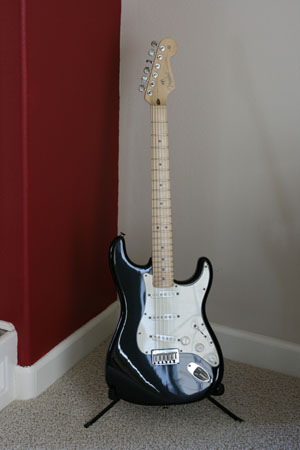
When I was younger electric instruments and anything beyond a piano or organ seemed wrong to me. Last week I went to the teen mass of my new parish and loved the sound of the happy musical worship. It’s how I think Heaven would sound. But, maybe I just say that because we were singing Matt Mahr songs. :)
All musicians should always be in tune.
Ruthenian Byzantine Rite just keeps using the same Carpathian Plainchant.” We don’t have to worry about changing things back and forth. We sing what this Rite has sung for generations. By St. John Chrysostom.
Are you talking about a church setting?
Yes. Teen Mass.
Amen!! Thank you . That is EXACTLY why I am Melkite. Nothing has changed in many, many centuries. It is as beautiful now as it was when St. John Chrysostom and St. Basil were alive.
(What would Marty Haugen do?)
what year and when was it made? And are you in California or Florida (terrazzo)?
Hopefully, go away. FAR away.
Good. Maybe we'll get less dreck this time.
Of course, if we just used CHANT, we wouldn't have to struggle to fit the words to pop music . . . . with a good chant tone (Gregorian OR Anglican), you can chant anything from a Psalm to a grocery list to the portion of the British Highway Code pertaining to pedestrians to The Weather Forecast.
*snort* I do like Gregorian Chant, but then I also love Anglican High Church hymns (William Byrd, Ralph Vaughn Williams), as well as some of the popular music. What I DON’T particularly like, is what our daughter describes as “Jesus is my boyfriend” music. ;o)
Good thing he's the Pope and not I (aside from the obviously disqualifying factors)!
I had loaned our choirmaster a DVD of the Clare College choir singing Purcell's Funeral Sentences and he was inspired to make it an all-17th-century Sunday!
We did a Christmas program awhile back that had a really good mix of old and new music. Costeley's "Allon, Gay Bergeres", some Gregorian chant "Hodie Christus Natus Est", Tavener's "The Lamb", Adam's "O Holy Night" . . . quite a mix but all good music.
Disclaimer: Opinions posted on Free Republic are those of the individual posters and do not necessarily represent the opinion of Free Republic or its management. All materials posted herein are protected by copyright law and the exemption for fair use of copyrighted works.