Posted on 01/15/2003 5:36:54 AM PST by SAMWolf
|
![]() are acknowledged, affirmed and commemorated.
|

|
|
|
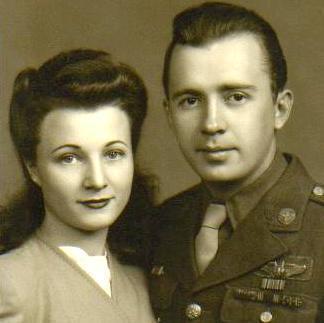
Dairy of a Ball Turret Gunner ![]() The emotional impact of combat is honestly portrayed in a diary my father, John J. Briol (Pictured with my mother, Marcella) wrote while flying on B-17s during WWII. He was a Ball Turret Gunner of the 457th Bomb Group, 748th Squadron at Glatton Air Field, England. The Pilot's Log, along with comments from the Co-Pilot and Toggalier (Bomb Release Switch Operator) are included. We were fortunate to have as Editor And Publisher, John F. Welch, Col. USAF Ret. Colonel Welch flew combat missions in WWII, staying with the Air Force through the Vietnam War, where he earned the Distinguished Flying Cross. "Dead Engine Kids," The book's title and name of the crew's plane, can be purchased online from the Amazon.Com Web Site. We had our toughest mission this morning so far. My stomach still has a sick feeling and my knees are still wobbly. We bombed Ruhland (Ruhleb). I'll start from the beginning. We got up at two o'clock this morning. It may take me a couple days before I feel like writing about these missions. I don't even like to think about them. Before we eat breakfast some of us who are Catholic go down before each mission for Absolution And Communion. When we go out to face death we can receive Communion without Confession or we can even eat breakfast before but it's not recommended. I feel much better when I can receive like that. Then we went down to briefing. They raised the curtain on the map where our route and mission were laid out. All the airmen groaned. We knew a lot of us wouldn't come back. All they did to console us was to say, "It's not pretty," and they let it go at that. The route was marked so we had to fly all the way across Germany to the other side to Ruhland. We had to pass near Berlin on the way. Our target was the synthetic oil refinery at Ruhland. They throw everything at you there, their rocket ships and everything, not to say anything about flak. After briefing we went to the equipment room where we keep all our flying equipment. We drew parachutes and harness and Mae Wests. We carry .45 automatic pistols in a shoulder holster. (We keep them with us in the hut.) We use electrically heated clothing, pants, coats, gloves and shoes, oxygen mask, helmet and goggles, flak suits, escape kit containing maps, compass, etc., in case one has to bail out or crash land in enemy territory. When you're in the ship you're a mass of wires. One to your throat mike, one to your headset, one to your electric suit and a hose to your oxygen mask. We get one B-4 bag to a ship which contains one extra thing of everything if something should go out on you. We pile all this stuff outside and then we go to the armour building for our machine guns. Before a mission we have to clean the oil off and check everything. We have to take the oil off or they'll freeze up at high altitude. After a mission we clean them and put the oil back on. We have to install them before every mission. ![]() A truck takes us out to the plane. It has to be preflighted, guns put in and a million things checked. We put on all our equipment and take off. After we're over the channel we take our positions and pray that we'll see England again. We usually hit the coast of France, Belgium or Holland. We pass over the lines where we see the boys fighting it out on the ground below. We have to fight it out in the air over Germany. After we get into Germany the flak starts coming up at us but it's not so intense until we get to the target. Fighters won't bother us until we get close to the target, unless we're caught straggling along behind our formation. After hours of sweating it out and praying, we saw Berlin in the distance. It seemed to be smoldering from the pounding we're giving it. We passed near it a little to one side to avoid the intense flak. Then it happened so quick you couldn't think. We heard the report "bandits". they seemed to come from nowhere. The Nazi fighters came barreling through our formations before you could wink an eyelash. I watched terrified as three of our Fortresses went down in flames with their bomb loads and our buddies in them. I saw five men get out of one of them. The rest were lost. One of them kept falling, I never did see his chute open. ![]() By this time I had my guns charged on as one came flashing by our ship. One of our escort fighters was on his tail, pouring lead into him. Besides that, a couple other Fortresses were giving it to him. You could have recognized the pilot if it weren't for his oxygen mask. He must have been dead as he went by. I think about 54 of our Fortresses and Liberators were lost on this raid. We had one engine gone but we kept up with the formation to the target at Ruhland and left it in flames. We turned around and beat it back across Germany. It wasn't long and another engine quit. I was never so scared in my life because we didn't have enough power to keep up with the formation. We couldn't keep up with them so we were left straggling across Germany on two engines and losing altitude. When you're all alone like that your greatest fear is enemy fighters ganging up on you. They were getting our range from the ground and the flak would come up and almost knock us down. We lost altitude down to about 10,000 ft. Then the engines seemed to hold us. God was with us though because we weren't attacked. Every time we saw a speck on the horizon we were terrified. We sweat it out for hours over Germany until we finally passed over the fighting lines into France, the happiest moments of our lives. We almost headed for Switzerland because it was closer but our engines managed to carry us back over the channel. Coming back from a mission and seeing the shore of England is the sweetest thing in the world.
|

Oct. 7, 1944:
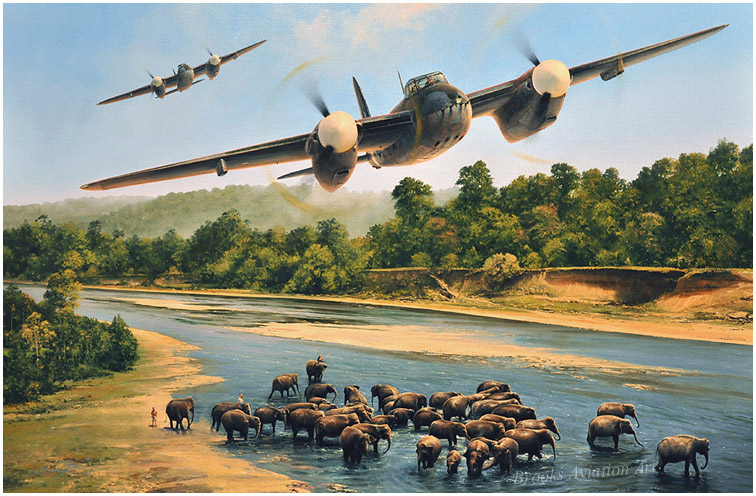
We Bombed Politz Today. All Three Ships In The Lead Element Were Shot Down Over The Target. Colonel Luper, Our Group Commander Was Lost. I Think Two Men Got Out Of His Plane. We Were Hit Over Fifty Times, Holes Everywhere. Every Direction I Looked Flak Was Bursting. I Must Have Prayed Out Loud. I Could Smell The Flak Through My Oxygen Mask. I Was Sweating Even At 40 Degrees Below Zero. The Ship Flying On Our Left Wing Got A Direct Hit In The Nose. It Almost Crashed Into Us Out Of Control. One Man's Body Was Hanging Half Way Out Of What Was Left Of The Nose, Most Of His Clothes Blasted Off. In The Ball I Was Practically Looking The Bursts In The Face As They Tracked Us Along And Kept Exploding Right Under Me...
Nov. 2, 1944:
Our Target For Today Was Merseburg. There Was Very Little Flak Over The Target But There Were Enemy Fighters Galore. I Was Blasting Away At The Nearest One As He Was Coming Up On Us. I Saw His Prop And Cowling Go Flying Away And Part Of His Wing Tip Go Sailing Behind Him. The Ship Behind Him, I think I damaged. Our Tail Gunner Was Also On Him. He Turned Away Smoking. Then, Like Last Time, Our Fighter Escort Was There And It Seemed Like There Were Planes Falling Everywhere. One Fortress Exploded Behind Us. A Man Was Thrown Through The Side. I Think We Lost Nine Fortresses...
Nov. 30, 1944:
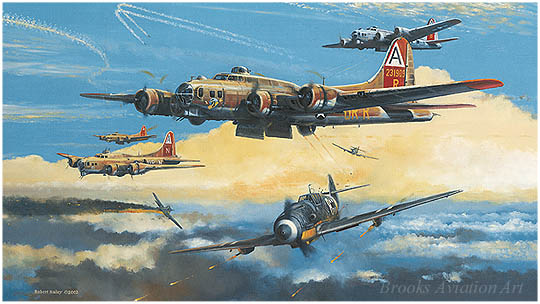
We Had To Crash Land In Belgium But Our Whole Crew Is Safe. Our Target Was Bohlen, On The Other Side Of Germany, Next To Leipzig. Then And There I Never Saw Such Horrible Flak In My Life. Fortresses Started Flaming, Exploding And Falling All Around Us. I Was Praying Out Loud Again. Wham! And Most Of Our No. 1 Engine Was Blasted Away. There Were Heavy Thumps In The Wings And Gas Started Leaking. One Rudder Control Was Shot Away. One Of The Oxygen Tanks Exploded. A Big Piece Of Flak Came Through The Waist. One Piece Thudded Against My Ball Turret But The Guns Saved Me. Our Radio Was Shot Away And The G. Box Burned Out. Our Flaps And Landing Gear Control Systems Were Shot Away. We Decided To Crash Land, Because We Figured We Had A Good Chance. We Came Down In A Field. The Prop On No. 1 Went Flying...
Dec. 7, 1944:
I Saw In The Stars And Stripes Where A Gunner Wants To Go On Missions Because They're Exciting. He's Either A Liar Or He's Crazy. It May Sound Exciting But When You See Your Buddies Getting Killed And You Know You Might Be Next, It's A Filthy, Dirty, Bloody Job... We Just Heard A British Lancaster In Trouble Overhead About An Hour Ago. We Ran Outside In Time To See The Whole Crew Of British Airmen Bailing Out Over Our Field Here. A Few Of Them Were Hurt. The Plane Went Off Over The Horizon. We Never Did See It Crash...

Dec. 27, 1944:
The Target For Today Was Gerolstein, Quite Close To Koblenz. I Can't Explain How A Guy Feels On A Bomb Run. He's Always Waiting For That One Explosion That Will Put Him Into Oblivion. As You Get Closer To The Target Your Heart Beats Faster And Faster. You Breathe Harder And Harder But There's No Air To Breathe. Even When It's 50 Below You Forget About The Cold. Your Nerves Are Strung Up To The Breaking Point. You Can Feel Every Blood Vessel In Your Body Bulging. You're So Nervous And Scared That Every Time There's A Burst Of Flak Or The Plane Jumps A Little, You Think; "This Is The End"...
Dec. 28, 1944:
Our Group Didn't Fly Today. The New Crews Are Up On A Practice Mission. I Think We Helped Things Yesterday. We Went For Transportation And Communication Facilities. We Were In An Area Of Hills Where Railroads Criss-Crossed Everywhere... Major Glenn Miller Is Still Missing. The Nazi Guns Know No Rank. When they Shoot Us Down And We're Armed To The Teeth, I Can Imagine What Happened To An Unarmed Ship...
Jan 14, 1945:
Today, We Destroyed The Huge Bridge Over The Rhine River In Cologne, With Thousand Pound Bombs. The Flak Was Very Accurate. You'd Hear A Tremendous "Whump" And A Concussion And Usually A Flash. Many Times You Would Hear A Loud "Clang" As A Piece Of Shrapnel Went Ripping Through The Ship. I Saw The Cathedral Of Cologne Standing Out From The Rest Of The City. It Looked Like It Was Standing Good Yet...

Feb. 3, 1945:
I Finished My Last Mission Today, But It Was A Rough One, Right To The Heart Of Berlin. What A Horrible Thing To Finish Up On. I Could See Berlin Below, Smoking And Exploding From The First Groups Over The Target. There Were Two Tremendous Explosions Ahead Of Us As Two Fortresses Got Hit And Blew To Bits Right In Front Of Us. Another Got Hit And Went Down In A Steep Dive. Half The Men Bailed Out And Went Floating Down Into The Fire And Smoke. We Lost Forty Bombers...
Feb. 15, 1945:
I Forgot To Mention I Saw Jimmy Stewart, The Movie Actor, Over Here A Short Time Ago. He's A C.O. And Pilot Of A Liberator. He Used To Be With The 389th. He's With The Second Division (Liberators). I Don't Think He's Taking It So Good. He's Nervous And His Hair Is Turning Gray. He Only Has In About 18 Missions And He Started Them Before I Left The States...
Feb. 21, 1945:
Got Off Guard Duty A Half Hour Ago. I Had A Lonely Post Last Night. While I Was Walking My Post, I Was Thinking Of All Sorts Of Things. I've Seen Too Much Happen. It's Not Much Fun To See A Riddled Plane Come Back And See Some Poor Guy's Intestines Splattered All Over The Inside And The Rest Of The Crew Crying Like Babies. When I Have Time On My Hands, It Seems As If I Can't Get Away From The Things I've Seen...
| 'I've Seen More In A Few Seconds Than Most Men Will See In Their Lifetime' -- John J. Briol 1922-1972 'Statistically, The Most Dangerous Place To Be In WWII, Was In A Bomber Over Germany' -- From "Bombers Of World War II" By Jeffrey L. Ethell |
|
Announcing "The Bunker" Dear Freeper Foxhole friends, Free Republic Network chapter leaders and frontline Freeper fighters and property rights activists:
Stop in for a Bunker Moment. Our mission is simple... support our Freeper friends and destroy the enemy. Restore the our Bill of Rights from those who would strip us of them. For a clearly superior Voice Chat application, give it a try tonight, especially during Mark's Night Talk Live. The password for tonight will be: freedom This is a private venue with limited seating! Real first names or a verifiable Freeper handle are REQUIRED. You are welcome to use the room any time for family oriented, grassroots Freeper conservative discussions. Chat room Moderators will be present in PrimeTime hours (7 to 10 p.m.) and will sit in from time to time in off-peak hours. Keep in mind, we may have to cycle visitors from time to time to make room for new visitors. Lurkers are welcome if there's ample room or a program in progress.
If your browser didn't support Form Posts Click on this I will be extending an invitation to some of our Free Republic friends in hopes of stimulating constructive dialogue. A key mission in this project is to support our good friend Mark William at KFBK and his new MSN Group at MarkTalk.com If you haven't joined his forum, please do. Be sure to check out Roger's Rant and the other great discussions. Mark as been a loyal friend to Free Republic and our issues. As always, our primary focus remains our nation's veterans, military personnel and those who feed America; the endangered ranchers and farmers of America. We will be a small group at first and grow as the will to make a difference translates into ACTION. Out there in Freeperland are bright ideas, solutions and the resolve to see them through. Dave (Comwatch) Jenest
|
||||

Glad to help J
Have some Biscuits and Gravy J
Good Morning Everybody
Breakfast Is Ready
| You Know The Drill Click the Pics ![]() Come on Y'all |

To be removed from this list, Click this link and send a BLANK FReepmail to AntiJen.
If you have comments for me to read, use this link. Thanks!
By Dennis McCarthy
Columnist
The first name that Marine Pfc. William "Bill" Moore scratched on his canteen cup before his final battle of World War II was that of his dad, Earl Moore, a Marine in World War I.
He was proud of his father, proud to follow in his footsteps and become a Marine himself.
His sisters talked about their brother Monday as they held the rusted, battered canteen cup that became a family treasure last week.
"Bill was still in high school; he didn't have to go," said Dorothy Saraga, one of his sisters, who now lives in Reseda. "He enlisted a week after his 17th birthday in 1942."
He died in 1944, a month before his 19th birthday, on tiny Peleliu Island in the Pacific in one of the bloodiest battles of World War II.
Fifty-eight years later, a couple of former Marines on a tour of military battle sites in the Pacific found a rusted canteen cup sticking out of some dirt under a clump of bushes.
When they dug it out and brushed it off, they found it had belonged to Pfc. William Moore, Echo Company, 2nd Battalion, 7th Marine Regiment.
They turned it around and saw the name Earl Warner Moore scratched into the cup, along with the names of Bill's brother, Roy Moore, and sister Elizabeth, both of whom had joined the Marines in World War II. Dorothy was too young to join but later married a Marine.
"What should we do with it?" Dan King asked John Edwards about the cup.
"Only one thing we can do with it," Edwards said. "Find them."
And that's just what they did -- spending months going through old high school yearbooks, telephone books and Marine archives to find out what happened to the Earl Moore family that lived in Sunland back in the '40s.
Last week, King and Edwards flew into Van Nuys Airport to deliver the cup, found in the dirt of a tiny 5-square-mile island in the Pacific, where 20,000 died more than a half-century ago.
They personally wanted to let Pfc. Moore's sisters know that their brother was thinking of his family right to the end.
Dorothy got the first call in July. It was someone from her alumni association at Verdugo Hills High School.
"She told me two men had called her looking for the Moore sisters, and she didn't feel right about giving them my number without asking my permission," Dorothy said. "I asked her what they wanted, and she said it had something to do with my brother Bill and an old cup."
The men on the phone were King and Edwards, who had already made two trips to the Valley from their homes in Fullerton to locate Moore's next of kin.
"We talked to Realtors, went to the library, tried the historical society, but weren't having much luck," Edwards said. "Then we got the yearbook from Moore's high school and saw he had two sisters.
When Dorothy hung up the phone after talking with the men, she sat there shaking her head, remembering some of the toughest days of her family's lives.
"The day my parents got the telegram saying Bill had been killed in action, I was in high school," she said. "Dad came and got me out of class. He was crying. We all were."
When Dorothy called her sister, Elizabeth Brich, living in Van Nuys, and told her about Bill's old canteen cup, Elizabeth was stunned.
"It's amazing that all these years later not only would the cup be found, but that our names Bill scratched on it would still be so clear," Elizabeth said.
"Amazing, too, that these men would take all that time to find us so we could have it."
Not amazing, Edwards said Monday. Just something Marines do for other Marines. Nothing gets left behind, not even an old canteen cup.
"This was a kid who could have stayed in high school for another two years and probably gotten out of serving, but he wouldn't do it," Edwards said.
"He wanted to be a Marine, like his father, and that makes him an American patriot to me."
Dorothy has the cup now, but it will soon go to Bill's nephew for a while, then to the grandkids in the family so they can hold some rich, family history in their hands and learn from it.
But before all that, the sisters will be taking the old canteen cup over to Glenhaven Memorial Park in Sylmar, where Bill is buried next to his father and mother.
They want to share it with their parents, too.
They want to let Earl Moore know that it was his name Bill scratched first and foremost in big letters on his old canteen cup before his final battle of World War II.
--- Dennis McCarthy's column appears Tuesday, Thursday, Friday and Sunday.
Thanks to Real Deal for sending this along to post at the Foxhole
(Mudboy Slim on keyboards...conservativemusician doin' the Townsend...LOL!!)
We'll enlighten all we meet...
For our children, we shall FReep...
Truth and Morals that we worship shall live on!!
'Tis Clinton who spurs us on...
Lib'ral Judgement is all Wrong...
Media LIES, but the Sheeple shall catch on!!
We'll re-enforce Nation's Ol' Constitution...
Devolve Power...The Great Devolution...
Laugh and sing and take Slick Willie down!!
Listen to what Limbaugh's sayin'...
Gotta do more than pray!!
Folks, we'll rise to our feet and sing...
"We shan't git fooled again!!!"...No NO!!
We'll raise our voice for our Country with pride...
Ain't gonna listen to Left's Med'yuh jive!!
We'll wake all the Sheeple and smite all Left's spies!!
Folks, you know that the Chi-Com spies always lie...don'tcha?!!
(Kewl synthesizer/guitar combo...maybe a li'l MUD on harp)
YEEEEEEEAAAAAAAAAAAAAHHHHHHHHHHHHH!!!!
FReepers, hit the streets...educate everyone you meet...
Lib'rals' "programs" we'll erase...by the by!!
And the SLAUGHTER of the Left...means momentum for the Right...
Sheeples' fears shall melt away before our sight!!
Right'll re-enforce our Ol' Constitution...
Reject Algore's Socialist solutions!!
Smile and grin at the change all around...
Pick up my ol' harp and sing...ain't like yesterday...
Folks, we'll take to streets and scream...
"FReeeeeeeeeeeeEEEEEEEEEEEEEEEEE-Muuuuuuud!!!!!!!!!!"
Meet MUD's New Boss...his name is GEORGE BUSH!!
Mudboy Slim
Anybody know how to play this on the synthesizer?! I'm practicin' my Roger Daultrey...
FReegards...MUD
1 Posted on 10/13/2000 01:23:41 PDT by Mudboy Slim (The Clinton Legacy SHALL BE the Destruction of the Democratic Party!!)
SITYS...MUD
Today's classic warship, USS Jacob Jones (DD-61)
Tucker class destroyer
Displacement. 1,160 t.
Lenght. 316'3"
Beam. 30'7"
Draft. 9'9"
Speed. 30 k.
Complement. 99
Armament. 4 4", 8 21" tt.
The USS Jacob Jones (DD-61) was laid down 3 August 1914 by New York Shipbuilding Corp.. Camden, N.J.: launched 29 May 1916; sponsored by Mrs. Jerome Parker Crittendon, great-granddaughter of Jacob Jones; and commissioned 10 February 1917, Lt. Comdr. W. S. Pye in command.
After shakedown, Jacob Jones began training exercises off the New England coast until entering the Philadelphia Navy Yard for repairs. Upon the outbreak of war between the United States and Germany 6 April 1917, Jacob Jones patrolled off the Virginia coast before departing Boston for Europe 7 May.
Arriving Queenstown, Ireland, 17 May, she immediately began patrol and convoy escort duty in waters of the United Kingdom. On 8 July she picked up 44 survivors of the British steamship Valetta, the victim of a German U-boat. Two weeks later, while escorting British steamship Dafila, Jacob Jones sighted a periscope; but the steamship was torpedoed before an attack on the submarine could be launched. Once again a rescue ship, Jacob Jones took on board 25 survivors of the stricken Dapfila.
Throughout the summer the destroyer escorted supply laden convoys and continued rescue operations in submarine-infested waters. On 19 October she picked up 305 survivors of torpedoed British cruiser Orama. After special escort duty between Ireland and France, she departed Brest, France, 6 December on her return run to Queenstown. At 1621, as she steamed independently in the vicinity of the Isles of Scilly, her watch sighted a torpedo wake about a thousand yards distant. Although the destroyer maneuvered to escape, the high-speed torpedo struck her starboard side, rupturing her fuel oil tank. The crew worked courageously to save the ship; but as the stern sank, her depth charges exploded. Realizing the situation hopeless, Comdr. Bagley reluctantly ordered the ship abandoned. Eight minutes after being torpedoed, Jacob Jones sank with 64 men still on board.
The 38 survivors huddled together on rafts and boats in frigid Atlantic waters off the southwest coast of England. Two of her crew were taken prisoner by attacking submarine U-58 commanded by Kapitan Hans Rose. In a humanitarian gesture rare in modern war, Rose radioed the American base at Queenstown the approximate location and drift of the survivors. Throughout the night of 6 to 7 December British sloop-of-war Camellia and British liner Catalina conducted rescue operations. By 0830 the following morning HMS Insolent picked up the last survivors of Jacob Jones.

USS Jacob Jones was named in honor of Commodore Jacob Jones, USN, (1768-1850), a naval hero of the War of 1812.

A Site For Veterans, About Veterans, By Veterans
Posted with permission. My collection of historical links is primarily concerned with military history as seen, heard, and experienced by veterans themselves. I have quite a collection of links to closed military bases and decommissioned ships, as well as to particular aircraft and other organizations. This has been a labor of love with me and I have not linked to any government sites except one that deals with health care. If you have any possible links for me, I would be happy to hear about them. Click on the e-mail icon on the page.
It's so amazing how far (technologically speaking) we've come in terms of what these brave souls had to use compared with what our Air Force has today.
In all wars there is many cases extreme bravery, but,
(Apologies to anyone offended by next statement!)
I feel that the crews of our bombers/fighters of WW-II were a cut above the rest.
Day after day, climbing into these ships and fly for hours & hours, fending off fighters, waiting for the next flak burst, dropping bombs on target, all while watching friends get blown out of the sky.
There was indeed something just a bit more to these men.
I honestly feel that I could not do what this man did.
Of course this is IMHO and I've got my Fire gear on, so if you feel inclined to flame me, I'm ready.
Thank you SAM for posting excerpts of John Briol's Diary and giving us a glimpse of "hell in the air"
*CASTLE, FREDERICK W. (Air Mission)
Rank and organization: Brigadier General. Assistant Commander, 4th Bomber Wing, U.S. Army Air Corps. Place and date: Germany, 24 December 1944. Entered service at: Mountain Lake, N.J. Born: 14 October 1908, Manila P.I. G.O. No. 22, 28 February 1947. Citation: He was air commander and leader of more than 2,000 heavy bombers in a strike against German airfields on 24 December 1944. En route to the target, the failure of 1 engine forced him to relinquish his place at the head of the formation. In order not to endanger friendly troops on the ground below, he refused to jettison his bombs to gain speed maneuverability. His lagging, unescorted aircraft became the target of numerous enemy fighters which ripped the left wing with cannon shells. set the oxygen system afire, and wounded 2 members of the crew. Repeated attacks started fires in 2 engines, leaving the Flying Fortress in imminent danger of exploding. Realizing the hopelessness of the situation, the bail-out order was given. Without regard for his personal safety he gallantly remained alone at the controls to afford all other crewmembers an opportunity to escape. Still another attack exploded gasoline tanks in the right wing, and the bomber plunged earthward. carrying Gen. Castle to his death. His intrepidity and willing sacrifice of his life to save members of the crew were in keeping with the highest traditions of the military service.
*FEMOYER, ROBERT E. (Air Mission)
Rank and organization: Second Lieutenant, 711th Bombing Squadron, 447th Bomber Group, U.S. Army Air Corps. Place and date: Over Merseburg, Germany, 2 November 1944. Entered service at: Jacksonville, Fla. Born: 31 October 1921, Huntington, W. Va. G.O. No.: 35, 9 May 1945. Citation: For conspicuous gallantry and intrepidity at the risk of his life above and beyond the call of duty near Merseburg, Germany, on 2 November 1944. While on a mission, the bomber, of which 2d Lt. Femoyer was the navigator, was struck by 3 enemy antiaircraft shells. The plane suffered serious damage and 2d Lt. Femoyer was severely wounded in the side and back by shell fragments which penetrated his body. In spite of extreme pain and great loss of blood he refused an offered injection of morphine. He was determined to keep his mental faculties clear in order that he might direct his plane out of danger and so save his comrades. Not being able to arise from the floor, he asked to be propped up in order to enable him to see his charts and instruments. He successfully directed the navigation of his lone bomber for 2 1/2 hours so well it avoided enemy flak and returned to the field without further damage. Only when the plane had arrived in the safe area over the English Channel did he feel that he had accomplished his objective; then, and only then, he permitted an injection of a sedative. He died shortly after being removed from the plane. The heroism and self-sacrifice of 2d Lt. Femoyer are in keeping with the highest traditions of the U.S. Army.
*GOTT, DONALD J. (Air Mission)
Rank and organization: First Lieutenant, U.S. Army Air Corps, 729th Bomber Squadron, 452d Bombardment Group. Place and date: Saarbrucken, Germany, 9 November 1944. Entered service at: Arnett, Okla. Born: 3 June 1923, Arnett, Okla. G.O. No.: 38, 16 May 1945. Citation: On a bombing run upon the marshaling yards at Saarbrucken a B-17 aircraft piloted by 1st. Lt. Gott was seriously damaged by antiaircraft fire. Three of the aircraft's engines were damaged beyond control and on fire; dangerous flames from the No. 4 engine were leaping back as far as the tail assembly. Flares in the cockpit were ignited and a fire raged therein, which was further increased by free-flowing fluid from damaged hydraulic lines. The interphone system was rendered useless. In addition to these serious mechanical difficulties the engineer was wounded in the leg and the radio operator's arm was severed below the elbow. Suffering from intense pain, despite the application of a tourniquet, the radio operator fell unconscious. Faced with the imminent explosion of his aircraft, and death to his entire crew, mere seconds before bombs away on the target, 1st. Lt. Gott and his copilot conferred. Something had to be done immediately to save the life of the wounded radio operator. The lack of a static line and the thought that his unconscious body striking the ground in unknown territory would not bring immediate medical attention forced a quick decision. 1st. Lt. Gott and his copilot decided to fly the flaming aircraft to friendly territory and then attempt to crash land. Bombs were released on the target and the crippled aircraft proceeded alone to Allied-controlled territory. When that had been reached, 1st. Lt. Gott had the copilot personally inform all crewmembers to bail out. The copilot chose to remain with 1st. Lt. Gott in order to assist in landing the bomber. With only one normally functioning engine, and with the danger of explosion much greater, the aircraft banked into an open field, and when it was at an altitude of 100 feet it exploded, crashed, exploded again and then disintegrated. All 3 crewmembers were instantly killed. 1st. Lt. Gott's loyalty to his crew, his determination to accomplish the task set forth to him, and his deed of knowingly performing what may have been his last service to his country was an example of valor at its highest.
*KINGSLEY, DAVID R. (Air Mission)
Rank and organization: Second Lieutenant, U.S. Army Air Corps, 97th Bombardment Group, 15th Air Force. Place and date: Ploesti Raid, Rumania, 23 June 1944. Entered service at. Portland, Oreg. Birth: Oregon. G.O. No.: 26, 9 April 1945. Citation: For conspicuous gallantry and intrepidity in action at the risk of life above and beyond the call of duty, 23 June 1944 near Ploesti, Rumania, while flying as bombardier of a B17 type aircraft. On the bomb run 2d Lt. Kingsley's aircraft was severely damaged by intense flak and forced to drop out of formation but the pilot proceeded over the target and 2d Lt. Kingsley successfully dropped his bombs, causing severe damage to vital installations. The damaged aircraft, forced to lose altitude and to lag behind the formation, was aggressively attacked by 3 ME-109 aircraft, causing more damage to the aircraft and severely wounding the tail gunner in the upper arm. The radio operator and engineer notified 2d Lt. Kingsley that the tail gunner had been wounded and that assistance was needed to check the bleeding. 2d Lt. Kingsley made his way back to the radio room, skillfully applied first aid to the wound, and succeeded in checking the bleeding. The tail gunner's parachute harness and heavy clothes were removed and he was covered with blankets, making him as comfortable as possible. Eight ME-109 aircraft again aggressively attacked 2d Lt. Kingsley's aircraft and the ball turret gunner was wounded by 20mm. shell fragments. He went forward to the radio room to have 2d Lt. Kingsley administer first aid. A few minutes later when the pilot gave the order to prepare to bail out, 2d Lt. Kingsley immediately began to assist the wounded gunners in putting on their parachute harness. In the confusion the tail gunner's harness, believed to have been damaged, could not be located in the bundle of blankets and flying clothes which had been removed from the wounded men. With utter disregard for his own means of escape, 2d Lt. Kingsley unhesitatingly removed his parachute harness and adjusted it to the wounded tail gunner. Due to the extensive damage caused by the accurate and concentrated 20mm. fire by the enemy aircraft the pilot gave the order to bail out, as it appeared that the aircraft would disintegrate at any moment. 2d Lt. Kingsley aided the wounded men in bailing out and when last seen by the crewmembers he was standing on the bomb bay catwalk. The aircraft continued to fly on automatic pilot for a short distance, then crashed and burned. His body was later found in the wreckage. 2d Lt. Kingsley by his gallant heroic action was directly responsible for saving the life of the wounded gunner.
LAWLEY, WILLIAM R., JR. (Air Mission)
Rank and organization: First Lieutenant, U.S. Army Air Corps, 364th Bomber Squadron, 305th Bomber Group. Place and date: Over Europe, 20 February 1944. Entered service at: Birmingham, Ala. Born: 23 August 1920, Leeds, Ala. G.O. No.: 64, 8 August 1944. Citation: For conspicuous gallantry and intrepidity in action above and beyond the call of duty, 20 February 1944, while serving as pilot of a B-17 aircraft on a heavy bombardment mission over enemy-occupied continental Europe. Coming off the target he was attacked by approximately 20 enemy fighters, shot out of formation, and his plane severely crippled. Eight crewmembers were wounded, the copilot was killed by a 20-mm. shell. One engine was on fire, the controls shot away, and 1st Lt. Lawley seriously and painfully wounded about the face. Forcing the copilot's body off the controls, he brought the plane out of a steep dive, flying with his left hand only. Blood covered the instruments and windshield and visibility was impossible. With a full bomb load the plane was difficult to maneuver and bombs could not be released because the racks were frozen. After the order to bail out had been given, 1 of the waist gunners informed the pilot that 2 crewmembers were so severely wounded that it would be impossible for them to bail out. With the fire in the engine spreading, the danger of an explosion was imminent. Because of the helpless condition of his wounded crewmembers 1st Lt. Lawley elected to remain with the ship and bring them to safety if it was humanly possible, giving the other crewmembers the option of bailing out. Enemy fighters again attacked but by using masterful evasive action he managed to lose them. One engine again caught on fire and was extinguished by skillful flying. 1st Lt. Lawley remained at his post, refusing first aid until he collapsed from sheer exhaustion caused by loss of blood, shock, and the energy he had expended in keeping control of his plane. He was revived by the bombardier and again took over the controls. Coming over the English coast 1 engine ran out of gasoline and had to be feathered. Another engine started to burn and continued to do so until a successful crash landing was made on a small fighter base. Through his heroism and exceptional flying skill, 1st Lt. Lawley rendered outstanding distinguished and valorous service to our Nation.
*MATHIES, ARCHIBALD (Air Mission)
Rank and organization: Sergeant, U .S. Army Air Corps, 510th Bomber Squadron, 351st Bomber Group. Place and date: Over Europe, 20 February 1944. Entered service at: Pittsburgh, Pa. Born: 3 June 1918, Scotland. G.O. No.: 52, 22 June 1944. Citation: For conspicuous gallantry and intrepidity at risk of life above and beyond the call of duty in action against the enemy in connection with a bombing mission over enemy-occupied Europe on 20 February 1944. The aircraft on which Sgt. Mathies was serving as engineer and ball turret gunner was attacked by a squadron of enemy fighters with the result that the copilot was killed outright, the pilot wounded and rendered unconscious, the radio operator wounded and the plane severely damaged. Nevertheless, Sgt. Mathies and other members of the crew managed to right the plane and fly it back to their home station, where they contacted the control tower and reported the situation. Sgt. Mathies and the navigator volunteered to attempt to land the plane. Other members of the crew were ordered to jump, leaving Sgt. Mathies and the navigator aboard. After observing the distressed aircraft from another plane, Sgt. Mathies' commanding officer decided the damaged plane could not be landed by the inexperienced crew and ordered them to abandon it and parachute to safety. Demonstrating unsurpassed courage and heroism, Sgt. Mathies and the navigator replied that the pilot was still alive but could not be moved and they would not desert him. They were then told to attempt a landing. After two unsuccessful efforts, the plane crashed into an open field in a third attempt to land. Sgt. Mathies, the navigator, and the wounded pilot were killed.
*MATHIS, JACK W. (Air Mission)
Rank and organization: First Lieutenant, U.S. Army Air Corps, 359th Bomber Squadron, 303d Bomber Group. Place and date: Over Vegesack, Germany, 18 March 1943. Entered service at: San Angelo, Tex. Born: 25 September 1921, San Angelo, Tex. G.O. No.: 38, 12 July 1943. Citation: For conspicuous gallantry and intrepidity above and beyond the call of duty in action with the enemy over Vegesack, Germany, on 18 March 1943. 1st Lt. Mathis, as leading bombardier of his squadron, flying through intense and accurate antiaircraft fire, was just starting his bomb run, upon which the entire squadron depended for accurate bombing, when he was hit by the enemy antiaircraft fire. His right arm was shattered above the elbow, a large wound was torn in his side and abdomen, and he was knocked from his bomb sight to the rear of the bombardier's compartment. Realizing that the success of the mission depended upon him, 1st Lt. Mathis, by sheer determination and willpower, though mortally wounded, dragged himself back to his sights, released his bombs, then died at his post of duty. As the result of this action the airplanes of his bombardment squadron placed their bombs directly upon the assigned target for a perfect attack against the enemy. 1st Lt. Mathis' undaunted bravery has been a great inspiration to the officers and men of his unit.
*METZGER, WILLIAM E., JR. (Air Mission)
Rank and organization: Second Lieutenant, U.S. Army Air Corps, 729th Bomber Squadron 452d Bombardment Group. Place and date: Saarbrucken, Germany, 9 November 1944. Entered service at: Lima, Ohio. Born: 9 February 1922, Lima, Ohio. G.O. No.: 38, 16 May 1945. Citation: On a bombing run upon the marshaling yards at Saarbrucken, Germany, on 9 November 1944, a B17 aircraft on which 2d Lt. Metzger was serving as copilot was seriously damaged by antiaircraft fire. Three of the aircraft's engines were damaged beyond control and on fire; dangerous flames from the No. 4 engine were leaping back as far as the tail assembly. Flares in the cockpit were ignited and a fire roared therein which was further increased by free-flowing fluid from damaged hydraulic lines. The interphone system was rendered useless. In addition to these serious mechanical difficulties the engineer was wounded in the leg and the radio operator's arm was severed below the elbow. Suffering from intense pain, despite the application of a tourniquet, the radio operator fell unconscious. Faced with the imminent explosion of his aircraft and death to his entire crew, mere seconds before bombs away on the target, 2d Lt. Metzger and his pilot conferred. Something had to be done immediately to save the life of the wounded radio operator. The lack of a static line and the thought that his unconscious body striking the ground in unknown territory would not bring immediate medical attention forced a quick decision. 2d Lt. Metzger and his pilot decided to fly the flaming aircraft to friendly territory and then attempt to crash land. Bombs were released on the target and the crippled aircraft proceeded along to Allied-controlled territory. When that had been reached 2d Lt. Metzger personally informed all crewmembers to bail out upon the suggestion of the pilot. 2d Lt. Metzger chose to remain with the pilot for the crash landing in order to assist him in this emergency. With only 1 normally functioning engine and with the danger of explosion much greater, the aircraft banked into an open field, and when it was at an altitude of 100 feet it exploded, crashed, exploded again, and then disintegrated. All 3 crewmembers were instantly killed. 2d Lt. Metzger's loyalty to his crew, his determination to accomplish the task set forth to him, and his deed of knowingly performing what may have been his last service to his country was an example of valor at its highest.
MICHAEL, EDWARD S. (Air Mission)
Rank and organization: First Lieutenant, U.S. Army Air Corps, 364th Bomber Squadron, 305th Bomber Group. Place and date: Over Germany, 11 April 1944. Entered service at: Chicago, Ill. Born: 2 May 1918, Chicago, Ill. G.O. No.: 5, 15 January 1945. Citation: For conspicuous gallantry and intrepidity above and beyond the call of duty while serving as pilot of a B17 aircraft on a heavy-bombardment mission to Germany, 11 April 1944. The group in which 1st Lt. Michael was flying was attacked by a swarm of fighters. His plane was singled out and the fighters pressed their attacks home recklessly, completely disregarding the Allied fighter escort and their own intense flak. His plane was riddled from nose to tail with exploding cannon shells and knocked out of formation, with a large number of fighters following it down, blasting it with cannon fire as it descended. A cannon shell exploded in the cockpit, wounded the copilot, wrecked the instruments, and blew out the side window. 1st Lt. Michael was seriously and painfully wounded in the right thigh. Hydraulic fluid filmed over the windshield making visibility impossible, and smoke filled the cockpit. The controls failed to respond and 3,000 feet were lost before he succeeded in leveling off. The radio operator informed him that the whole bomb bay was in flames as a result of the explosion of 3 cannon shells, which had ignited the incendiaries. With a full load of incendiaries in the bomb bay and a considerable gas load in the tanks, the danger of fire enveloping the plane and the tanks exploding seemed imminent. When the emergency release lever failed to function, 1st Lt. Michael at once gave the order to bail out and 7 of the crew left the plane. Seeing the bombardier firing the navigator's gun at the enemy planes, 1st Lt. Michael ordered him to bail out as the plane was liable to explode any minute. When the bombardier looked for his parachute he found that it had been riddled with 20mm. fragments and was useless. 1st Lt. Michael, seeing the ruined parachute, realized that if the plane was abandoned the bombardier would perish and decided that the only chance would be a crash landing. Completely disregarding his own painful and profusely bleeding wounds, but thinking only of the safety of the remaining crewmembers, he gallantly evaded the enemy, using violent evasive action despite the battered condition of his plane. After the plane had been under sustained enemy attack for fully 45 minutes, 1st Lt. Michael finally lost the persistent fighters in a cloud bank. Upon emerging, an accurate barrage of flak caused him to come down to treetop level where flak towers poured a continuous rain of fire on the plane. He continued into France, realizing that at any moment a crash landing might have to be attempted, but trying to get as far as possible to increase the escape possibilities if a safe landing could be achieved. 1st Lt. Michael flew the plane until he became exhausted from the loss of blood, which had formed on the floor in pools, and he lost consciousness. The copilot succeeded in reaching England and sighted an RAF field near the coast. 1st Lt. Michael finally regained consciousness and insisted upon taking over the controls to land the plane. The undercarriage was useless; the bomb bay doors were jammed open; the hydraulic system and altimeter were shot out. In addition, there was no airspeed indicator, the ball turret was jammed with the guns pointing downward, and the flaps would not respond. Despite these apparently insurmountable obstacles, he landed the plane without mishap.
MORGAN, JOHN C. (Air Mission)
Rank and organization: Second Lieutenant, U.S. Army Air Corps, 326th Bomber Squadron, 92d Bomber Group. Place and date: Over Europe, 28 July 1943. Entered service at: London, England. Born: 24 August 1914, Vernon, Tex. G.O. No.: 85, 17 December 1943. Citation: For conspicuous gallantry and intrepidity above and beyond the call of duty, while participating on a bombing mission over enemy-occupied continental Europe, 28 July 1943. Prior to reaching the German coast on the way to the target, the B17 airplane in which 2d Lt. Morgan was serving as copilot was attacked by a large force of enemy fighters, during which the oxygen system to the tail, waist, and radio gun positions was knocked out. A frontal attack placed a cannon shell through the windshield, totally shattering it, and the pilot's skull was split open by a .303 caliber shell, leaving him in a crazed condition. The pilot fell over the steering wheel, tightly clamping his arms around it. 2d Lt. Morgan at once grasped the controls from his side and, by sheer strength, pulled the airplane back into formation despite the frantic struggles of the semiconscious pilot. The interphone had been destroyed, rendering it impossible to call for help. At this time the top turret gunner fell to the floor and down through the hatch with his arm shot off at the shoulder and a gaping wound in his side. The waist, tail, and radio gunners had lost consciousness from lack of oxygen and, hearing no fire from their guns, the copilot believed they had bailed out. The wounded pilot still offered desperate resistance in his crazed attempts to fly the airplane. There remained the prospect of flying to and over the target and back to a friendly base wholly unassisted. In the face of this desperate situation, 2d Lt. Officer Morgan made his decision to continue the flight and protect any members of the crew who might still be in the ship and for 2 hours he flew in formation with one hand at the controls and the other holding off the struggling pilot before the navigator entered the steering compartment and relieved the situation. The miraculous and heroic performance of 2d Lt. Morgan on this occasion resulted in the successful completion of a vital bombing mission and the safe return of his airplane and crew.
*PEASE, HARL, JR. (Air Mission)
Rank and organization: Captain, U.S. Army Air Corps, Heavy Bombardment Squadron. Place and date: Near Rabaul, New Britain, 6-7 August 1942. Entered service at: Plymouth, N.H. Birth: Plymouth, N.H. G.O. No.: 59, 4 November 1942. Citation: For conspicuous gallantry and intrepidity above and beyond the call of duty in action with the enemy on 6-7 August 1942. When 1 engine of the bombardment airplane of which he was pilot failed during a bombing mission over New Guinea, Capt. Pease was forced to return to a base in Australia. Knowing that all available airplanes of his group were to participate the next day in an attack on an enemy-held airdrome near Rabaul, New Britain, although he was not scheduled to take part in this mission, Capt. Pease selected the most serviceable airplane at this base and prepared it for combat, knowing that it had been found and declared unserviceable for combat missions. With the members of his combat crew, who volunteered to accompany him, he rejoined his squadron at Port Moresby, New Guinea, at 1 a.m. on 7 August, after having flown almost continuously since early the preceding morning. With only 3 hours' rest, he took off with his squadron for the attack. Throughout the long flight to Rabaul, New Britain, he managed by skillful flying of his unserviceable airplane to maintain his position in the group. When the formation was intercepted by about 30 enemy fighter airplanes before reaching the target, Capt. Pease, on the wing which bore the brunt of the hostile attack, by gallant action and the accurate shooting by his crew, succeeded in destroying several Zeros before dropping his bombs on the hostile base as planned, this in spite of continuous enemy attacks. The fight with the enemy pursuit lasted 25 minutes until the group dived into cloud cover. After leaving the target, Capt. Pease's aircraft fell behind the balance of the group due to unknown difficulties as a result of the combat, and was unable to reach this cover before the enemy pursuit succeeded in igniting 1 of his bomb bay tanks. He was seen to drop the flaming tank. It is believed that Capt. Pease's airplane and crew were subsequently shot down in flames, as they did not return to their base. In voluntarily performing this mission Capt. Pease contributed materially to the success of the group, and displayed high devotion to duty, valor, and complete contempt for personal danger. His undaunted bravery has been a great inspiration to the officers and men of his unit.
*SARNOSKI, JOSEPH R. (Air Mission)
Rank and organization: Second Lieutenant, U.S. Army Air Corps, 43rd Bomber Group, Place and date: Over Buka Area, Solomon Islands, 16 June 1943. Entered service at: Simpson, Pa. Born. 30 January 1915, Simpson, Pa. G.O. No.: 85, 17 December 1943. Citation: For conspicuous gallantry and intrepidity in action above and beyond the call of duty. On 16 June 1943, 2d Lt. Sarnoski volunteered as bombardier of a crew on an important photographic mapping mission covering the heavily defended Buka area, Solomon Islands. When the mission was nearly completed, about 20 enemy fighters intercepted. At the nose guns, 2d Lt. Sarnoski fought off the first attackers, making it possible for the pilot to finish the plotted course. When a coordinated frontal attack by the enemy extensively damaged his bomber, and seriously injured 5 of the crew, 2d Lt. Sarnoski, though wounded, continued firing and shot down 2 enemy planes. A 20-millimeter shell which burst in the nose of the bomber knocked him into the catwalk under the cockpit. With indomitable fighting spirit, he crawled back to his post and kept on firing until he collapsed on his guns. 2d Lt. Sarnoski by resolute defense of his aircraft at the price of his life, made possible the completion of a vitally important mission.
SMITH, MAYNARD H. (Air Mission)
Rank and organization. Sergeant, U.S. Army Air Corps, 423d Bombardment Squadron, 306th Bomber Group. Place and date: Over Europe, 1 May 1943. Entered service at: Cairo, Mich. Born: 1911, Cairo Mich. G.O. No.: 38, 12 July 1943. Citation: For conspicuous gallantry and intrepidity in action above and beyond the call of duty. The aircraft of which Sgt. Smith was a gunner was subjected to intense enemy antiaircraft fire and determined fighter airplane attacks while returning from a mission over enemy-occupied continental Europe on 1 May 1943. The airplane was hit several times by antiaircraft fire and cannon shells of the fighter airplanes, 2 of the crew were seriously wounded, the aircraft's oxygen system shot out, and several vital control cables severed when intense fires were ignited simultaneously in the radio compartment and waist sections. The situation became so acute that 3 of the crew bailed out into the comparative safety of the sea. Sgt. Smith, then on his first combat mission, elected to fight the fire by himself, administered first aid to the wounded tail gunner, manned the waist guns, and fought the intense flames alternately. The escaping oxygen fanned the fire to such intense heat that the ammunition in the radio compartment began to explode, the radio, gun mount, and camera were melted, and the compartment completely gutted. Sgt. Smith threw the exploding ammunition overboard, fought the fire until all the firefighting aids were exhausted, manned the workable guns until the enemy fighters were driven away, further administered first aid to his wounded comrade, and then by wrapping himself in protecting cloth, completely extinguished the fire by hand. This soldier's gallantry in action, undaunted bravery, and loyalty to his aircraft and fellow crewmembers, without regard for his own personal safety, is an inspiration to the U.S. Armed Forces.
*TRUEMPER, WALTER E. (Air Mission)
Rank and organization Second Lieutenant, U.S. Army Air Corps. 510th Bomber Squadron, 351st Bomber Group. Place and date: Over Europe, 20 February 1944. Entered service at: Aurora, Ill. Born: 31 October 1918, Aurora, Ill. G.O. No.: 52, 22 June 1944. Citation: For conspicuous gallantry and intrepidity at risk of life above and beyond the call of duty in action against the enemy in connection with a bombing mission over enemy-occupied Europe on 20 February 1944. The aircraft on which 2d Lt. Truemper was serving as navigator was attacked by a squadron of enemy fighters with the result that the copilot was killed outright, the pilot wounded and rendered unconscious, the radio operator wounded and the plane severely damaged Nevertheless, 2d Lt. Truemper and other members of the crew managed to right the plane and fly it back to their home station, where they contacted the control tower and reported the situation. 2d Lt. Truemper and the engineer volunteered to attempt to land the plane. Other members of the crew were ordered to jump, leaving 2d Lt. Truemper and the engineer aboard. After observing the distressed aircraft from another plane, 2d Lt. Truemper's commanding officer decided the damaged plane could not be landed by the inexperienced crew and ordered them to abandon it and parachute to safety. Demonstrating unsurpassed courage and heroism, 2d Lt. Truemper and the engineer replied that the pilot was still alive but could not be moved and that they would not desert him. They were then told to attempt a landing. After 2 unsuccessful efforts their plane crashed into an open field in a third attempt to land. 2d Lt. Truemper, the engineer, and the wounded pilot were killed.
VOSLER, FORREST T. (Air Mission)
Rank and organization: Technical Sergeant, U.S. Army Air Corps. 358th Bomber Squadron, 303d Bomber Group. Place and date. Over Bremen, Germany, 20 December 1943. Entered service at: Rochester, N.Y. Born: 29 July 1923, Lyndonville, N.Y. G.O. No.: 73, 6 September 1944. Citation: For conspicuous gallantry in action against the enemy above and beyond the call of duty while serving as a radio operator-air gunner on a heavy bombardment aircraft in a mission over Bremen, Germany, on 20 December 1943. After bombing the target, the aircraft in which T/Sgt. Vosler was serving was severely damaged by antiaircraft fire, forced out of formation, and immediately subjected to repeated vicious attacks by enemy fighters. Early in the engagement a 20-mm. cannon shell exploded in the radio compartment, painfully wounding T/Sgt. Vosler in the legs and thighs. At about the same time a direct hit on the tail of the ship seriously wounded the tail gunner and rendered the tail guns inoperative. Realizing the great need for firepower in protecting the vulnerable tail of the ship, T/Sgt. Vosler, with grim determination, kept up a steady stream of deadly fire. Shortly thereafter another 20-mm. enemy shell exploded, wounding T/Sgt. Vosler in the chest and about the face. Pieces of metal lodged in both eyes, impairing his vision to such an extent that he could only distinguish blurred shapes. Displaying remarkable tenacity and courage, he kept firing his guns and declined to take first-aid treatment. The radio equipment had been rendered inoperative during the battle, and when the pilot announced that he would have to ditch, although unable to see and working entirely by touch, T/Sgt. Vosler finally got the set operating and sent out distress signals despite several lapses into unconsciousness. When the ship ditched, T/Sgt. Vosler managed to get out on the wing by himself and hold the wounded tail gunner from slipping off until the other crewmembers could help them into the dinghy. T/Sgt. Vosler's actions on this occasion were an inspiration to all serving with him. The extraordinary courage, coolness, and skill he displayed in the face of great odds, when handicapped by injuries that would have incapacitated the average crewmember, were outstanding.
*WALKER, KENNETH N. (Air Mission)
Rank and organization: Brigadier General, U.S. Army Air Corps, Commander of V Bomber Command. Place and date: Rabaul, New Britain, 5 January 1943. Entered service at. Colorado. Birth: Cerrillos, N. Mex. G.O. No.: 13, 11 March 1943. Citation: For conspicuous leadership above and beyond the call of duty involving personal valor and intrepidity at an extreme hazard to life. As commander of the 5th Bomber Command during the period from 5 September 1942, to 5 January 1943, Brig. Gen. Walker repeatedly accompanied his units on bombing missions deep into enemy-held territory. From the lessons personally gained under combat conditions, he developed a highly efficient technique for bombing when opposed by enemy fighter airplanes and by antiaircraft fire. On 5 January 1943, in the face of extremely heavy antiaircraft fire and determined opposition by enemy fighters, he led an effective daylight bombing attack against shipping in the harbor at Rabaul, New Britain, which resulted in direct hits on 9 enemy vessels. During this action his airplane was