Skip to comments.
The FReeper Foxhole Remembers The War in the Aleutians - Feb 17th, 2003
http://www.hlswilliwaw.com/aleutians/Aleutians/html/aleutians-wwii.htm ^
Posted on 02/17/2003 5:36:32 AM PST by SAMWolf
|
U.S. Military History, Current Events and Veterans Issues
Where Duty, Honor and Country are acknowledged, affirmed and commemorated.
|
| Our Mission: The FReeper Foxhole is dedicated to Veterans of our Nation's military forces and to others who are affected in their relationships with Veterans. We hope to provide an ongoing source of information about issues and problems that are specific to Veterans and resources that are available to Veterans and their families. In the FReeper Foxhole, Veterans or their family members should feel free to address their specific circumstances or whatever issues concern them in an atmosphere of peace, understanding, brotherhood and support.

To list previous Foxhole Threads or to add The Foxhole to your sidebar Click on the Logo
|
|
Resource Links For Veterans  Click on the pix
|
World War II In The Aleutians The Forgotten War
"You served where?"
The Islands
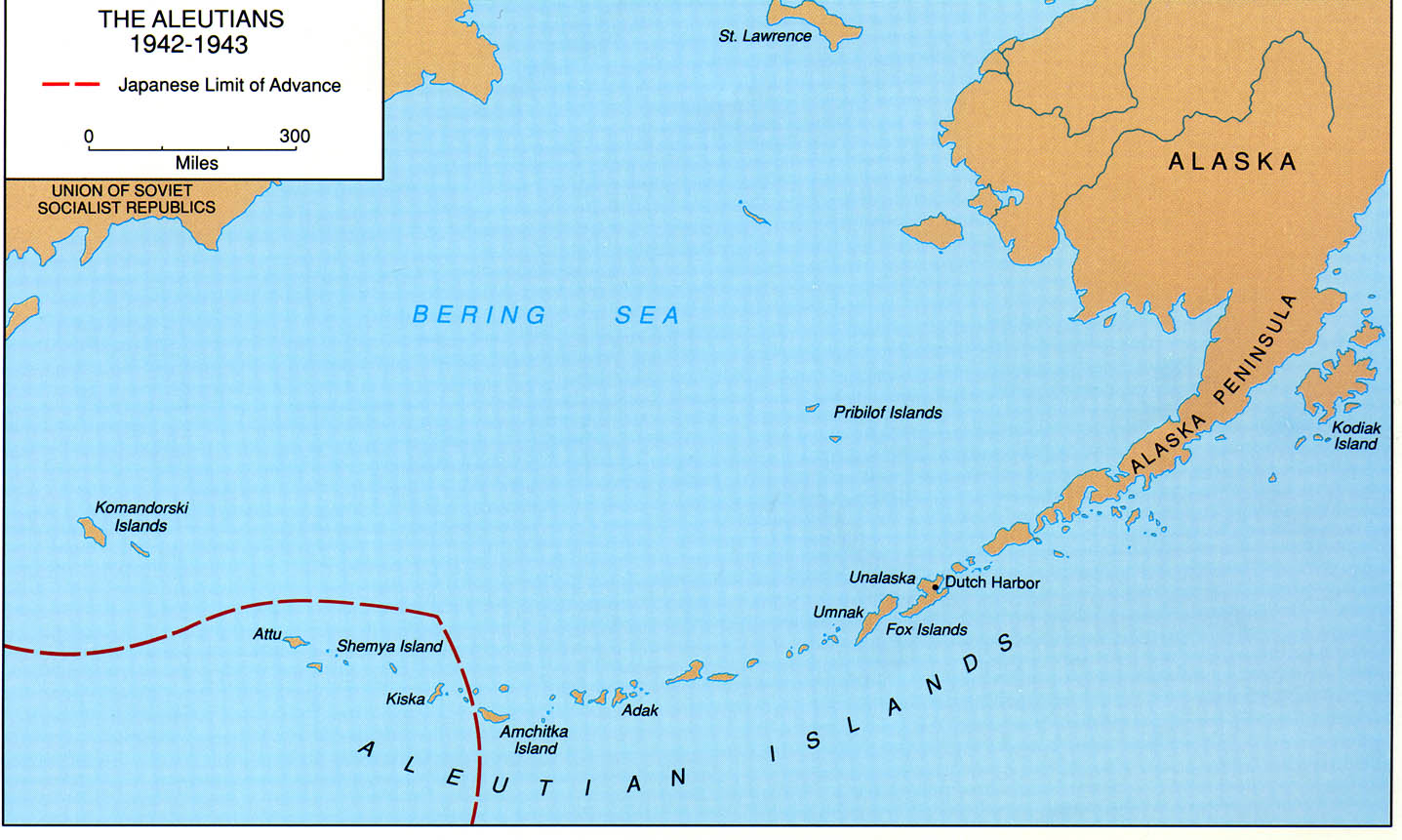
There are approximately 120 islands comprising the Aleutian chain that stretches from the tip of the Alaskan peninsula to within 90 miles of Kamchatka, Russia. The easternmost island, Unimak, is also the largest, measuring 65 by 22 miles. To the southwest is Unalaska, on the north coast of which is located Dutch Harbor. Unalaska is about 2,000 miles from both San Francisco and Honolulu. Continuing westward, in order, lie Umnak, Atka, and Adak. Kiska is 610 miles west of Dutch Harbor. Further west you will find Shemya, a small island located about 35 miles east of Attu. The Shemya landmass is only two by four miles, with the highest point being about 240 feet. Attu, the westernmost American island, is nearly 1,100 miles from the Alaskan mainland and 750 miles northeast of the northernmost of the Japanese Kurile Islands. Attu is about 20 by 35 miles, and has some fairly high mountainous terrain beginning just a short distance from its shore line, rising abruptly to altitudes of 3000 feet, and stretching through to the interior of the island. One writer of the time wrote, "Attu is the lonesomest spot this side of hell."
All the Aleutians are volcanic in origin. They are uniformly rocky and barren, with precipitous mountains (usually covered with snow) and scant vegetation. There are no trees on the islands, with the exception of a few stunted spruces at Dutch Harbor, and no brush. The lowlands are covered with a spongy tundra or muskeg as much as three feet thick, making walking very difficult. Below the tundra is volcanic ash, finely ground and water soaked to the consistency of slime. In many places water is trapped in ponds under the tundra. A man on foot may readily break through the tundra, sinking in watery mud up to his knees. Men have fallen into these bogs and have been lost. Motor vehicles, even those with caterpillar treads, quickly churn the tundra into a muddy mass in which sunken wheels and treads spin uselessly.
The Aleutians, being unsuitable for agriculture, lacking in mineral resources, and with little possibility of commercial exploitation, received only slight attention after their acquisition from Russia in 1867. A chart of the coast lines were prepared by the United States Coast and Geodetic Survey office. The Aleutian island's shorelines are jagged with submerged rock formations rendering navigation hazardous. The better anchorages, such as Dutch Harbor, are located in the easternmost islands, while the worst are located in the westernmost islands. Attu has four relatively unguarded bays...Holtz, Chichagof (the best), and Sarana on the northeast side, with Massacre Bay on the southeast side.
The Weather
Aleutian weather becomes progressively worse as you travel from the easternmost islands to the west. Attu weather is typified by cold, damp fog, often accompanied by snow or icy rain. The winds often reach velocities of more than 100 miles an hour. There are many days during the year where working outside is impossible. On Attu, five or six days a week are likely to be rainy, with hardly more than eight or ten clear days a year. The rest of the time, even if rain is not falling, fog of varying density is the rule rather than the exception. Shemya, located a short distance from Attu, suffers the same fate, but to not as great an extent due to the lack of mountainous terrain. This weather is highly localized, however, and areas of high visibility can be found within 20 miles of fog concentration! The average rainfall is around 40 to 50 inches throughout the islands, with the heaviest rains in fall and early winter.

Snow Scene Onboard Ship
Squalls, known as "williwaws," sweep down from the island's mountainous areas with great force, sometimes reaching gale proportions within 30 minutes. The mountains are concentrated on the north sides of the islands, which results in strong off-shore winds that in turn make it difficult to find a lee along the north coasts. The columns of spray and mist resulting from the williwaws frequently resemble huge waterfalls. In the winter, the williwaws can cause snow to be blown right up your pant legs, with many having observed the phenomenon of snow blowing from the ground up!
The Aleutian weather turned out to be a constant impediment to the military operations of the United States and Japan alike. Japan, however, enjoyed one advantage: the weather in this theater moves from west to east, resulting in Japan always knowing in advance the conditions which were likely to prevail in the islands.
Background
As a diversionary move in conjunction with their strike against Midway, the Japanese in June 1942 bombed Dutch Harbor in the Aleutian Island chain and landed troops on Kiska and Attu islands. Here the Japanese remained, primarily in a defensive situation, to prevent any movement by American forces toward Japan through the Aleutians.
Why Japan clung to its positions in the Aleutians after the battle of Midway is not known, but it is probable that Attu and Kiska were either going to provide the jumping-off places for future invasions of the North American continent, or merely provide advanced observation posts and defenses for the Empire. General Simon Buckner had proposed to attack Japan via a northern route, through the Aleutians, thus giving some credence to Japan's concerns about protecting their northern flank, which formulates the second reason for Japan's wanting to hold on to Kiska and Attu. A line drawn from Kiska through Attu and down to Midway Island would define Japan's eastern line of homeland defense.

It was clear to the Allied Forces that the Japanese occupation in the Aleutians provided a continuing threat to America's (and possibly Canada's) security. Any plans for Allied Forces to seize the offensive in the Central Pacific would be difficult to execute while Japan maintained flanking positions in the Aleutians. One should also consider that every day Japan's troops remained on American soil was beneficial to Japanese morale (especially after the losses incurred at the Battle of Midway), while it was deleterious to that of the American's. Perhaps this was the primary reason for what became the total blackout of news relating to events in the Aleutians...to keep the American public from becoming too overly concerned about events in Alaska that were perceived by some higher military and government authorities to be of not much importance considering the scope of WWII. Would the American public panic if they knew that Japan had actually occupied American soil at this time? Because of America's commitments elsewhere, the means of quickly resolving these issues were far from adequate.
The War In The Aleutians
Lieutenant General Hideichiro Higuda, commander of the Japanese Northern Army, said they wanted to break up any offensive action the Americans might contemplate against Japan by way of the Aleutians, to set up a barrier between the United States and Russia in the event Russia joined with the United States in its war against Japan (Russia at this time was neutral in terms of the Japanese conflict with America), and to make preparations through the construction of advanced airbases for future offensive actions.
Japan's intent was brought to light on June 3, 1942, when Japanese carrier-borne aircraft flew out of the Aleutian fog and bombed the American installations at Dutch Harbor on the island of Unalaska. There were few casualties incurred with only minor damage to the Dutch Harbor facilities. Nevertheless, WWII now became more personal to those who lived in Alaska. News of this event took an inordinate amount of time to reach Americans living on the mainland's "lower 48."

On the 6th of June, 1942, the Japanese No. 3 Special Landing Party and 500 Marines went ashore at Kiska. The Japanese captured a small American Naval Weather Detachment consisting of ten men, including a Lieutenant along with their dog. One member of the detachment escaped for 50 days. Starving, thin, and extremely cold he finally surrendered to the Japanese.
At the same time, the Japanese 301st Independent Infantry Battalion landed on Attu via Chichagof Harbor. At this time Attu's population consisted of several Blue Fox, forty-five native Aleuts, and two Americans: Charles Foster Jones, a sixty year old ham radio operator and weather observer, and his wife Etta Jones, a teacher and trained nurse. They (with the exception of the fox) all lived in a little village of frame houses around Chichagof Harbor, maintaining a precarious existence by fishing, trapping the foxes, and weaving baskets. Missionaries, as well as government patrol boats and small fishing craft, provided the inhabitants with their only direct link with the outside world...except for the small radio operated by Mr. Jones. Mr. and Mrs. Jones, having heard of the Japanese atrocities committed against the Chinese during their conquests on that continent, attempted suicide as the Japanese invasion force began their sweep of the island. While Mr. Jones was successful, his wife Etta recovered under Japanese care. [Note: There are several variations on the story relating to the Jone's fate after the Japanese invasion of Attu. One story has it that the roles were reversed with Foster Jones being the schoolteacher. Another story has it that Foster was shot by the Japanese. Additionally, other stories indicate that Foster had a cache of guns in the mountains of Attu and that he was shot as he headed for his weapons.] For a short time, the Japanese occupational forces maintained the services of the Aleut fishermen to supply them with food. As the Japanese forces became more entrenched on Attu, Mrs. Jones and the entire Aleut population of the little village of Chichagof was transported in the hold of a freighter to Hokkaido, Japan for internment. Additional information indicates that Mrs. Jones was separated from the native Aleuts and interred at Yokohama (along with U.S. Navy personnel captured by the Japanese on Kiska), while the Aleuts were interred at Otaru, Hokkaido. The Japanese garrison now had the island of Attu entirely to themselves, and began setting up defensive positions.
By the 11th of June 1942 it was evident that Japan had landed substantial forces on Kiska and Attu. The U.S. Navy's PatWing 4 (Patrol Wing 4) consisting of PBY Catalina's flying out of Atka, bombed the Japanese held positions on Kiska that same day.
On the 12th of June, 1942, the U.S. Army's 11th Air Force heavy bombers made their first run over Kiska at 1200 feet, claiming hits on two Japanese cruisers and one destroyer. One B-24 Liberator was lost to the intense anti-aircraft fire originating chiefly from the Japanese ships in the harbor.

The rusted and scorched hulk of the bombed barracks ship Northwestern is part of the Dutch Harbor scene as is the whirling snow shipped up by constant williwaw, the eccentric and unpredictable winds of the Aleutians. At the extreme left a cargo ship unloads at dock.
On the 30th of August, 1942, the allied forces captured Adak during a raging storm that prevented air cover during the assault. The first plane to land on the new Adak runway on 10 September 1942 was piloted by Col. Eareckson. This brought the Aleutian war uncomfortably closer to the Japanese occupying the islands of Kiska and Attu.
Kiska came to be regarded as the primary objective for re-conquest by American Forces. Not only was Kiska the most advanced Japanese threat to those Aleutian Islands remaining in America's possession and to the Alaskan/Canadian mainland, but it provided better potential air facilities from which to launch attacks against Japan, a more satisfactory harbor, and terrain more suitable for a base. In December, 1942 Rear Admiral F. W. Rockwell, Commander Amphibious Force Pacific Fleet was directed by CINCPAC to submit an estimate of the situation along with a plan for the reduction and occupation of Kiska. On 24 January 1943 Admiral Rockwell reported to CINCPAC that the earliest date of troop readiness would be about 1 May, 1943.
Due to a severe shortage of equipment and transport, Admiral Kinkaid recommended on 3 March 1943 that the Kiska operation be tabled for the time being, and that an attack on Attu be substituted. The Commanding General, Alaska Defense Command, Maj. Gen. Simon Buckner agreed and CINCPAC directed Admiral Rockwell to plan an operation against Attu.
The plan as it evolved was to land the 7th Division on Attu in two forces. One would land north and the other south of the enemy positions. They would then converge at the top of a peninsula which would isolate the enemy.
Thanks to FReeper SamWise for the research and idea for this thread
|
TOPICS: VetsCoR
KEYWORDS: alaska; aleutians; attu; freeperfoxhole; japan; ksika; veterans; wwii
Navigation: use the links below to view more comments.
first 1-50, 51-100, 101-148 next last
January 11th, 1943 saw the beginning of events that would place Amchitka Island in the hands of the allied forces.
January 28th, 1943 brought Jack Chennault and his squadron of P-40s to Amchitka's new airfield, with P-38s joining soon after. The 36th Bombardment Squadron also moved to Amchitka.
February 4, 1943 saw American P-40's strafing Japanese installations on Kiska, while five of Japan's bombers attacked American positions on Amchitka.

The first Japanese raid on the island of Amchitka brings forth a frantic burst of anti-aircraft fire. In this picture, a 37mm gun adjacent to the mess tent spits out a stream of lead at the invader, while his bombs explode geyser-like in the harbor.
On 11 March, 1943, CINCPAC made available three battleships, three heavy cruisers, three over-aged light cruisers, one escort carrier, nineteen destroyers, plus tenders, oilers, mine-sweepers, etc., and four attack transports. The Army commander was Commanding General 7th Division. The forces assigned Navy were Task Forces KING and ROGER. Army forces, assault, reserve, and initial occupation troops were as follows: Assault on Attu, 7th Division Combat Team, consisting of the 17th Infantry, one battalion field artillery, one battalion engineers for shore parties, one battery AA automatic weapons, three detachments 75th Special Signal Company, one company 7th Division Organic Combat Engineers, one medical collecting company, 7th Division. One Platoon 7th Division Medical Clearing Company, Detachment HQ 7th Division Battalion, detachment 7th Division Quartermaster Battalion, detachment 7th Division Organic Signal Company. For the initial occupation of the selected site in the Near Islands, 18th Combat Engineers from Adak, 4th Infantry Composite Regiment from Adak. The floating reserve was one regimental combat team consisting of the 32nd Infantry with reinforcements similar to those for the 17th Infantry indicated above. The garrisons for Attu and the selected site in the Near Islands are to be designated by the Commanding General Western Defense Command, and are to include 17th Infantry Combat Team, 32nd Infantry Combat Team, 78th CAAA and 2nd Battalion 51st CAAA. The target date is May 7th, 1943.
In early February of 1943 it was realized that since Japan knew of America's occupation of Amchitka, Japan would be taking countermeasures. There appeared to be an increase in Japanese forces and installations located at Holtz Bay and Chichagof Harbor areas of Attu. With a desire to remove the Japanese from the Aleutians, Rear Admiral McMorris's Task Group Mike was directed to isolate Attu and Kiska from Japan with a blockade formed by his seemingly inadequate fleet of old, incapable, and far too few ships, and to proceed with direct naval bombardment of these islands. Knowing he didn't have the resources to intimidate both Kiska and Attu at the same time, Adm. McMorris decided to concentrate on Attu. This way he could also blockade Japan's re-supply efforts of both Attu and Kiska. On the 18th of February the shelling of Attu began without opposition.
On March 26, 1943 Rear Admiral McMorris's Task Group Mike engaged the Japanese Northern Pacific Fleet which was attempting to re-supply the Japanese garrisons located on Attu and Kiska. This engagement, 150 miles west of Attu's Cape Wrangle, was to become known as the Battle of the Komandorskies. The defeat of the Japanese Northern Fleet by Task Group Mike ended Japan's attempts to gain a greater foothold in the Aleutians, and seemingly left the Japanese garrisons on Attu and Kiska to fend for themselves. U.S. airpower wasn't able to engage the Japanese during this skirmish as U.S. aircraft had been loaded with bombs with which to bomb Kiska. By the time the aircraft had changed-out their arsenal with weapons more suitable for naval engagements, the battle of the Komandorskies was over. This was the last pure navy fleet Vs. navy fleet battle to occur during WWII. Subsequent WWII naval engagements made heavy use of air power assisting the naval fleets to overcome the enemy. U.S. Bombers and fighters continued to bomb and strafe the islands of Kiska and Attu as the weather permitted. During March of 1943, 39 raids were made against Kiska.
On the 1st of April, 1943, a joint directive from CINCPAC and Commanding General Western Defense Command orders preparations for Operation LANDGRAB, the invasion of Attu Island.
In early April a spell of stormy weather with winds up to 108 m.p.h. grounded all planes for five days. Sixteen B-24, five B-25, and twelve P-38 sorties were ultimately flown against Kiska Island from Adak and Amchitka Islands. Antiaircraft fire damaged two bombers. During the month of April, the 73rd bombardment Squadron (Medium), 28th Composite Group with B-25s transferred from Elmendorf field, Anchorage, Alaska to Umnak Island.
On the 12th of April, 1943, 3 B-25's, 24 P-40's, and 13 P-38's flew 7 missions to Kiska. The fighters also strafe Little Kiska. AA fire damaged 1 P-40 and 1 P-38. The P-38 force-lands safely.
On the 13th of April, 1943, 15 B-24's 15 B-25's, 28 P-38's and 20 P-40's flew 11 attacks to Kiska; 43 tons of bombs were dropped. Fighters attacked the Main Camp causing large fires, and also strafed aircraft on the beach. Heavy AA fire damaged 2 P-38's, 1 of which later crashed into the sea, and 1 B-25.
The 14th of April, 1943 saw 30 P-40's 17 P-38's, 9 B-24's and 6 B-25's fly 10 missions to Kiska, bombing and strafing the runway, North Head area, installations, parked seaplanes, and facilities on Little Kiska.
The 16th of April, 1943 saw Kiska bombed and strafed 13 more times.
April 17th saw 7 B-24's bomb and score 8 direct hits on the runway and gun emplacements at Attu. One B-24 and 2 F-5A's abort due to weather. Four B-25's, 31 P-38's, and 14 P-40's hit Kiska 9 times, bombing installations and strafing gun emplacements and 3 parked airplanes.
On Sunday, April 18th, 1943 22 P-38's (some flown by Royal Canadian Air Force pilots) and 37 P-40's hit Kiska 9 times. The submarine base and gun emplacements on North Head were bombed and gun emplacements near the submarine base were silenced.
On Monday, April 19th, 1943 9 missions involving 14 B-24's, 12 B-25's, 32 P-40's, and 23 P-38's were flown to Kiska. The first mission was weathered out of the primary target, Attu, and directed to Kiska. Bombing and strafing concentrated on 4 grounded ships and the submarine base area where fires were started. One ship, believed to serve as a power station, was set on fire.
The 20th of April 1943 included 10 bombing and strafing missions by 15 B-24's, 16 B-25's, 10 P-38's, and 32 P-40's. They hit shipping in the harbor at Kiska and gun positions in North Head. Other targets included buildings in the Main Camp area and the runway.
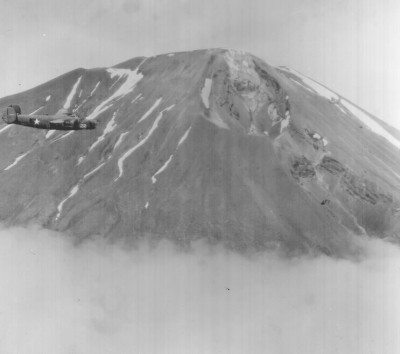
By the 21st of April Kiska had been attacked 83 times.
Strong Naval reinforcements began to reach the Aleutians for the eventual assault on Attu. On Sunday, the 25th of April 1943, another naval bombardment was conducted against Attu. There were no signs of personnel or activity ashore. A number of small buildings and huts testified to the continuing presence of the Japanese. Fifteen B-24's, 12 B-25's, 32 P-40's, 23 P-38's, and 1 F-5A fly 12 missions to Kiska and Attu. Targets included Holtz Bay, North Head, South Head, the beach areas, the runway, shipping and the submarine base.
By the end of April, 1943, Adak, now the center of Army, Air Force, and Navy operations in the Aleutians, was maintaining a garrison of 19,067 Army personnel and 7,811 Navy. At Amchitka, where there were 10,260 Army and 903 Navy personnel, a 5,000-foot bomber strip had been completed during the month. This enabled America's air power to finally begin a significant presence in the war. Many of the buildings in the Main Camp area on Kiska, as well as part of the submarine base, had been destroyed, but despite the 1,000 sorties made by American planes during April, new construction on Kiska and Attu rapidly replaced damaged structures. By the end of the April 640 tons of bombs had been dropped.
In May of 1943 American Forces completed 35 strikes in 22 days with 17 of them against Kiska, 17 against Attu, and one directed at the Rat Islands. American Forces dropped 470 tons of bombs on the two major islands with a loss of 28 planes, only three of which were known to have been destroyed by enemy action, the remainder succumbed to the weather or other mishaps.
1
posted on
02/17/2003 5:36:32 AM PST
by
SAMWolf
To: MistyCA; AntiJen; Victoria Delsoul; SassyMom; bentfeather; GatorGirl; radu; souris; SpookBrat; ...
The Invasion of Attu
The battle of Attu was essentially an infantry battle. The climate greatly limited the use of air power as the island was shrouded in fog and experienced high winds almost every day. The terrain...steep jagged crags, knifelike ridges covered with snow, boggy tundra...made the use of mechanized equipment and of all motorized vehicles impracticable. The American GI, thus reduced to moving only on foot, had to blast his way to victory with only the weapons he could carry with him. The American troops, some trained and equipped for fighting in desert climates, some totally inexperienced in combat, had found a most formidable enemy in the Japanese who were fully equipped, thoroughly acclimated, and fanatically determined to hold their strong, well chosen, defensive positions.
The Attu attack force was originally scheduled to leave Cold Bay on May 3rd, but bad weather postponed sailing until the 4th of May, 1943. D-day was re-designated to be 8 May, 1943, then, again as a result of bad weather, D-day was postponed to 9 May, 1943, then to Tuesday, 11 May, 1943.
There were numerous "firsts" experienced by the U.S. Forces in the Aleutians. The American 7th Division had embarked on the first Allied sea-borne invasion of enemy-held territory. The 7th had trained in the Mojave Desert expecting eventually to fight the Germans in North Africa. Soon after the defeat of the German Army in North Africa, the 7th began to practice amphibious landings on San Clemente Island. With their training completed and plans in place, the 7th eventually shipped out of San Francisco, destination unknown. As the ships later set a northerly bearing, heading for the Aleutians once out to sea, the GIs were finally informed of their real destination. Cold weather uniforms were then issued to the men, including leather boots that would prove useless in the wet snow and mud soon to be encountered on Attu.

A J2F-4 refuels on the airfield at Dutch Harbor preparatory to taking off. The drab supply house stands in humble contrast to the distant mountains
The arrival of American forces off Attu was uneventful. A dense fog obscured the Island and surrounding area. The 7th Scout Co. had safely landed at Beach Scarlet, located on the northern shore of Attu, from their submarine transport. The Northern Force landing took place at 1450 hrs on Beach Red. The Southern Force landings at Massacre Bay proved difficult to the extreme. Some landing craft snagged on outcroppings of rock, sank, and dragged their crews to the bottom. A few landing craft collided with each other in the fog.
The northern force followed the island's coast-line, accompanied by a small flanking scout battalion to their right. The southern force finally pushed upwards from Massacre Bay through what was named Massacre Valley. The first wave of Americans found snow running all the way down the beach. The first artillery pieces promptly sank into the tundra after being fired. Air support from the nearby CVE Nassau was eliminated by 90% cloud cover over the island. Those fighters that were able to find their way to the island more often than not strafed friendly units. A flight of F4F Wildcats attempted an attack against the Japanese defenders. As they flew through what was to become known as Jarmin Pass, a williwaw blew two of the planes against the mountain. A thick ground fog persisted to a considerable altitude that, while preventing the American invaders from seeing the Japanese defenders, provided protection for the Japanese (invisible in their white clothing) who could clearly see American troop movements below them.
The beaches quickly jammed up with supplies and bogged-down vehicles. The 7th soon realized they wouldn't be able to get their artillery or tracked vehicles across the muskeg. It was apparent the battle would have to be fought by the foot soldiers themselves. Troops in the front lines began to suffer greatly from the effects of the bitter cold. Hundreds of GIs would eventually have their feet amputated as a result of frostbite and trench foot (roughly a quarter of all casualties would be traced to frostbite). American troops, lost in the fog, walked into enemy cross-fires and would be pinned down for hours with no reasonable shelter from the cold.
The American's continued to slug it out for eight days of nearly perpetual combat as the Japanese forged a bloody withdrawal. Finally, on the 18th of May, 1943, with the added help of the "Fighting Fourth," the American northern and southern forces linked up as per the original plan objective.
Badly outnumbered and sensing possible defeat, the Japanese now killed their own wounded by injecting them with morphine. To make sure the job was completed, they then threw hand grenades into their own medical tent.
On the 28th of May, 1943, Colonel Yasuyo Yamasaki, commander of the Japanese forces on Attu, formed a plan that could possibly turn the tide of battle in favor of the Japanese. In the middle of the night he would lead his remaining force of 800 men (of an initial 2600) through a weak point in the American lines, capture an American Howitzer emplacement, then use it to pin down the Americans long enough to evacuate his surviving forces.

Seabees at Dutch harbor, Alaska
At 3:15 the following morning, Yamasaki's remaining troops took advantage of the lingering fog and managed to break through the American lines. Ten minutes later, with the artillery battery of Engineer Hill in sight, the Japanese commander ordered a Banzai attack. They killed several American patients in their field hospital and exploded a propane stove in the mess. The sleeping Americans quickly rallied their forces and threw the Japanese back into the fog after intense close combat. The failure to carry out their plan effectively destroyed the Japanese morale. Five hundred of the remaining Japanese committed mass suicide (gyokusai) with grenades held close to their stomachs, chests, and foreheads. Yamasaki attempted a final but fruitless charge later in the day with what remained of his force. During this charge he lost his own life to a .30-caliber bullet. The battle for Attu was over.
The casualties incurred during the invasion of Attu were appalling. The Americans suffered 3829 casualties, roughly 25% of the invading force, second only in proportion to Iwo Jima. Of these, 549 were killed; 1148 injured; 1200 with severe cold injuries; 614 with disease; and a remaining 318 to miscellaneous causes. On the Japanese side, 2351 men were counted by American burial parties, and hundreds more were presumed already buried. Total prisoners taken: 28 (none of whom were officers). The Japanese fought to virtually the last man.
By May 30th, 1943, unknown to the allied forces at the time, all organized Japanese Army resistance ended in the Aleutians.
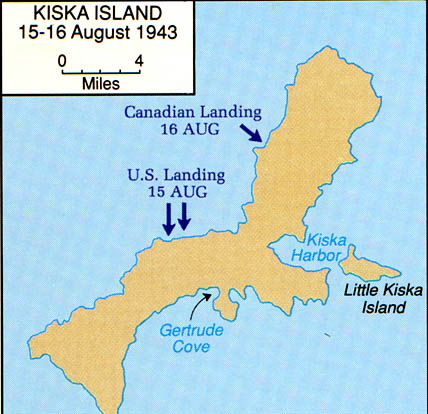
On August 15th, 1943 the allied invasion of Kiska finally began. There was no opposition to the invasion of Kiska by the US and Canadian forces as there were no Japanese troops left on the island. The Japanese had been secretly removed from Kiska by I-class submarines and surface vessels prior to the allied attack. Allied casualties during the invasion nevertheless numbered close to 200, all from friendly fire, booby traps set out by the Japanese to inflict damage on the invading allied forces, or disease. There were seventeen Americans and four Canadians killed from either friendly fire or booby traps, fifty more were wounded as a result of friendly fire or booby traps, and an additional 130 men came down with trench foot.
The Japanese were finally ejected from the Aleutians only after 15 months of arduous operations hampered by shortages afloat, ashore, and in the air...not to mention the almost insuperable obstacles of weather and terrain.
2
posted on
02/17/2003 5:37:01 AM PST
by
SAMWolf
(To look into the eyes of the wolf is to see your soul)
To: All
| 'Attu is the lonesomest spot this side of hell.' -- Anonymous |
3
posted on
02/17/2003 5:37:20 AM PST
by
SAMWolf
(To look into the eyes of the wolf is to see your soul)
To: All
The State of the Union is Strong!
Support the Commander in Chief
Click Here to Send a Message to the opposition!
4
posted on
02/17/2003 5:37:41 AM PST
by
SAMWolf
(To look into the eyes of the wolf is to see your soul)
To: All

Thanks, Doughty!
5
posted on
02/17/2003 5:38:09 AM PST
by
SAMWolf
(To look into the eyes of the wolf is to see your soul)
To: All
Good Morning Everybody.
Coffee and Donuts
Courtesy of Fiddlstix.
6
posted on
02/17/2003 5:38:30 AM PST
by
SAMWolf
(To look into the eyes of the wolf is to see your soul)
To: SAMWolf
Good Morning SAM
To: SAMWolf
Happy Presidents Day.
Thanks for the thread today. We have studied the history of the Aleutians in our school this year. I will try to have Ally take a look at this later in the day.
The school bell rings.....have a good day everyone.
8
posted on
02/17/2003 6:04:28 AM PST
by
SpookBrat
To: SAMWolf; Fiddlstix
Good Morning, SAM. Thanks to you and Fiddlstix for the coffee...
It really hits the spot after spending 15 minutes in the Aleutians!
What a miserable place to spend a war...
9
posted on
02/17/2003 6:06:24 AM PST
by
HiJinx
To: HiJinx; AntiJen; MistyCA; Victoria Delsoul

<===Mash This
10
posted on
02/17/2003 6:33:44 AM PST
by
SAMWolf
(To look into the eyes of the wolf is to see your soul)
To: HiJinx
There's never a good place to spend a war, some are just worse than others.
11
posted on
02/17/2003 6:34:32 AM PST
by
SAMWolf
(To look into the eyes of the wolf is to see your soul)
To: SpookBrat
Morning Spooky. I'm sure Ally will be thrilled having to read this. LOL!
12
posted on
02/17/2003 6:36:05 AM PST
by
SAMWolf
(To look into the eyes of the wolf is to see your soul)
Comment #13 Removed by Moderator
To: coteblanche
Good Morning, Cote.
You found a good shot of a PBY to go with it.
14
posted on
02/17/2003 6:53:06 AM PST
by
SAMWolf
(To look into the eyes of the wolf is to see your soul)
To: coteblanche

Battle of the Komandorski (Comodore) Islands, 26 March 1943: Salt Lake City in action laying the smoke screen during the battle, with an enemy salvo landing astern. She was called "Swayback Maru" by her crew.
15
posted on
02/17/2003 7:19:04 AM PST
by
SAMWolf
(To look into the eyes of the wolf is to see your soul)
To: coteblanche
Oh and since I know you're gonna ask:
When the war began, the cruiser "Salt Lake City" was already an old lady of a ship, two years from replacement date, and a rather disreputable old lady at that. She was at the bottom of the fleet in gunnery and ninth in engineering efficiency, had weak armor, a reputation for being a hazard to other ships because she steered so wildly and a crew that didn't seem to care whether school kept or not. But when the time came to put the heat on the Japs, she poured it all over them. She became known as "the one-ship fleet" because she conducted a personal feud with a Jap base and almost single-handed fought one of the decisive battles of the war. She killed more Japs and fought more actions than any other cruiser. This is the story of how the old lady turned into a tiger.
"Slick City", her crew used to call her, but she was the "Swayback Maru" to the rest of the fleet and before the war they used to laugh at her. There was reason to laugh. She was one of the first pair of cruisers built after the Washington Treaty, and a good deal of a comic compared with the sleek vessels that came later. When she was designed, American shipbuilders were faced with the problem of restricted tonnage, which they had never met before. They saved weight by cutting her armor belt down to a patch amidships and giving even that a thickness that would hardly have been adequate for a light cruiser; by omitting the upper deck to leave a long well amidships that gave her a swaybacked look; by placing her ten big guns three over two, fore and aft; and by cutting down on things inboard.
The results were that every time the "Salt Lake City" rolled, water went tearing through that well deck, the ventilation was never good and gunnery officers nearly went mad trying to synchronize the firing of two different types of turret. On top of that her steering gear behaved in the most unpredictable manner, and other ships hated to be in column behind her. The weakness of her protection did not show up until she began fighting, but the command knew about it and knew how inferior she was to the Japanese cruisers built at the same time---the famous "cheating cruisers" that were built by setting the 10,000 ton figure down on a piece of paper, then building a ship nearly half again as large.
16
posted on
02/17/2003 7:23:23 AM PST
by
SAMWolf
(To look into the eyes of the wolf is to see your soul)
Comment #17 Removed by Moderator
To: coteblanche
Yep, it was our friends from the First Special Service Force
18
posted on
02/17/2003 8:03:47 AM PST
by
SAMWolf
(To look into the eyes of the wolf is to see your soul)
To: coteblanche
Private Henri Richard
Kiska, Alaska
June 1943 - January 1944
The Japanese attacked and occupied Attu and Kiska Alaska on 7 Jun 42. During the Spring of 1943 it was decided by the Canadian government to send a force in the recovery of these islands. A force was to be assigned to assist the Americans in their assault on Kiska, scheduled for September 1943.
By 2 Jun 43 the basic order of battle was decided. The 13th Canadian Infantry Brigade would consist of the Winnipeg Grenadiers, the Rocky Mountain Rangers and the Canadian Fusiliers. Other formations consisted of Twenty Fourth Field Regiment (Royal Canadian Artillery), The Twenty Fourth Field Company (Royal Canadian Engineers), a machine gun company from the Saint John Fusiliers and various service detachments. The brigade would be called GREENLIGHT FORCE.
Private Henri Richard wasn't initially a member of GREENLIGHT FORCE. He had been assigned to the Midland Regiment in Terrace, BC, where the army was busy building an airfield. But on 7 Jun 43 it was decided that any soldier who had been enlisted after 15 Feb 43 was too "fresh" to fight a seasoned and dug in enemy on Kiska. Due to this ruling the Winnipeg Grenadiers lost 52 men, but gained 196 new soldiers, including Private Henri Richard who was transferred to the regiment on 8 Jun 43.
At this point events happened particularly fast for Henri. The assault was initially scheduled for September, but now it was moved ahead to August. Also, once soldiers arrived in Courtenay, BC, a rigorous training regime was put in place. This training was designed to prepare them for the peculiar conditions they would face on Kiska Island. They had to prepared to run up mountains and fight in biting cold winds. All members of the force had to be in top-notch physical shape.
On 12 Jul 43 the brigade boarded four US transport ships in the ports of Nanaimo and Chemainus and headed north for Adak, Alaska. At this time a total of 165 men were reported absent without leave. Pacific Command attributed these absences were due to "a feeling of discourse among the men". This was created when within the space of a month, or less, about one third of existing personnel were shuffled from one unit to another.
The force arrived in Adak on 21 Jul 43. While on Adak, GREENLIGHT FORCE troops were kept busy with marches (physical training) and individual and sub-unit training, the latter emphasizing battle drill and patrolling tactics. The high point of the training was an amphibious landing exercise held on Great Sitkin Island during the first week of August. General Buckner and Rear Admiral Thomas C. Kincaid, the US Navy's senior officer in Alaska, both expressed favorable opinions about the appearance and bearing of the Canadians.
While on Adak, GREENLIGHT FORCE was also issued American environmental clothing (parkas), medical supplies and assigned American vehicles, though few vehicles would be used in the mountainous terrain of Kiska.
On 13 August the transport ships departed from Adak for Kiska, and were accompanied later by the US navy ships Pennsylvania, Idaho, Tennessee, Santa Fe andtheir escorts. Prior to the landing, a heavy bombardment of Kiska was undertaken from both the air and the sea. On the day of the invasion, the landing plan was to provide a bombardment and feint landing on the south side of the island, then complete the real landings on the west and northwest sides on the 15th and 16th of August.
GREENLIGHT FORCE landed upon a rocky beach on the northwest side of Kiska on 16 Aug 43, a day after the American troops landed further south. The brigade was to move inland as quickly as possible as they
sought an enemy believed to have withdrawn into the hills. The Canadians followed a ravine up into the hills, cautiously approaching two nearby gun emplacements and several machine gun nests, all of which were luckily unmanned. Despite heavy fog all troops reached and surpassed their initial goals. Of course no enemy was to be found. The only thing there was a friendly dog left behind by the Japanese.
There were many who thought that the Japanese were in every cave and behind every rock in these days of the invasion. American forces reported contact with Japanese riflemen in the fog and wild shooting took place. Of the Americans 28 soldiers were dead and another 50 wounded after the first two days on the island. Only 4 of the dead and several of the wounded were actually of the result of Japanese mines and booby traps. The Canadians meanwhile, accounted for 4 dead and another 4 wounded, all the cause of Japanese munitions. (There is another source which does indicate that one of the Canadian wounded was the cause of "unidentified machine gun fire.")
Stories of caves found with coffee pots "still hot" and in Henri's case, a story of "bowls of rice still warm on the table" were later discovered to be a case of a soldier's imagination acting up and regimental rumors running rampant. Once the war ended it was finally discovered that all Japanese forces had been taken off the Island a full three weeks prior to the landing. It is believed that the main Japanese evacuation took place on or about 28 July. The departure had taken 1 hour and was done in dense fog, a feat within itself, although the Japanese force did leave most of their weapons and equipment behind.
Many soldiers expressed regret that the Japanese weren't there. In one report it was stated "When we got there, the cupboard was bare." Deep down though there was a sigh of relief. Of the 5300 Canadian men that were sent to Kiska, it was initially expected that 1800 would be casualties.
The GREENLIGHT FORCE remained on Kiska as a garrison for more than 3 months, living in "winterized" tents, and engaged in road and pier construction and other general duties. Fog, rain and wind made the island an unpleasant place at the best of times. The Canadian troops finally started to come home in November 1943.
Henri was one of the last to leave Kiska, on or near 7 Jan 44. He arrived home in St. Genevieve, MB, in the middle of a cold January 1944 night to the surprise of his family. It was then that Henri astonished his family with stories of Kiska and told them of the army life that he grown accustomed to.
Note for clarification purposes: Another Canadian Force participated in he Kiska Invasion. The First Special Service Force, made up of Canadian and American (40/60% ratio) troops, was not related in any way to the GREENLIGHT
19
posted on
02/17/2003 8:14:13 AM PST
by
SAMWolf
(To look into the eyes of the wolf is to see your soul)
To: SAMWolf
This is one of the most interesting campaigns in the history of warfare -- the conditions extreme, not only in physical conditions but pyschological as well. The infantry in rows of pup tents and not much else suffered from extreme boredom. PT boats were brought, for some months, into this theater ... the bad seas and high waves proved impossible for them -- but one can hardly imagine the difficulty of serving on such a small boat in such choppy seas and bitterly cold, high-wind blizzards of weather.
Some very important advancements were developed there -- especially the managment of logistics in beach landings -- later applied in all the allied landings in Africa, Europe and the Pacific, "timing patterns" -- that phrase we now use in football, came orginially from the necessity of flying blind on bombing runs, using only the clock, a constant airspeeed, and a heading. Radar was hardy born yet.
20
posted on
02/17/2003 8:14:53 AM PST
by
bvw
To: bvw
I can't imagine conducting a campaign in the conditions found in the Aluetians. Just the logistics had to be a nightmare.
21
posted on
02/17/2003 8:33:09 AM PST
by
SAMWolf
(To look into the eyes of the wolf is to see your soul)
To: SAMWolf
To: top of the world ma
Good Morning, top of the world ma. Good to see you.
I remember hearing about bomber 31. Didn't see the documentary though. Thanks for the link.
23
posted on
02/17/2003 8:36:49 AM PST
by
SAMWolf
(To look into the eyes of the wolf is to see your soul)
To: SAMWolf
On This Day In History
Birthdates which occurred on February 17:
1444 Rudolf Agricola [Roelof Huysman], Dutch humanist/organist
1490 Charles de Bourbon officer/governor (Lombardy)
1519 François de Guise [Balafré], French general strategist (Calais)
1583 J Henry Alting Dutch theologist
1653 Arcangelo Corelli Fusignano Italy, violinist/composer (Concerto Grosso)
1667 Georg Bronner composer
1675 Johann Melchior Conradi composer
1696 Baron Ernst Gottlieb composer
1697 Louis-Maurice de La Pierre composer
1699 Hans Georg Wenzeslaus von Knobelsdorff German architect (Sanssouci)
1723 Tobias Mayer "method of lunars" for longitude determination
1740 Horace B de Saussure Swiss physicist/geologist
1747 Narciso Casanovas composer
1752 Friedrich M Klinger German playwright (Wirrwarr)
1754 Jan Jachym Kopriva composer
1758 John Pinkerton Scottish historian
1774 Raphaelle Peale US, painter (After the Rain-1823)
1781 René-Théophile-Hyacinthe Laënnec France, inventor (stethoscope)
1796 Giovanni Pacini composer
1804 Samuel Read Anderson Brigadier General (Confederate Army), died in 1883
1816 Friedrich Wilhelm Markull composer
1817 Frederick Douglass famous African-American
1820 Henri Vieuxtemps Verviers Belgium, composer/teacher (Brussels Cons)
1824 William Farrar "Baldy" Smith Major General (Union volunteers), died in 1903
1831 Francisco Salvador Daniel composer
1837 Francis Jay Herron Major General (Union volunteers), died in 1902
1837 Sam[uel] van Houten Dutch (Liberal) minister (child labor laws)
1844 A Montgomery Ward founded mail-order business (Montgomery Ward)
1849 Selwyn Image Bodiam Sussex, painter
1850 Anton Urspruch composer
1850 Ludwig Bonvin composer
1853 Jaroslav Vrchlicky [Emil Frída], Czechoslovakian poet (1 night on Karlstein)
1854 Friedrich A Krupp German arms manufacturer
1855 Otto Liman von Sanders German general in Turkey (WWI)
1857 Samuel Sidney McClure Irish-American newspaper editor/publisher
1858 Ernest Ford composer
1862 Edward German (Jones) Whitchurch Shropshire, British composer
1862 Mori Ogai [Mori Rintarô) Japanese author (Maihime/Gan)
1864 Andrew Barton "Banjo" Paterson New South Wales Australia, poet (Waltzing Matilda)
1867 William Cadbury England, chocolate manufacturer (Cadbury)
1870 Louis de Raet Belgian economist/founder (Flemish People's Party)
1874 Thomas J Watson Sr US, representative/founder (IBM)
1877 Henri Vandeputte Belgian author/poet (L'homme Jeune)
1879 Dorothy Canfield Fisher US, novelist (Book-of-the Month-Club)
1880 Alvaro Obregon General/President of Mexico (1920-24)
1882 Kurt Schindler composer
1882 Noah Beery Smithville AR, actor (Story of Esther, Mark of Zorro)
1884 Arthur Vanderpoorten Flemish minister of Internal affairs (1940)
1887 Leevi Antti Madetoja composer
1888 Henrietta P "Hetty" Beck actress (Bouwmeester Award)
1888 Otto Stern German/US physicist (Stern-Gerlach-experiment, Nobel 1943)
1888 Ronald Aburthnott Knox English priest/writer (Viaduct Murder)
1889 H[aroldson] L Hunt Texas oil multi-millionaire
1891 Georg Britting writer
1892 Theodor Plievier German writer (Des Kaisers Kulis, Stalingrad)
1895 Anita Stewart New York, actress (South of Hell Mountain)
1895 Edna Park Edwards PA
1897 Johan[nes A] Kaart Dutch actor/stage manager (My Fair Lady)
1898 Tom Lowry cricketer (New Zealand batsman in seven Tests & their 1st Test captain)
19-- Christine Pickles Yorkshire England, actress (Helen-St Elsewhere)
1902 Marian Anderson Philadelphia PA, operatic contralto (banned by D A R)
1903 Johannes Linthorst Homan director of the queen in Groningen
1904 Albert Kuyle [Louis Kuitenbrouwer], Dutch writer (Jesus' Robe)
1906 Galo Plaza Lasso President of Ecuador (1948-52), head of OAS (1968-75)
1906 Ramon Tapales composer
1907 Alec Wilder Rochester NY, composer (1973 ASCAP award)
1907 Charles B Timmer Dutch translator/writer (Russia Black on White)
1908 Walter L "Red" Barber Mississippi, sports announcer (Brooklyn Dodgers, New York Yankees)
1908 Staats Cotsworth Oak Park IL, actor (Peyton Place)
1909 Marjorie Lawrence Australia, soprano (Venus-Tannhäuser)
1909 Joseph "Poeske" Scherens Belgian cyclist (champion sprinter 1932-37)
1910 Ai Qing poet
1910 Marc Lawrence New York NY, actor (Man With Golden Gun)
1911 Arthur Hunnicutt Gravelly AR, actor (Big Sky, Apache Uprising)
1912 Andre [Alice Mary] Norton Cleveland OH, science fiction writer (Beast Master, Stand & Deliver)
1913 Joséphine F "Fietje" van Anrooy Dutch actress/director
1913 Oskar Danon composer
1913 Rene Leibowitz composer
1914 Arthur Kennedy Worcester MA, actor (Fantastic Voyage, Peyton Place)
1914 [Bert de] Wayne Morris Los Angeles CA, WWII-pilot/actor (Paths of Glory)
1914 Albert Westerlinck [José J M Aerts], Flemish literary
1914 Per-Jakez Helias writer/teacher
1915 Homer Keller composer
1916 Don Tallon cricketer (perhaps Australia's greatest wicket-keeper)
1916 Raf Vallone Tropea Italy, actor (El Cid, 2 Women, Greek Tycoon)
1918 Charles A Hayes (Representative-D-IL, 1983- )
1918 Olive Gibbs peace campaigner
1919 Kathleen Freeman Chicago IL, actress (Beverly Hillbillies)
1919 Jock Mahoney Chicago IL, actor (Dallas, Yancy Derringer, Day of Fury)
1919 Joseph R Hunt tennis champion (US Open-1943)
1920 Colin Franklin doctor
1920 Paul Fetler composer
1920 Trevor Oswald Ling religious studies professor
1922 Tommy Edwards rock vocalist (It's All in the Game)
1923 Alden Winship Clausen Hamilton IL, banker (President of World Bank)
1924 Margaret Truman Missouri, president's daughter/writer (Murder at FBI)/pianist
1925 Hal Holbrook Cleveland OH, actor (All the President's Men, Mark Twain)
1925 Fritz Behrendt German/Dutch cartoon character (The Slogan)
1926 Lee Hoiby Madison Wisconsin, composer (1957 Arts & Letters)
1926 Friedrich Cerha composer
1929 Chaim Potok New York NY, novelist (The Promise)
1929 Yasser Arafat PLO-leader (Achille Lauro, Nobel 1994)
1930 Usko Merilainen composer
1932 Buck Trent Spartanburg SC, banjoist/singer (Hee Haw)
1933 Bobby Lewis rocker (Tossin' & Turnin')
1933 Craig Thomas (Representative-R-WY)
1934 Alan Bates Allestree England, actor (Zorba the Greek, Unmarried Woman)
1934 Barry Humphries Australia TV host (Dame Edna Everage)
1934 Buddy Ryan NFL coach (Philadelphia Eagles, Phoenix Cardinals)
1935 Johnny Bush country singer
1936 Barry Jarman cricketer (Australian wicket-keeper in 60's)
1936 Jim Brown Georgia, NFL full back (Cleveland Browns)/actor (Dirty Dozen)
1936 Peter Walker cricket all-rounder (Glamorgan did little for England 1960)
1937 Mickey McGill US vocalist (Dells-Love is Blue)
1938 Mary Frances Berry educator/head (US Commission on Civil Rights)
1939 Mary Ann Mobley Biloxi MS, Miss America-1959/actress (Diff'rent Strokes)
1940 Dennis Gamsy cricketer (South African bat in 2 Tests vs Australia 1970)
1941 Heidi Biebi German Federal Republic, downhill skier (Olympics-gold-1960)
1941 Gene Pitney Hartford CT, singer/songwriter (Town Without Pity)
1942 Huey Newton Black Panther leader
1944 Bernie Grant British politician (Labour)
1945 Patricia Morrow actress (Rita-Peyton Place)
1945 Brenda Fricker Dublin Ireland, actress (My Left Foot)
1945 Willie J L Swildens-Rozendal Dutch MP (PvdA)
1946 André Dussollier Annecy France, actor (3 Men & a Cradle)
1946 Valdemar Bandolowski Denmark, yachting (Olympics-gold-1976, 80)
1946 Zina Bethune New York NY, actress (Nurses, Who's That Knocking at My Door)
1947 Ben Cramer Dutch vocalist (Clown)
1947 Dallas Adams British actor/painter/writer (Terror From Within)
1947 Dodie Stevens [Geraldine Ann Pasquale] Chicago IL, actress (Mary Hartman!)
1949 Fred Frith English guitarist/violinist/bassist (Skeleton Crew)
1950 Rick Medlocke rock guitarist/vocalist (Blackfoot)
1952 Guillermo Vilas tennis player (1977 US Open)
1952 Insook Bhushan Seoul Korea, US US table tennis player (Olympics-92)
1953 Janice Dickinson Brooklyn NY, model (Vogue)
1954 Rene Russo actress (Ransom)
1958 Heidi Hagman actress (Linda-Archie Bunker's Place)
1958 Karen Lende O'Connor Concord MA, equestrian 3-day (Olympics-silver-96)
1959 Ambrose "Rowdy" Gaines US, 100 meter swimmer (Olympics-gold-1984)
1959 Daniel Ray "Danny" Ainge basketball & football star
1959 Richard Karn Seattle WA, actor (Al-Home Improvement)
1961 Deb[ra] Richardson Minneapolis MN, beach volleyballer (Olympics-96)
1961 Guy McIntyre NFL guard (Philadelphia Eagles)
1962 David McComb Australia, vocalist/songwriter (Triffids)
1962 Hennie Meijer soccer player (Cambuur L, FC Heerenveen)
1962 Lou Diamond Phillips Philippines, actor (La Bamba, Stand & Deliver)
1962 Tony Blain cricketer (New Zealand Test wicket-keeper)
1963 Michael "Air" Jordan Brooklyn NY, NBA guard/forward (Chicago Bulls)
1963 Dan Reed rocker/actor (HOTS, Lake Consequence)
1964 Mike Campbell Seattle WA, pitcher (Chicago Cubs)
1965 Clayton Prince Philadelphia PA, actor (Dark Justice, Reuben-Another World)
1965 Jim Bowie Japanese/US baseball infielder (Oakland Athletics)
1966 Melissa Brooke-Belland rocker (Voice of the Beehive-Let it Bee)
1966 Luc Robitaille Montréal, NHL left wing (New York Rangers, Pittsburgh Penguins)
1967 Gary Shuchuk Edmonton, NHL center (Los Angeles Kings)
1967 Michelle Forbes Austin TX, actress (Ensign Ro-Star Trek Next Generation)
1968 Bryan Cox NFL linebacker (Miami Dolphins, Chicago Bears)
1968 Celita Schutz Riverdale NJ, half-middleweight judoka (Olympics-96)
1968 Patrick Uterwijk pop guitarist (Pestilence, Consuming Impulse)
1969 David Klingler NFL quarterback (Oakland Raiders, Cincinnati Bengals)
1969 Joel Steed NFL nose tackle (Pittsburgh Steelers)
1969 Levon Kirkland NFL linebacker (Pittsburgh Steelers)
1969 Traci Adell New Orleans LA, playmate (July, 1994)
1970 Tommy Moe Anchorage AK, nordic skier (Olympics-gold/silver-1994)
1972 Billie Joe Armstrong singer/musician (Green Day)
1972 Lloy Ball Ft Wayne IN, volleyball setter (Olympics-96)
1972 Richard MacQuire Melbourne VIC Australia, canoeist (Olympics-96)
1972 Stephen Robinson Arlington VA, rower (Olympics-1996)
1972 Tony Lawson NSA Australia, diver (Olympics-96)
1972 Vladimir Vujtek NHL forward (Team Czechoslovakia Olympics-gold-1998, Tampa Bay)
1972 William Floyd full back (San Francisco 49ers)
1973 Chris Robinson NBA guard (Vancouver Grizzlies)
1973 Drew Barry NBA guard (Atlanta Hawks)
1973 Frank Sanders NFL wide receiver (Arizona Cardinals)
1973 Raymond Jackson NFL defensive back (Buffalo Bills)
1974 Jerry O'Connell New York NY, actor (Scream 2, Sliders, Andrew Clements-My Secret Identity)
1974 Valeria Mazza Rosario Argentina, model (Cosmopolitan-July 1995)
1975 Sung-Hee Park Pusan Korea, tennis star (1993 Futures-Seoul)
1975 Todd Harvey Hamilton, NHL center (Dallas Stars)
1975 Vaclav Prospal NHL forward (Team Czechoslovakia Olympics-gold-1998, Philadelphia)
1980 Shanyn MacEachern Brampton Ontario, gymnast (Olympics-96)
1981 Donielle Thompson Wheatridge CO, gymnast (World-bronze-95, Olympics-96)
1981 Lisa Skinner Queensland Australia, gymnast (Olympics-96)
1982 Joseph Gordon-Levitt actor (Tommy Solomon-Third Rock From the Sun)
Deaths which occurred on February 17:
0364 Flavius Jovianus Christian emperor of Rome (363-64), dies at about 32
0956 Hugo the Great earl of Paris/duke of Francia, dies at about 55
1600 Giordano Bruno advocate of Copernican theory & plurality of worlds, burned at stake by the Inquisition in Rome
1612 Ernst of Bayern prince/bishop of Luik/archbishop of Cologne, dies at 57
1612 Jodocus Hondius Flemish cartoonist/mathematician, dies at 48
1652 Gregorio Allegri Italian singer/composer (Miserere), dies at about 67
1654 Michael Lohr composer, dies at 62
1673 Jean Baptiste Poquelin French author & dramatist, dies
1673 Molière [Jean Baptiste Poquelin] French playwright (Learned Lady), dies in Paris at 51
1688 Reverend James Renwick hanged in Scotland for being a Presbyterian
1715 Antoine Galland French interpreter, dies at 68
1732 Louis Marchand composer, dies at 63
1796 James Macpherson poet, dies
1803 Louis R E prince de Rohan-Guémené archbishop of Straatsburg, dies at 68
1804 Christian Ernst Graf composer, dies at 80
1815 Franz Gotz composer, dies at 59
1827 Johann Heinrich Pestalozzi Swiss educator, dies at 81
1841 Ferdinando Carulli composer, dies at 70
1847 William Collins landscape painter, dies
1852 Micha Joseph Levenson Hebrew poet, dies
1854 Hugues F R de Lamennais French priest/writer, dies at 71
1856 Heinrich Heine German poet, dies at 58 in Paris
1856 John Braham singer/composer, dies at 81
1874 [Lambert] Adolphe J Quetelet Belgian astronomer/sociologist, dies at 77
1875 Luís Varela Brazilian romantic poet, dies at 33
1878 José Amador de los Ríos Spanish historian/poet, dies at 59
1883 Napoleon Coste composer, dies at 76
1901 Ethelbert Woodbridge Nevin composer, dies at 38
1903 Joseph Parry composer, dies at 61
1905 Serge Alexandrovich Governor-General Moscow, murdered
1907 Henry Steel Olcott US co-founder (Theosophist Society-Madras), dies at 74
1908 Geronimo Apache chief, dies at about 79
1912 Aloys von Aerenthal foreign minister (Austria-Hungary), dies at 57
1912 L Oates British explorer (Antarctica), dies
1917 Edmund Bishop English Secretary of Thomas Carlyle, dies at 70
1918 Wilfrid Laurier Canadian PM (1896-1911), dies
1924 Oskar Merikanto composer, dies at 55
1929 John Read cricketer (batted in 17 Tests for England for 463 runs), dies
1932 Frans Gailliard Belgian painter/graphic artist (Egina), dies at 70
1933 Henri[cus A] Viotta Dutch composer (Handbook of Music), dies at 84
1934 Albert I LCMM von Saksen-Coburg king of Belgium (1909-34), dies at 58
1936 Erich Schaeder German theologist (Theozentrische), dies at 74
1944 Fausto Agnelli Swiss painter, dies at 64
1951 Nikoghayos Fadeyi Tigranyan composer, dies at 94
1954 Evert Gorter children's artist (Kindergeneeskunde), dies at 72
1955 Otto J Gombosi Hungarian/US musicologist, dies at 52
1959 Tim Mara co-founder of NFL's New York Giants, dies
1959 Kathryn Adams actress (Meet the Chump, 5th Avenue Girl), dies
1961 Nita Naldi actress (Dr Jekyll & Mr Hyde), dies of heart attack at 63
1962 Joseph Kearns actor (George-Dennis the Menace), dies at 55
1962 Bruno Walter symphony conductor (New York Philharmonic), dies at 85
1966 Frank Pettingell actor (Becket, Up the Creek), dies at 75
1966 Gail Kane actress (White Sister, Arizona), dies at 81
1966 Hans Hofmann German/US painter (Search for the Real), dies at 85
1968 Donald Wolfit actor (Lawrence of Arabia), dies of heart ailment at 65
1970 Agnon [SJ Czaczkes], Hebrew writer (Nobel 1966), dies at 81
1970 Alfred Newman US composer, dies at 69
1970 Schmuel J Agnon novelist (Nobel 1966), dies
1971 Teddy Hart actor (3 Men on a Horse), dies at 73
1972 Gavril Nikolayevich Popov composer, dies at 67
1972 Shunryu Suzuki Roshi founder (San Francisco Zen Center), ½ ashes buried
1976 Jean Servais Belgian actor (Every Man is My Enemy), dies at 65
1976 Johan[nes A] Card actor/stage manager (My Fair Lady), dies at 78
1977 Quincy Howe newscaster (CBS Weekend News), dies at 76
1979 William Gargan actor (Rain, Bells of St Mary), dies at 73
1980 Jerry Fielding orchestra leader (Bewitched, Hogan's Heroes, Lively Ones), dies at 57
1980 Graham Sutherland painter, dies
1982 Lee [Israel] Strasberg father of method acting/actor (And Justice for All), dies of a heart attack at 80
1982 Theolonious S Monk US, jazz pianist/composer (Blue Monk), dies at 64
1984 Lucille Benson actress (Lilly-Bosom Buddies), dies at 69
1985 Wanda Perry actress (Roberta, Death of a Salesman), dies at 67
1986 Jiddu Krishnamurti Indian philosopher (Kingdom Happiness), dies at 90
1986 Paul Stewart actor (Opening Night, In Cold Blood, Window), dies
1987 Hal K Dawson actor (Another Language, Wells Fargo), dies
1987 Verree Teasdale actress (Skyscraper Souls), dies
1989 Lefty Gomez New York Yankee pitching great, dies at 80
1990 Erik Rhodes actor (Top Hat), dies of pneumonia at 84
1990 Frans Kellendonk Dutch writer (Good for Nothing), dies at 39
1990 Keith Haring US graffiti-artist, dies at 31
1990 Marc Clement actor (Career Opportunities, Sluggers Wife), dies
1991 Enrique Bermudez commandant (Contra), dies
1993 Alfredo de Leon leader (Philippines Red Scorpio Gang), killed
1993 George E Wilburn film editor, dies of emphysema at 77
1993 Leslie Townsend cricket all-rounder (England in 4 Tests 1930-34), dies
1994 Randy Shilts US journalist (And the band played on), dies of AIDs at 41
1995 Jan Bart Klaster music editor (The Slogan), dies at 50
1995 Thelma Hulbert painter, dies at 81
1995 Timothy Hugh Brown theatre critic, dies at 52
1995 Uta Graf singer/teacher, dies at 80
1996 [Elsie] Evelyn Laye actress/singer (Sun Child), dies at 95
1996 Bentley Bridgewater British Museum secretary, dies at 84
1996 Henry Guinness missionary, dies at 87
1996 Jean Writer-Pierre Herve Bazin dies at 84
1996 Michael Raptis writer/revolutionary, dies at 84
1998 Ernst Juenger German writer, dies at 102
On this day...
1370 Battle at Rudau Germany beats Lithuania
1568 Holy Roman Emperor agrees to pay annual tribute to Sultan for peace
1598 Boris Godunov chosen tsar of Russia
1621 Miles Standish appointed 1st commander of Plymouth colony
1634 William Prynne tried in Star Chamber for publishing "Histriomastix"
1670 France & Bavaria sign military assistance treaty
1676 Kings Charles II & Louis XIV sign secret treaty
1691 Thomas Neale granted British patent for American postal service
1714 Parliament of Paris accepts Pope Clemens XI's "Unigenitus" degree
1772 1st partition of Poland-Russia & Prussia, joined later by Austria
1776 1st volume of Gibbon's "Decline & Fall of the Roman Empire" published
1791 Messier catalogs M83 (spiral galaxy in Hydra)
1795 Thomas Seddal harvests 8.3-kg potato from his garden Chester, England
1801 House breaks electoral college tie, chooses Jefferson President over Burr
1817 1st US city lit by gas (Baltimore)
1818 Baron Karl von Drais de Sauerbrun patents "draisine" (early bicycle)
1836 HMS Beagle/Charles Darwin leaves Tasmania
1841 Dutch ex-king Willem I marries Henriette d'Oultremont de Wégimont
1848 Toscane gets liberal Constitution
1854 British recognize independence of Orange Free State (South Africa)
1859 Giuseppe Verdi's opera "Un Ballo in maschera" premieres at the Apollo Theatre in Rome
1864 Confederate sub "HL Hunley" sinks Union ship "Housatonic" (1st submarine to sink an enemy ship)
1865 Columbia SC burns down during the Civil War
1865 Battle of Charleston SC
1867 1st ship passes through Suez Canal
1867 Gyula Andressy becomes premier of Hungary
1870 Mississippi becomes 9th state re-admitted to US after Civil War
1870 Esther Morris appointed 1st female judge
1876 Sardines 1st canned (Julius Wolff-Eastport ME)
1878 1st telephone exchange in San Francisco opens with 18 phones
1880 Tsar Alexander II of Russia survives an assassination attempt
1882 1st Test Cricket match played at Sydney Cricket Ground
1883 A Ashwell patents free-toilet in London
1885 Bismarck gives Carl Peters' firm management of East-Africa
1896 London Country Councils' Muzzling Order becomes effective
1897 National Congress of Parents & Teachers (PTA) organizes (Washington DC)
1904 Giacomo Puccini's opera "Madama Butterfly" premieres in Milan
1905 Frances Willard becomes 1st woman honored in National Statuary Hall
1906 Theodore Roosevelt's daughter Alice marries in the White House
1911 1st amphibian flight to & from a ship, by Glenn Curtiss, San Diego
1913 New York Armory Show introduces Picasso, Matisse, Duchamp to US public
1913 1st minimum wage law in US takes effect (Oregon)
1915 Edward Stone, 1st US combatant to die in WWI, is mortally wounded
1916 Romberg/Hanley/Atteridge/Smith' musical premieres in New York NY
1921 Arthur Honegger's "Pastorale D'été" premieres
1923 Ottawa Senator Cy Denneny becomes NHL's all time scorer (143 goals)
1924 Johnny Weissmuller sets 100-yard freestyle record (52.4 seconds)
1926 Tennis star Suzanne Lenglen beats Helen Wills in their only match
1926 Avalanche buries 75 in Sap Gulch Bingham UT, 40 die
1930 French government of Tardieu, falls
1931 1st telecast of a sporting event in Japan (baseball)
1931 Hockey's Hershey Bears (now with AHL) 1st game
1932 Irving Berlin's musical "Face the Music" premieres in New York NY
1933 Blondie Boopadoop marries Dagwood Bumstead; Dagwood's father promptly disinherits him
1933 1st issue of "Newsweek" magazine published
1933 Marinus van der Lubbe arrives in Glindow, at Potsdam
1933 US Senate accept Blaine Act ending prohibition
1934 1st high school auto driving course offered (State College PA)
1936 "The Phantom" cartoon strip by Lee Falk debuts
1936 -58º F (-50º C), McIntosh SD (state record)
1936 S[amuel] N[athaniel] Behrman's "End of Summer" premieres in New York NY
1938 1st public experimental demonstration of Baird color TV (London)
1939 Katwijk soccer team forms
1940 Bradman scores 135 in a non-Shield match for South Africa vs West Australia
1940 British destroyers board German Altmark off Norway
1941 Joe Louis KOs Gus Dorazio in 2 for heavyweight boxing title
1943 Dutch churches protest at Seyss-Inquart against persecution of Jews
1943 General-Major Bradley flies to Washington DC
1943 Hitler visits field marshal von Mansteins headquarters in Zaporozje
1943 New York Yankee Joe DiMaggio, enlists into the US army
1944 Battle of Eniwetok Atoll begins; US victory on Feb 22
1944 US begins night bombing of Truk
1946 Humanistic Covenant forms in Amsterdam
1947 Voice of America begins broadcasting to USSR
1947 Dutch Roman Catholic bishops publish manifest against "godless communism"
1949 Chaim Weizman elected 1st President of Israel
1949 Ice Pairs Championship at Paris won by Andrea Kékessy/Ede Király of Hungary
1949 Ladies Figure Skating Championship in Paris won by Alena Vrzanova of Czechoslovakia
1949 Men's Figure Skating Championship in Paris won by Richard Button USA
1950 31 die in a train crash in Rockville Center, New York
1953 Baseball star/pilot Ted Williams uninjured as plane shot down in Korea
1953 DSB soccer team forms in Eindhoven
1955 Mike Souchak sets PGA 72-hole record of 257
1955 Ice Dance Championship at Vienna Austria won by J Westwood/Demmy Great Britain
1955 Ice Pairs Championship at Vienna won by Frances Dafoe & Bowden of CAN
1955 KTVF TV channel 11 in Fairbanks AK (CBS/ABC) begins broadcasting
1955 Ladies Figure Skating Championship in Vienna won by Tenley Albright US
1956 Ice Dance Championship at Garmisch won by Pamela Weight/P Thomas Great Britain
1956 Ice Pairs Championship at Garmisch won by Schwarz & Oppelt of Austria
1956 Ladies Figure Skating Championship in Garmisch won by Carol Heiss USA
1956 Men's Figure Skating Championship in Garmisch won by H A Jenkins USA
1957 Suez Canal reopens
1957 Fire in Warreton MO, kills 72
1957 Mary Lena Faulk wins LPGA St Petersburg Golf Open
1958 Comic strip "BC" 1st appears
1958 WETV (now WPBA) TV channel 30 in Atlanta GA (PBS) begins broadcasting
1959 1st weather satellite launched, Vanguard 2, 9.8 kg
1962 Wilt Chamberlain of NBA Philadelphia Warriors scores 67 points vs St Louis
1962 Beach Boys introduced a new musical style with their hit "Surfin"
1962 Storm in Hamburg, kills 265
1963 Toru Terasawa runs world record marathon (2 15 15.8
1964 101st member elected to baseball's hall of fame (Luke Appling)
1964 US House of Reps accept Law on the civil rights
1964 US Supreme court rules - 1 man 1 vote (Westberry vs Sanders)
1964 WMEM TV channel 10 in Presque Isle ME (PBS) begins broadcasting
1965 US Ranger 8 launched, will transmit 7,137 lunar pictures
1965 US-Japan baseball relations suspended over Masanori Murakami dispute
1966 French satellite Diapason D-1A launch into Earth orbit
1967 Beatles release "Penny Lane" & "Strawberry Fields"
1967 Kosmos 140 (Soyuz test) launches into Earth orbit
1968 Naismith Memorial Basketball Hall of Fame, Springfield MA, opens
1969 Bob Dylan & Johnny Cash record an album (never released)
1969 Golda Meir sworn in as Israel's 1st female prime minister
1970 Jeffrey McDonald slices up his wife & daughter
1970 Joni Mitchell's final concert (Royal Albert Hall)
1970 Robert Marasco's "Child's Play" premieres in New York NY
1971 England regains cricket Ashes with a 2-0 series win
1972 President Nixon leaves Washington DC for China
1972 British Parliament votes to join European Common Market
1973 Rodney Redmond scores 107 on debut vs Pakistan, his only Test Cricket
1974 49 die in stampede for seats at soccer match, Cairo, Egypt
1974 Carol Mann wins LPGA Naples Lely Golf Classic
1976 Organic statute makes Macao autonomous
1976 "Rockabye Hamlet" opens at Minskoff Theater NYC for 7 performances
1976 Macau adopts constitution (Organic Law of Macau)
1976 New Zealand scores their 1st innings win in Test Cricket, vs India
1976 Richard Hadlee takes 7-23 vs India, his 1st match-winning spell
1979 China invades Vietnam
1979 Eric Heiden equals skating world record 1000 meter (1:14.99)
1980 Buddy Baker wins Daytona 500 (177.6 MPH/285.8 kph)
1980 Dot Germain wins LPGA S&H Golf Classic
1981 Chrysler Corp reports largest corporate losses in US history
1982 Commencement of Sri Lanka's 1st Test Cricket match, vs England
1983 Bob Bourne fails on 8th Islander penalty shot
1983 Netherlands adopts constitution
1983 US performs nuclear test at Nevada Test Site
1985 1st class postage rises from 20¢ to 22¢
1985 3rd person to receive an artificial heart (Murray Haydon)
1985 1st day/night game at the MCG, Australia vs England
1985 Hein Vergeer becomes world champion skater
1985 Laffit Pincay Jr is third to ride 6,000th winners at Santa Anita
1986 1st Francophone Summit convenes at Versailles
1986 Johnson & Johnson announces it no longer sells capsule drugs
1986 Howard Stern radio show returns to NYC morning radio (WXRK 92.3 FM)
1986 Libyan bombers attack N'djamena Airport in Chad
1987 Don Mattingly wins highest salary arbitration ($1,975,000 per year)
1987 Michelle Renee Royer, 21, (Texas), crowned 36th Miss USA
1988 US Lieutenant Colonel William Higgins kidnapped by Lebanese terrorists & later killed
1989 6-week study of Arctic atmosphere shows no ozone "hole"
1989 Former baseball player/manager Leo Durocher injured in a car crash
1989 Mauritania, Morocco, Algeria, Tunisia & Libya form common market
1989 Orel Hershiser, Dodger pitcher signs record $7.9M-3 year contract
1989 Whitesnake's rocker David Coverdale weds actress Tawny Kitaen
1989 USSR performs nuclear test at Eastern Kazakhstan/Semipalitinsk USSR
1991 US male Figure Skating championship won by Todd Eldredge
1993 Haitian ferry boat capsize in storm, 800-2,000 die
1993 Mark Foster swims world record 50 meter free style (21.60 seconds)
1995 11th Soap Opera Digest Awards
1995 Colin Fergusson found guilty of killing 6 people on the Long Island Railroad in New York
1995 Federal judge allows lawsuit claiming US tobacco makers knew nicotine was addictive & manipulated its levels to keep customers hooked
1995 Tiger manager Sparky Anderson takes unpaid leave due to baseball strike
1996 1st full ODI for the Netherlands vs New Zealand, cricket World Cup Nolan Clarke makes ODI debut for Netherlands at age 47
1997 Carl Sagan Public Memorial at Pasadena CA
1997 Weekly Standard shows evidence Larry Flint sex abused his daughter
1998 Diane Zamora, 20, Naval Academy cadet convicted of capital murder
1998 Larry Wayne Harris & Bill Levitt arrested for possession of anthrax
Holidays
Note: Some Holidays are only applicable on a given "day of the week"
Sri Lanka : Maha Shivaratree
US : Presidents' Day (formerly Washington's Birthday)-legal holiday - - - - - ( Monday )
Religious Observances
Ancient Rome : Quirinalia-Feast of Quirinus (a d xiij Kal Mar)
Christian : Feast of St Silvinus
Christian : Commemoration of Flight into Egypt
Roman Catholic : Memorial of 7 Holy Founders of the Servite Order (opt)
Cyprus, Greece : Green (or Clean) Monday (1st Monday of Lent-movable)
Religious History
1741 English revivalist George Whitefield advised in a letter: 'Be content with no degree of sanctification. Be always crying out, "Lord, let me know more of myself and of thee."'
1815 In deciding the legal case "Terrett v. Taylor," the U.S. Supreme Court declared unconstitutional an act of the Virginia Legislature which denied property rights to Protestant Episcopal churches in the state. The Court ruled that religious corporations, like other corporations, have rights to their property.
1816 Birth of Edward Hopper, American Presbyterian clergyman. He is remembered today as author of the hymn, "Jesus, Savior, Pilot Me."
1889 Billy Sunday, 27, baseball player-turned-preacher, made his first appearance as an evangelist in Chicago. A strong fundamentalist, Sunday preached temperance and opposed scientific evolution. Over 100 million are estimated to have heard Sunday preach before his death in 1935.
1969 Russian-born, Milwaukee-raised Golda Meir (ne Mabovitch [Myerson]), 70, was sworn in as Israel's first female prime minister. (She would hold the office for five embattled years.)
Thought for the day :
"Be silent as to services you have rendered, but speak of favours you have received."
24
posted on
02/17/2003 8:58:55 AM PST
by
Valin
(Age and Deceit, beat youth and skill)
To: Valin
1864 Confederate sub "HL Hunley" sinks Union ship "Housatonic" (1st submarine to sink an enemy ship) The Foxhole has a thread coming up on the Hunley soon.
25
posted on
02/17/2003 9:03:09 AM PST
by
SAMWolf
(To look into the eyes of the wolf is to see your soul)
To: Warrior Nurse; JAWs; DryLandSailor; NikkiUSA; OneLoyalAmerican; Tester; U S Army EOD; sonsa; ...
Fall in to the FReeper Foxhole!
To be removed from this list, send me a blank FReepMail (private reply) with "REMOVE" in the subject line. Thanks, Jen
26
posted on
02/17/2003 9:39:36 AM PST
by
Jen
(Still Aiming High!)
To: AntiJen
27
posted on
02/17/2003 9:44:31 AM PST
by
manna
To: AntiJen
Colder than Hades Dutch Harbor bump!
28
posted on
02/17/2003 9:46:55 AM PST
by
VOA
To: AntiJen
Present!
To: AntiJen
Morning Jen.
30
posted on
02/17/2003 9:48:58 AM PST
by
SAMWolf
(To look into the eyes of the wolf is to see your soul)
To: manna
Thanks for the Link to that Threa, manna.
31
posted on
02/17/2003 9:49:47 AM PST
by
SAMWolf
(To look into the eyes of the wolf is to see your soul)
To: AntiJen
BTTT!!!!!!
32
posted on
02/17/2003 9:57:49 AM PST
by
E.G.C.
To: AntiJen; E.G.C.; MJY1288; WatchNKorea; ChaseR
"Behind Left's Lies"
(To be sung to The Who's "Behind Blue Eyes")
No one knows what it's like...to be Left's BagMan...
To be Slick's Stag, man...Behind Left's Spies!!
No one knows what it's like...
To be Hated, Lib'rally-Jaded, Believin' all Dem LIES!!
Aid my dreams...fer "T." McAuliffe...
Help MUD's Prescience come to be!!
Righteous Power...Devolved Nobly...
Right's Goal is Vengeance...fer Tyranny!!
No one knows what it's like...
To know Slick's Tyranny...like I do...and I blame YOU!!
No one fights back this hard 'gainst Left's Evil...
None of MUD's Pain and Woe...shall show through!!
Folks, my dreams...they aren't that risky...
Heed MUD's Prescience...Follow Thee!!
Po' McAuliffe, he's MUD's only...
Slim's GOAL is Vengeance...fer Tyranny!! (eee-eeeeeee-ummmmm!!)
(Big Man gettin' busy on the GeeTAR!!)
When my fist clenches, 'tis Verboten!!
Hell, Yeah!! I'll use it 'cuz MUD's NO Fool!!
Networks smile, tell me their bad news...still, Mudboy laughs at their Leftist drool!!
FRiends, if I swallow the Med'yuh's EVIL...Strap yer fingers roun' MUD's throat!!!
If I back down, please give me a whuppin'...
Righteous Swarm!! Leftists...Fear the VOTE!!
(Yep...the BigMan wailin' on his new LesPaul)
No one knows what it's like...to be the bad man
To be the mad man...REJECT Left's Lies!!
FReegards...MUD
40 posted on 01/17/2002 2:59 AM EST by Mudboy Slim
33
posted on
02/17/2003 10:07:46 AM PST
by
Mudboy Slim
(Git the US Outta the UN...and Git Ashcroft Outta the DOJ!!!)
To: SAMWolf
I've often heard them referred to as the forgotten warriors. Good post and a salute to all of them.
Eagle
To: Mudboy Slim
BTTT!!!!! Thanks, Mudboy for the bump and the post.
35
posted on
02/17/2003 10:15:40 AM PST
by
E.G.C.
To: ProudEagle
Thanks ProudEagle. Hell of a place to have to fight a war.
36
posted on
02/17/2003 10:30:35 AM PST
by
SAMWolf
(To look into the eyes of the wolf is to see your soul)
To: E.G.C.
De nada, mi amigo bueno...MUD
37
posted on
02/17/2003 10:33:22 AM PST
by
Mudboy Slim
(Git the US Outta the UN...and Git Ashcroft Outta the DOJ!!!)
To: AntiJen; SAMWolf
There should be a special medal for those who serve under these circumstances. Thank you for the thread. They did indeed keep the Aleutian war quiet...no doubt to prevent the WWII Daschles in Congress from causing a national panic for political purposes.
Happy "Washington's Birthday" Day:
The fate of unborn millions will now depend. under God, on the courage of this army. Our cruel and unrelenting enemy leaves us only the choice of brave resistance, or the most abject submission. We have, therefore to resolve to conquer or die.
Not a Belgian waffler, our awesome founding father. (^:
38
posted on
02/17/2003 10:50:31 AM PST
by
Ragtime Cowgirl
(If Al Gore were President our sole purpose would be not to offend the Taliban. -RcWino)
To: SAMWolf
U.S.S. SALT LAKE CITY CA25
"MY SPEED ZERO"
John Bishop
An American Base in the Aleutians
The Battle of the Komandorski Islands, little heard of at the time beyond the Aleutians, was one of the strangest sea engagements ever fought. Afterward, Americans who were engaged in it came to look upon it as a miracle at sea. For surely it is a miracle when a great fighting ship walks wounded on the water, halts in her tracks to die, then comes alive to lob victorious shell at her foe. Surely it is part of the miracle when three little destroyer David's...with torpedoes in their slings, go forth to meet a Jap Goliath, ten times their strength and power, slug it out with him and return alive
Yet it all happened, and now it's significance is known. After we captured Attu in May (1942), took Kiska bloodlessly in August (1942), and our balance sheet of the Aleutian campaign was totaled up, the truth was plain to see: Blockade, as much as bombing, bombardment and amphibious attack- perhaps even more - contributed to our success in expelling Hideki Tojo's military squatters from the islands. Blockade isolated the Jap-held Aleutians from all reinforcements and supplies except the thin trickle which got in by submarines or in lone transports under cover of the demoniac Aleutians weather. And the blockade was clamped on irremovably in the Battle of the Komandorskie Islands.
From the moment of sighting the enemy on that March (1943) morning, the Americans fought at a bitter disadvantage. The American task group was steaming through the dusk before dawn - four destroyers, a light cruiser and a heavy cruiser in a scouting line - a long column which stretched miles across the sea somewhere northwest of Jap-held Attu and south of Russia's Komandorskie Islands, the nearest land. Their mission in these waters was to intercept and turn back or destroy any Jap Convoys. The flag of Rear Adm. Charles H. McMorris flew on the light cruiser, second in the line: one of the rakish four-stacker cruisers, she was of the Omaha Class. Captain Ralph S. Riggs commanded the destroyer division.
Fifth in the line, more powerful and massive than the others with her 8-inch guns, steamed the heavy cruiser, Capt. Bertram J. Rodgers commanding. Her crew stood at their battle stations. Her lookouts, along with every lookout of the American force, were peering with frozen concentration through their binoculars across a calm gray sea to a horizon clear as glass under a solid overcast. Out there to the north, vertical needle lines showed above the horizon's knife edge, the masts of Jap ships.
That first sighting was made on two large Jap Transports with destroyer escorts who immediately reversed course to run to the north. But as the American ships turned northwestward to cut off the Jap line of retreat, a second sighting was made on more masts to the east of the first group, plain pole masts like any merchantman's. But these enemy ships gave no sign of turning away in flight. They held on along a course opposite to, and paralleling, the American course, ten miles or more to the eastward. A few moments of waiting revealed the reason for their rashness. Below these pole masts, those merchantman's masts, the fighting tops of warships began to appear. Swiftly, they came over the horizon. Two heavy cruisers in the van, then two light cruisers, then six destroyers
0837...The first exchange of the battle was brief and sharp. The Japs were closing the range rapidly, and as the flagship, now heading the American column, swung left into her westward turn to begin the retirement, the Jap heavies opened fire on her from a distance of twelve miles. Four times at least, without registering a hit, the shells splashes spradled her or leaped close - short, vicious spurts made by armor-piercing shells with delay-action fuses. As the Jap heavies closed within range of her own 6-inch batteries, she returned the fire with salvo after salvo. Then se checked fire as her turn put the Japs beyond range of her guns and the Japs were training their turrets around. They had recognized their Target NO. 1, the lone American heavy. The first Jap salvo, fired hastily, fell short.
0842...The American heavy cruiser's decks leaped with the enormous concussion of her reply. Sixteen times in the course of her turn away from the Japs, she fired full salvos. Her fourth salvo scored a hit on the lading heavy, the Jap flagship and touched off an explosion of some kind. At the base of the Jap's bridge, a light flared, as no shellburst would flare, to envelop the whole tall bridge and firecontrol superstructure in a sheet of flame. The sixteenth salvo hit again. From the vicinity of the Jap's forward stack, smoke billowed suddenly, we think, black sluggish smoke of an oil fire.
0848...Following the wake of the flagship, our heavy cruiser swung around to a heading a little southwest and steadied on the course while the four destroyers maneuvered to their stations in line astern on the left flank of the two cruisers. From the American ship, men looked astern to assess the damage done to the Jap flagship but there were good damage-control parties aboard the Jap. The black pillar of smoke thinned and disappeared, and he came on without losing a knot of his speed or missing a beat of the slow regular rhythm of his salvos.
A Grim Game of Tag
The two Jap heavies lay over the American heavy's quarter now, so that her forward turrets, blocked off by her bridge superstructure, could not bear. Only five guns of the after turrets stood against the twenty of the Japs.
The Jap ships showed in dark silhouette against the gray horizon, cardboard cutouts from which clusters of orange flame bloomed and vanished deliberately at thirty-second intervals. The range held fairly constantly at about ten miles. The Japs shot skillfully. Time after time, the splashes of a salvo seemed to walk up from astern and on past only a few yards away from the foam which roared sibilantly along the hard-driven sides.
On the open bridge, Captain Rodgers watched the fall of a Jap salvo close aboard and spoke to the officer of the deck, Lieutenant (jg) R. B. Hale, "Fifteen degrees right rudder, Mr. Hale." The helmsman moved the wheel, and the ship, traveling at full speed, heeled hard to port, laboring under the pull of centrifugal forces, then righted herself slowly as she straightened out of the turn. Another Jap salvo fell. Captain Rodgers judged angle and distance, and said, "Ten degrees left rudder, Mr. Hale." He was calling on all his seamanship and knowledge of gunnery to outguess the Jap gunners. He watched the salvos, estimated how the Jap spotters would correct the errors, and conned his ship with a sure timing and skill which nullified every Jap correction. Commander Worthington S. Bitler, the executive office, described it:
"The skipper zigzagged the ship.........We talked normally in between times.
....The skipper would ask, "well, Worthy, which way shall we turn next? I'd answer, "your guesses have been perfect so far, Captain. Guess again." He'd swing right or left, and the spot we would have been in had we gone the other way would be plowed up with ten or fifteen eight inch shells. The skipper would then look at me with a grin on his face a yard wide and say, just like a schoolboy that's got away with something in school, "Fooled them again, Worthy," He did too. It was uncanny."
0856...One of the Jap light cruisers was seen to launch a plane. All but invisible against the gray overcast, it began to work up to a good spotting position on the American Ship's beam.
0910...Our heavy suffered her first hit. She leaped and shuddered and seemed almost to stand still in the water, paralyzed by her pain. But then, she was racing smoothly on again. A Jap shell, falling steeply, had glanced off her hull hear the water line and exploded within a few feet of her bottom. It had bruised her and shaken her cruelly, without breaking her steel skin.
0913...Sky Control reported the Jap spotting plane within range abeam, and Commander James T. Brewer, the gunnery officer, prowling restlessly around the bridge with a long tangle of phone wires trailing behind him, ordered the 5-inch batteries to open fire. Less than a minute of ack-ack discouraged the pilot. He pulled up to safety and uselessness, in the clouds.
0920...The Jap flagship took another certain hit. Smoke rose above his after superstructure, and this time it persisted, drifting away astern without any sign that the Jap damage control parties were able to smother the fire.
0931...The spotting plane reappeared on the starboard beam. The antiaircraft batteries of our light cruiser joined with the heavies to fill the air around the plane with a maelstrom of shellbursts and drove it away, floundering , to the northward with smoke streaming from its fuselage. The next day a Navy PBY sighted the wreck of a plane still afloat bottom up in the sea not many miles from the battleground.
0942...The leading Jap heavy, still smoking, lost speed and dropped astern to bring under control the fire which burned somewhere near his stern. His guns were silenced, and Admiral McMorris took advantage of the easing of the pressure on our heavy cruiser by a move to bring his flagship into the fight once again. He led his force in a swift circle to the northward against the two Jap light cruisers, which, until now had been steaming along nearly abeam of the American Heavy to the north, safely out of reach of her guns. The range to the leading light cruiser closed with a rush, and within a few minutes of making the turn, the heavy, with her forward turrets, and the flagship, with her full main battery, were firing salvos which painted the fleeting white stripes of shell splashes along the leading Jap's gray hull. He returned the fire, but sheered away in haste to open the range.
0955...The damaged Jap heavy, no longer smoking, cut across the arc of the American's turn to the north and re-entered the fight, but he found himself opposed by ten guns instead of five, for now his position relative to the big American ship enabled her forward guns to bear. The battle track led to the northwest now. Minute after minute the guns of the American heavy thundered their salvos, and minute after minute the plunge of Jap shells all but grazed her as Captain Rodgers conned her along her elusive zigzag. Ahead, the flagship carried on her own duel with the leading Jap light cruiser, a duel for which the Jap seemed to have little stomach, since again and again he sheered nervously out of range after the the exchange of a few quick salvos.
To a turret officer watching from his little steel booth, his men might have seemed to be going through a jerky mechanical dance times by the rhythm of outlandish instruments. Backs heaved with the clack and hiss of breechblocks opening, bowed with the roar of compressed air rushing into the gun barrels, straightened with up-flung arms to the shout, "Bores clear". At the hoot of a whistle, men lifted and lunged, and the loading trays crashed in the open breaches; arms like pistons threw remer levers, jerked them back with the heavy thud of the shell driven home in the rifling. Shoulders swung to the pianissimo slither of powder bags shoved after the shells, and backs bowed and heaved again with the hissing, clashing impact of breechblocks swung closed and locked. Men stepped backward to the whirl of gears as the big silver breeches sand into their pits to elevate the muzzles.
All men froze at the sound of the firing buzzer warning with dot-dit-dash. And then the deep concussion, the rearward leap and return of the guns, jarred them to a slavish repetition of their strange dance figure. They know nothing of what went on outside their turrets, nothing of the calm sea and the bleak gray sky and the faraway silhouettes which flashed the orange flames. All they knew was the insatiable hunger of those silver breeches for powder and more powder, shells and more shells.
1010...Our heavy took her second hit. With the clang of an enormous metal punching machine, the Jap shell punctured her hull above the water line.
1018...After the American heavy had been cruelly shaken by a series of very close near-misses, the decision was made to shield her behind a smoke screen. On her fantail, man worked at the valves of the smoke banks until the chemical smoke was rolling away astern in a sluggish, snow-whit cloud. At the same time Capt. Ralph Riggs' destroyer flagship led the destroyers in a dash to begin a wild snake dance back and forth across the heavy's stern. Smoke boiled like black oil from their stacks to diffuse and hang in billowing clouds streaked by the white of the chemical smoke, and presently the big ship was hidden to her foremast hid from the enemy.
In their fighting tops, Americans and Japs kept an unrelenting watch on the smoke screen, and whenever the fire-control crews sighted the enemy over a depression in the screen or through a gap, the guns blasted a salvo. The battle went on at a slower, irregular tempo. The strain had been intensified, sharpened by those minutes of waiting for the next crash of a salvo.
1058...The Americans looked off to the Japs heavies with a shadow lifted from their minds. Admiral McMorris had led the way through a series of radical course changes aimed at baiting the Gaps into damaging countermoves and he had succeeded. The American Force was steaming due south with the Jap heavies dead astern. The road of escape had been opened.
FORTUNE OF WAR
For two hours and sixteen minutes the big American ship had fought off two Jap heavies and had dealt out in the fighting far more punishment than she had received. She had steamed among hundreds of falling Jap shells, yet had suffered only two hits. A great and incredible good fortune had guarded her all the way. But fortune now abandoned her.
1059...A shell struck and exploded above decks.
1103... A shell struck below the water line.
The first killed two men and wounded several more. The second pierced oil tanks, bulged and wrenched an engine-room bulkhead, and loosed a flood of water and fuel oil into several compartments adjoining the engine room.
Down among the white serpents' nets of steam lines, the fantastic shadows and shapes of machinery, in the dimly lit engine-room bilge's a struggle began which was no less grim than the gunnery battle above. From the scores of leaks where pipes and steam lines passed through the wrenched bulkhead, the mixture of water and fuel oil from the flooded compartments gushed in a splashing cascade. It gathered and rose in the bilge's, water, whose temperature was the deadly thirty-two degrees Fahrenheit of the Bering Sea in winter; oil, which coagulated in the cold to form heavy shreds and sheets of tarry stuff which clung like black glue. Inch by inch it rose, if it should rise too far the engines would have to be stopped.
Pumps labored to suck sway the flood, and damage-control parties attacked the leaking bulkhead. The men stood thigh deep in the freezing water while they pounded caulking into the leaks. Any leaks of caulking-rags, wiping waste, their shirts, their jackets- anything which could be wadded into the spurting crevices and pounded tight. Still, the level inched higher, to their waist, to their chests, to their shoulders.
They almost lost their battle. There came a moment at 1125, when the engines in that one engine room had to be stopped. But it was only for a moment. The flood began to recede at last. The men stood exhausted and oil-streaked while the level dropped as inexorably as it had risen, until it was little more than knee deep. They had son, but ill fortune was to strike again.
1140...Word came to the bridge that in the magazines and shell docks which fed the after guns, little powder and not many shells remained. A few salvos more and the guns would be silenced. Those guns had to be fed; they alone were able now to fight off the Jap heavies dead astern. And there was only one way to feed them. The forward shell decks were opened. Men muscled the heavy shells out to the wind-swept main deck, cradled them in wheeled dollies; trundled them aft. The forward magazines, with all their intricate safeguards against fire and explosion, were thrown open. From the Powder-handling rooms deep down in the ship, men started chains of powder bags passing from man to man up to the deck below the main decks, and on from man to man along passages, past galleys, through messing compartments and berthing compartments, past work sh