Skip to comments.
The Freeper Foxhole Profiles Gliders and Glider Troops - August 14th, 2003
see educational sources
Posted on 08/14/2003 3:27:48 AM PDT by snippy_about_it
|

Lord,
Keep our Troops forever in Your care
Give them victory over the enemy...
Grant them a safe and swift return...
Bless those who mourn the lost. .
FReepers from the Foxhole join in prayer for all those serving their country at this time.
God Bless America ...................................................................................... ...........................................
|
|
|
|
|
|
|
U.S. Military History, Current Events and Veterans Issues
Where Duty, Honor and Country are acknowledged, affirmed and commemorated.
|
| Our Mission: The FReeper Foxhole is dedicated to Veterans of our Nation's military forces and to others who are affected in their relationships with Veterans. In the FReeper Foxhole, Veterans or their family members should feel free to address their specific circumstances or whatever issues concern them in an atmosphere of peace, understanding, brotherhood and support. The FReeper Foxhole hopes to share with it's readers an open forum where we can learn about and discuss military history, military news and other topics of concern or interest to our readers be they Veteran's, Current Duty or anyone interested in what we have to offer. If the Foxhole makes someone appreciate, even a little, what others have sacrificed for us, then it has accomplished one of it's missions. We hope the Foxhole in some small way helps us to remember and honor those who came before us.
To read previous Foxhole threads or to add the Foxhole to your sidebar, click on the books below.
|
|
|
|
|
|
Gliders and Glider Troops

Gliders gradually became part of the airborne program slowly taking shape in 1942. Nicknamed "canvas coffins," the flimsy gliders had plywood floors and a steel tubing frame covered with a canvas skin. The standard Waco CG-4A Glider had a troop capacity of fifteen men and the capability to carry a jeep or small artillery piece.
 Restored Waco CG-4A on display at the USAF Museum Wright-Patterson AFB. Note the skids under the nose. These replaced the nose wheels found on powered aircraft.
The engineless glider was towed by a C-47 transport plane until over its landing zone, when the tow plane would release a three-hundred-foot nylon towrope, and the glider made what amounted to a crash landing.
 "At an airfield in Britain a C-47 transport snatches up a CG-4A glider. The glider's towline was suspended between two poles, and the transport flew over them trailing a long hook. The hook picked up the line a fraction of a second before this picture was taken, and the plane is now opening its throttles and taking up the slack. Within a second or two the glider will jerk forward and be pulled over the two posts as it goes."
 This CG4A Glider from Atterbury Army Air Field didn't quite make it back and landed in Perry Doup's farm field at the corner of the base in 1945. It was "snatched" out of the field by a C-47 tow plane.
Gliding was a dangerous and thankless job. In training alone, from May 1943 to February 1944, there were 162 injuries and seventeen deaths due to glider accidents. Many more men would die when their gliders cracked up on the landing zones of Europe.
 A burned out CG-4A Glider that had a Jeep on board and what appears to be a fatality under the burned out wing spar. Note the helmets in the wreckage.
Also know as "Glider Riders" or "The Towed-Target Infantry," the Glider Infantry rode gliders into combat, flying in the same sky as their paratrooper comrades but, for some time, they were excluded from the hazard pay the paratroops received. Eventually, and after casualties proved otherwise, it became apparent that riding a glider was often more hazardous than jumping. This injustice was corrected and in July 1944 the glidermen receive their well-earned hazardous-duty pay (although it was half what the paratroopers received) and the right to wear glider wings.
 The squadron code 8Y is of the 96th Troop Carrier Squadron of the 440th Troop Carrier Group of the 50th Troop Carrier Wing. The 96th TCS was stationed at Exeter, England, home base of the 50th TCW.
When asked, most paratroopers preferred jumping to riding a glider. This was easy to understand since Glider Pilots and Glider Infantry wore no parachutes in combat missions. The added weight of the parachutes meant that fewer troops and supplies could be carried in each glider. Although considered airborne soldiers, glider troops were uniformed and equipped similar to regular infantry troops, the same wool uniform, M1941 field jacket, M1943 combat boots and leggings. Along with the ammo cartridge belt, they carried the general purpose ammunition bag, designed for 19 different ammunition items and grenades. This bag was widely used by the airborne forces.
 Paratroopers preparing for the mission. Note the rare pistol grip 30-caliber carbine the trooper has slung over his shoulder
The differences in uniforms was a continuing sore point with the glider troops. The prestige of the jump boots were so strong that in 1943 the commanding general of the 82nd, authorized his staff to wear them if they undertook a single parachute jump, (without completing full jump training). The 505th Parachute Infantry Regiment, in retaliation, posted a notice that any paratrooper making a single glider landing was authorized to wear shoes and leggings!
 Glider Troops before the Holland invasion mission
These troopers consistently distinguished themselves in combat. As one veteran Glider Pilot explained after visiting this site, "You are very generous in your praise of the Glider Pilots but the real heroes were the Glider Troopers who were not volunteers but who covered themselves with glory in combat. For example: The 325th Glider Infantry Regiment of the 82nd Airborne Division received the Presidential Unit Citation for an outstanding combat record in Normandy. The Glider Troops were the equal of anybody on the ground."
 September 23, 1944 photo of a jeep being loaded into a CG4-A Glider before the Holland invasion.
 Glider Pilots just one half hour before their take-off for the invasion of Holland
History of the 327th Infantry/401st Glider Regiment
The 3rd Battalion, 327th Infantry Regiment was first organized on 17 September 1917 at Camp Gordon, Georgia as an element of the 82nd Division. One year later, having arrived in France as a part of the American Expeditionary Force, the battalion participated with the regiment in the St. Mihiel Offensive. This proved to be the first operation in World War One conducted entirely by American units. The battalion also participated in the final Allied Offensive of the war in the Meuse-Argonne sector during early November 1918. During this operation, the battalion earned the honor of being part of the first regiment to reach and pierce the Kriemhilde Stellung, Germany's last defensive line on the Western front. Following the conclusion of the war, the unit was demobilized at Camp Upton, New York on 26 May 1919, and later reconstituted in the Organized Reserves in South Carolina on 24 June 1921.
With the involvement of the United States in the Second World War, the battalion was ordered to active military service on 15 August 1942 under the colors of a new unit. Serving as the 1st Battalion, 401st Glider Infantry Regiment, it immediately joined the 101st Airborne Division at Camp Claiborne, Louisiana upon activation. It then trained with the division at Fort Bragg, North Carolina for a year prior to sailing for England on 5 September 1943. Shortly thereafter, the 401st Glider Infantry Regiment was split in two and the 1st Battalion was provided as a temporary third battalion to the 327 Glider Infantry Regiment.
 "Glider Attack on D-Day. Some American glidermen in both Horsas and CG-4As having already landed, more gliders continue to cut loose to commence their attack."
On 6 June 1944, following months of extensive preparation and intense training in England, the battalion entered combat as a part of Operation Overlord, the invasion of Normandy and Nazi-occupied France. Arriving by amphibious assault on the afternoon of D-Day, the unit moved from Utah Beach to secure vital areas inland from the invasion beaches. It later participated in the attack on Carentan and, despite many casualties, accomplished its mission. The battalion returned to England on 13 July 1944.
 Brigadier General Anthony C. McAuliffe, artillery commander of the 101st Airborne Division, gives his various glider pilots last minute instructions before the take-off on D plus 1. England. National Archives Photo
The 1st Battalion, 401st Glider Infantry Regiment was next committed to action in Operation Market-Garden, the daring airborne invasion of Holland, on 18 September 1944. Landing by glider, it soon moved to seize and defend a portion of highway between Eindhoven and St. Oedenrode, so as to enable British armored units to advance towards the city of Arnhem. It saw its heaviest fighting of the campaign during the Battle of Opheusden from 6 October to 14 October 1944, and continued to battle German forces in the area until relieved from combat in order to rest and refit. The battalion then moved to Camp Mourmelon, France in late November.
From this peaceful state, the battalion was alerted to participate in what would ultimately become its bloodiest two months of combat - the Battle of the Bulge. Shortly after its arrival at the vital crossroads city of Bastogne, Belgium on 19 December 1944, the entire 101st Airborne Division was surrounded by elements of the German 5th and 7th Panzer Armies. On 22 December, the commander of the German 47th Panzer Division Corps sent a note through the lines to Brigadier General Anthony McAuliffe, Acting Division Commander, demanding the surrender of the 101st. General McAuliffe replied to the ultimatum with his now famous statement: "NUTS!" The besieged Bastogne garrison continued to hold out receiving supplies via air drops and glider landings, until the encirclement was broken on 26 December. For its valiant actions in the defense of Bastogne, the 1st Battalion, 401st Glider Infantry Regiment was awarded it first Presidential Unit Citation. This heroic enagagement also earned the 327th the nickname "Bastogne Bulldogs."
 "Stars and Stripes" 8 June 1944 Front Page "Air Train 200 Mi. Long Takes Troops to France."
In March 1945, combat gliders flew in their last major mission in the European war in "Operation Varsity," the first airborne assault onto German soil and the costliest for the Glider Pilots. 1,348 gliders took part in this airborne drop. On the first day of the assault, March 24, 1945, the Glider Pilots suffered their highest one-day casualty rate -- 78 killed. Before the mission ended, a total of 80 Glider Pilots were killed and approximately 240 were wounded. Many Glider Pilots who took part in this mission had survived the dangers of several previous missions only to lose their lives in this final airborne assault into the teeth of massed German forces defending their soil. This offensive was one of the final, major blows to the Nazi regime and hastened the German retreat. The European war ended the next month. On 8 May 1945, the war ended with the battalion in the vicinity of Hitler's famous "Eagle's Nest."
 Troops on the ground with British Horsa Glider landing overhead "Operation Varsity".
In June 1945, in "Mission Appari," American Glider Pilots delivered 11th Airborne Division troops to northern Luzon in the Philippines. This was the first and last glider mission in the Pacific and the last glider mission of WWII. Notably, it was the first and last combat mission for a larger version of the Waco CG-4A, the CG-13A, twice as large and able to carry twice as many troops and far more equipment.
The U.S. combat glider program was initiated during World War II. These men had been engaged in the risky activity of flying unarmed and unpowered aircraft built of steel tubing, cloth and plywood across enemy lines.
These gliders were flown with heavy loads, and were capable of carrying a jeep loaded with supplies, or 16 men. Though many today remain unaware that there ever was a Glider Corps, to historians and military buffs the activities of this group are legendary. When the topic is discussed, the conversation inevitably turns to the bravery and/or the questionable sanity of the men who willingly participated in such activity.
Clic here to see Glider snatch animation

   |
TOPICS: VetsCoR
KEYWORDS: 101st; 325thgir; 327thgir; 401stgir; 82nd; airborne; army; freeperfoxhole; gliders; glidertroops; michaeldobbs; veterans; wacocg4a; wwii
Navigation: use the links below to view more comments.
first 1-50, 51-75 next last
The WACO CG-4A Invasion Glider
TRIBUTE TO THE AMERICAN COMBAT GLIDER PILOTS OF WORLD WAR II

The WACO CG-4A Invasion Glider
The CG-4 became the first and most-widely used US. troop glider of World War II
After trials with the XCG-4 in 1942, a second prototype was ordered (42-53534) and plans were made for large scale production in which, eventually, sixteen different assembly lines participated, to deliver 13,906 examples of the CG-4A. Of mixed wood and metal construction, mostly fabric covered, the CG-4A was of conventionaltroop-glider design, with a high wing, a box-section fuselage and an upward-hinged nose section to permit direct loading of vehicles into the cabin. The hinged portion of the nose contained the cockpit with its dual control for two pilots sideby-side, and the tow attachment.
As required by the specification, the CG-4A could accommodate I5 equipped troops, including two serving as pilots. Among other tactical loads which could be carried were a standard Army Jeep, Ford or Willys 1/4 ton truck with four-man crew, or a 75-mm. howitzer and crew. Its gross weight of 7,500 lb.-9,000 lb. and towing speed of 150 m.p.h. made it suitable for operations behind the C-46 and C-47.
The CG-4A went into operation, rather disastrously, in the Allied invasion of Sicily in July 1943. A series of misadventures, none of them attributable to the design of the aircraft, minimized the effectiveness of the glider attack. Greater success attended their participation, in March, 1944, in the second Wingate Chindit operation in Burma, involving landing in a jungle clearing by night ISO miles behind the main Japanese lines. Subsequently these gliders participated in other major airborne operations of which the most significant were the D-Day landings in France on June 6,1944, the landings in southern France in August 1944, the action at Arnhem and the crossing of the Rhine.
Today's Educational Sources and suggested further reading:
www.worldwar2history.info/
www.campbell.army.mil/
www.fiddlersgreen.net/
www.atterburybakalarairmuseum.org/
www.pointvista.com/
To: snippy_about_it
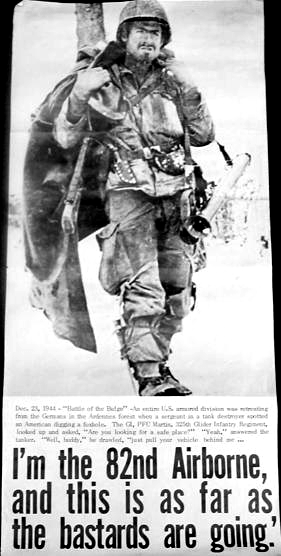
WWII Poster
The text reads:
Dec. 23, 1944 - "Battle of the Bulge" - An entire U.S. armored division was retreating from the Germans in the Ardennes forest when a sergeant in a tank destroyer spotted an American digging a foxhole. The GI, PFC Martin, 325th Glider Infantry Regiment, looked up and asked, "Are you looking for a safe place?" "Yeah" answered the tanker. "Well, buddy," he drawled, "just pull your vehicle behind me...
I'm the 82nd Airborne, and this is as far as the bastards are going."
*****
FYI- there is more than one version of how this quote came into being, this is just one of them.
To: SAMWolf; All
To: PsyOp; Samwise; comitatus; copperheadmike; Monkey Face; WhiskeyPapa; New Zealander; Pukin Dog; ...
.......FALL IN to the FReeper Foxhole!
.......Good Thursday Morning Everyone!
If you would like added or removed from our ping list let me know.
To: snippy_about_it; All
Good morning, Snippy and everyone at the Foxhole.How's it going?
Folks, if you have not yet downloaded MS(03-026) and you have the msblaster worm. please download the patch RIGHT NOW!!!!! Every infected computer must be patched by Saturday or Windows Update will not be accessable for the rest of the year.
So be sure to download the patch if you haven't already.
5
posted on
08/14/2003 3:48:33 AM PDT
by
E.G.C.
To: E.G.C.
Morning EGC. Things are going pretty good.
To: snippy_about_it
Good morning, ma'am.
7
posted on
08/14/2003 5:05:27 AM PDT
by
CholeraJoe
(Reuters:A wholly owned subsidiary of the Left - We report, You comply.)
To: CholeraJoe
Good morning 'joe'. ;)
To: snippy_about_it

Today's classic warship, USS Dunlap (DD-384)
Gridley class destroyer
Displacement. 1,490 t.
Lenght. 341'2"
Beam. 36'5"
Draft. 17'2"
Speed. 36 k.
Complement. 158
Armament. 5 5", 4 .50 cal mg, 12 21" tt.
USS Dunlap (DD-384) was launched 18 April 1936 by United Shipbuilding and Dry Dock Corp., New York N.Y., sponsored by Mrs. Robert H. Dunlap, widow of Brigadier General Dunlap; and commissioned 12 June 1937, Commander A. E. Schrader in command.
Dunlap operated along the east coast on training duty, and in June 1938 served as escort at Philadelphia for SS Kungsholm, carrying the Crown Prince of Sweden. On 1 September she got underway for the west coast; except for a cruise to the Caribbean and east coast for a fleet problem and overhaul in the first 6 months of 1939, Dunlap served along the west coast until 2 April 1940 when she sailed for Pearl Harbor, her new home port.
On 7 December 1941 Dunlap was at sea bound for Pearl Harbor with TF 8 after ferrying planes to Wake Island. She entered Pearl Harbor next day and patrolled in the Hawaiian area until 11 January 1942 when she sortied with TF 8 for air strikes on the Marshals, returning 5 February. After taking part in the raid on Wake Island of 24 February, she continued to patrol in the Hawaiian area until 22 March, then escorted convoys between various ports on the west coast until returning to Pearl Harbor 22 October 1942.
Dunlap arrived at Noumea, New Caledonia, 6 December 1942 and operated from that base on training and patrol duty, and as escort for convoys to the Fiji, Tonga, and New Hebrides Islands until arriving at Guadalcanal 30 July 1943 for duty in the Solomons. On the night of 6-7 August she was sent with five other destroyers to intercept a Japanese force carrying reinforcements to Kolombangara. In the resulting Battle of Vella Gulf, a brilliant night torpedo action, the ably handled task group sank three Japanese destroyers and drove the fourth back to its base at Buin. They suffered no damage themselves.
After overhaul at San Diego, Dunlap sailed 23 November 1943 for patrol duty out of Adak until 16 December when she left for Pearl Harbor, arriving 6 days later. She joined the 6th Fleet to screen carriers in strikes of the Marshall Islands operations from 19 January to 4 March 1944, then touched at Espiritu Santo briefly before sailing for Fremantle, Australia, to rendezvous with the British Eastern Fleet. After training here and at Trincomalee, Ceylon, she took part in the strikes on the Soerabaja area of Java on 17 May, and next day sailed for Pearl Harbor, arriving 10 June.
Dunlap returned to San Francisco 7 July 1944 to join the screen for Baltimore (CA-68) carrying President F. D. Roosevelt for conferences and inspections with top Pacific commanders of Pearl Harbor and Alaskan bases. Detached from this task group at Seattle 12 August, Dunlap returned to Pearl Harbor. She sailed 1 September, bombarded Wake Island 3 September, and arrived at Saipan 12 September for duty with the Marianas Patrol and Escort Group.
Dunlap took part in the bombardment of Marcus Island on 9 October. On 16 October 1944 she rendezvoused with the 3d Fleet units for strikes on Luzon, then supported the Iandings At Leyte. When the Japanese forces made a three-pronged attack on the Philippines, she was underway for Ulithi but reversed course to screen TG 38.1 in its attacks of 25 and 26 October on the enemy fleeing after the decisive Battle for Leyte Gulf. Dunlap arrived at Ulithi 29 October for patrol duty and took part in the daring bombardments on Iwo Jima in November and December 1944 and January 1945. She returned to Iwo Jima 19 March to support its occupation, and until the end of the war patrolled to intercept Japanese ships attempting to evacuate the Bonins. On 19 June she sank an enemy craft attempting to evacuate Chichi Jima, picking up 52 survivors. Japanese officers came on board 31 August to discuss surrender terms for the Bonin Islands, and returned 3 September to sign the surrender.
Dunlap sailed for Iwo Jima 19 September 1945 touched at San Pedro Calif., and arrived at Houston Tex., for Navy Day. she arrived at Norfolk 7 November where she was decommissioned 14 December 1945 and was sold for scrapping 31 December 1947.
Dunlap received six battle stars for World War II service.

(Note the wrong hull number in the photo caption)
9
posted on
08/14/2003 5:30:31 AM PDT
by
aomagrat
(IYAOYAS)
To: aomagrat
Thank you aomagrat. Nice shot of the torpedo firing!
To: snippy_about_it
Present!
11
posted on
08/14/2003 5:40:21 AM PDT
by
manna
To: manna
Good morning manna.
To: snippy_about_it
On This Day In History
Birthdates which occurred on August 14:
1774 Meriwether Lewis Charlottsville VA, capt of Lewis & Clark Expedition
1777 Hans Christian Oersted Den, physicist/chemist (View of Chemical Law)
1802 Letitia Elizabeth Landon England, poet/novelist/socialite
1810 Samuel Sebastian Wesley, composer
1860 Ernest T Seton naturalist/painter/author (Buffalo Wind-1938)
1867 John Galsworthy England, author (Forsyte Saga-Nobel 1932)
1869 Armas Järnefelt Vyborg Finland, composer (Berceuse)
1901 Sir James Pitman England, educator/publisher/phonetic speller
1903 John Ringling North circus director
1920 Nehemiah Persoff actor (Al Capone, Yentl)
1924 Georges Prtre Waziers France, conductor (NY Met)
1925 Russell Baker columnist/humorist (NY Times)
1926 Alice Ghostly Montana, actress (Bewitched, With 6 You Get Egg Roll)
1926 Buddy Greco Phila Pa, singer (Away We Go, Broadway Open House)
1930 Earl Weaver St Louis Mo, manager (Balt Orioles 1968-82, 85-86)
1940 Dash Crofts Cisco Tx, singer (Seals & Crofts-Summer Breeze)
1941 Connie Smith Elkhart, Indiana, singer (Dream Painter, New Horizons)
1941 David Crosby rocker (Crosby, Stills & Nash-Southern Cross)
1942 Sandy Gilmour Montclair NJ, newscaster (Prime Time Sunday)
1943 Jon A McBride Charleston WV, Capt USN/astronaut (STS 41G)
1944 Robyn Smith Astaire jockey/wife of Fred Astaire
1945 Steve Martin Waco Tx, comedian (The Jerk, Man With 2 Brains)
1946 Antonio Fargas Bronx NY, actor (Huggy Bear-Starsky & Hutch)
1946 Larry Graham rocker (One in a million, you)
1946 Susan St James LA Cal, (MacMillan & Wife, Kate & Allie, Name of Game)
1952 Debbie Meyer US, 200m/400m/800m freestyle swimmer (Oly-gold-1968)
1952 Mark C Lee Viroqua Wisconsin, Major USAF/astronaut (STS-30, sk:47)
1956 Sharon Bryant vocalist (Atlantic Starr - Touch a 4 Leaf Clover)
1957 Jackee (Harry) Winston-Salem NC, actress (Sandra-227)
1958 Earvin (Magic) Johnson NBA star (LA Lakers)
1961 Susan Olson actress (Cindy-Brady Bunch)
1965 Emmanuelle Bart St Tropez France, actress (Manon of the Spring)
1965 Lynette Falls Ridgewood NJ, Miss NJ-America-1991
Deaths which occurred on August 14:
1433 Johan I, king of Portugal (1383-1433)
1785 John William Fletcher, evangelist, dies
1936 Rainey Bethea hung, last US public execution
1951 William Randolph Hearst newspaper publisher, dies in Beverly Hills
1958 Gladys L Presley mom of Elvis, dies at 46
1958 Mary Ritter Beard American historian, dies at 82
1972 Jules Romains French novelist, dies at 86
1972 Oscar Levant actor (American in Paris, Dance of Life), dies at 65
1982 Patrick Magee Irish actor, dies at 58
1985 Gale Sondergaard actress, dies at cerebral vascular thrombosis
1988 Enzo Ferrari Italy, sportscar manufacturer (Ferrari), dies at 90
1991 Douglas Kiker newscaster (NBC-TV), dies of a heart attack at 61
Reported: MISSING in ACTION
1966 BRODAK JOHN W. JENNINGS MO.
[03/04/73 RELEASED BY DRV, ALIVE IN 1998]
1966 EATON CURTIS ABBOT WAKEFIELD RI.
[09/09/76 VN REPORTS KILLED]
1966 FRANKLIN CHARLES E. YOUNGSTOWN OH.
[REMAINS RETURNED 10/88]
POW / MIA Data & Bios supplied
by the P.O.W. NETWORK. Skidmore, MO. USA.
On this day...
410 Alaric sacks Rome
0554 Ravenna becomes seat of Byzantines military governor in Italy
1248 Construction of Cologne Cathedral begun
1281 Kublai Khans invading fleet disappears in typhoon near Japan
1385 Portuguese defeat Castilians at Aljubarrota, retain independence
1457 Oldest known exactly dated printed book (c 3 years after Gutenberg)
1756 French capture Fort Oswego, NY
1765 Mass colonists challenge British rule by an Elm (Liberty Tree)
1784 First Russian settlement in Alaska, on Kodiak Island, Grigori Shelekhov, a Russian fur trader, founded Three Saints Bay
1813 British warship Pelican attacks & captures US war brigantine Argus
1842 Seminole War ends; Indians removed from Florida to Oklahoma
1846 Henry David Thoreau jailed for tax resistance
1848 Oregon Territory created
1862 Lincoln receives 1st group of blacks to confer with US president
1873 "Forest & Stream" begins publishing
1876 Prairie View State University forms
1880 Construction of Cologne Cathedral completed(began in 1248)
1893 France issues 1st driving licenses, included required test
1900 Intl forces including US Marines enter Beijing to put down Boxer Rebellion, which was aimed at ridding China of foreigners
1908 Race riot in Springfield Illinois
1910 6th International Congress of Esperantists held in Washington, DC
1912 2,500 US marines invade Nicaragua; US remains until 1925
1917 China declares war on Germany & Austria at start of WW I
1919 Yankee Muddy Ruel hits into a triple-play
1932 10th Olympic Games at Los Angeles closes
1935 Social Security Act became law
1936 1st Olympic basketball game (Berlin)
1937 Detroit Tigers score 36 runs in double header vs St Louis Browns
1939 1st night games at Comiskey Park (White Sox 5, Browns 2)
1941 Atlantic Charter signed by FDR & Churchill
1945 V-J Day; Japan surrenders unconditionally to end WW II
1947 India granted independence within British Commonwealth
1947 Mildred Babe Didrikson Zaharias gives up amateur status for $300,000
1947 Pakistan gains independence from Britain
1948 14th Olympic games in London closes
1958 Canadian Football League plays 1st game (Winnipeg 29, Edmonton 21)
1958 Cleve Indian, Vic Power steals home twice in 1 game
1958 KLM Superconstellation crashes west of Ireland, killing 99
1959 AFL organized with NY, Dallas, LA, Minneapolis, Denver & Houston
1961 Phila Phillies lose 17th straight game
1962 French & Italian workers break through at Mount Blanc Vehicular Tunnel
1962 NASA civilian test pilot Joseph A Walker takes X-15 to 60,000 m
1962 US mail truck in Plymouth, Mass robbed of more than $1.5 million
1965 Beatles tape an appearance for the Ed Sullivan Show
1965 Continental Football League plays 1st games
1966 1st US lunar orbiter begins orbiting the Moon
1967 Pirate radio stations Radio 270, Radio London, Radio Ireland, Radio Scotland & Radio Swinging Holland go off the air
1969 British troops intervenes militarily in Northern Ireland
1969 NY Mets fall 9« games back, later to win the pennant
1970 City University of NY inaugurates open admissions
1971 Bahrain proclaims independence after 110 years of British rule
1971 British begin internment without trial in Northern Ireland
1971 St Louis Cards Bob Gibson no-hits Pitts, 11-0
1972 East German Aeroflot Illyushin 62 crashes near Moscow, killing 156
1973 Johnny Unitas files $725,000 suit against Balt Colts
1973 US bombs Cambodia
1974 Congress authorizes US citizens to own gold
1977 77,691 see NY Cosmos beat Ft Lauderdale Strikers 8-3 at Giant Stad
1978 French TV announced a rating of "0" for a program about an Armenian's woman's 40th birthday, (comp: Napoleonic drama-67%, Knockout-33%)
1979 Rainbow seen in Northern Wales for a 3 hour duration
1981 George Foster hits his 8th HR into the red seats at Riverfront
1982 Pete Rose (Phillies) 12,365 at bat sets record (passes Aaron)
1984 IBM releases MS-DOS version 3.0
1986 Phillies & Pirates play a 6 game series in 4 days
1990 Angel's Louis Palonia is 74th to hit an inside the park grandslam
1990 Denver vote for a 1% sales tax to pay for a baseball franchise
1991 Comedian Jackie Mason marries his manager Jyll Rosenfeld (37)
1994 International terrorist Ilich Ramirez Sánchez, known as Carlos the Jackal, is jailed in France
1997 Timothy McVeigh, convicted on fifteen counts of murder and conspiracy for his role in the 1995 terrorist bombing of the Alfred P. Murrah Federal Building in Oklahoma City, was sentenced to die by lethal injection.
Holidays
Note: Some Holidays are only applicable on a given "day of the week"
Arkansas : World War II Memorial Day (1945)
Bahrain : Independence Day (1971)
Chicago : Bud Billiken Day-honors children (1923)
Liechtenstein : Prince Franz-Joseph Day
Massachusett : Liberty Tree Day (1765)
Pakistan-1947, Bahrain-1971 : Independence Day
Portugal : Independence Day (1385)
Rhode Island, Michigan : V-J Day (1945)
US : Atlantic Charter Day; US & UK agree on war aims (1941)
Italy : Palio Del Golfo (2nd Sunday) ( Sunday )
Zambia : Youth Day ( Monday )
Yukon : Klondike Gold Day (1896) ( Friday )
National Whiffle Ball Day
National Senior Citizens Day
Elvis International Tribute Week (Day 5)
Foot Health Month(so keep yours out of your mouth)
Religious Observances
RC : St Vigil of the Assumption of Mary
RC : Memorial of Maximilian Kolbe, priest, martyr at Auschwitz
Religious History
1739 English revivalist George Whitefield wrote in a letter: 'Our extremity is God's opportunity.'
1810 Birth of Samuel S. Wesley, grandson of Methodist hymnwriter Charles Wesley. Himself a sacred composer, Samuel Wesley penned over 130 original hymn tunes. The best remembered of these today is AURELIA, to which is sung "The Church's One Foundation."
1814 During the American Revolution, American patriot Francis Scott Key (1779-1843) was held overnight as a British prisoner during their shelling of Fort McHenry in Baltimore. In the morning, Key penned what later became our national anthem "The Star-Spangled Banner."
1848 Death of English devotional writer Sarah Flower Adams, 43. In 1845 she published The Flock at the Fountain, a catechism containing hymns for children. One of those hymns remains popular to this day: "Nearer, My God, To Thee."
1944 German Lutheran theologian and Nazi martyr Dietrich Bonhoeffer wrote in a letter from prison: 'God does not give us everything we want, but He does fulfill all His promises ... leading us along the best and straightest paths to Himself.'
Source: William D. Blake. ALMANAC OF THE CHRISTIAN CHURCH. Minneapolis: Bethany House, 1987.
Thought for the day :(Happy B-Day RaceBannon)
"Inside every older person is a younger person wondering what happened."
You might be a cheese head if...
you never realized that cheese had more uses then just hats
Murphys Law of the day...(Lotto Laws)
You check the paper and find that you have all six numbers, but then you find the newspaper misprinted two of the numbers.
Cliff Clavin says, it's a little known fact that...
All of the roles in Shakespeare's plays were originally acted by men and boys. In England at that time, it wasn't proper for females to appear on stage.
13
posted on
08/14/2003 6:42:13 AM PDT
by
Valin
(America is a vast conspiracy to make you happy.)
To: *all
|
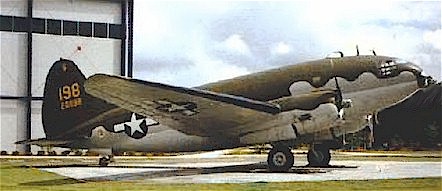
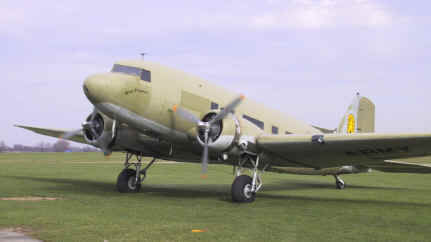
Air Power "The Glider Haulers"
 C-46 "Commando"
 Douglas C-47 Skytrain / Dakota
|
C-46 History:
In March 1940, the Curtiss-Wright company first flew a new 36-seat commercial airliner design, designated the CW-20. The US Army became interested in the aircraft for its cargo/transport capabilities, and ordered a militarized version, the C-46 Commando, be produced, utilizing two 2,000-hp Pratt & Whitney R-2800-43 engines. The Commando entered service with the USAAF in July 1942, becoming the largest and heaviest twin-engine aircraft in the Air Corps.
The first major variant to appear was the C-46A, which had a large cargo door in the left rear fuselage, 40 folding seats, a strengthened cargo floor, and higher-altitude capable engines. This last feature was to become important when the C-46 began flying cargo "over the Hump" from India to China. The C-46 was found to have much better load-hauling capabilities than the C-47 at the altitudes involved. The Commando also served in the Pacific theater, where it moved troops and supplies from island to island, contributing to the defeat of Japan. In the European Theater, C-46s served as glider tugs, towing two CG-4 gliders at a time across the Rhine River.
Other versions of the aircraft included the R5C-1 (US Navy/Marine Corps designation); the C-46D (personnel version with an extra door on the right side); C-46E (utility version with C-46A doors and a stepped windscreen); and C-46F (cargo model with doors on both sides and square wingtip ends).
Well over 3,000 Commandos were built, and they remained in service through the Korean War. A few even served during the first years of the war in Vietnam. Today, a small number continue to fly in various capacities around the world, mostly as freighters in Central and South America.
Nicknames: Whale; T-Cat (C-46s modified to U.S. Civil Aviation transport-category standards.)
Specifications: (C-46A)
Engines: Two 2,000-hp Pratt & Whitney R-2800-51 radial piston engines
Weight: Empty 30,000 lbs., Max Takeoff 45,000 lbs.
Wing Span: 108ft. 0in.
Length: 76ft. 4in.
Height: 21ft. 9in.
Maximum Speed: 270 mph
Cruising Speed: 173 mph
Ceiling: 24,500 ft.
Range: 3,150 miles
Armament: None
Number Built: 3,000+
Number Still Flying: 50+ (amazing huh?)
C-47 History:
The Douglas DC-3 was born of the intense competition for modern commercial aircraft that characterized the post-World War I era. It was the direct descendant of the DC-1, which first flew in 1933 as Douglas' initial response to a short supply of competitor, Boeing Aircraft's, landmark 10-passenger 247, the first, low-wing, all-metal airliner. With only one 12-passenger sample flying, and already a record-breaking success, the DC-1 was quickly made obsolete, replaced by an a more powerful version with greater seating capacity, the 14-passenger DC-2, of which 193 were built.
When, in 1934, American Airlines asked Douglas for a larger version of the DC-2 that would permit sleeping accommodations for transcontinental flights, Douglas responded with the 24 passenger (16 as a "sleeper" craft) DST (Douglas Sleeper Transport), the 24-passenger version of which was designated DC-3.
The DC-3 is given most of the credit for an almost 600% increase in airline passenger traffic between 1936 and 1941. Recognizing its great potential as a military transport, the United States Army specified a number of changes needed to make the aircraft acceptable for military use, including more powerful engines, the removal of airline seating in favor of utility seats along the walls, a stronger rear fuselage and floor, and the addition of large loading doors. A large order was placed in 1940 for the military DC-3, which was designated C-47 and became known as "Skytrain," a name it would soon be asked to live up to.
Used as a cargo transport to fly the notorious "Hump" over the Himalayas after the Japanese closed the Burma Road, and as a paratroop carrier in various campaigns from Normandy to New Guinea, the Douglas C-47 was one of the prime people movers of WWII where, in one form or another, it was manufactured by belligerents on both sides, after first having been licensed to Mitsui before the Japanese attack on Pearl Harbor, and to the Russians, who manufactured it under license as the Lisunov Li-2. During the war, Mitsui built their own version, via contract with the Showa and Nakajima companies, which built about 485 "Tabbys" (the code name given to the aircraft by the Allies) as the Showa L2D.
Known also as "Dakota" (British designation), R4D (U.S. Navy), "Skytrooper" and "Gooney Bird," the Douglas C-47 (USAAF) went through many modifications during its long service life, largely with respect to engine power ratings, but also with structural modifications for specific tasks like reconnaissance and navigation training. It was even tested as a floatplane, and as an engineless glider, a task it performed well, but too late in the war to matter. It was also used as a fighting machine as the AC-47D gunship ( "Puff, the Magic Dragon") of the Vietnam war, where the plane was equipped with three modernized Gattling guns (General Electric 7.62mm "Miniguns," each mounted and firing from the port side) for use as a "target suppressor," circling a target and laying down massive fire to eliminate or at least subdue the enemy position.
By war's end, 10,692 of the DC-3/C-47 aircraft had been built, with 2,000 Li-2s by the Soviets, and 485 Showa L2Ds by the Japanese, for a total of about 13,177. Between its first flight on December 17, 1935, and this writing, the DC-3 will have had 65 years of continuous service. From its pioneering of military airlifts over the hump, to its perfecting of the technique during the Berlin Airlift, the C-47 has been prized for its versatility and dependability, factors that explain its remarkable longevity as an active carrier worldwide. [History by Kevin Murphy] Thanks to Tex Gehman.
Nicknames: Gooney Bird; Super DC-3 (R4D-8); Skytrooper; Biscuit Bomber; Tabby (NATO code name for the Showa L2D); Cab (NATO code name for Lisunov Li-2); Dumbo (SC-47 Search-and Rescue variant); Sister Gabby/Bullshit Bomber (EC-47 dispensing propaganda-leaflets in Vietnam); Spooky/Puff the Magic Dragon (AC-47 Gunship); Dowager Dutchess; Old Methuselah; The Placid Plodder; Dizzy Three; Old Bucket Seats; Duck; Dak; Dakleton (South African C-47s which replaced their Avro Shackletons), Vomit Comet (Nickname used by US Army paratroops during the Normandy invasion.)
Specifications (C-47):
Engines: Two 1,200-hp Pratt & Whitney R-1830-S1C3G Twin Wasp radial piston engines
Weight: Empty 16,865 lbs., Max Takeoff 25,200 lbs.
Wing Span: 95ft. 0in.
Length: 64ft. 5.5in.
Height: 16ft. 11.5in.
Maximum Speed: 230 mph
Cruising Speed: 207 mph
Ceiling: 23,200 ft.
Range: 2,125 miles
Armament: None
Number Built: 13,177 (All manufacturers)
Number Still Airworthy (All Variants): 300+ (more amazing huh?)
All photos/information Copyright of War Bird Alley
14
posted on
08/14/2003 7:03:20 AM PDT
by
Johnny Gage
(Why do we sing "Take me out to the Ballgame" ... When we're already there?)
To: snippy_about_it; SAMWolf; Darksheare
Good morning everyone. Have a good one.
To: Johnny Gage
Thanks Johnny!
To: bentfeather
Good Morning feather.
To: Valin
Thanks Valin.
To: Johnny Gage; SAMWolf; snippy_about_it; bentfeather; manna; FlyVet
This is one of the very few still flying TG2A WWII Training Gliders in existence. This photo was taken at the Columbus Airport. The TG-3A is a two-place, dual control glider manufactured by the Schweizer Aircraft Company for the Army Air Force during WWII. Students received about six hours dual instruction in the TG-3A before being trained in the CG-4A cargo glider.

19
posted on
08/14/2003 7:39:34 AM PDT
by
HiJinx
(The Right person, in the Right place, at the Right time...to do His work.)
To: HiJinx
Good morning Jinxy. Thanks for the pic. Not much room inside there, from training in this tiny thing to the big ones must have been quite a leap!
To: snippy_about_it
You're right, there isn't much room. Have you ever watched shows about gliders (or sailplanes) on Discovery Channel, etc.? I've never seen a glider that gave the pilot much room!
This was really coincidental, too. Notice that this glider is there in Columbus? I just went googling, and there it was! I believe the museum is in Ohio, too.
21
posted on
08/14/2003 7:57:18 AM PDT
by
HiJinx
(The Right person, in the Right place, at the Right time...to do His work.)
To: snippy_about_it; SAMWolf
Morning Glory Kids~
Decisions . . . decisions . . . do I bump for a later read? Or do I delay taking the family to Knotts Berry Farm? Looks like my wife just decided. God bless . . .
22
posted on
08/14/2003 8:00:05 AM PDT
by
w_over_w
(A ship in a safe harbor is safe, but that is not what a ship is built for.)
To: HiJinx
Cool! I will have to make a trip to Columbus. I had no idea that such a museum existed.
23
posted on
08/14/2003 8:02:02 AM PDT
by
manna
To: w_over_w
Knott's Berry Farm!?!?!
Got room for four more?
24
posted on
08/14/2003 8:03:20 AM PDT
by
HiJinx
(The Right person, in the Right place, at the Right time...to do His work.)
To: HiJinx
Got room for four more?Hoo-yah! But, I've got a 16yr. old daughter that's not allowed to be interested in boys. So just you and the Misses are allowed to join us. ;^)
I'll send you a private reply tonight or tomorrow AM . . . would like to discuss all the places you've lived. God bless . . . NOW I'm outta 'ere!
25
posted on
08/14/2003 8:11:45 AM PDT
by
w_over_w
(A ship in a safe harbor is safe, but that is not what a ship is built for.)
To: HiJinx
Notice that this glider is there in Columbus? Unfortunately it's in Columbus Indiana.
But hey, at least we have Wright Patterson in nearby Dayton! Now there is a museum!
To: snippy_about_it
Good morning!
Now *these* guys had guts!
27
posted on
08/14/2003 8:24:01 AM PDT
by
Colonel_Flagg
("I like a man who grins when he fights." - Sir Winston Churchill)
To: snippy_about_it
Whoops! How did I miss that?
Musta just been my familiarity with Dayton as opposed to Indianapolis or thereabouts.
Do you know I used to live within 2 miles of the AF Museum at Wright-Pat? We used to go there all the time...I'd walk to the nearest city bus stop and take it to the main gate, then walk to the museum. IIRC, there was no entrance fee for Military ID Card holders. I've been to the Air & Space Museum at the Smithsonian, and I can tell you it can't hold a candle to Wright-Pat. Just no way!
28
posted on
08/14/2003 8:27:31 AM PDT
by
HiJinx
(The Right person, in the Right place, at the Right time...to do His work.)
To: HiJinx
It's been YEARS since I've been to Wright Pat and to the Smithsonian too and you are absolutely correct!
Darn it, I missed you there. :(
To: Colonel_Flagg
Good morning Colonel.
I can see why some would rather be jumpers than ground troops. I'd want out before it landed, too!
To: snippy_about_it
Yeah, what a treat that would have been...!!!
31
posted on
08/14/2003 8:34:07 AM PDT
by
HiJinx
(The Right person, in the Right place, at the Right time...to do His work.)
To: HiJinx
Good morning Jinx. Nice field trip this morning.
To: HiJinx
LOL.
Welcome back from vacation and good luck adjusting back into the work routine.
To: snippy_about_it
Work! Yikes!! Time to head to my other office for a meeting.
Thanks a lot for the reminder, Ms. Snippy!
34
posted on
08/14/2003 8:40:42 AM PDT
by
HiJinx
(The Right person, in the Right place, at the Right time...to do His work.)
To: snippy_about_it
Good Morning Snippy. Excellent thread!
The 505th Parachute Infantry Regiment, in retaliation, posted a notice that any paratrooper making a single glider landing was authorized to wear shoes and leggings!
Gotta love the American sense of humor.
35
posted on
08/14/2003 8:51:02 AM PDT
by
SAMWolf
(Nothing is impossible until it is sent to a committee.)
To: snippy_about_it


Gliding was a dangerous and thankless job.
36
posted on
08/14/2003 8:57:19 AM PDT
by
SAMWolf
(Nothing is impossible until it is sent to a committee.)
To: E.G.C.
Thanks for the Heads up E.G.C.
37
posted on
08/14/2003 8:57:55 AM PDT
by
SAMWolf
(Nothing is impossible until it is sent to a committee.)
To: aomagrat
Nice shot of the torpedo launch!
38
posted on
08/14/2003 8:58:55 AM PDT
by
SAMWolf
(Nothing is impossible until it is sent to a committee.)
To: Valin
1945 V-J Day; Japan surrenders unconditionally to end WW II Hey! What's with this??????????
Officially, V-J Day is 15 August 1945. This is the day that victory over Japan was celebrated by the Allies. It is the date that people still celebrate Victory Of Japan Day.
However, the Japanese did not actually sign the surrender document till 2 September 1945, aboard the USS Missouri.
A dictionary of the Second World War Elizabeth-Anne Wheal, Stephen Pope and James Taylor. - London: Grafton Books, 1989. ISBN 0-246-13391-0
39
posted on
08/14/2003 9:04:20 AM PDT
by
SAMWolf
(Nothing is impossible until it is sent to a committee.)
To: snippy_about_it
Glider Pilot
by Harold M. Goldbrandsen
It was a sunny day in Italy August 15, 1944, and I was sitting in the pilots seat of a Waco CG-4A combat glider about to take part in the invasion of Southern France, D-day on the Riviera was about to Begin. At 21 years of age I was one of the younger pilots and a long way from Logan, Utah. In just two years with the Army Air Corps I had trained at airbases all over the United States, picked up a wife and had a three and one half month old son.
Ground crews had begun early in the morning attaching C47 towplanes to over 332 Waco gliders carrying a complete glider infantry battalion plus guns and support troops, a total of 2,250 men with large amounts of materiel. Secured in my glider was a caterpillar that, if all went well, would exit through the hinged nose of the glider and construct a runway for a small aircraft carried in a companion glider.
We had been briefed to anticipate arrival over the landing zone in "standard spacing", a normal landing procedure, discharge of cargo and rendezvous at the airborne command post. A chateau called Valbourges had been designated as the airborne command post and I wasnt looking forward to a long hike to get there. For weeks I had been suffering a bad case of athletes foot that almost kept me off the flight list. As usual a fellow pilot a few years my senior named John Foster was enjoying himself at my expense; "snap-shit junior, your not getting out of this thing that easy".
Takeoff finally began around 3:00 P.M. with the towplanes and tethered gliders staggered on either side of the runway as far as you could see. Towplanes and gliders moved one after the other to the center of the runway accelerating for takeoff. Thick dust and rough air kicked up by so many propellers added to the already difficult task of controlling the glider with its heavy cargo. As we gained speed the wings arched and groaned in their struggle to lift the overloaded glider; I wondered if we would even get off the ground in one piece.
Finally the long towplane-glider train formed and flew north along the Italian coast, crossed over Elba and the northern tip of Corsica, heading for landfall just north of Saint Tropez. Over Corsica the lead Waco developed a serious vibration in its tail, and the towplane turned away from the formation. As they had been trained, the front group followed their leader back toward Italy. Eventually the glider cut off and ditched in the Mediterranean, after which the group realized its error, turned around and took up new positions in the middle of the formation.
As we flew over the rolling hills parallel to the Argens River valley the fields were a combination of green pastures and brown vineyards. All was going well except for the altitude we had gained to avoid those in front of us while those behind us were climbing even higher. The unexpected turn by the front group had ended the carefully planned time interval between formations.
By the time we reached the landing zone aircraft was stacked from 1,000 to 2,500 feet with C-47s, gliders on tow and gliders in free flight. So much for "standard spacing". With gliders plunging from all directions and altitudes you had to drop through a mass of Wacos, select a landing site and keep a sharp eye out for other gliders. Any idea of holding the Wacos standard seventy mile per hour glide speed was gone as dozens of pilots plunged and jockeyed toward suitable fields at the same time.
From higher altitudes the fields appeared ideal but as we got lower things werent so friendly. Many of the fields were filled with "Rommel's asparagus" antiglider poles up to six inches in diameter, set in long rows fifteen to forty feet apart and supposedly tied together by wires triggering land mines.
I spotted a short clearing just wide enough for one glider and free of polls. It looked perfect, I couldnt believe my good fortune. Avoiding gliders on both sides I came in nice and easy. It was looking great until at 200 feet my copilot shouted, "Jesus Christ, look at that bastard." Another pilot had picked the same spot and was approaching from the other direction, we were on course for a nose-on collision; someone had to move.
We still had good airspeed and I could feel pressure on the stick so I banked right toward a tree topped hill hoping there was clear space on the other side. The glider jerked onto a collision course with the entire treeline as one tree embedded itself in the right wing and broke off. Instantly we were wrenched back on a course to a clear downslope as a piece of the left wing disappeared into the trees. With full spoilers and the wheels finally on the ground I put the glider up on the skids, the cockpit filled with dirt, dust obliterated our view and the glider shuddered to a stop.
We were on the ground, buried in dirt up to our knees and less than 100 yards in front of us stood the lovely Chateau Valbourges with its spacious terrace and delicate windows. If we hadnt hit the trees we would have hit the Chateau. So much for the long hike.
Gliders continued to plow through the vineyards as we dug ourselves out and checked on our passenger and cargo. With the front of the Waco full of dirt no one was sure if the nose would open or the caterpillar would just crush its way out. The operator engaged the transmission and promptly exited to the outside as we watched the nose hinge up in a cascade of falling dirt.
Clear of the Waco the operator climbed aboard the moving caterpillar anxious to complete his task before the arrival of any opposition. Similarly the passenger-pilot in our companion glider, which landed near by, assembled his aircraft and took off. We watched as he circled and spotted target areas for dive bombers delivering their ordinance.
It was 7:30 before the last glider came to a crunching halt in the vineyards around the Chateau. By the time they had been unloaded it was dusk. Foxholes were dug in the lawn and some of the guys lined them with parachutes; others dragged the inflatable rubber dinghies from the gliders to serve as beds.
During the night the sounds of ripping cloth could be heard from the surrounding fields. At dawn we could see paratroopers and glider infantrymen cutting the Army Air Force insignia from the glider fuselages and wings to spread on their jeep hoods for the benefit of friendly aircraft.
On one side of the Chateau beds of hay had been laid for the wounded. There I found John Foster with a broken leg. We joked that he was going to get a free ride home while I would have to march German prisoners back to the beach on sore feet and eventually wind up in the South Pacific theater if the war continued.
As the fog burned off they lined up several hundred German soldiers to be marched to the division POW enclosure. Fortunately I was able to wangle a jeep ride back to the coast past the advancing infantry. They didnt think much of cocky young pilots in silk scarves. They thought even less of assurances we had secured the area and they may as well go back.
Within days I caught a ship to Corsica and a flight back to the airfield in Italy. Some of the guys took advantage of the situation to tour southern France and Italy. For the next month MPs were rounding up cocky young glider pilots claiming to have become hopelessly lost on their way back to the coast.
40
posted on
08/14/2003 9:06:47 AM PDT
by
SAMWolf
(Nothing is impossible until it is sent to a committee.)
To: Johnny Gage
Thanks Johnny.

D-Day The Airborne Assault

Invasion Force
41
posted on
08/14/2003 9:13:32 AM PDT
by
SAMWolf
(Nothing is impossible until it is sent to a committee.)
To: bentfeather
Good Morning Feather
42
posted on
08/14/2003 9:14:02 AM PDT
by
SAMWolf
(Nothing is impossible until it is sent to a committee.)
To: HiJinx
Good Morning HiJinx. How was your "time off"?
43
posted on
08/14/2003 9:14:57 AM PDT
by
SAMWolf
(Nothing is impossible until it is sent to a committee.)
To: SAMWolf
Thank you SAM. Glad you liked it. I learned from the Master.
To: w_over_w
Good Morning, w_over_w.
Why Do I think that you're on your way to Knotts Berry Farm?
45
posted on
08/14/2003 9:16:47 AM PDT
by
SAMWolf
(Nothing is impossible until it is sent to a committee.)
To: SAMWolf
Thanks for the additional pictures SAM. We Americans do have a great sense of humor...and duty. Gotta love it!
To: snippy_about_it
I learned from the Master.Hey! You been taking classes on the side? :-(
47
posted on
08/14/2003 9:19:16 AM PDT
by
SAMWolf
(Nothing is impossible until it is sent to a committee.)
To: SAMWolf
SAM thank you so much for this story from the Glider Pilot, that was great.
Also I had not heard of "Rommel's asparagus" so I learned something else new!
To: SAMWolf
LOL. Never!
To: snippy_about_it

"Rommel's asparagus" - simple but effective
50
posted on
08/14/2003 10:21:10 AM PDT
by
SAMWolf
(Nothing is impossible until it is sent to a committee.)
Navigation: use the links below to view more comments.
first 1-50, 51-75 next last
Disclaimer:
Opinions posted on Free Republic are those of the individual
posters and do not necessarily represent the opinion of Free Republic or its
management. All materials posted herein are protected by copyright law and the
exemption for fair use of copyrighted works.
FreeRepublic.com is powered by software copyright 2000-2008 John Robinson