Posted on 07/04/2002 9:44:05 AM PDT by Criminal Number 18F
Some things, you just can't do. Flying an airliner while under the influence of alcohol is right at the top of the list. America West always knew that; it's a shame two of its pilots didn't.
America West announced on Wednesday that the two pilots who failed sobriety tests Monday night in Miami are no longer with the airline. They were told they were fired Tuesday.
Pilot Thomas Cloyd, 44, and First Officer Christopher Hughes, 40, were called back to the gate Monday, after security complained that they smelled of alcohol. They were already taxiing out for takeoff to Phoenix with 124 aboard, but returned without incident. They were checked at the plane, failed, and brought to the station for a more-sophisticated test... which they failed.
Cloyd blew .091%, and Hughes hit .084%, both beyond the limit -- for drivers. The FAA has nailed them both; and the Florida cops even got to issue felony drunk-driving citations to the pair. They sobered up and were released on $7000 bond each.
They both have recourse in the firing, to the union, which is not expected to be overly-sympathetic, given the circumstances.

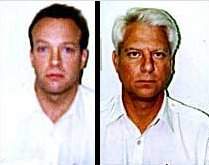
Huughes (l.) and Cloyd (r.)
Thu Jul 4,12:09 PM ET
By PETE YOST, Associated Press Writer
WASHINGTON (AP) - The Federal Aviation Administration ( news - web sites) revoked the licenses of the two America West pilots accused of trying to fly a jetliner from Miami while drunk.
The federal agency announced Thursday that emergency orders taking away the licenses are effective immediately.
Federal regulations prohibit pilots from operating an aircraft or performing other safety sensitive functions within eight hours of consuming alcohol or if they have an alcohol concentration of 0.04 or higher, said FAA spokeswoman Laura Brown. America West's policy is 12 hours.
Both pilots had blood-alcohol levels above Florida's legal limit of 0.08 after they were ordered to return their Phoenix-bound plane, carrying 124 passengers, back to the gate Monday morning.
A security screener alerted authorities after noticing that Thomas Porter Cloyd, 44, and co-pilot Christopher Hughes, 41, smelled of alcohol.
Hughes initially told police it was "merely mouthwash," according to police reports.
The two pilots were charged with a felony count of operating an aircraft under the influence and operating a motor vehicle under the influence. They were released on $7,000 bond each late Monday and returned to their Arizona homes.
Arraignment was set for July 22. The pilots could face five years in prison if convicted.
Brown has said Cloyd and Hughes will be able to reapply for licenses after a year by meeting the same requirements they faced when they first applied.
A spokesman for the Cloyd's family, Steve Hicks said, "We're saddened by the occurrences and the allegations made against them."
Arizona police records show that Cloyd has been arrested twice for alleged alcohol-related offenses while at his home in Arizona.
Two years ago, Cloyd was arrested on a charge of disorderly conduct after allegedly harassing his downstairs neighbor. He told police he had been "drinking a lot" before he shouted obscenities, pounded on her door and stomped on his floor, records show.
He was sentenced to two years' probation.
In 1998, Cloyd had been drinking when he was arrested for misdemeanor domestic assault at his home in Chandler, Ariz., near Phoenix, records show. He admitted he spit on his then-wife and shoved her into a refrigerator.
Prosecutors dropped the assault charge after Cloyd took an anger-management class, said Carla Boatner, administrator for Chandler Municipal Court.
FAA policy requires pilots to report if they have been charged with certain alcohol-related offenses, such as driving under the influence. Their pilot's certificate is suspended after a third offense.
In 2000, the last year for which a detailed breakdown is available, nine of 10,419 airline employees randomly screened for alcohol tested positive, the FAA said. Nine pilots also failed last year.
So far this year, seven have failed, not including the America West pilots.
FAA rules require airlines every year to test 10 percent of employees who have jobs in which safety matters, including pilots, flight attendants and maintenance crews, the agency said.
Airlines must notify the FAA when an employee tests positive for drugs or alcohol.
Pilots who fail the tests lose their medical certificates, which they need to fly, the FAA said. Last year, 54 pilots had their medical certificates suspended or revoked because they were convicted for operating motor vehicles under the influence of alcohol.
Pilots who lose their medical certificates can get back into the cockpit by going through a rehabilitation program and getting medical approval.
Copyright © 2002 The Associated Press.
Yep. This guy has a serious problem, and IMHO should have been suspended or sacked once the problem became evident.
Clearly pilots need to be drug and alcohol-tested before every flight.
Every pilot before every flight? I'd respectfully disagree, and don't think there's a chance of pilots agreeing to it.
FWIW, drug and alcohol tests are done on crew (living or dead) after crashes. I can't remember a single accident report -- admittedly, I haven't read anything like all of them -- that showed significant blood alcohol.
I've pinged some FReepers who'll have better information.
Nor do I, they have a very powerful union that would fight tooth and nail against it. But I still believe they should be tested before every flight.
I've pinged some FReepers who'll have better information.
A jet crashed in Alaska years ago and the dead pilot's blood alcohol level was way over anyone's definition of drunk, much higher than these two pilots. It was a freighter, flying cattle to Japan.
Actually alcoholics have a very high tolerance and I'd rather fly with an alcoholic pilot whose had a few than a non-alcoholic. His hand-body coordination would not be as impaired.
Years ago I read of a group within AA made up of recovering alcoholics who had commercial pilot licenses. They called themselves Birds of a Feather.
There are many active alcoholic pilots. Don't forget F. Lee Bailey ... he is a licensed pilot and may still represent the pilots' union. Read Patty Hearst's book about her trial and her descriptions of Bailey's alcohol consumption -- at lunch, during trial -- and make up your own mind.
That is the most assinine statement I've ever read on this board. I suggest you supply us with proof of this amazing revelation? Oh and before you suggest I post proof, read Tennessee Bob's post in #15. He beat me to the punch. In my ten years of flying I have had nothing but responsible professionals next to me, to the last man. They all are professionals and conduct themselves as such pre, during and post duty times. And I know of very few who drink. These two were an exception, not the rule. The aviation industry gets enough speculative garbage from the media. I suggest you get a clue before you go generalizing on an industry you obviously know nothing about.
o Pilots have shown impairment in their ability to fly an ILS approach or to fly IFR, and even to perform routine VFR flight tasks while under the influence of alcohol, regardless of individual flying experience.
o The number of serious errors committed by pilots dramatically increases at or above concentrations of 0.04% blood alcohol. This is not to say that problems don't occur below this value. Some studies have shown decrements in pilot performance with blood alcohol concentrations as low as the 0.025%.
Year General Pilots with Piots with
Aviation BAC BAC
Pilot of of
Fatilities 0.02% or more* 0.04% or more *
1987 341 13.5% 8.5%
1988 364 6.6% 6.3%
1989 349 12.9% 8.0%
1990 367 14.2% 7.9%
1991 379 12.9% 7.9%
1992 396 11.9% 7.3%
1993 338 12.7% 8.9%
*Some cases may include alcohol produced after death by tissue decomposition.
BAC= Blood alcohol concentration
Excerpted from here.
While blocking healthy captains from flying after the cutoff age, the FAA has been liberal over the years in certifying alcoholics, past drug abusers, pilots with psychiatric problems, and those who are blind in one eye or deaf in one ear, as well as hundreds who have undergone multiple heart bypass operations.(Excerpted from here.)
Followed up by a search for 'ALPA' (Air Lines Pilot Assoc.) and 'alcoholics':
PEER PILOT ASSISTANCE PROGRAM
The mission of the Continental Airlines Peer Pilot Assistance Program (PPAP) is to provide Continental Pilots a group of trained peers to which any pilot may turn for confidential assistance with personal problems on a voluntary basis.The Program's objective is to get the troubled pilot to proper medical evaluation and treatment before his or her health, life, and employment are threatened by unresolved personal problems. Such problems may be denied or unrecognized by the pilot, thus calling for sensitive but firm intervention. The major concern for the PPAP is to intervene prior to a pilot receiving a positive alcohol/drug test result. ...
Recovery Rates
The Human Intervention Motivation Study started in 1972 by a grant given to ALPA and the FAA by the National Institute of Alcoholism & Alcohol Abuse (NIAAA). The sole focus of the grant was to develop a system to return a pilot to flight status after he/she receives a diagnosis of chemical or alcohol dependency. The Peer Pilot Assistance Program is modeled after this program.Twenty-seven years later, the HIMS program is one of the most successful programs for impaired professionals. Bar associations, State Medical authorities and other professional associations have designed programs based on the philosophy, principles and success of HIMS. The success rate of HIMS is 93% over 27 years. This rate is based on the percentage of relapses (7%) after 3 years of continued abstinence from alcohol and/or drugs.
No other profession has been able to achieve this high recovery rate.
The partnership of Management, the EAP and the IACP has made the PPAP a success. While return to flight status and a regular paycheck are important, the real purpose of this program is to recover the quality of life lost to the addiction, for the life of the pilot.
For those seeking reassurance, one sentence stands out here:
No pilot in a CFR Part 121 (Air Carrier) fatal aviation accident was found to be positive for drugs or alcohol.Those out for some moments of terror, look here:
Five years ago, Southwests Capt. Gary Higby had to save another Boeing 737 on approach to the Oakland, Calif., airport when his co-pilot, who was at the controls for the night-time descent in low visibility, let out a curdling scream and froze in his seat, Higby recalled. The co-pilot jammed on the right rudder and the jetliner, barely 900 feet above ground, responded with a 35-degree roll. Unable to push on the left rudder because his co-pilot was in a catatonic rigid state, Higby said he was able to retrieve a level flight only by increasing the thrust on the right engine. He landed the aircraft after flight attendants finally pried the co-pilot from the seat and dragged him to the galley.Higby said that doctors at the hospital where the copilot was rushed after landing concluded that the second-in-command was an alcoholic who had experienced delirium tremens during the landing. Later, Higby said, the airline discovered that he had had four arrests for drunken driving and had admitted to being a binge drinker.
Prevalence of Drugs and Alcohol in Fatal Civil Aviation Accidents Between 1994 and 1998 Office of Aviation Medicine Washington, D.C. 20591
Abstract
The use of drugs and alcohol in aviation is closely monitored by the FAA Office of Aviation Medicine's (OAMs) Civil Aeromedical Institute (CAMI) through the toxicological analysis of specimens from pilots who have died in aviation accidents.This information on the use of drugs in aviation is helpful to the FAA in developing programs to reduce the usage of dangerous drugs and identify potentially incapacitating medical conditions that may cause an accident.
Data collected from this research can be used to evaluate the effectiveness of the FAA drug testing program.
The toxicology reports prepared by the CAMI Forensic Toxicology Research Section are used by the FAA and the National Transportation Safety Board to determine the cause of aviation accidents. Specimens (blood, urine, liver, kidney, vitreous fluid, and other bodily specimens) were collected by pathologists near the accident and placed in evidence containers provided by CAMI. These samples were refrigerated and shipped by overnight air. Upon receipt, the specimens were inventoried and accessioned for the analysis of drugs, alcohol, carbon monoxide, and cyanide. All data collected by the laboratory were entered into a computer database for future analysis.
The database was searched using a Microsoft Access TM program developed by a local contractor. The database was sorted based on the class of drug, controlled dangerous substance schedules I and II, controlled dangerous substance schedules III-V, prescription drugs, over-the-counter drugs, and alcohol.
The Toxicology and Accident Research Laboratory received specimens from 1683 pilots for postmortem toxicology analysis between 1994 to 1998. Controlled dangerous substances, CDS, (schedules I and II) were found in 89 of the pilots analyzed. Controlled dangerous substances (schedules III - V) were found in 49 of the pilots tested.
Prescription drugs were found in 240 of the pilots analyzed. Over-the-counter drugs were found in 301 of the pilots analyzed.
Alcohol at or above the legal limit of 0.04% was found in 124 pilots. The number of positive drug cases has doubled over the past 5 years.
Over-the-counter medications are the most frequently found drugs in fatal aviation accidents and many of these drugs, or the medical conditions for which they are being used, could impair a pilot's ability to safely fly an aircraft.
The increased number of positive cases found in this research is most likely the result of improved methods of analysis, rather than an increase in the use of drugs.
The low incidence of CDS III-V drugs found in fatal aviation accidents may be a result of the difficulty in finding and identifying the new benzodiazepines commonly prescribed in this class.
The full report, containing a breakdown of the types of substances they found in pilot's blood, may found here in this Adobe ".pdf" format document.
If the incidence of alcoholism in the public is 5% to 10% (some think it's 15% to 20%) please explain why airline pilots would have a lower percentage.
Do you think the annual phsyical exam is going to uncover the problem and weed them out? Go to a few AA meetings and ask the recovered alcoholics at the meeting about their experiences with doctors. Be prepared to hear lots of scornful laughter.
Perhaps you think active alcoholics are physically incapable of performing the job. How about baseball stars? (Mantle, Cobb, others). NBA basketball stars? (Pete Maravich, others). What about a world-class PBA golfer? (John Daly). All these people were active alcoholics at the peak of their careers. Daly, who's been in and out of rehab, may still be drinking.
Think the job is too intellectually demanding for an active alcoholic? The first three members of AA were an investment banker, a surgeon and a lawyer. Five American writers who won the Nobel were active alcoholics when they were honored.
I could go on and on mentioning CEO's, senior government officials (Ike's Secretary of Treasury, for example) but I'll close with a pilot who became an astronaut. Buzz Aldrin has revealed that he was an active alcoholic when he went to the moon with Armstrong and that he drank throughout his training. Those first astronauts were the most thoroughly examined (medically and psychologically) people in human history ... but the docs and psychologists couldn't diagnose one alcoholic in a three-man crew.
Sorry, but any society that has put an alcoholic on the moon (Aldrin took a small quantity of wine with him for a "sacramental" drink on the lunar surface) is utterly incapable of keeping them out of our airline cockpits.
The alcoholism doesn't disappear when the blood alcohol level goes to zero so statistics based on post-acccident examinations are irrelevant.
Active alcoholics tend to be over-achievers for many, many years. They also are very good at hiding their drinking. In short, you have probably shared the cockpit with more than one "invisible" alcoholic, but they're usually good at their chosen profession and most of them have little problem obeying the airlines' rules about drinking most of the time so you shouldn't worry ... too much.
Good grief! Delirium tremens usually don't appear until the person is a daily inebrient living under a bridge.
Two words: "Professional survival".
I believe the rate of incidence of alcoholism is a mere fraction of the general population.
Regarding Aldrin, a true alcoholic can't do without regular and periodic 'self medication' without suffering actual physical symptoms.
Do you actually think that mission control wouldn't have seen these signs given all the vitals they monitor during lengthy tests and thr missions?
One of the symptoms of alcoholism: Going on the Wagon! They abstain from alcohol for weeks, even months. (A friend and now recovering alcoholic even managed to avoid drinking while performing his job --- as a beer salesman which put him in bars daily.)
What you call a "true" alcoholic is a late-stage alcoholic, a daily inebrient who indeed would suffer greatly without booze. But most alcoholics never reach that stage and experts estimate that they represent less than 5% of the alcoholic population. If they don't reach that stage alcoholics can perform all sorts of demanding jobs.
Do you actually think that mission control wouldn't have seen these signs given all the vitals they monitor during lengthy tests and thr missions?
What signs? There was no test for alcoholism at the time and, as far as I know, none now. If the alcoholic abstains what vital signs tell the monitors he's an alcoholic?
When I was in the navy, a guy sabotaged one of the main engines on a ship that a buddy of mine was on. That guy got sentenced to 25 years in Leavenworth. The charge that really got the guy hammered was "Improper Hazarding of a Vessel". I think that these two drunken pilots should face a similar charge and see some serious prison time. They could have killed thousands of people.
What signs?Many signs.
I have seen the signs, such as these people get real 'edgy' (heart-rate, BP rise) and uncomfortable without their crutch - these signs AREN'T hard to spot and mankind has had a LOT of experience with alkies over the years.
There was no test for alcoholism at the time and, as far as I know, none now.Oh brother ... this isn't rocket science and simply denying it as a form of argumentation won't cut it (now or in the future).
If one has a chance (as many of the MDs and other scientists did) to examine our human 'lab rats' as closely as the astronauts - there wouldn't be MANY SECRETS AT ALL theyu could keep to themselves ...
If the alcoholic abstains what vital signs tell the monitors he's an alcoholic?
I also notice that 'alkies' have trouble learning new tasks - and get flustered easily when situations out of the norm arise ... don't you think that the rigours of the tests they subjected these guys to wouldn't 'flush out' adverse reactions at some point?
All in all I think you're making stuff up -
- or repeating old wive's tales told at AA or Al-Anon meetings ...
but since you've accused me of fabricating factsI didn't accuse you of 'fabricating facts' - what I wrote *plainly* below was "All in all I think you're making stuff up". This indicates I think your observations and subsequent rationale for what you observed is seriously in error.
If you were fabricating evidence/facts - I would CERTAINLY have said so. Believe me.
I still contend that under the medical scrutiny that the astronauts were under - there is *no* way a full-blown alcoholic alcoholic-dependant individual could have A) hidden that fact B) existed for days without symptoms (even minor symptoms) outside of an environment where his 'drug' could be accessed for the 'self-medication' that alcoholics are famous for.
I, too, have witnessed my share of alcohol abuse - as well as done my fair share of reading about it too - from both on-line 'open-forum' sources to the usual books on the subject ...
Please - *no* high horses ...
Right. Buzz Aldrin is a liar. (But don't tell him that to his face unless you're prepared to take a punch.)
And don't dare go to Google and enter Buzz Aldrin Alcoholic.
As for "full blown" alcoholics let me quote Ruth Fox, MD, founder of Society for Addiction Medicine: "Alcoholism is like pregnancy. Either you are or your aren't." There are as many "full blown" alcoholics as there are "full blown" pregnant women.
Disclaimer: Opinions posted on Free Republic are those of the individual posters and do not necessarily represent the opinion of Free Republic or its management. All materials posted herein are protected by copyright law and the exemption for fair use of copyrighted works.