Posted on 09/21/2002 8:19:30 PM PDT by Swordmaker
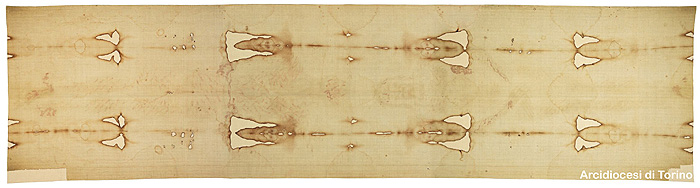
Restored Shroud Unveiled
Photograph © 2002 Archdiocese of Turin
As I reported in August, a major restoration of the Shroud of Turin was undertaken by its owners in June-July 2002. All thirty of the patches sewn into the cloth in 1534 by the Poor Clare nuns to repair the damage caused by the 1532 fire were removed, allowing the first unrestricted view of the actual holes burned into the cloth by the fire. It appears that some of the most seriously charred areas around the burn holes were also removed during the restoration. The backing cloth (known as the Holland Cloth) that was added at the same time, was also removed and replaced with a new, lighter colored cloth, which can now be seen through the burn holes. As you can see, virtually all of the creases and wrinkles that had been previously evident on the Shroud are gone. For larger, more detailed views of the individual ventral and dorsal images and the ability to compare the old with the new, visit the Examine the Shroud page of this website
In a press conference held in Turin on September 21, 2002, the world was introduced to the newly restored cloth. New photographs and a full account of the restoration (in Italian) first appeared on the Archdiocese of Turin Website. In an effort to provide you with the most up-to-date information, I am including an Acrobat PDF file with a very preliminary computer software generated English translation of the "Story of the Restoration," graciously provided by Rev. Albert "Kim" Dreisbach, Jr. It is a bit rough, but should give you a good overview of the original article by Mons. Joseph Ghiberti that appears on the Archdiocese website. I also want to thank Emanuela Marinelli and Alessandro Malantrucco for keeping me informed over the past 24 hours. I will include a better quality translation in the near future, although I expect the multi-language Archdiocese website will soon be including an English language translation themselves.
Bigger words than I know alert!
Hopefully I'll learn something.
Need a little help opening some eyes around here.
Ah, but that is where the new stuff is. I've read the others.
--------------------
The history of the restoration 2002
Tuesday, July 23 rd 2002. The Shroud lay on the ' lettino Microtecnica' in the decent humility of its recovered nudity. It had left its chapel and 'reliquary Alenia' five weeks before and now it was about to return. To the arrival of Mons. Lanzettis entered in it ' sacristia nuova' all the persons that attended in the ' corridor to vetri'; to an instant of concentration it followed a brief comment on the moment that the history of the Shroud was living. The Auxiliary Bishop, led then a choral prayer in representation of the archbishop that had gone to reach the Pope in Toronto for the World Day of the Youth. A procession was immediately formed to accompany the Shroud to his chapel. Apart Mechthild Flury Lemberg and Irene Tomedi looked at the procession that was taken off with a stringimento to the heart: It seemed a funeral procession.. When it ended, the confidences came: During the job we strove to not think too much of the mysterious reality that passed between our hands, to not lose the thread of what we had to do. But every time that we interrupted, returned the tremor of the wonder at the end of a day. At the end it increased the desire to stop us in company of that cloth to excess, to be able to talk to that Suffering. The time there was not instead just now more. So it was for all those that had lived with grieved intensity those five weeks. From the Thursday evening 20 June to the Tuesday evening July 23 rd 2002 the Shroud had remained out of its reliquary and of its chapel. It returned somehow rejuvenated. But how much road was one due to cross from when it had entered for the first time in the 'reliquary Alenia', in November of 2000, on completion of the exposition.
The idea of a conservative intervention on the Shroud, on the basis of that that had been operated from the Clarisses of Chambéry in 1534, a lot of time first interior shot the Errand had been ventilated for the maintenance of the Shroud
The Cardinal Saldarini, who had received the trust of the Shroud in the period of the maximum polemic follows to the analyses of C14, had the delivery to not think of new scientific searches and to face systematically instead the problem of the maintenance of the same Shroud. It constituted therefore in 1991 a small group of job with the charge to prepare a meeting of competent persons to treat the problem of the maintenance. We were all new to Shroud enterprises organizational, strongly conditioned by a past that it weighed like a boulder. The delivery moving us in the total reserve was narrow since the beginning.
September 7 th 1992 a small errand, still a little bit informal, after a day of departed preparation to Pianezza it had the fortune to contemplate the Shroud, for quite a lot times, in the sacristy of the Cathedral (we now call it the 'sacristy vecchia', but the historians of the Cathedral say that it is not the most ancient), with the assignment to formulate judgments for its maintenance. It began to snow the proposals to improve a condition that, if it had his explanation in the historical circumstances of the Cloth, it didn't correspond to the acquisitions of the science of the maintenance of the ancient fabrics
The most worrisome observation concerned the presence of the folds on the figure of the Shroud, especially on the face: more and more numerous and aggressive. All agreed in requiring that the Shroud was no longer preserved rolled up; besides that it was freed by the numerous bonds that held it hold: her ' superior fodera', the frame of silk between the blue and the greenish one, the silver sticks present in the short sides of the frame. We also spoke - like of an utopia - of the liberation from the patches, taking back a discourse that had already leaned out in 1969 during the job of the scientific errand created by the Wandering Cardinal
Nothing was made of all this. The Shroud had to return in its closet, in it 'glory' of the altar of the Bertola, and of there one didn't know when it would have been able to be removed. The Providence however it drove the things in a mysterious way of which only at the end we succeeded in following the interlacements a little bit. 4 May 1990, party of the Shroud, in the chapel of the Guarini they were detached from the groins of the dome some pieces of marble. It was finishing the Mass of the festive day and, if the pieces of marble had struck some participant to the function, would have been a tragedy. Fortunately, nothing happened, but the authorities decided to close the Chapel and to undertake a radical restauration of the dome of the Guarini. What of it of the Shroud would have been there? In dialogue with the superintendence, the cardinal decided to move it to the choir of the Cathedral, in a small monument of glass designed by the architect Bruno. On February 24 th 1993, Ash Wednesday, the Shroud left that chapel that had been built for it and inaugurated three hundred years first, in 1694. It remained in the choir of the Cathedral for four years. About ten days past Easter of 1997, when in the night in the Friday 11 April and the Saturday 12 a furious fire brought the panic in the Cathedral, it damaged a wing of the palace building and it sowed destruction in the Guarini chapel. The Shroud didn't suffer any damage, but it was taken off for a year from its usual location
All these movements stimulated the Errand of the maintenance, that was gathered of so much in so much, to deepen the initiated reflections in 1992. Cardinal Saldarini was more and more convinced that it was not more eludibiles the application to preserve the Shroud firmly in extended position, of rest, on a lettino. But this demanded an afterthought of the architecture of the chapel of the Guarini, that had been planned instead to circular plant, in operation of an a little wider container of a meter: now it was necessary to place a container four times greater, without touching the ancient architectural structures. Suggestions, attempts, proposals followed without laying in a comparison that it saw architects, representatives of the Superintendence, members of the errand in continuous dialogue. Before a satisfactory solution was found came the terrible night of the fire. Unfortunately, the Guarini chapel would not be repaired for many years; it was then decided that the Shroud would be moved to the left extremity of the transetto, in the Cathedral
Since then it is stored in that 'chapel of the Sindone'
To this it was worth the punishment to take back all the thematic of the maintenance touched to the beginning. it was invited to belong to the group and to give an American scientist, that united a love only to a rare competence and authoritativeness for the Shroud to his contribution. Alan Adler had been a conquest of Father Rinaldi, a Piedmontese Salesian transplanted to America, where he spread the most impassioned interest for the Shroud. It now became the providential bond that resulted in relationships with the American researchers and it allowed to recover the rich thematic of their searches. He came to Turin to more resumptions, up to the symposium of Villa Gualino, in the March of 2000. A little afterwards it came, on June 12, Adler died, preventing him from participating in the second exhibition. To him we owe many suggestions for the maintenance of the cloth, such as maintaining the Shroud in an atmosphere of inert gas
Adler was very worried of the possible harmful effects of the residues of the fire introduced under the patches applied by the nuns of Chambéry. When he spoke to the errand, he didn't escape from the most advanced hypotheses, that they remained in the drawer of the dreams: it so also happened with the proposal (not new, but now enriched of the weight of his authority) to detach patches and lining from the Shroud
But to the moment of the new official photos, in 2000, ideas returned to emerge, when he underlined more and more the dirt that had to be accumulated between the patches and the lining
In the preceding years had been already done interventions liberanti, what the removal of the frame of cloth and the silver sticks, and always if it was verified some advantage on the Cloth that returned a few for time to breathe: it was not advisable to complete the operation in definitive way? The reflection was long, but at the end the illuminating word came from the doctor Carla Enrica Spantigati, superintendent for the artistic and historical good of the Piedmont, a part of the Errand: five hundred years of cohabitation between Shroud, Holland cloth and patches almost confer really a characteristic of stable tradition in the life of a relic. For in comparison to this history and to the tradition of generations of believers and visitors of the Shroud that know it with these characteristics, it would be to recommend the permanence in the actual situation. If however they are us serious motives that have of a remarkable advantage thought for the maintenance of the same Shroud when patches and lining are removed, then those reasons can surrender the footstep to the emergent demands of the same object
The whole Errand stuck in this way to reason and a document was worded, to signature of everybody, to introduce ours to the pontifical Custodian to consider. The Cardinal Poletto examined it and definite to do coming to the Pope. It was the Cardinal Secretary of State that brought it personally to the Pope and, after taking it in consideration, gave permission for the intervention. The answer from the Cardinal Sodano, Secretary of State, was dated November 3rd 2001
Having gotten the permission, all advised to proceed to the realization without delays. But a non indifferent quantity of problems remained to resolve. First. between everybody, the place in which to bring the Shroud to perform the job. L'11 September of 2001, with the demolition of the 'towers' in New York, had left in the conscience of the opulent west the awareness of its vulnerability and in the big Italian cities had been identified important points, that can become object of attacks. To Turin the Shroud was on top of the list. In a meeting between civil authority and religious authority it was discussed the necessity to find a shelter for the Shroud, concluding in favor of him however ' status quo'. But would not the dangers be increased with the move? Any release of news was enough to bait a perverse chain of reactions to damage the object that was so much a jewel
It was taken in consideration the launch environments, but at the end the Cardinal Poletto, pontifical Custodian, definite for the 'sacristia nuova', that had already entertained all the preparatory and following operations to the last exhibition: the Shroud doesn't go out from the area of the Cathedral; they will take all the necessary precautions. First was the silence: it was decided to say to all those that would ask possible information that it was not happening (the difficulty of the mental restrictions!). Meanwhile the allertamento of the police came, the recourse to the faithful ones ' City of the ordine' (one which had already done service at all the public exhibitions since 1978) and the execution of a fence that continued with naturalness that of the yard of the sottoduomo and meanwhile it created a kind of go between the 'sacristy nuova' and the plaza
The preparations were slowed down from the reflection and discussion on the particular ones of the intervention on the Shroud. They were all of accord that the old cloth of Holland it was able alone to be musealizzato, dates his precarious conditions, especially in subject of cleaning. The patches which end they would have done? They had to follow the fate of the lining; but was it the case to think of a substitution? Despite there had been a precise orientation for the no in the proposal of the November 2000 and this orientation had been accepted from the pontifical Custodian and from the Pope himself, he still wanted to leave an open door to the reflection: the last decisions owed taking to being in progress of work
But soon he saw that it was not necessary to return on the discussion. Mechthild Flury Lemberg came to the last preparatory meeting with a facsimile of the job that proposed to perform on the Shroud: on a piece of cloth ' similsindonica' (prepared by Peter Vercelli) a scorch had been performed similar to those that they observe on the Shroud and on the bottom had been applied a piece of the lining that would have replaced that historical one. Cloth ' similsindonico' and lining were almost stopped from an invisible seam of perfect invoice. All the members of the Errand judged the really convincing conservative result and it were easy to confirm the primitive decision to remove the patches without proceeding to one substitution of theirs
I don't want to bore the reader with the relationship of the whole preparatory job that brought to the definitive result. It doesn't make sense to say that it was an optimal job, but humanly it is possible to affirm that we tried to not leave anything to chance and to avoid any form of risk
A big worry remained: documenting the most possible as would have happened and to acquire the biggest number of given to put to disposition of the community of the scientists. To complete job the appearance of the Shroud would be a partially new result, but a public exhibition was not thinkable that it allowed the vision to of it a large number of persons: it was necessary therefore to provide to an immediate acquisition of images to distribute as soon as possible. Then the side which would usually have been visible in progress of work hidden of the same Shroud, the back, when lining and patches had been removed. But it would have been a provisional situation, because it was absolutely necessary to apply a new lining: the cloth has preserved an exceptional sturdiness certainly, having also faced so many vicissitudes, during its history, but it needs a support, to be able to be handled with safety on the occasion of the exhibitions is above all because it can be preserved the parts damaged by the fire of 1532. The application of the new lining happened, the back or toward some Shroud would have returned invisible for the one that it knows how much time
To the images it was thought to provide in more ways: applying to study it Giandurante, that had already made the official photos of 1997 and 2000, to get new traditional photos (with normal apparatuses and with digital apparatuses) of the straight one of the Shroud and traditional photo still (the first ones and for a lot of anchor the only ones) of the toward some Shroud is in global vision is in particular reduced; effecting a program of total scanning of the surface sindonica is in the straight one is in the verse (entrusted Electronic National Galileo Ferraris, that had already done a partial realization of scanning in 2000 with the equipment of Paul Soardo of the institute); the everything had to be accompanied by instant photographic documentation of the principal moments of execution of the jobs, for a documentation in support to the minutes (it was thought by Giuliano Marchisciano and his collaborators). Video was effected by a team from Telesubalpina (Daniel D’aria and Vittorio Billera) in particularly meaningful moments
We also discussed the possibility of picking up other data and him dovettero to face, as always, indeed the difficulties of the time and then those of the same nature of the Shroud, to which can not be had some risk taken. We excluded for instance, the fluorescence spectroscopy to RX, of delicate nature and of which some results of the measurements of 1978 still exist. They decided instead on reflectance spectrophotometry, UV VIS, ghosts of fluorescence and ghosts Raman on the front of the Shroud. Object of particular discussion was eventuality to operate miniprelievi on the toward of the Shroud. The prevailing tendency was for no, having been chosen the criterion of the visual reliefs only, but there was who made notice that on the verse they would not be each other more can not make probably interventions for a period brief. The matter was resolved in way of jeopardized by the pontifical Custodian, that allowed some collecting with adhesive ribbon (completed, in the same places, with process of aspiration), reserving him the exclusive one for the use of that material, that is preserved in its file sindonico. The course of the events would have made partially then superfluous this discussion, because how much was picked up to the moment of the leaving of the patches and the cleaning of the holes produced by the fire it got an unsuspected quantity of material for future examinations
A chapter itself could be represented from the preparation of the tools for the varied phases of the job. For the transport of the Shroud it was used the 'lettino Microtecnica', on which the Shroud usually lies, and the table mobile basculante, that allowed to face the brief trip without winces. In her 'sacristy nuova' was still used the 'lettino Microtecnica' on the table mobile basculante and, in alternation, the 'lettino Bodino' and a double table, preserved by the preceding jobs and repaired for the first phase of the photographic resumptions. The problem of the scanning and the moviment of the apparatuses of resumption above some surface sindonica was resolved with the construction of a mobile bridge (the ' bridge ADL') applied basculante to the table (already realized in 2000 from the ADL). For the necessities of the seam, that it required under the cloth sindonico and its lining a hard and smooth surface, that postponed the bent needle used by the operative ones, on the 'read Bodino' was applied a surface of glass and on of it would have abandoned the new lining with the Shroud above. To disposition of the operators Mrs Irene Tomedi had set a videomicroscope (enlargement from 80 to 450 times) with elements optic terminantis to the extremity of a cable to optic fibers, furnished of a monitor of a printer and of possibility of digital recording,: it allowed a perfect vision of all the particular of the fabric, distinguishing the polluting substances from the crustings of blood, and it gave safety to the action of pulitura of the operative ones. To the instrumentation it was still added a delicate aspirator and a vaporizer to ultrasounds, besides a series of slides and lead weights, to operate small conciliatory pressures on the folds of the Shroud. Sindonico for the protection of the cloth often resorted to the paper laughed Japanese anacida,; for the transfer from a lettino to the other he used a big sheet of paper melinex, resistant and easily removable
The execution of the conservation program happened three times: to a) remove the old lining (the famous ‘Holland Cloth) and of the patches and execution of the intervention ' distensivo' on the folds in the part of the toward of the cloth sindonico (21-25 June); b) photos, reliefs spectrophotometry and scanning of the verse and the straight one (26 giugno-15 July); c) fixation of the new lining indeed in the areas of the holes and then along the whole perimeter, last photographic action to create an image of the new figure of the Shroud, measurement of the Shroud in the new setup (16-23 July). Phase b), that required the greatest employment of time, inclusive also the preparation of the new lining and one his first provisional fixation, through impuntura of the superior side only, to give to the scanning of the anterior side (the straight sindonico) the definitive vision of the holes filled already by the lining
In the scanning of the times of the program a discard was usually verified in saving from the staplers and a discard in loss from the operators of the reliefs. Staplers were Mechthild Flury Lemberg and Irene Tomedi
First had been invited to interest in the Shroud since the time of the preparation of the analysis of C14, to half the years ' 80 (but she had left the group then), and subsequently, beginning from 1992, never missed any of our meetings. From the point of view of the fabric she is today the biggest authority in field sindonico. The second, formatasi near the Flury in the school of restauration of the Foundation Abegg, to Riggisberg, in the press of Berna, work from vent'anni as restauratrice in Italy. The agreement between the two restauratricis was always perfect
We don't underestimate the difficulties of the scucitura, the doctor Flury Lemberg repeated. An unknown initial it was really constituted by the splendid but dense seam with which the Clarisses of Chambéry had fixed the cloth sindonico to the lining and the patches. An unexpected help came from the scalpels gotten from Pier Luigi Baima Bollone: small, pointed, sharp, in the hands of the operative ones they replaced the earwigs too slow, fatiguing and insecure and they operated miracles
Operating some reliefs were the technicians involved by Peter Savarino (the Raman spectroscopy was performed from the doctors Tagliapietra and Courses, the examinations in riflettanza and fluorescence from the doctors Pilgrim and Caldironi) and Paul's Soardo équipe (Joseph Rossi, Paola Iacomussi, Natalia Bo)
To them they added each other, for the resumptions in fluorescence, the inspectors of the scientific police in Turin Diego Ambroggio and Charles Marchese, to the dependences of doctor Maurice Celia
The impressive discovery came to the opening of the patches, that authentic containers of carbonaceous residues and deposits of dirty waste were revealed. It was the confirmation of the necessity of the conservative intervention that was operating him. But meanwhile it began the problem of the management of that material, that to a large extent it originated from the primitive Shroud and however you/he/she had been for centuries to contact with it. Peter Savarino, scientific advisor of the pontifical Custodian, brought a whole battery of containers, that they came systematically labeled and they welcomed how much you/he/she originated from the varied points of the cloth, qualified all second a mappatura used already during the jobs of 2000 on a photo sindonica to natural greatness. Quite a lot facsimiles sindonici in these days was employed for varied uses, because the harvest of data happened in the most varied forms and it was necessary to predispose a guarantee of recognition for each of the operated reliefs. All the particular of the daily execution of the jobs was recorded in the minute, entrusted to the secretary of the Errand, Suor M
Clara Antonini, and to his collaborators. In some circumstances it was thought to resort to the guarantee of the Chancellor arcivescovile, that acts from notary in ecclesiastical hole for all the events that involve the Shroud however. This happened when on the side of the back it was in presence of small leaning threads, fruit of inequality of the fabric and that the restauratricis advised to remove. Nothing is meaningless in the Shroud and everything you/he/she can reveal precious to the goals of the search. It was therefore necessary to guarantee the authenticity of every more small rest or fragment. The same thing was necessary, and you/he/she was done, for the miniprelievis of which you/he/she is spoken him above (n. 9). The Chancellor arcivescovile also checked the operations of filing and it picked up all the small containers in an only general container, it affixed the seal to you arcivescovile and he withdrew same the material, that will stay so to disposition of the Saint Center, of the pontifical Custodian and - when the Pope will judge it opportune - of the scientists to which will be entrusted the future searches
Removing the patches, it came to light the painful reality of the effects of the fire of 1532. We learned that it is true, almost anywhere some cloth, because the Clarisses had refolded to the inside the edges of the damaged cloth, but making the accounts was necessary with the borders charred of the holes produced by the fire. Many fragments had already detached and they constituted the thin dust of present coal under the patches, but evidently the process of carbonization had ' camminato' (like Adler had affirmed) and it was not probably it is stuck halted. Which intervention had to be operated? The cut of the part charred for coming certainly on the part of uninjured cloth would have produced an unnatural effect and devastation
We decided to remove with the tweezers the whole material that would have surrendered to come to that edge color marroncino that allowed to realize the reality of the ancient disaster to the traction. So we reached the result of a cloth altered not more by the intrusion of patches, but also marked, in that thin browned edges, as from scars of a dramatic event
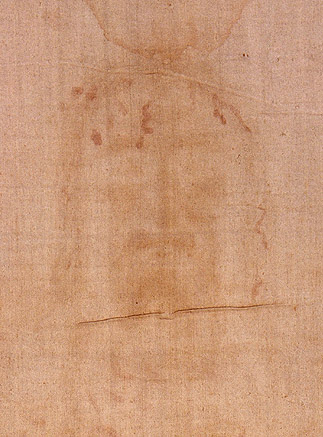
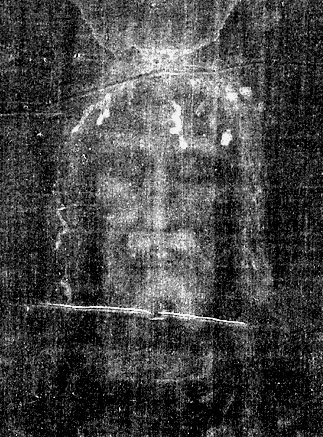
The second phase of the job departed from the condition of the Shroud with the toward in evidence, turned toward the tall one, and it finished with the return to the vision of the part of the image. The Shroud confirmed how much it was already been able to establish in the partial scanning of 2000: on the toward of the cloth sindonico all the blood was visible, that was pierced in such a total form to constitute rhyming sure for the identification of the corresponding point on the straight one; it was not instead recognizable anybody trace of image. The only point of possible discussion was constituted by the face, because in the verse they seemed identifiable the two gangs of hair. You insist therefore some acquirable details with all the means of relief. Waiting for the analyses that will be done beginning from these gives, the presents were found of accord in him to attribute the impression of image for that alone point of the whole surface sindonica to the fact that the two gangs bring traces of blood pierced from the facial surface and to the fact that is above all on the right part in that point it foresees a darkest strip on the same fabric, due to some cause insudiciante
Some difficulties in coordinating the interventions, giving the time to the delivery of the tools, brought above all to some days of reduced job. They were however always exploited for a completion of the documentation and for the relaxation of the cloth sindonico from the part of the verse. The greatest problems had presented in the preparation of the scanning. How would we be able to face the enormous surface of the Shroud and be able to manage the acquisitions subsequently? Information on the instrumentation to use dovettero to confine for motive for time (it could not go past the month of July, to not take the risk of ending in a period of vacations) and, it can be prepared of a possibility of resumption of the format only To 4 to the surrender of the accounts. You dovettero, accordingly, to perform for each some two surfaces 102 resumptions. The times of suspension were exploited for getting the ' back up' of the stored data. It will be the operators themselves, in the opportune center, to describe the innumerable surprises that made them remain with the breath suspended up to the term of the job. In our publication it is not still possible to offer a congruous number of reproductions of the job of the scanning, because the necessary time for the elaboration of the picked material and the identification of the single images overcomes the time of preparation of this first relating of events, that wants to give a timely communication of the whole action owing to make the accounts with the interruptions of the summer pause however
The new lining, on which the Shroud is now attached, is a raw flax, given by Mechthild Flury Lemberg
She had bought in Holland (still ' cloth of Holland'!) a cinquantina of years ago for possible family uses, that were not then. Mrs Flury washed it more times for disapprettarlo and to confer on it softness, without however neither bleach nor to color it. It preserves therefore the character of fabric treated not chemicallly and the color intense ivory, that gives soft relief to the void in the holes left by the fire of 1532. Its textile structure is normal, rather than very elaborate like that of the cloth sindonico, from which also for this it is easy to distinguish it
The photos performed by the équipe of Gian Charles During (Joseph Cavalli, Daniel Demonte, Tiziana Durante) with the consultation of Nello Balossino they can not enjoy any same elaborate preparation of 2000, but they bring equally the characteristics of total reliability of I Study it that they have accumulated the greatest experience in the field of Shroud photography. The Shroud has been photographed with the Shroud positioned on the ' third tavolo's, held up perfectly not from easels with angolatura ortogonale (around 105°), while the side with the image, photographed at the end of all the operations, was held up perfectly from the table basculante in position ortogonale. To photograph the toward some Shroud was employed a trabattello on which was positioned the photographic car, while for the side of the image the car was positioned on a tripod on the ground. As was previously done for the photos of 1997 and those of 2000, Gian Charles During also generously gave up all his copyrights for these new images, leaving the archdiocese of Turin as the sole owners of the photographs
Out particularly precious program was the recognition of details of the cloth sindonico performed with the microscope of Mrs Tomedi. The optic element can be fixed to the mobile bridge, in way to be able to move from point to point and then to maintain necessary immobility for the resumptions. You/they were taken of aim above all the points of great accumulation ematico and he immediately saw the advantage of the maintenance of extremely suggestive images. The recording was made on digital cassettes and it was motive for great emotion for how much they had occasion to take some vision in that days. Its suggestions are particularly accented by the effect of the filmed one produced by the same ribbon. The immediate connection with the printer made contemporarily made possible the photographic capture of the particular areas that aroused interest
To the microscope she still applied for the recording of details of other cloths, deriving from the Museum of the Shroud, with the purpose to establish a comparison between the cloth recante the true image sindonica and others gotten in attempts of reproduction of that image
At the end of the second section it was gotten off the mobile bridge fixed to the table basculante. Conceived by Giangi Ardoino, it had been performed to tappe requested from the firm ADL and one of the tools of more precious job was proven. It raced on rails fixed to the sides of the table basculante and it covered transversally contemporarily the whole surface sindonica, holding up the tools that of time in the times they were applied to it: the scanner, the optic element or circumferentor of the videomicroscope, the photographic car for the fluorescence photos, the sensors for the spectrophotometric reliefs. Two ribbons, gifted of digital numerator of the distances they allowed to individualize the entity of the moves automatically and to fix the positioning of every operation on the long side and on the short side of the cloth. Certainly, the mobile bridge didn't resolve all the problems (motive for worry, was the verification of the possibility that the scanner also operated the resumptions in the inverted position of the apparatus for the scannerization), but undoubtedly many reliefs would have been unthinkable without it
The last phase of the job left jobless the greatest part of the members of the Errand and it weighed totally on the restorers. Mechthild Flury Lemberg had taken care of the perfect adherence of the cloth sindonico to that of the new lining and Irene Tomedi it was focused in the fixation of the holes of the scorches particularly. The job proceeded with quickness and how much they were leaned out on of it they didn't succeed in distinguishing the holes systematized already by the others, so much invisible era the intervention of the restoration. Thin and a little bit bent the needles, almost fleeing (like an 'angel’s hair'!), yet strong, the thread of silk that was employed. It is interesting to check on the photos of the surrounding surface the holes, to verify how much visible is some impuntatura
The fixation of the borders of the Shroud to those of the lining was performed with a thread more corposos
A small problem was introduced by the zones where it had been removed (in ancient times) some part of the fabric sindonico, above all to the extremities of the superior strip (in position ostensiva). The precedent ' Holland cloth' was extended for the whole original length of the cloth sindonico and also it was necessary now to reconstruct how much of it was missing. The thing was not easy, because the cloth sindonico is not perfectly rectangular, on the contrary it is lengthened to the four extremities. The experience of the restauratricis came of this problem happily to head. The Cardinal Poletto, Mons accompanying. Romeo, apostolic Messenger in Italy, was the first one to congratulate them for the result of their work of passage to Turin
Who observed the Shroud it rejoyced for its extended beauty. The signs of the vicissitudes continued to speak of the uneven walk that had crossed this holy Cloth, in the middle of the men, along the centuries
But the dramatic seems to have acquired a tone of serenity, in the acceptance of insults that he didn't pretend more than to hide and that the big testimonies of suffering were cooperated they you introduce in the image. It was still the same Shroud, but also the relaxation happened in the folds, that gave up the surly aggression that had made very uneven the cloth, brought a pleasant novelty
For case, was that novelty also extended to the dimensions of the Cloth? The first signals of a small change in the dimensions had already gathered them the operators of the scannerization, that had owed to see again the measures of the borders of overlap in every field of resumption. The verification was made at the end of all the operations on the cloth, to acquire the definitive measures of the Shroud, as it would have returned in the reliquary of its chapel. They were performed by Bruno Barberis and Gian Maria Zaccone, that they ascertained happens the growth in the proportion of some centimeters, on the base of measures that had already been effected in 2000. It is known that the measures of the Shroud can vary according to the tension to which the cloth is submitted. But a pair of data can be indicative: looking at the Shroud in position ostensiva (frontal figure to left and dorsal to the right), the side in low it measured in the 2000 cm
437,7 and in the 2002 cm. 441,5; the tall side (less indicative, because the extremities are constituted only by the lining, having been removed, anciently, two portions of the original cloth) in 2000 it was long cm
434,5 and in the 2002 cm. 442,5; the height to the extremities (with relative value, for the cause mentioned now) respectively cm. 112,5 to left and 113 to the right in 2000 and cm. 113 to left and 113,7 to the right in 2002
The present publication offers a first documentation of the history that we have now finished to narrate
The global photo will give the evidence of the new face of the Shroud. The succession of the details will allow to follow the carrying out of the jobs analytically. The presence of some documentary photos will grant a vision of the environment of the job and some of the persons that have participated to you. A ridottissimo I number of images scannerizzate it constitutes a small advance of the scientific publication that will crown the whole job
How much they have participated in this season of interventions they thank for the gift that we have received from the Lord for trust that has been them shown from the Saint Center and from the pontifical Custodian and for the help that has been lent to them by an incalculable number of collaborators and friends
Joseph Ghiberti
Disclaimer: Opinions posted on Free Republic are those of the individual posters and do not necessarily represent the opinion of Free Republic or its management. All materials posted herein are protected by copyright law and the exemption for fair use of copyrighted works.