Posted on 01/24/2005 10:53:22 AM PST by FoxInSocks
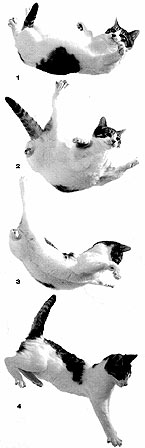
How does a cat land on its legs when dropped?
ANSWER 1:
Cats have the seemingly unique ability to orient themselves in a fall allowing them to avoid many injuries. This ability is attributed to two significant feline characteristics: A “righting reflex” and a unique skeletal structure.
The “righting reflex” is the cat’s ability to first, know up from down, and then the innate nature to rotate in mid air to orient the body so its feet face downward. Animal experts say that this instinct is observable in kittens as young as three to four weeks, and is fully developed by the age of seven weeks.
A cat’s “righting reflex” is augmented by an unusually flexible backbone and the absence of a collarbone in the skeleton. Combined, these factors allow for amazing flexibility and upper body rotation. By turning the head and forefeet, the rest of the body naturally follows and cat is able reorient itself.
Reports of cats surviving falls of several stories in height have coined the expression of cats having “high rise syndrome.” Like many small animals, cats are said to have a non-fatal terminal falling velocity. That is, because of their very low body volume-to-weight ratio these animals are able to slow their decent by spreading out – flying squirrel style. Simply put, animals with these characteristics are fluffy and have a high drag coefficient giving them a greater chance of surviving these falls.
ANSWER 2: (Moment of inertia is important . . .)
To understand how a cat can land on it's feet, you must first understand some concepts of rotational motion, since the cat rotates as it falls.
Rotational motion is similar to motion in a straight line (linear motion), however the constants are slightly different. For example, instead of the mass of an object, we use what is known as the moment of inertia.
The moment of inertia of an object is determined by the distance it's mass is distributed from the rotational axis. Think of a ball tied to a string that you swing around your head, the greater the length of the string, the greater the object's moment of inertia. Relating this to the cat, if the cat stretches out it's legs and tail, it increases it's moment of inertia; conversely, it can decrease it's moment of inertia by curling up. You can prove this by extending your arms while spinning around on a swivel chair.
Just as a more massive object requires more force to move, an object with a greater moment of inertia requires more torque (which is the angular equivalent of force, and is proportional to the distance from the axis of rotation) to spin. Therefore by manipulating it's moment of inertia, by extending and retracting its legs and rotating its tail, the cat can change the speed at which it rotates, giving it control over which part of it's body comes in contact with the ground.
ANSWER 3: (. . . and the conservation of angular momentum . . .)
If a cat is dropped they almost always tend to land on their feet because they use the conservation of angular momentum to change their orientation. When a cat falls, as you would expect, its centre of mass follows a parabolic path. The cat falls with a definite angular momentum about an axis through the cat’s centre of mass. When the cat is in the air, no net external torque acts on it about its centre of mass, so the angular momentum about the cats centre of mass cannot change. By pulling in its legs, the cat can considerably reduce it rotational inertia about the same axis and thus considerably increase its angular speed. Stretching out its legs increases its rotational inertia and thus slows the cat’s angular speed. The conservation of angular momentum allows the cat to rotate its body and slow its rate of rotation enough so that it lands on its feet safely.
Animal experts learned this by dropping baby kittens :-)

My dad used to call this "The Official Cat Trick".
Just another unique power in the Viking Kitty arsenel.
Here's a point to ponder. If a buttered piece of bread lands buttered-side down more times than not, and a thrown cat lands almost always on their feet, what would happen if you affixed a piece of buttered bread on the back of a thrown cat?
I don't know but lets put a pancake on its head and see what happens.
I wonder what kind of "research" they did to determine how they survive falls from several stories? :)

That was my first thought after read that line. Then I started to laugh. I am sick :)
all that without a degree from mit!
I like your way of thinking.
I wonder if you dropped a bunny if it would land on its feet.
They use their tail to flip themselves into landing position.
NEXT QUESTION...
Depends on the price of the carpet.
"OK, hand me one of the one-week-old litter....Nope. Two-week old....Nope. Three-week-old....Hey, that one worked!
"OK, get the cleaning lady in here."
Cats ALWAYS 'jump'!
So a cat without a tail will not land on its feet?
I wonder if I could get a grant to study this. I have two Cats.
Disclaimer: Opinions posted on Free Republic are those of the individual posters and do not necessarily represent the opinion of Free Republic or its management. All materials posted herein are protected by copyright law and the exemption for fair use of copyrighted works.