Posted on 02/25/2006 10:44:53 AM PST by blam
Ancient refuge found by workmen

The stone-built tunnel leads into the hillside
Workmen have unearthed 1,000 years of history on a County Down building site. They have come upon an underground stone-built tunnel in Raholp, where our ancestors might have hidden from the Vikings or from warring neighbours.
Archaeologist Ken Neill said that with chambers off from the main tunnel it was a quite complicated souterrain, and probably built by better off farmers.
The opening that led to the tunnel - which leads into the hillside - will be sealed and the passage left alone.
"It was really somewhere for you to get down and hide when your area was being attacked by your neighbours or Vikings," he said.
"You would get down into this and you would be relatively safe.

The souterrain was found on a building site
"It would be a brave man that would come down one of these after you - not knowing the plan of it and not knowing at which corner he stuck his head round you'd be waiting on the other side with an axe or whatever."
There are about 1,000 known souterrains in Northern Ireland, about 100 of which are in County Down.
They are one of Ireland's most distinctive archaeological features but very few are accessible to the public.
While the one on the building site is being closed off the Finnis souterrian, near Dromara, is open to the public.
Known locally as Binder's Cove it was found in the 18th century and consists of a main passage of around 30m in length and two straight side passages on the right hand side, each approximately 6m long.
GGG Ping.
What is the nearest town?
Being in Ireland, I thought you meant a pub...
Instead of hiding from the vikings is it possible they stored their vegetables there?
Sounds like a good old fashioned "cave" we used to have on the farm.
Hiding when the Vikings came to town seems like a very good idea.
bump
I thought the Vikings were peace loving seafarers who only wished to trade with their neighbors. Why would anyone want to hide from them?
At least Daunte Culpepper can be confident in knowing upon which bench he will be sitting come September.
Because of a trip I took to Ireland in 2001, I am the grateful recipient of a beautiful bi-monthly publication called "Ireland of the Welcomes".
In the most recent issue there is a long article about Newgrange, Knowth, and Dowth -- three 5000 year old stone age burial sites north of Dublin. Apparently, Newgrange is also an astronomical site, built in the stone age to mark the shortest day of the year.
Newgrange has a slit in the ground that focuses a sunbeam on the day of the winter solstice against the back wall of this long tunnel. Dec. 21 or 22 is the only day of the year when the sun can penetrate the tunnel and fall on the wall at the end.
These burial mounds are quite elaborate and decorated with many spirals and other figures of ornamentation. They were built by stone age people long before the pyramids of Egypt without the help of metal tools.
The article was fascinating, and I am sorry that Newgrange was not on our tour.

Newgrange interior.

The Winter Solstice sun illuminating the quartz wall. I don't know if this will flash, but if you go to the Knowth link above, you can see this photo in action.
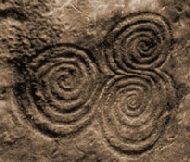
Famous Irish megalithic tri-spirals seen in the cave.

ping

Actually, you're not completely off base here...the Danish Vikings who cruised the British Isles were the warlike, rapacious lot; but, the Swedish Vikings traveling south into Europe were more likely to trade with you as kill you.
Our tour guide and bus driver on my tour of Ireland 5 years ago would regale the passengers every time we came to a near collision with our huge bus on the impossibly narrow Irish roads.
"Viking!" he would spat while he muttered a disgusted oath under his breath at the driver of every oncoming car that cut too close to our bus.
...and the bad memories of Vikings continue in Scotland. At the new year, only a dark haired man is allowed to enter for "first foot." No blondes...
Thanks, excellent pictures and links.
Any idea the meaning of the spirals? I've seen these all over the world.
Thanx 4 those kind words re Swedes....
While the Vikings from Norway and Denmark went hunting for new land in the west and southwest, the Vikings from present-day Sweden usually went east and south-east.
There was another aspect to their business abroad. While the Danes and the Norwegians usually conquered and colonized, the Swedes traded (although they were well armed and certainly knew how to fight) and didn't seek to establish kingdoms and colonies.
There were Swedes that went on voyages with the Danes and Norwegians (at that time the differences between the countries were much less than they are now), but the main stream of Swedish Vikings went eastward. They travelled much farther east than any other European people. The Swedish Vikings even travelled as far as Jerusalem (or Jorsalir as they called it), the Caspian sea, and Baghdad (they called it Särkland). Hundreds of Swedes travelled to the eastern Roman city Constantinople (or Miklagård). Many of them returned rich from their combined trading/plundering expeditions.
There are more ancient English coins found in Sweden than there are in England, and over 90% of all the coins found in Europe from Baghdad and surroundings have been found in Sweden (Gotland to be precise).
Hmmmmm....
But they did establish colonies in North America. One one side of my family, I am descended from Swedish immigrants who founded New Sweden in the Philadelphia & Delaware area in the 1640s. The colony lasted only a few years, eventually conquered by the Dutch and then taken over by the British when the British ran the Dutch out of New Amsterdam.
The Swedes and the Finns sailed together and intermarried a lot too.
That hmmmmmmmm....was in response to the dark haired man comment.
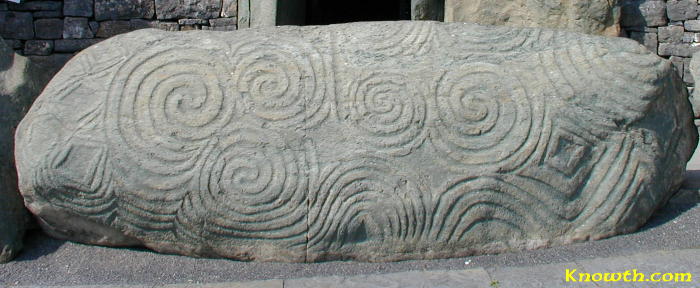
The tri-spiral design on orthostat C10 in the back recess of the chamber at New Grange is probably the most famous Irish Megalithic symbol. The design is often called a triple spiral; however archaeologists call it the three-spiral stone. The tri-spiral is often referred to as a Celtic design, however it was carved about 2500 years before the Celts reached Ireland. The tri-spiral design is quite small in size at 30x28cm (12x11 inches) which is less than one-third the size of the similar design on the entrance stone.
I don't have the original magazine article ("Ireland of the Welcomes") at hand, but as I remember they have been unable to unlock the secret of the carvings. So far, they have not found a "Rosetta" stone for these megolithic symbols.
I don't know what period you are talking about here, but my Swedish ancestor arrived on the Kalmar Nyckel (asa a seaman) in the 1640s with the first governor at the age of 19, worked for the governor as skipper of his private yacht for a year and then went back to Europe to collect his wages.
Family history says that his accumulated wages were paid partly in Amsterdam and the remainder at his home port in Sweden. I'm certain that some ships paid their crews out of London too. It only makes sense.
After collecting the rest of his wages in Sweden, he found a bride and the two of them returned to New Sweden where they established a farm and began to raise a family.
If this was the normal pattern of Swedish sailors, it only makes sense that a lot of foreign coinage would arrive back in Sweden where it was used to acquire goods and to pay off debts.
Just guessing...
I don't know how much credance to put on this because all of the other links say that they do not know the meanings of these carvings, but this makes sense to me.
The period I was referring to was the Dark Ages--WAAAY before Sweden was organized as a country. Think 600 AD rather than 1600 AD...
I thought the Vikings were peace loving seafarers who only wished to trade with their neighbors. Why would anyone want to hide from them?
At a glance, without looking at pictures for detailed comparison, the spirals remind me of some depicted in one of Marija Gimbutas' books on Old Europe (in the archaeological sense, not the Rumsfeldian sense, LOL) which she interprets in terms of birth symbolism related to earth goddess imagery, i.e. the spiral represents the descent into the "womb" of the earth/underworld. There are also similar spirals in Asian and Mesoamerican art, representing a stylized Yin/Yang shape, but there the end of the spiral typically has a more pronounced right angle at the whorl tip than what I see here.
The decoration at Newgrange plays an important role in representing the function of this site. The decoration n the kerbstone in front of the passage announces the purpose of the cairn. Newgrange was built with a passage which was oriented towards the rising position of the sun at the time of the winter solstice. At this time the sun reaches its most southerly rising position on the eastern horizon and reverses to start rising more northerly after the solstice.In effect the sun changes its direction of movement on the horizon at at the time of the solstice. The phenomenon of reversal of movement is graphically illustrated on the kerbstone in front of the passage (see picture above). The spiral ornamentation on this stone travels in two different directions separated by a vertical line. This mimics the revesal of movement of the sun at the time of the winter solstice, as represented by the movement of the sun's rays in the chamber of Newgrange. This spiral ornamentation is then repeated in other areas throughout the site.
The construction features of Newgrange provide the ideal environment in which to study the minute movement of the sun when it is at visual standstill at the time of the winter solstice. For the society which built it, Newgrange could have provided the earliest possible evidence that the sun had begun to reverse its movement along the eastern horizon, bringing with this change the promise of another growing season and the lengthening of daylight hours.
This naturally occurring phenomenon is celebrated in the unique ornamentation found at the site.
This is the best explanation I can find of the meaning of the spirals, although nobody really knows what they meant.
Well, we are all creatures of habit. What was good in 600 was good in 1600, perhaps! LOL.
The writings about Newgrange all remark on the similarity of other passage tombs found in Spain and Portugal. I think that there is no doubt that many ancient peoples were connected in some way.
Organization does change things...Uf Dah!
I was raised on a road named, Swedetown Road. Some of the family names on the road were, Anderson, Peterson, Ott, Vanek, Kasky and Haskew. Are those Swedish names?
I just leafed through one of Gimbutas' books I have for photo comparison. The spirals she includes closest to the ones I see in Post 13, though not identical, are some 5th-6th millennia designs from Eastern Europe, related to snake goddess imagery. I didn't see anything with the distinctive tri-spiral, though, which is an interesting feature.
The best books on decoding prehistoric symbolism I have read are Gimbutas' Goddesses and Gods of Old Europe and Adrian Bailey's Caves of the Sun. I would tend to interpret the Newgrange stuff along Bailey's lines. He compares the structure of a number of megaliths and myths with ancient beliefs about parallels between the annual seasonal cycle and the birth-death cycle, arguing that dolmens and similar structures are designed to draw a symbolic parallel between death and the decline of the Sun during winter (to sum up a detailed argument without doing justice to the book).
And as a Tolkien fan I can't help being reminded of Helm's Deep when I read this part of the first post :-)
It would be a brave man that would come down one of these after you - not knowing the plan of it and not knowing at which corner he stuck his head round you'd be waiting on the other side with an axe or whatever.
Neat links, Thanks.
The 3,000 year old Caucasian mummy found in China, Cherchen Man, had spirals on his temples when he was buried.
Obviously the Anderson and Peterson are Swedish, and some of the others may be too. What part of the country?
My mother's family name was Longacre, and we always thought it was English. We learned a few years ago, however, that it is actually Swedish. At the time the Swedes first came here they used the patronymic (sp?) method of naming their children. In other words Lars Peterson's sons last names would be Larson, or Larsen. His daughters' last names would be Larsdotter. This changed every generation, so there was no obvious continuity. The Dutch did the same thing.
When the English kicked the Dutch out of the New World and took over New Amsterdam they passed a law that said that all the Scandinavians and Dutch had to adopt the Anglo way of naming children -- the father's last name carries on through the generations -- because the Dutch and the Swedish methods were too confusing. This was in the 1700s.
We don't know the reason; but my ancestor, who at that time was named Anders Peterson, adopted the last name of Longacre (Lonoker), instead of Peterson. He is recorded in the records variously as Andreas (Anders) P. Lonoker, Longaker, or Longacre. At the time he owned a piece of land on an island in the Schuykill River (PA) that was long and skinny -- a long acre. Either he named himself after his land, or he named himself after his brother in law who was an Englishman and owned the adjacent land -- his name being Longshore. The two parcels are marked on the old map -- Longacre and Longshore.
Reason? I figure it was because there were already too many Petersons in the community! Or, he had a great sense of humor. And it has confused multiple subsequent generations.
But if you look at the lists of the "Old Swedes" from New Sweden, you will find many names that do not sound Swedish to our present day ears. In other words, not all of the names ended in "son".
What town would I find Swedetown Road?
Fascinating link. I'd love to see those textiles.
It's in a small unincoroprated town about 15 miles west of Mobile, Alabama.
My dad ran Browder's Dairy within the area of that map. All those roads on the left of the map are now on land that was the dairy.
Hmmmm. I don't know if any of my ancestors made it to Alabama, although their descendents are all over the place. My family branch went from Pennsylvania to Virginia to Tennessee to Missouri to Oregon to California. Other branches are in nearly every state of the union. Your "Swedetown Rd." was probably named for a later group of Swedes because by the time my family started spreading out they were pretty well intermarried with the Dutch, Finns, Norwegians, English, and Germans. My husband's family has roots in 'Bama, Arkansas, OK, and NC, but they were Scots-Irish.
When I looked on your Chinese link about the mummy, there was a paragraph about the "Dingling tomb". I couldn't help but laugh.
You can in this excellent book: The Mummies Of Urumchi
The author, Elizabeth Barber, has a PhD in textiles.
Please FREEPMAIL me if you want on or off the
Gods, Graves, Glyphs PING list or GGG weekly digest
-- Archaeology/Anthropology/Ancient Cultures/Artifacts/Antiquities, etc.
Gods, Graves, Glyphs (alpha order)
I know Vikings invaded what is now Ireland. Those Celtic artifacts look similar to Anasazi artifacts.

|
|
|
Disclaimer: Opinions posted on Free Republic are those of the individual posters and do not necessarily represent the opinion of Free Republic or its management. All materials posted herein are protected by copyright law and the exemption for fair use of copyrighted works.