Skip to comments.
Happy Patriots' Day (April 19, 1775)
The Library of Congress, Today in History ^
| April 19, 2007
| NonValueAdded
Posted on 04/18/2007 11:22:01 PM PDT by NonValueAdded
On April 19, 1775, British and American soldiers exchanged fire in the Massachusetts towns of Lexington and Concord. On the night of April 18, the royal governor of Massachusetts, General Thomas Gage, commanded by King George III to suppress the rebellious Americans, had ordered 700 British soldiers, under Lieutenant Colonel Francis Smith and Marine Major John Pitcairn, to seize the colonists' military stores in Concord, some 20 miles west of Boston.
A system of signals and word-of-mouth communication set up by the colonists was effective in forewarning American volunteer militia men of the approach of the British troops. Henry Wadsworth Longfellow's poem "Paul Revere's Ride" tells how a lantern was displayed in the steeple of Christ Church on the night of April 18, 1775 as a signal to Paul Revere and others.
One if by land, and two if by sea;
And I on the opposite shore will be,
Ready to ride and spread the alarm
Through every Middlesex, village and farm,
For the country folk to be up and to arm.
At Lexington Green, the British were met by 77 American Minute Men led by John Parker. At the North Bridge in Concord, the British were confronted again, this time by 300 to 400 armed colonists, and were forced to march back to Boston with the Americans firing on them all the way. By the end of the day, the colonists were singing "Yankee Doodle" and the American Revolution had begun.
(Excerpt) Read more at memory.loc.gov ...
TOPICS: Announcements; Culture/Society; US: Massachusetts
KEYWORDS: concord; lexington; revolutionarywar
Navigation: use the links below to view more comments.
first 1-20, 21-40, 41-49 next last
Happy Patriots' Day, the original holiday of that name, commemorating the day of "the shot heard 'round the world" when the British lobsterbacks marched on Lexington and Concord in the gun grab that started it all.
See also J. L. Bell's excellent Web site covering this period at blogspot: Boston 1775
By the way, there will be a quiz:
1) Hancock and Adams missed out on their planned salmon dinner that day. What did Hancock eventually pay for the meal he did receive?
2) Capt. Isaac Davis made the famous statement "No, I am not and I haven't a man that is!" in response to what question?
3) What was special about Davis' Acton Minutemen?
4) How many eventually responded to the alarm that day? Which group traveled the most distance?
5) Who was Mother Batherick and what did she do that day?
6) Who was the "White Horseman?"
7) Why would some think AlGore was present in Lexington & Concord on April 16th of this year?
8) In which Massachusetts town was the fighting the fiercest that day? (Extra credit for its name both then and now).
And double extra credit if you can source all of the answers within the confines of FreeRepublic.com
To: Pharmboy; CaptIsaacDavis; LS
2
posted on
04/18/2007 11:23:09 PM PDT
by
NonValueAdded
(Prevent Glo-Ball Warming ... turn out the sun when not in use)
To: secret garden; Robert A. Cook, PE; XRdsRev; gusopol3; Gondring
3
posted on
04/18/2007 11:28:18 PM PDT
by
NonValueAdded
(Prevent Glo-Ball Warming ... turn out the sun when not in use)
To: NonValueAdded
For the country folk to be up and to arm.People armed were vital to this nation gaining freedom. Now, it's vital to KEEPING it.
4
posted on
04/18/2007 11:38:20 PM PDT
by
Just Lori
(Trying to reason with a liberal is like sucking spaghetti through a straw.)
To: NonValueAdded
Great article WooHoo!
You should get some US Constitution History/Studies threads going also.
5
posted on
04/18/2007 11:47:21 PM PDT
by
RunningWolf
(2-1 Cav 1975)
To: NonValueAdded; indcons; Chani; thefactor; blam; aculeus; ELS; Doctor Raoul; mainepatsfan; timpad; ..
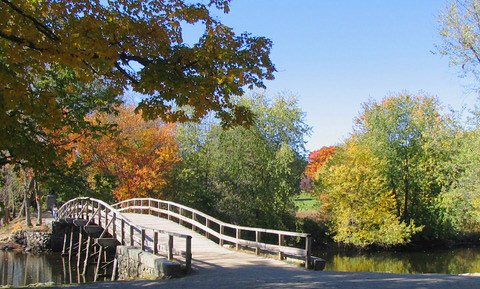
Concord Bridge
The RevWar/Colonial History/General Washington Ping list
Please freepmail me to get ON or OFF this list
Thanks for the post and ping, NonValueAdded.
Indeed, a great day to remember that those men who stood up that day did it for LIBERTY.
6
posted on
04/19/2007 3:30:41 AM PDT
by
Pharmboy
([She turned me into a] Newt! in '08)
To: Pharmboy
7
posted on
04/19/2007 3:42:23 AM PDT
by
aculeus
To: NonValueAdded
8.Menotomy (Arlington)— gotta go to work, or I’d be pursuing 1-7 also. God Bless the memory of Jonathan Harrington.
8
posted on
04/19/2007 4:05:35 AM PDT
by
gusopol3
To: NonValueAdded
By the rude bridge that arched the flood,
Their flag to April’s breeze unfurled,
Here once the embattled farmers stood,
And fired the shot heard round the world.
The foe long since in silence slept;
Alike the conqueror silent sleeps;
And Time the ruined bridge has swept
Down the dark stream which seaward creeps.
On this green bank, by this soft stream,
We set to-day a votive stone;
That memory may their deed redeem,
When, like our sires, our sons are gone.
Spirit, that made those heroes dare
To die, and leave their children free,
Bid Time and Nature gently spare
The shaft we raise to them and thee.
9
posted on
04/19/2007 4:10:44 AM PDT
by
BigCinBigD
(You "abort" bad missile launches and carrier landings. Not babies.)
To: NonValueAdded
Happy Patriots' Day!

10
posted on
04/19/2007 5:15:50 AM PDT
by
M. Espinola
(Freedom is never free)
To: Just Lori; RunningWolf; aculeus; gusopol3; BigCinBigD; M. Espinola
Good Patriots’ Day morning posters and thank you for visiting the thread. Just Lori, right you are! I have a special answer to your post but must save it until after the quiz is over.
11
posted on
04/19/2007 5:25:38 AM PDT
by
NonValueAdded
(Prevent Glo-Ball Warming ... turn out the sun when not in use)
To: NonValueAdded
7) Why would some think AlGore was present in Lexington & Concord on April 16th of this year?It was unseasonably cold that day?
12
posted on
04/19/2007 5:41:44 AM PDT
by
NeoCaveman
(Abramoff, Katrina, Foley, and Iraq have made the R label toxic, not conservatism.)
To: NeoCaveman
You are on the right track but your answer must evolve :)
13
posted on
04/19/2007 6:01:25 AM PDT
by
NonValueAdded
(Prevent Glo-Ball Warming ... turn out the sun when not in use)
To: NonValueAdded
I can get two off the top of my head, I think:
7) Because the weather was unseasonably cold and awful. This made the water extra high at Lechmere's Point, so the lobsterbacks would be extra soaked as they started their forced march.
8) The Village of Menotomy, which is known today as Arlington. That's where Samuel Whittemore made his famous stand.
To: NonValueAdded

Click for much bigger image.
15
posted on
04/19/2007 6:27:05 AM PDT
by
zeugma
(MS Vista has detected your mouse has moved, Cancel or Allow?)
To: NonValueAdded
I notice the article didn't mention anything about the fact that one of the reasons the colonists were so pissed, was the British had come to confiscate their guns. Both the American and Texan revolutions began because of an attempt at "gun control".
Molon Labe
16
posted on
04/19/2007 6:32:02 AM PDT
by
zeugma
(MS Vista has detected your mouse has moved, Cancel or Allow?)
To: zeugma
Both the American and Texan revolutions began because of an attempt at "gun control". The Powder House Alarm, seven months earlier, was an even more brazen gun grab. You almost never hear about that these days.
To: NonValueAdded
i will share this with my US History students... i teach in a homeschool co-op (my class consists of four boys)... we just finished studying the American Revolution last quarter... this quarter we are touching on The Bill of Rights...
To: zeugma
Is Massachusetts celebrating patriots' day by passing more gun control this year? Or have they already banned and regulated everything so that there isn't anything left to forbid? Since they've already made the possession of silhouette targets a felony, maybe they could outlaw die cast toy muskets and any plastic soldiers with (horrors) weapons.
Ronmey, Guiliani, and McCain - never met a gun control law that they didn't like.
19
posted on
04/19/2007 6:54:09 AM PDT
by
from occupied ga
(Your most dangerous enemy is your own government)
To: from occupied ga
Is Massachusetts celebrating patriots' day by passing more gun control this year? No.
It was celebrated on Monday with a nice Red Sox win over the Angels.
Navigation: use the links below to view more comments.
first 1-20, 21-40, 41-49 next last
Disclaimer:
Opinions posted on Free Republic are those of the individual
posters and do not necessarily represent the opinion of Free Republic or its
management. All materials posted herein are protected by copyright law and the
exemption for fair use of copyrighted works.
FreeRepublic.com is powered by software copyright 2000-2008 John Robinson
