Posted on 08/17/2007 3:03:37 AM PDT by Inge_CAV
ATHENS, Ala. -- The Tennessee Valley Authority shut down one of three units at the Browns Ferry nuclear plant on Thursday because water drawn from a river to cool the reactor was too hot, a spokesman said.
The nation's largest public utility shut down Unit 2 about 5:42 p.m. CDT because water drawn from the Tennessee River was exceeding a 90-degree average over 24 hours, amid a blistering heat wave across the Southeast.
"We don't believe we've ever shut down a nuclear unit because of river temperature," said John Moulton, spokesman for the Knoxville, Tenn.-based utility.
__
TVA: http://www.tva.gov
(Excerpt) Read more at waff.com ...
I have not read up this case but I have a small bit of experience that may be relevent...
90 degree water can absolutely be used for cooling but there are environmental limitations on how hot the water can be when it is returned to the river - they don’t want to kill the fish etc.
So its possible this is not a safety hazard at all but a fish hazard.
Of course it will likely be framed as George Bush causing a near meltdown for letting Karl Rove cause global warming.
But then we are used to that.
Why can’t they just reduce output instead of completely shutting down?
“Why cant they just reduce output instead of completely shutting down?”
Something to do with the dylithium crystals Captn.
:)
It looks like you are correct. It is a cooling water issue and not a safety issue. The water is too hot coming into the system. They don't know when it can come back online due to the incoming water being too warm.
>>Why cant they just reduce output instead of completely shutting down?<<
With the disclaimer that I am not familiar with this particular site...
Short answer: They can reduce capacity but they doing by shutting down a reactor. With only three reactors that’s really gonna effect production
Long answer: You can’t shut down part of a reactor nor can you quickly restart a reactor. BTW, that’s how Chernobyl happened - they were ordered to restart a reactor too quickly. American reactors don’t share the fatal design flaw in Chernobyl but its still irritating to shut down a reactor because of the long restart time.
A nuclear plant will have cooling towers for water that has been used to cool the reactor. Those towers have a maximum cooling capacity. The cooling capacity plus the storage capacity determines how much hot water the system can absorb before they would be forced to return water to the river that is over the environmental limit.
Its protocol to shut down a reactor at that point. Problems with cooling towers have forced shutdowns before. What’s unusual here is that the incoming water temperature caused this.
Disclaimer #2 - Its possible there is a bigger problem, I’m not discounting that.. but I wanted to point out there is a simple, not so bad cause that is likely.
If I am reading the article correctly. It looks like the river water is too warm due to drought conditions. This would be possible as the high heat and lowered runoff decrease the water level allowing the water to warm more quickly. This situation also lowers the available cool bottom waters.
That sounds reasonable - hopefully the media will have a rational reading of the situation. Droughts happen.
They don’t say its just an environmental issue though. It would be nice if they clarified.
“90 degree water can absolutely be used for cooling but there are environmental limitations on how hot the water can be when it is returned to the river - they dont want to kill the fish etc.”
I will agree with you. TVA does not want to become known for mass killing fish.
Thanks for putting that in perspective. (fish dying)
Between the terms "heat wave" and "nuclear plant," the chances of the media handling this in a rational manner is about zero.
I stand corrected - it looks like they did try to tune down the reactors a bit first.
>>When the water temperature remains at an average of 90 degrees or higher over a 24-hour period, we have to take steps to try and reduce that temperature, Johnson said. We had reduced power output from all three units by 15 percent earlier, but that did not bring the temperature down enough.<<
This new article does make it sound like its a release water temperature problem and thus environmental rather than safety.
>>The massive cooling towers at the plant usually are sufficient to control the temperature of water released from the plant, Johnson. Due to the historic heat wave currently enveloping much of the Tennessee Valley, however, it now may be necessary to bring cooler water down from tributaries in East Tennessee, Johnson said.<<
http://www.enewscourier.com/local/local_story_228222435.html
Other considerations beside return temperature is the fact that if intake temperature is too high, it actually degrades performance (low condenser vacuum) to the point where the plant can’t run nearly as efficiently as well.
But the primary reason in this case is discharge temperature—the other two units heat burden is taxing the system to the max, and that’s WITH the cooling towers cut in.
The previous poster was also right—although I’m wondering why a FULL shutdown was necessary. Could they have simply down-powered to a self-sustaining condition (about 15 percent) and just stayed there until weather conditions improved and returned to full power ops? Probably didn’t want to if they didn’t know how long they’d be.
At least we don’t have that problem up here... :)
No, how it will later be reported is that the reactor was shut down because it was making the cooling water effluent too hot, not that the cooling water in the river was too hot to be used for cooling (for whatever reason).
The problem with reducing power that significantly is they they still use up the fuel at a rate similar to if they were running at 100%. Nuclear is different than fossil fuel in that regard - lowering output will still effect the longevity of the fuel rods just as if it was running at full output. So, it's more efficient to take one of 3 units off line and run the other two at or near full output than to run all 3 at a significantly reduced output.
Hopefully, they'll get some rain in eastern Tennessee - it's effecting their hydro generation as well as nuclear. I'm certain that it's effecting other plants along the river as well.
Yeah, I hadn’t really thought of the fuel depletion rate but now that you mention it, that makes sense. Does BFN (a BWR plant) typically run the same boron concentrations as do commercial PWR plants?
From what I remember seeing of the plant while flying it is located in a slow flow area of the Tennessee River. That is between two dams, Wilson Dam in Muscle Shoals and Guntersville Dam. At this time of year, middle of a hot August, with lower water levels you can see just how shallow the river is near Decatur, AL. During normal weather years this would not be a problem but this year is dryer and hotter than we usually have to endure.
Good point as well. Like I said, good thing we don’t have that problem. In fact, in winter we have to PREHEAT the water.
It might be an untested condition related to service water loads (safety train loads).
I wish I knew a bit more about how nuclear plants work, but I’m assuming that the river water, before being returned to the river, is cooled in the cooling towers using ambient air.
Besides the high input temperature of the water, are the higher air temperatures this time of the year also a contributing factor?
If they’re using cooling towers, undoubtedly so. The cooling towers won’t work as well, with higher temperature. Wet bulb is more important than dry bulb temperatures, but the wet bulb temps have been plenty high.
Also remembered there is a large wildlife refuge nearby with lots of shallow water for birds.
The plant may also have as part of its design basis an assumption w/r to the initial heat sink temperature in their accident analyses. The reservoir/river in conjunction with a pond or some other impoundment/basin would serve as part of the ultimate heat sink complex for the plant. The complex would serve as the repository for the station’s residual energy during an accident.
As part of the plant’s operation specifications you could not continue operating outside of the assumptions in your accident analyses. Typically you select your initial conditions as bounding values in your analyses, but sometimes those bounding values may not have enough chubby in them. If you exceed them, you have to get them back in line and failing that, commence a shutdown.
There isn’t anything in this article to suggest they are outside analyzed space.
Browns Ferry is a boiling water reactor. It also has mechanical draft cooling towers (rather than natural/forced draft tower). The cooling towers are likely not credited in any accident analyses (loss of offsite power assumption would shut them down, the expense to make the cooling towers qualified makes it unlikely— however it is the TVA). The cooling tower water basin may count.
You can always re-analyze to a higher initial water temperature— not an insignificant undertaking, mind you. Though not uncommon (I’ve done it twice in the past 12 years at two separate companies).
I live in Knoxville, TN, about 35 miles west of where the French Broad and Holston rivers join to form the Tennessee. The problem isn’t just the very hot summer we’ve been having. We’ve had a year long drought (right now about 11 inches of rain short) that’s substantially reduced the amount of water coming into the river system. That, in turn, means the water that is in the system is easier for the sun to warm and we have a much warmer river than otherwise.
I can't answer that - I'm not that closely tuned to the nuclear process. I'm more familiar with them from the outside, viewing each plant as an asset in a portfolio of power sources meant to meet load. I have to know their availability and the reasoning behind their not being available, but I don't need to know anything that specific.
I spent a few years in a couple of coal-fired plants back in the '80's, but I avoided nuclear like the plague.
Thanks for the info!
I got the impression from the article that they were using a “once through” cooling system, which would explain the high incoming temperature causing a shutdown. Evaporative cooling towers would NOT have a problem with makeup water being warm, as it would be quite effectively cooled by the tower’s intended purpose.
photograph, which enforces my premise in my previous post.
ping
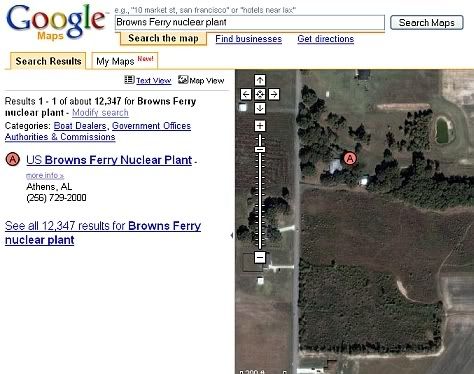
The size of cooling towers needed for a 1.whatever GIGAWATT plant would be very large. Not seeing them in the satellite or ground level shots means they probably don’t exist at this site. I’ll bet the TVA is regretting not spending that couple of million bucks they “saved” by not building a couple of cooling towers right about now
They’re clearly visible from Google maps. See here:
The reactor building is bottom center, and there are rows of mechanical-draft cooling towers flanking some ponds, to the upper left. If you were looking for a large hyperbolic natural draft tower, you were looking for the wrong thing.
See my previous post re: cooling towers.
I stand corrected. I was expecting to see the tall parabolic wall style, not low profile mechanical with cooling ponds.
Another factor could be that they've decided to use this outage to do work on the unit, rather than use the fuel for little return. I worked at one of TVA's nuclear sites for some years (IT). If an outage was forced or probable, there would be a lot of planning going on while they decided what maintenance and upgrade work they could fit in the outage window. They would always take advantage of any outage time to the fullest.
DH is a SRO at a S. Florida plant, 72 hours is normal to get a reactor through startup and obviously longer if they have to enter containment for repairs etc.
Between cooldown and startup, 7 days is not unusual.
Reducing power is quite easy compared to shutting down (boron anybody?) however that would only reduce the amount of water to the outakes, not the temp.
Surprisingly as hot as we are down here, we’ve never tripped or shutdown due to intake water temps being too hot.
The best answer here...is that only 60 miles away to the north...is the Jack Daniels distillery where cool mountain spring water seeps out of the hills...quiet chilled. The JD folks probably have more than enough that they could pump down in a 12-inch pipe to TVA and help refresh the nuke plant. Course, mixing JD spring water with nukes...might be something that wasn’t meant to be...some kind of anti-Einstein rule or such.
Power demand in the TVA service area peaks during summer months so it behooves them to upgrade the cooling capacity of these plants. Since it is a BWR using low-profile cooling towers, perhaps simply cascading some additional cooling units would do it?
The article (deliberately?) DIDN’t say whether the “too hot” exit temperatures were against condenser design limits or arbitrary ecological limits.
It depends on the power plant: Local enviro reg’s at some plants mean that “extra” cooling is done on the “river water” to get it closer to the “natural” temperatures before it is re-released to the river.
Don’t know if that is a requirement here.
You do lose a lot of cooling capacity at 90 inlet degrees compared to say 70 (nominal) or 45 (winter) inlet temps.
Yeah, but even then you’re only looking at about 60-70 hours on a down-power until you’re at the new equilibrium reactivity.
And less steam flow means less condensate heating means lower outlet temps back to the river. Unless they had some maintenance which would have had relatively short tech specs (<72 hours) or this is as one of the Ops guys discussed with me this morning, a case of heat load requirements for train-related loads that hadn’t been analyzed for, it might have been easier just to stay at self-sustaining and then up-power later.
Then again, if long-term forecasts don’t show much rain or temps coming down much, you’re probably better off shutting down and waiting it out.
Both have to be taken into consideration. Even thermal pollution is considered with the license, and in extreme cases high temps in the condenser tube sheet can cause fouling or scaling, reducing effectiveness.
Tell me about it—on my first boat we did a flank run from Japan (31 degree injection temp) to Guam (85 degree injection temp).
The reduction in speed was amazing.
Brown’s Ferry does not have cooling towers, they use direct cooling from the river. If the water is too hot, you get turbine trips from low condenser vacuum. If that was the reason, then the other two units would have to shut down also. The real reason for completely shutting down one unit is to not violate an EPA rule about too high cooling water discharge temperature back into the river.
I have worked at several nukes where we would have to cut back power in the summer for just that reason. At Dresden, we would de-rate 200-300 MWe (~30%) to keep the river discharge temperature below 93 degrees. You can safely run a reactor at less than full power. A light water reactor can be stable at 10% power, especially if the power block has been designed for load following. If the power block is optimized for baseload generation, then below about 30% power, you start to get transients than can trip the turbine. Chernobyl happened when they tried running a coastdown test at an unstable point at very low power and then had a sudden inrush of relatively cold water into the reactor, causing a HUGE reactor power spike.
Boron shim is NOT used in BWR’s. Power is controled with rods only. The nly boron in a boiler is the no-$h_t emergency shutdown bron injection system using a squib valve.
Those look more like helper CT’s designed more to draw in circ water discharge and cool it a bit before letting it go back into the river.
Thanks Grammy. You should see Norris Lake right now, there’s no water, it’s been sucked dry. I guess because of using more water for generating, along with no rain.
BTW, TVA is the leader in managing tailwaters for the benefit of aquatic resources. The agency has been applauded for efforts to maintain minimum flows, and building structures to create oxygen for tailwater fish. That’s why this state’s tailwater trout fishing is some of the best in the country. See Diana, yet another reason you need to move to Tennessee (grin).
I suspected but wasn’t sure—boron is a real PITA. Just ask that (former) engineer over at Davis-Besse.
I can see where boron would not play well with the secondary components.
I live close to the plant(Browns Ferry).The water temps at this point are in the 90-92 degree range on the boat thermometer.They can’t cool the reactors with water that hot and return it to the river,at a temp below 90 degrees,as law mandates.
They could release cool water from Tims Ford dam to help,but that water would be below the streamflow of the plant.
They may have to release cooler water upstream,to lower the lake water temps.
I’m paddling as fast as I can, GA! :)
Under normal operation, BFN uses a once-through circulating water system to dissipate heat from the main turbine condensers. Water is drawn from the Tennessee River by the plant intake system and is discharged back to the river. In addition, BFN currently has four mechanical draft cooling towers which can be operated to assist in heat dissipation (helper mode) primarily during summer hot weather periods.
Excerpted from here.
Disclaimer: Opinions posted on Free Republic are those of the individual posters and do not necessarily represent the opinion of Free Republic or its management. All materials posted herein are protected by copyright law and the exemption for fair use of copyrighted works.