|
 are acknowledged, affirmed and commemorated.
|
Posted on 12/06/2002 11:03:54 PM PST by SAMWolf
|
are acknowledged, affirmed and commemorated.
|

| 'Unless we fail in our objective -- this thread is designed to stir your emotions and memories and to bring out the patriotism in you.' -- SAMWolf, US Army Veteran
|
| Our Mission: The FReeper Foxhole is dedicated to Veterans of our Nation's military forces and to others who are affected in their relationships with Veterans. We hope to provide an ongoing source of information about issues and problems that are specific to Veterans and resources that are available to Veterans and their families. In the FReeper Foxhole, Veterans or their family members should feel free to address their specific circumstances or whatever issues concern them in an atmosphere of peace, understanding, brotherhood and support.
|
|
"This is no drill!"
Military and Naval aircraft at Oahu's airfields were second only to battleships among the Japanese target priorities, though the reason was different. While Pearl Harbor's battleships represented American strategic "reach", and had to be eliminated to safeguard Japan's offensive into Southeast Asia and the East Indies, Oahu's aircraft had to be taken out for a more immediate reason: to protect the Pearl Harbor attack force. U.S. fighter planes, if they could get into the air in any numbers, would be a serious threat to Japanese bombers. U.S. Army bombers and Navy patrol planes potentially imperiled the Striking Force's invaluable aircraft carriers.
 Less than one hour after the attack on Pearl Harbor, USAAF 2nd Lt.’s Ken Taylor and George Welch make an aggressive strike back against the enemy. Taylor, flying his P-40 Tomahawk, is seen bringing down his second enemy aircraft, an Aichi D-31A dive-bomber, on the morning of December 7, 1941. Welch is in close as they chase Japanese planes heading for the open sea. In the background, palls of smoke rise from Hangar 6 housing the naval float-planes, the battleship Nevada, beached off Hospital Point, and the up-turned battleship Oklahoma. The Japanese first attack wave therefore assigned many fighters and bombers to airbase supression, the fighters to set planes afire with machine gun and cannon fire and the bombers to wreck them with high explosives. The second attack wave also had airfield strikes among its tasks. Wheeler Army Airfield, in central Oahu, was Hawaii's main fighter base. It was heavily attacked. Of some 140 planes on the ground there, mainly P-40 and P-36 pursuits, nearly two-thirds were destroyed or put out of action. A similar proportion of the B-17, B-18 and A-20 bombers at Hickam Army Airfield, adjacent to the Pearl Harbor Navy Yard, was also wrecked or damaged enough to keep them grounded. Many men were killed at Hickam when the Japanese bombed their barracks. Smaller Bellows Field in eastern Oahu was also hit, destroying several P-40s, including two whose pilots courageously attempted to take off in the teeth of the enemy onslaught.  U.S. Navy and Marine Corps air stations on Pearl Harbor's Ford Island, at Ewa to the west of Pearl and at Kanoehe Bay near Bellows Field, also received concentrated attention from the raiders. Ewa's aircraft complement, mainly carrier-type bombers and fighters, was reduced from nearly fifty operational planes to less than twenty. Ford Island and Kanoehe, home to several squadrons of long-range PBY patrol seaplanes, were massively attacked, with Ford Island losing about half its planes and Kaneohe all but a few. These very successful Japanese strikes thus prevented any significant aerial opposition, though the few Army fighters that got airborne gave a good account of themselves. Later on December Seventh, surviving bombers and patrol planes were sent out to search for the Japanese carriers. They found nothing and confronted considerable "friendly" anti-aircraft gunfire when they returned to their bases. Ford Island Naval Air Station, in the middle of Pearl Harbor, was headquarters of Patrol Wing Two, and an important target for the Japanese first wave raiders. Reportedly, the initial bomb of the whole attack burst there, prompting the message that electrified the World: "Air Raid, Pearl Harbor--this is no drill.". Several PBY patrol seaplanes and other aircraft were destroyed on Ford Island, and one big hangar was gutted. In all, 33 planes were put out of commission there. Several planes from the aircraft carrier Enterprise, which was approaching Hawaii after a mission to Wake Island, arrived in the midst of the attack. A few were shot down by the Japanese and more by understandably jittery American anti-aircraft gunners. However, several of these planes, and others from Ford Island's own complement, were airborne again within a few hours, sent out to search for the enemy. Some, at the end of a very long day, were shot down by their fellow-countrymen as they returned from these unfruitful searches.
Kanoehe Bay, on the east coast of Oahu, was the site of a major Navy patrol seaplane base. A new facility, with some of its buildings still under construction, this Naval Air Station was home to three Patrol Squadrons. It had 33 PBYs on the ground or floating just offshore when the Japanese arrived. Of those planes, all but six were destroyed, and the survivors were damaged. Only the three Kaneohe Bay PBYs then out on patrol were fit for service at the end of the raid.
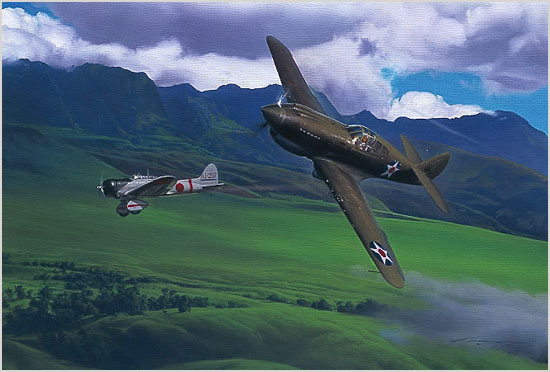 A tribute to the Americans who got airborne on the "date which will live in infamy". A thrilling image of a lone P-40B and Japanese Val Despite the effective Japanese counter-air effort, a few Army P-40 and P-36 pursuit ships got airborne, including some from the small, and untargeted, airfield at Haleiwa on Oahu's north coast. These shot down perhaps as many as eleven enemy planes of the second attack wave, losing four of their number in return, two while taking off and one to American anti-aircraft fire while returning to base. In the midst of the raid, twelve unarmed B-17C and B-17E four-engine bombers arrived over Oahu after a long flight from California. Unaware of the events then unfolding at their destination, several of these were attacked. Though unable to fire back, only two B-17s were destroyed, both after landing, an early indication of the toughness of the "Flying Fortress" in combat. Two Navy SBDs flying into Oahu from the carrier Enterprise, were also downed by enemy action during the raid. One of these may have been the victim of a mid-air collision with its opponent near Ewa Field.
|

Lt. Commander Takahashi's Aichi D3A1 Type 99 "Val" Dive bomber rolls in on Hangar 6 on the southern tip of Ford Island. By accident, Takahashi was the first to drop his ordnance because of a mistake in interpreting the signal flares beginning the attack. Takahashi's bomb struck the water's edge in front of hangar 6 located at the bottom this depiction of Ford island. Battleship Row is seen in serene repose in the last moments before the Japanese wreak havoc and devastation on the unsuspecting American sailors.
When the first Japanese attack wave arrived over Pearl Harbor seven of their primary targets, the U.S. battleships, were moored along "Battleship Row", on the eastern side of Ford Island. Another battleship was in drydock in the nearby Navy Yard. Other moorings which the Japanese believed might include battleships, or the equally important aircraft carriers, were at the Navy Yard's 1010 Dock and along Ford Island's western side.
The Japanese initially hit airfields, including that on Ford Island. Dive bombers attacked there at about 7:55 AM, destroying many aircraft, among them PBY patrol planes at the island's southern tip. This attack prompted the dispatch of the famous message "Air raid, Pearl Harbor -- this is no drill", the outside World's first indication that war had come to the Pacific.

Within a few moments, torpedo planes attacked from east and west, with one of the latter torpedoing the USS Helena at 1010 dock. Others, from the same direction, hit USS Utah and USS Raleigh, off the western side of Ford Island.
The great majority of the torpedo planes came in from the east, flying up the waterway between Pearl Harbor Navy Yard and the Submarine Base to hit the ships on that side of Ford Island. They put two "fish" into USS California, at the southern end of the row. At the northern end, another struck USS Nevada. The outboard ships in the center of "Battleship Row", USS Oklahoma and West Virginia, each had their port sides torn open by many torpedoes.
As the torpedo planes were completing their work, horizontal bombers swept up "Battleship Row", dropping armor-piercing bombs. Several ships were hit. One received a death blow, as USS Arizona blew up with a tremendous explosion.
Planes of the second attack wave revisited some of the ships already hit, and also spread destruction in the Navy Yard, where they bombed the drydocked battleship Pennsylvania and three destroyers. Other dive bombers went after the Nevada, which had left her berth and was trying to get to sea. Very heavy anti-aircraft gunfire greeted these aircraft, whose losses were significantly greater than those of the first attack wave.
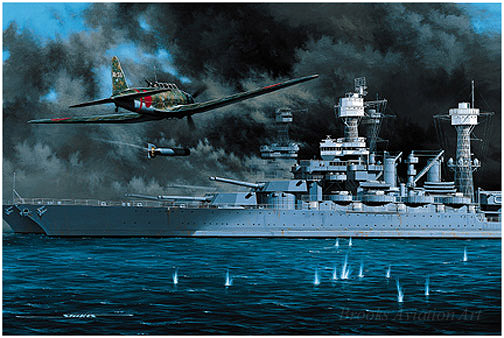
Dec. 7th. 1941, a Japanese "Kate" from the Akagi launches a torpedo against the U.S.S. West Virginia.
The raiders had no opportunity to hit American aircraft carriers, all of which were at sea, and did not target fuel storage, most cruisers and destroyers, submarines and most maintenance facilities. However, in just under two hours they had wrecked the U.S. Pacific Fleet's battleship force, ensuring that it would not interfere with Japan's plans for conquest.
The Japanese fleet arrived to within 275 miles of Oahu and sent its first attack wave into the air at 6:00 AM. This force, composed of 49 bombers, 40 torpedo planes, 51 dive bombers, and 43 fighters, arrived at Pearl at 7:55 AM (1:50 PM Washington time) and continued the assault until 9:45 AM. Shortly after the completion of the first attack, the second wave of 54 bombers, 78 dive bombers, and 36 fighters arrived. In the end, nineteen ships were either disabled or sunk, including all eight American battleships. In addition, 164 U.S. planes were destroyed and 128 damaged while 2,335 American sailors, soldiers, and marines were killed along with 68 civilians and 1,178 were wounded. Although Yamamoto's plan called for a third attack wave to destroy the 4.5 million gallons of fuel oil and support facilities, Nagumo felt that the threat of a counter attack was too great, so he ordered the fleet to turn towards home.

Before dawn on 7 December 1941, the American strategic center of gravity in the Pacific reposed in the seven battleships then moored along "Battleship Row", the six pairs of interrupted quays located along Ford Island's eastern side. Quay F-2, the southernmost, which usually hosted an aircraft carrier, was empty. Northeastward, Battle Force flagship California was next, moored at F-3. Then came two pairs, moored side by side: Maryland with Oklahoma outboard, and Tennessee with West Virginia outboard. Astern of Tennessee lay Arizona, which had the repair ship Vestal alongside. Last in line was USS Nevada, by herself at quay F-8. These seven battleships, ranging in age from eighteen to twenty-five years, represented all but two of those available to the Pacific Fleet. The Fleet flagship, Pennsylvania, was also in Pearl Harbor, drydocked at the nearby Navy Yard. The ninth, USS Colorado, was undergoing overhaul on the west coast.
Together, these ships were one short of equalling Japan's active battlefleet. Clearly a worrisome threat to Japanese plans for Pacific Ocean dominance, they were the Japanese raiders' priority target. Twenty-four of the forty Japanese torpedo planes were assigned to attack "Battleship Row", and five more diverted to that side of Ford Island when they found no battleships in their intended target areas. Of these planes' twenty-nine Type 91 aerial torpedoes (each with a warhead of some 450 pounds of high explosive), up to twenty-one found their targets: two hit California, one exploded against Nevada and as many as nine each struck Oklahoma and West Virginia. The latter two ships sank within minutes of receiving this torpedo damage.

Horizontal bombers, armed with heavy armor-piercing bombs, arrived just as the last torpedo planes finished their attacks, and other horizontal and dive bombers came in later. Together, these planes scored many hits or damaging near-misses on the "Battleship Row" ships: two on California, Maryland and Tennessee; a few on West Virginia. Most spectacular of the bombers' victims was Arizona, which was struck many times. One bomb penetrated to the vicinity of her forward magazines, which detonated with a massive blast, immediately sinking the ship. Nevada, which got underway during the latter part of the attack, attracted many dive bombers, was hit repeatedly as she steamed slowly between Ford Island and the Navy Yard, and, sinking and ablaze, had to be run ashore.
The Japanese had thus put out of action all seven battleships present on "Battleship Row". Two, Maryland and Tennessee, were repaired in a matter of weeks, as was the Pennsylvania. However, three were under repair for a year or more. Oklahoma and Arizona would never return to service. Even with the addition of three more battleships brought around from the Atlantic, the Japanese battleline was assured of absolute superiority in the critical months to come.

USS Nevada (BB-36), eldest (by a few months) of the battleships in Pearl Harbor on 7 December 1941, was hit by one torpedo during the last part of the Japanese torpedo planes' attack. This opened a large hole in the ship's port side below her two forward turrets. Her anti-torpedo protection, of a type back-fitted to the Navy's older battleships, resisted the warhead's explosion fairly well. However, serious leaks were started in the inmost bulkhead, allowing a considerable amount of water into the ship.
The damaged Nevada got underway at 0840, about a half-hour after she was torpedoed, backed clear of her berth, and began to steam down the channel toward the Navy Yard. The slowly moving battleship was an attractive target for Japanese dive bombers, which hit and near-missed her repeatedly, opening up her forecastle deck, causing more leaks in her hull, starting gasoline fires forward and other blazes in her superstructure and midships area. Now in serious trouble, Nevada was run aground on the Navy Yard side of the channel, just south of Ford Island.
As her crew fought her many fires, the ship twisted around until she was facing back up the harbor. With the help of tugs, Nevada then backed across the way and grounded, stern-first, on the other side of the channel. Her old, much-modified structure proved itself to be anything but watertight, and water traveled inexorably throughout the ship. By the following day, she had settled to the bottom, fortunately in fairly shallow water. There she was to remain for over two months, the subject of one of the first of Pearl Harbor's many demanding salvage projects. Of USS Nevada's crew of nearly 1500, fifty officers and men were killed in action during the Pearl Harbor raid.

Destruction of the battleship Arizona, A direct hit to her forward magazine destroyed the forward half of the ship killing over 900 of her crew instantly. The time is 0810, approximately 12 minutes into the attack.
USS Arizona (BB-39) was moored inboard of the repair ship Vestal (AR-4) when the Japanese struck Pearl Harbor. Early reports claimed that she had been hit by one torpedo in the first part of the action. However, this appears not to have been the case, and the destruction of the ship was entirely the work of Japanese horizontal bombers, which struck her with several bombs. Some of these caused damage to her after and midships areas, but their effects were minor compared with what resulted from one that penetrated beside her forward turrets.
The massive explosion that followed has never been fully explained, since the bomb apparently did not pierce Arizona's armored deck, which protected her magazines. Many qualified authorities have blamed powder storage outside of the magazines as the cause, but this is conjectural and probably will always remain so. In any case, the battleship was utterly devastated from in front of her first turret back into her machinery spaces. Her sides were blown out and the turrets, conning tower, and much of the superstructure dropped several feet into her wrecked hull. This tipped her foremast forward, giving the wreck its distinctive appearance.
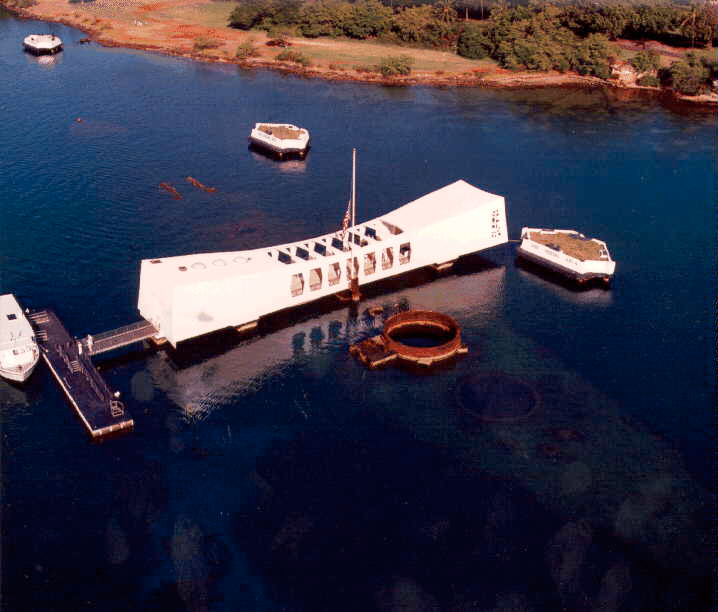
Blazing furiously, Arizona quickly settled to the bottom of Pearl Harbor, a total loss. She burned for more than two days and was subsequently the subject of only partial salvage. Over 1100 of her crew were killed, including Rear Admiral Isaac C. Kidd, Commander Battleship Division One, and the ship's Commanding Officer, Captain Franklin Van Valkenburgh. Their sacrifice, and that of the other men lost at Pearl Harbor, is now permanently memorialized by the USS Arizona Memorial, erected over her sunken hull in the berth it has occupied since shortly after 8 AM on 7 December 1941.
The repair ship Vestal (AR-4), moored outboard of the battleship Arizona on the morning of 7 December 1941, was hit by two Japanese bombs and received additional damage from the force and heat of Arizona's explosion. Casting loose from the sunk and burning battleship at about 8:30 AM, Vestal moved up the harbor a short distance and anchored. However, one of the bomb hits caused her to flood aft, and the water could not be controlled in the ship's old hull. Accordingly, she hoisted her anchor and was beached on Aiea Shoal, in Pearl Harbor's northeastern corner. Vestal was repaired by mid-February 1942.

The battleships Tennessee (BB-43) and West Virginia (BB-48) were moored together on "Battleship Row" when the Japanese attacked Pearl Harbor. West Virginia was struck by up to nine enemy torpedoes, tearing open her midships and forward hull and wrecking her rudder. She initially listed severely to port, but quick counterflooding by her crew allowed her to settle to the bottom on a relatively even keel. Her Commanding Officer, Captain Mervyn S. Bennion, was one of over a hundred of her officers and men killed in the raid.
West Virginia, sunk, largely full of water and further damaged by fire and bombs, was subsequently the subject of a massive salvage operation and a very thorough modernization. She did not return to active service until mid-1944.
USS Tennessee, the inboard ship of the pair, was hit by two bombs, which disabled her second and third 14" gun turrets but caused no further serious damage. She was set afire in several places by burning debris when USS Arizona , moored just astern, exploded. Her hull plates were also damaged by oil fires. Tennessee was wedged tightly between the sunken West Virginia and her mooring quay and had to be blasted free. She was given initial repairs at Pearl Harbor Navy Yard and steamed to the west coast for further work later in December. Five of her crew were killed in the attack.

On 7 December 1941, USS Maryland (BB-46) was moored inboard of USS Oklahoma (BB-37), and was thus protected by her when Japanese torpedo planes struck. The unfortunate Oklahoma, an older ship with much less adequate protection against underwater damage, was hit by up to nine torpedoes. Her hull's port side was opened almost completely from below the forward gun turret back to the third turret, a distance of over 250 feet. She listed quickly, her port bilge struck the harbor bottom, and she then rolled almost completely over. Oklahoma came to rest less than twenty minutes after she was first hit. Some of her starboard underwater hull and the starboard propeller were now all that showed above the surface of Pearl Harbor.
Some of Oklahoma's men were still alive inside her upturned hull, and their rescue became the focus of an intense effort over the next two days. Thirty-two Sailors were recovered alive, but over four-hundred were killed. In 1943, the capsized ship was rolled upright and raised in one of the salvage profession's greatest undertakings, but she was not further repaired.
Maryland was hit by two bombs, which caused relatively light damage and some flooding forward. Four of her men lost their lives. The battleship was able to steam to the west coast for final repairs later in December and was fully returned to service in February 1942.

USS California (BB-44), flagship of the Battle Force, was hit forward and aft by two Japanese torpedoes in the early minutes of the Pearl Harbor raid. She was later hit by a bomb and near-missed by another, which caused additional flooding. Though her design included very good protection against underwater damage, California's actual condition was much less satisfactory, with many watertight compartments open and some design details proving unable to resist the effects of torpedo warheads.
California had steam up and was nearly ready to get underway when a large mass of burning oil, drifting down "Battleship Row", threatened to set the ship afire. She was ordered abandoned, and, when the crew returned on board sometime later, it was impossible to control her flooding. Despite strenuous efforts, she slowly settled to the bottom of Pearl Harbor, coming to rest on 10 December. The battleship was raised in March 1942 and received repairs and modernization work that lasted until January 1944, over two years after she was sunk. Nearly a hundred of her officers and men were killed in action during the Pearl Harbor attack.
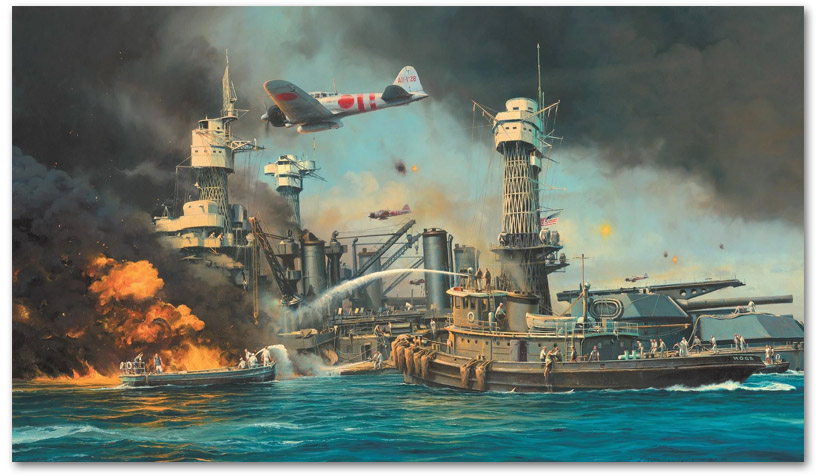
Having taken six torpedo hits and two bomb strikes in the first wave attack on Battleship Row, the West Virginia is ablaze, her bows already low in the water and decks awash. Ignoring the risk, crews push the Navy tug Hoga alongside with fire-fighting equipment and to pick up survivors. Overhead, Japanese Zeroes swoop through the smoke, aiming the second wave attack at installations on Pearl Harbor’s Ford Island, to complete one of history’s most devastating unprovoked declarations of war.
In addition to strategically vital "Battleship Row", the Japanese thought two other areas were important enough to warrant attention from the initial Pearl Harbor attack wave's torpedo planes. These were the long 1010 Dock at the Navy Yard, and the fixed moorings on the western side of Ford Island, both of which might hold battleships or aircraft carriers. On the morning of 7 December 1941, the latter location was occupied by the seaplane tender Tangier, the old target and training ship Utah and the light cruisers Raleigh and Detroit. Six aerial torpedoes were launched against these ships, of which three hit, sinking one vessel and nearly sinking another.
The thirty-year-old Utah, which had been converted from an obsolete battleship ten years earlier, received two torpedoes, completely overwhelming her very limited ability to absorb underwater damage. She capsized to port in about ten minutes, coming to rest with her bottom in the air. As Utah's crew were abandoning ship and swimming through the oily water to Ford Island, they were the target of machine-gun attacks by Japanese planes. Although ten trapped Sailors were later cut free from her upturned hull, about sixty were lost with their ship. Utah was partially turned upright in 1943-44 but was not further salvaged. Her remains are now the site of a small memorial.
USS Raleigh was hit by one torpedo and a bomb. Of an old and not very sturdy design, she barely avoided capsizing, but her crew, assisted by a salvage barge and a tug, kept her upright and afloat. Major repairs returned Raleigh to the active fleet in a a little over a half-year.
Also damaged west of Ford Island was the seaplane tender Curtiss, hit by a crashing enemy dive bomber, plus one bomb and fragments of another during the second wave attack. Curtiss was also unsuccessfully attacked by a Japanese midget submarine, which fired a torpedo at the seaplane tender and was then promptly sunk by the destroyer Monaghan.

The initial Japanese attack wave hit the Pearl Harbor Navy Yard area relatively lightly, with a few torpedoes launched at ships along 1010 Dock and some dive bombers targeting that vicinity and the drydock area immediately to the southward. The torpedo planes made one hit, on the light cruiser Helena, opening two of her engineering spaces to the sea. The minelayer Oglala, tied up alongside Helena, fared much worse. This old converted passenger ship had her port side opened up by the blast of the torpedo that hit the cruiser, and the resulting inrush of water could not be controlled. About two hours later, Oglala rolled over to port and sank alongside 1010 Dock.
The second Japanese attack wave's horizontal and dive bombers gave the Navy Yard's drydock area considerable attention. Though their efforts were somewhat mitigated by the diversion of some planes against USS Nevada as she passed nearby, these bombers made several hits, wrecking three destroyers and damaging the battleship Pennsylvania. The latter, Flagship of the Pacific Fleet and one of the raiders' priority targets, was "high and dry" in Drydock # One with destroyers Cassin and Downes. One bomb hit Pennsylvania amidships, killing eighteen crewmembers and producing modest damage to the battleship. Other bombs, hitting on and near the two destroyers, opened their fuel tanks and set intense fires. Ammunition explosions, including the detonation of a torpedo on Downes, added to the destruction, which was compounded when the drydock was partially flooded. Cassin then lifted off her blocks and rolled over against Downes.

Dive bombers from the second wave also struck the destroyer Shaw, which was in the floating drydock YFD-2. The resulting fires spread to Shaw's forward magazines, which blew up spectacularly, severing her bow. However, the rest of the ship remained afloat as the drydock sank beneath her. The little tug Sotoyomo, also in YFD-2, was badly burned by Shaw's fires and went down, too.
Japanese bombs near-missed some of the ships at the piers in the northeastern part of the Navy Yard, producing notable damage to the hull of light cruiser Honolulu. However, the attackers' concentration on battleship targets left the Yard's vital industrial facilities essentially untouched. These were soon hard at work on rescue, repair and salvage jobs, of which there were many immediately at hand.
You guys are doing such a great job. God bless.
 to visit the tribute page

 Toward FREEDOM
Maybe so Sam, but none better than the FR Foxhole's.


Todays classic warship, USS Arizona (BB-39)
Pennsylvania class battleship
Displacement 31,400
Lenght 608'
Beam 97'1"
Draft 28'10"
Speed 21 k.
Armament 12 14" 22 5"
Laid down 16 March 1914
Launched 19 June 1915
Commissioned on 17 October 1916
USS Arizona was built at the New York Navy Yard, Brooklyn, New York, was commissioned in October 1916. After shakedown off the east coast and in the Caribbean, she operated out of Norfolk, Virginia, until November 1918, when she made a brief cruise to France. She made a second cruise to European waters in April-June 1919, proceeding as far east as Turkey. During much of 1920-21, the battleship was in the western Atlantic and Caribbean areas, but paid two visits to Peru in 1921 in her first excursions into the Pacific. From August 1921 until 1929, Arizona was based in Southern California, making occasional cruises to the Caribbean or Hawaii during major U.S. Fleet exercises.
In 1929-31, Arizona was modernized at the Norfolk Navy Yard, Portsmouth, Virginia, emerging with a radically altered appearance and major improvements to her armament and protection. In March 1931, she transported President Herbert Hoover and his party to Puerto Rico and the Virgin Islands. In August of that year, Arizona returned to the Pacific, continuing her operations with the Battle Fleet during the next decade. From 1940, she, and the other Pacific Fleet battleships, were based at Pearl Harbor on the orders of President Franklin D. Roosevelt.

USS Arizona after modernization.
Arizona was moored in Pearl Harbor's "Battleship Row" on the morning of 7 December 1941, when Japanese carrier aircraft attacked. She was hit by several bombs, one of which penetrated her forecastle and detonated her forward ammunition magazines. The resulting massive explosion totally wrecked the ship's forward hull, collapsing her forward superstructure and causing her to sink, with the loss of over 1100 of her crewmen. In the following months, much of her armament and topside structure was removed, with the two after triple 14" gun turrets being transferred to the Army for emplacement as coast defense batteries on Oahu.

USS Arizona (BB-39) ablaze, immediately following the explosion of her forward magazines, 7 December 1941. Frame clipped from a color motion picture taken from on board USS Solace (AH-5).
The wrecked battleship's hull remained where she sank, a tomb for many of those lost with her. In 1950, she began to be used as a site for memorial ceremonies, and, in the early 1960s a handsome memorial structure was constructed over her midships hull. This USS Arizona Memorial, operated by the National Park Service, is a permanent shrine to those Americans who lost their lives in the attack on Pearl Harbor and in the great Pacific War that began there.

USS Arizona earned one Battle Star for WWII.
Disclaimer: Opinions posted on Free Republic are those of the individual posters and do not necessarily represent the opinion of Free Republic or its management. All materials posted herein are protected by copyright law and the exemption for fair use of copyrighted works.