|
 are acknowledged, affirmed and commemorated.
|
Posted on 02/23/2003 12:02:12 AM PST by SAMWolf
|
are acknowledged, affirmed and commemorated.
|

| Our Mission: The FReeper Foxhole is dedicated to Veterans of our Nation's military forces and to others who are affected in their relationships with Veterans. We hope to provide an ongoing source of information about issues and problems that are specific to Veterans and resources that are available to Veterans and their families. In the FReeper Foxhole, Veterans or their family members should feel free to address their specific circumstances or whatever issues concern them in an atmosphere of peace, understanding, brotherhood and support.  To list previous Foxhole Threads or to add The Foxhole to your sidebar Click on the Logo
|
|
|
|
As Allied forces retook territory the Japanese had wrested from them at the beginning of the war in the Pacific, the fate of prisoners of war (POWs) and civilian internees was of major concern to the Allied high command. This was particularly true in the Philippines, where thousands of survivors of the Bataan Death March, as well as American and European civilians, were being held prisoner. General Douglas MacArthur, the U.S. commander in the Philippines, ordered his subordinates to make every effort to liberate camps in their areas of operation as quickly as possible. Daring raids were organized to free prisoners and internees ahead of the attacking American forces, for it was suspected that the Japanese captors would slaughter their charges before they could be rescued. These fears were not unjustified--on more than one occasion, POWs had been slaughtered by their guards.  The former University of the Philippines Agricultural School at Los Baños, a town on the island of Luzon some 40 miles southeast of Manila, had been converted into an internment camp for more than 2,000 civilians who had had the misfortune of falling into Japanese hands at the beginning of the war. The 2,122 internees who were at the camp in the late winter of 1945 were of many nationalities, though the majority were American, and of every age, including infants. For more than three years, the internees at Los Baños, along with POWs in other camps, had waited patiently for the day when their liberators would arrive. On January 9, 1945, the U.S. Sixth Army waded ashore at Lingayen Gulf and began moving south. Three weeks later the Eighth Army landed at Nasugbu and began moving north. Within a month, the advancing U.S. forces were on the doorstep of Manila. For the occupants of the Los Baños camp, rescue appeared imminent. As the advancing U.S. forces drew nearer and nearer to Manila, General MacArthur became concerned that the Japanese might decide to slaughter the American POWs and other Allied civilians under their control. During the Sixth Army's movement south, troops liberated American and other Allied POWs in several camps. One of the most spectacular liberation efforts was that conducted by the 6th Ranger Battalion at Cabanatuan. A Ranger task force, assisted by Filipino guerrillas, penetrated deep into Japanese territory and, after crawling more than a mile on their bellies, attacked Cabanatuan prison and freed some 500 POWs, bringing them 20 miles to safety. Nearer Manila, elements of the 1st Cavalry assaulted the campus of Santo Tomas University and freed more than 3,500 civilian internees. Los Baños was some 25 miles southeast of Manila and thus outside the primary line of advance for the American forces. Located on Laguna de Bay, a large freshwater lake, Los Baños was accessible to amphibious and ground forces. Because Los Baños was located in the 11th Airborne Division's area of operations, a third means of attack was also possible: a paratroop assault from the skies.  The 11th Airborne Division had arrived in the southwest Pacific in mid-1944. Under the command of Maj. Gen. Joe Swing, the 11th had undergone theater training in New Guinea prior to taking part in the invasion of Leyte. The 503rd Regimental Combat Team and the 11th were the only American airborne forces to fight in the Pacific. After Leyte, the parachute elements of the 11th moved to Mindoro, while the glider troops prepared for an amphibious landing at Nasugbu Bay. On January 31 the 188th Glider Regiment landed at Nasugbu with the Eighth Army. Four days later, the airborne infantry of the 511th Airborne Regimental Combat team jumped onto Tagaytay Ridge. Because of a shortage of available transport, the 475th Parachute Field Artillery and other support units jumped in the following day. Once on the ground on Luzon, the 11th Airborne began working its way toward Manila after the parachute and glider elements had linked up. By mid-February, the 11th was engaged in combat along the so-called Genko Line, a fortified system of interlocking pillboxes running along the south side of Manila. Although the division was already engaged in heavy combat, General Swing and members of his staff were well aware that they were responsible for liberating the Los Baños internees. The problem was that they had not yet determined the best method for carrying out the mission. The Filipino guerrilla groups operating in the area played a key role in the liberation of the camp. The Hunters-ROTC (Reserve Officers Training Corps) Guerrillas, made up originally of former cadets of the Philippine Military Academy, were one of the most active groups, along with ex-ROTC students and other former college students. Other groups included President Quezon's Own Guerrillas (the PQOG), the Chinese Guerrillas of Luzon and the Hukbalahaps, a Marxist group with their own agenda for the Philippines. To bring some order to the guerrilla effort, U.S. Army Major Jay D. Vanderpool had formed a combined guerrilla command known as the General Guerrilla Command (GGC) of Luzon. The GGC would coordinate operations against Los Baños. Inside the camp, there was some dissension as to whether the internees should make any effort to make contact with the Americans and effect a rescue. Los Baños was filled with civilians, with the exception of 12 U.S. Navy nurses. Some of the men were of military age, however, and one or two had tried to enlist in the U.S. forces shortly after Pearl Harbor but had been unsuccessful.  On the night of February 12, 1945, Freddy Zervoulakas, a 19-year-old Greek-Filipino, slipped out of the camp and made contact with the guerrillas. He was sent back into the camp with a copy of a letter from Major Vanderpool instructing the guerrillas to make every effort to free the internees--but the internee committee responsible for governing the camp decided that it would be best for the internees to do nothing. Nevertheless, several male prisoners slipped under the wire in the days before the rescue. On Sunday, February 18, Major Henry Burgess, commander of the 1st Paratrooper Battalion, was ordered to withdraw his battalion from positions on the Genko Line and proceed to Manila. While the battalion rested, Burgess reported to the 11th Airborne Division headquarters, then located at Paranaque. The 26-year-old major met first with Colonel Douglas Quant, the division G-3 (operations officer), who informed him that his unit was going to be involved in the liberation of 2,000 civilian prisoners from the camp at Los Baños. Burgess spent the remainder of the day at headquarters, meeting with division Intelligence and Operations and planning the mission. The following day Burgess met Pete Miles, an internee who had escaped from the camp the previous day and been conveyed by guerrillas to the 11th Airborne Division. Miles provided information of the layout of the camp and the schedules of the guards, details that were essential to complete the mission precisely and without needlessly endangering the internees. The division plan called for a multi-pronged assault on the camp. A parachute company would launch the raid by jumping into a drop zone inside or adjacent to the camp at dawn on the day of the attack. The division recon platoon would cross the bay in advance of the main party, make contact with the guerrillas and organize them to attack the camp sentries exactly at H-hour. Major Burgess' battalion, minus one company, would proceed across Laguna de Bay aboard amphibious vehicles and provide the main body of the attacking force. A combat team was to attack overland from Manila on Highway 1, with the objective of providing a blocking force to cut off any Japanese reinforcements.  For the parachute assault, the 511th's regimental commander, Lt. Col. Ed Lahti, selected B Company of the 1st Battalion, commanded by 1st Lt. John M. Ringler, because it was closest to full strength. Heavy combat in recent days had severely depleted the ranks of all the division's units. One unique factor in the Los Baños mission was that the planning for the raid itself was generally left up to the men who would do the job. Ringler personally planned the airborne phase of the mission, down to selecting a 500-foot-jump altitude instead of the usual 700-1,000 feet, so the men would be exposed for less time. Ringler also determined that the drop formation should fly three V's-in-trail of three planes each because of the small drop zone. Nine Douglas C-47s from the 65th Troop Carrier Squadron of the 54th Troop Carrier Group were selected to make the drop. The division reconnaissance platoon under Lieutenant George Skau played a major role in the Los Baños operation. Skau's 31-man platoon would be responsible for infiltrating into the area around the camp prior to the raid and linking up with the guerrillas, then integrating the indigenous forces into the rescue effort. The soldiers of the platoon were typically of the "rugged outdoorsman" variety, and their familiarity with hiking, camping and hunting especially suited them for missions deep behind enemy lines. On the evening of February 21, some 36 hours before the planned attack, Lieutenant Skau's recon platoon moved out by truck for the barrio of Wulilyos, where they met Filipino guides and the crews of three bancas (sailing vessels ordinarily used for fishing and trade in the coastal waters of the Philippines). The first banca moved out at 2000 hours with Skau and his headquarters group aboard. A second, larger banca set sail some 15 minutes later. The third was meant to sail right behind with the bulk of the platoon's supplies and men, but the Filipino captain discovered that the rudder was broken. Repairs took two hours.
|
The trip across Laguna de Bay was planned to take two or three hours. But it was not until the wee morning hours that the first banca finally touched shore near Los Baños after an eight-hour journey due to light winds that failed to fill the sails. One of the bancas was still in the middle of the lake at daybreak and making little progress. The Filipino crew spent the rest of the day trying every trick in the book to get the heavily laden vessel to its destination, but it was well into the evening when the banca reached shore. The paratroopers of the recon platoon had spent most of the day crouching uncomfortably beneath the side rails of the ship to avoid being seen by the Japanese patrol boats that still ruled the waters.

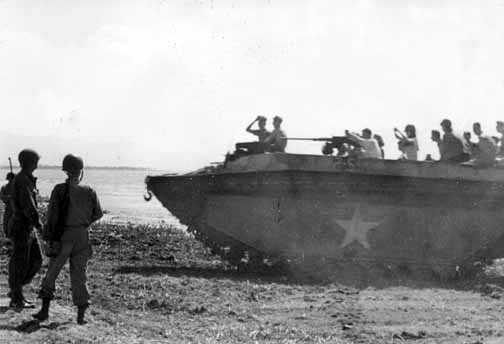
The amphibious element boarded amtracs and moved out at 0500 on February 23. Fifty-four amtracs from the 672nd Amphibian Tractor Battalion set out across Laguna de Bay from Mamatid, their noisy engines giving notice that the attacking force was on its way. In the pitch-black, pre-dawn darkness, a lack of landmarks forced the tractor drivers to navigate solely by compass.
At Nichols Field outside Manila, the paratroopers boarded nine C-47s at 0530. Half an hour later, the pilots started their engines. After takeoff, each of the jump planes orbited over the field until all nine were airborne and had joined the formation. At 0640 the C-47s headed southeast over Laguna de Bay toward Los Baños. Fifteen minutes later, the pilots signaled a six-minute warning by turning on the red paratrooper jump lights in the cargo compartments of their airplanes. At 0700 Ringler stepped from the door of the lead C-47; the Los Baños raid was in progress.
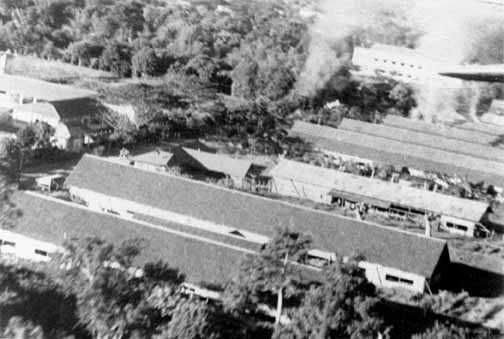
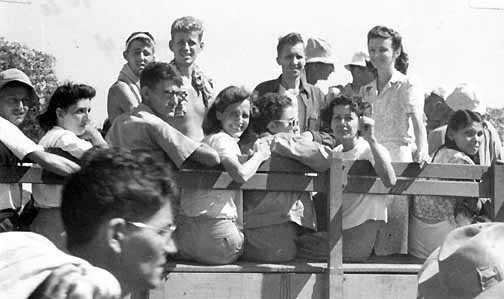
By the time the amtracs arrived from the shores of Laguna de Bay, the gun battle was practically over. Guards of the overwhelmed Japanese garrison had either been killed, were hiding, or had fled. Among the latter was Warrant Officer Sadaaki Konishi, the tyrannical second-in-command at the camp. Largely because of Konishi's policy of withholding food, the paratroopers found a starving horde of internees, many of whom weighed barely 100 pounds.
The reference to POWs being killed refer primarily to the massacre at Palawan.
The prisoners knew something was up, some had seen shiny new American dimes months prior to the raid. They knew that Manila was being bombed, and they knew that American forces knew they were there as a couple of American fighters had buzzed the camp in the weeks prior to the raid.
Hearing my parents tell it, and mentioned in some of the books I read, the internees were so slow in going to get what possessions they still had and deciding what they would bring back home that the decision was made to set fire to the dorms to get them moving at all, not just herding them. The internees were on an 800 calorie a day towards the end.
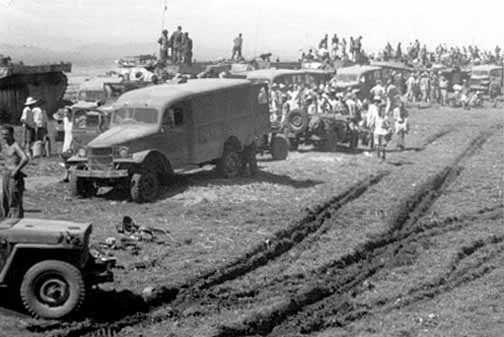
I thought it might be helpful to note that due to the number of internees the amtracks had to make two return trips over Laguna de Bay to pick them up and San Antonio. My mother was in the first group and remembers getting fired on.
One other part is that no casualties are mentioned in your account. One of the remarkable events of the war in my opinion is the fact that all 2,100+ internees were evacuated with only 3 or 4 getting wounded, and they were minor (one got burnt by a shell casing ejected from a .50 cal on one of the amtracks that was returning fire from the shore). The 3 military deaths occurred in the overland task force.
Konishi was recognized as he was on a maintenance detail on a Manila golf course, arrested, tried, and put to death.


| 'I doubt that any airborne unit in the world will be able to rival the Los Banos prison raid. It is the textbook airborne operation for all ages and all armies.' -- Colin Powell |

| You Know The Drill Click the Pics 
|
1916 French artillery kills entire French 72nd division at Samogneux Verdun Oops! Sorry guys we we trying to surrender but we screwed up.
Today's graphic

Disclaimer: Opinions posted on Free Republic are those of the individual posters and do not necessarily represent the opinion of Free Republic or its management. All materials posted herein are protected by copyright law and the exemption for fair use of copyrighted works.


