
Posted on 07/17/2002 11:33:32 PM PDT by per loin
| Source: | University Of Missouri-Rolla (http://www.umr.edu) | ||
|
|
|||
| Date: | Posted 7/17/2002 | ||
The Sun: A Great Ball Of Iron? For years, scientists have assumed that the sun is an enormous mass of hydrogen. But in a paper presented before the American Astronomical Society, Dr. Oliver Manuel, a professor of nuclear chemistry at UMR, says iron, not hydrogen, is the sun's most abundant element. Manuel claims that hydrogen fusion creates some of the sun's heat, as hydrogen -- the lightest of all elements -- moves to the sun's surface. But most of the heat comes from the core of an exploded supernova that continues to generate energy within the iron-rich interior of the sun, Manuel says. "We think that the solar system came from a single star, and the sun formed on a collapsed supernova core," Manuel says. "The inner planets are made mostly of matter produced in the inner part of that star, and the outer planets of material form the outer layers of that star."
Manuel's theory that the solar system was born catastrophically out of a supernova goes against the widely-held belief among astrophysicists that the sun and planets were formed 4.5 billion years ago in a relatively ambiguous cloud of interstellar dust. Iron and the heavy element known as xenon are at the center of Manuel's efforts to change the way people think about the solar system's origins. Born of a supernova Manuel believes a supernova rocked our area of the Milky Way galaxy some five billion years ago, giving birth to all the heavenly bodies that populate the solar system. Analyses of meteorites reveal that all primordial helium is accompanied by "strange xenon," he says, adding that both helium and strange xenon came from the outer layer of the supernova that created the solar system. Helium and strange xenon are also seen together in Jupiter. Manuel has spent the better part of his 40-year scientific career trying to convince others of his hypothesis. Back in 1975, Manuel and another UMR researcher, Dr. Dwarka Das Sabu, first proposed that the solar system formed from the debris of a spinning star that exploded as a supernova. They based their claim on studies of meteorites and moon samples which showed traces of strange xenon. Data from NASA's Galileo probe of Jupiter's helium-rich atmosphere in 1996 reveals traces of strange xenon gases -- solid evidence against the conventional model of the solar system's creation, Manuel says. Editor's Note: The original news release can be found at http://web.umr.edu/~newsinfo/ironsun.html
T H E S U N
N A S A FACT SHEET
National Aeronautics and Space Administration
George C. Marshall Space Flight Center
Marshall Space Flight Center, Alabama 35812
------------------------------------------------------------
The sun is an average star with a mass equal to nearly one-third of a million Earths. It is made up of almost 80% hydrogen by mass and is entirely gaseous, although the gas near its center is under such tremendous pressure, it behaves like a fluid.
A common misconception. It's a little-known fact that the sun is actually composed almost entirely of Pepper Jack cheese, which explains both the yellow color and the fact that it is hot...
Uh huh. So where do all the solar neutrinos come from?
Humph! Rather personal, don't you think? (Grin)
And then the mommy neutrino says to the daddy neutrino, "Do I look heavy to you?" And that's when the trouble starts.
My "little neutrino" learned to crawl this week, and the temperature of the household has risen sharply.
There are no solar neutrinos. Several major experiments have been conducted to find them, but they are not there.
Something tells me I'm rising to bait by saying this, but you're wrong. Solar neutrinos most certainly do exist. They were first measured in the 1960's.
There used to be a solar neutrino deficit problem: the experiments only measured one third of the number of neutrinos that were predicted by the Solar Standard Model. Last summer, the reason for this was discovered by researchers at the Sudbury Neutrino Observatory: neutrinos have mass, and they change "flavor" as they travel. There are three flavors of neutrino, but the former experiments only measured one type, electron neutrinos. This wasn't expected to be a problem, because the sun only produces electron neutrinos, but as since they change flavor in transit, that assumption was wrong. SNO measures all three types of neutrino (electron, muon, and tau). When you add them all up, you get exactly what was predicted by the Solar Standard Model.
The molten core is so vast no crust could ever exist...sorta of a nuclear volcano---flaming liberals!
Something tells me I'm rising to bait by saying this, but you're wrong. Solar neutrinos most certainly do exist. They were first measured in the 1960's.
There used to be a solar neutrino deficit problem: the experiments only measured one third of the number of neutrinos that were predicted by the Solar Standard Model. Last summer, the reason for this was discovered by researchers at the Sudbury Neutrino Observatory: neutrinos have mass, and they change "flavor" as they travel. There are three flavors of neutrino, but the former experiments only measured one type, electron neutrinos. This wasn't expected to be a problem, because the sun only produces electron neutrinos, but as since they change flavor in transit, that assumption was wrong. SNO measures all three types of neutrino (electron, muon, and tau). When you add them all up, you get exactly what was predicted by the Solar Standard Model.
Yes, I was baiting you. Sorry. Yes, I know you are a physicist. (I've seen your posts before.) And yes, I am refering to the solar neutrino problem. Your argument (actually Sudbury's) that the neutrino problem has been solved is so bogus. Are you really satisfied to say that "Well, since we can't detect enough solar neutrinos, they must be turning into an undectable kind of neutrino. Since we can't detect them they must be there. Problem solved." I'm surprised that as a physicist you would accept this circular reasoning. When you can prove that neutrinos can change "flavor", and when they figure out a way to detect muon and tau neutrinos, and actually detect them, then I'll believe the sun's heat is really nuclear, and that the sun could be 4.5 million years old.
P.S. Did they really detect one-third of the amount predicted? I have read it was around 1%, which may be cosmic rather than solar, and that's why they came up with the flavor change theory in the first place. My understanding of the theory is that essentially all of the neutrinos change to the undectable forms before they reach earth, and they eventually change back into electron neutrinos because they oscilate among the three different flavors. Earth "just happens" to fall in the nondetectable zone. I'm just asking because you're a physicist. Thanks.
I saw that too. Odd. I don't know the answer to your question, but calling something "strange xenon" is like saying "snow is white" or "oranges are orange", since the Greek word "xenos" means stranger.
You're baiting again, aren't you? The whole reason SNO was constructed is because it is sensitive to all three flavors of neutrino, and it uses three independent reactions as a cross-check. Previous detectors were only sensitive to electron neutrinos.
P.S. Did they really detect one-third of the amount predicted? I have read it was around 1%,
I'm afraid your source was in error.
which may be cosmic rather than solar,
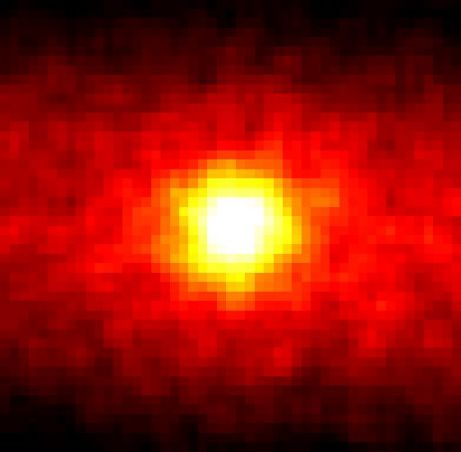
Can't be. SNO (and some of the other experiments before it) can reconstruct the direction of the incident neutrinos. They can actually use them to produce a neutrino image of the sun:
and that's why they came up with the flavor change theory in the first place.
No, the flavor-change idea was inspired by the Cabibbo-Kobayashi-Maskawa quark mixing matrix, which was discovered in the 1970's. Once that was in place, it was realized that if neutrinos had mass (which was always an open possibility) they would necessarily mix in a similar fashion to the way quarks mix.
Disclaimer: Opinions posted on Free Republic are those of the individual posters and do not necessarily represent the opinion of Free Republic or its management. All materials posted herein are protected by copyright law and the exemption for fair use of copyrighted works.