Skip to comments.
Great Britain: Thames reveals forgotten wrecks ( 7 shipwrecks discovered, up to 350 years old)
The Evening Standard (U.K.) ^
| August 26, 2008
Posted on 08/26/2008 10:12:31 PM PDT by Stoat
Thames reveals forgotten wrecks
Mark Blunden
26.08.08
The largest-ever post-war salvage operation on the Thames has discovered seven shipwrecks up to 350 years old.
They include a warship that was blown up in 1665, a yacht converted to a Second World War gunboat, and a mystery wreck in which divers found a personalised gin bottle.
The vessels, in the Thames Estuary, are just some of about 1,100 ships which went down in the whole of the river.
The salvage by Wessex Archaeology and the Port of London Authority, which regulates the river, was both historical and practical. Jagged metal from the wrecks which stick out of the mud, silt, and gravel act as a "can-opener" that can split apart vessels, especially large container ships which can skim within half a metre of the riverbed.
The operation was filmed for the BBC and took four months, using a dozen divers who used 3D survey equipment to locate the wrecks in near-zero visibility.
Frank Pope, the marine archaeologist who led the research, said: "This is the first time it's been done on this scale on the Thames, clearing to such depths - down to 16 metres - to get at ships this big." The ships explored by diving teams were:
• HMS London, the oldest wreck, found near Southend. It was collected by Charles II from Sweden during the Restoration. The 90-cannon warship was blown up accidentally in peacetime in 1665, just a year after its launch, killing 300 - but 24 people, including one woman, survived after being blown clear. Samuel Pepys wrote about the ship in his diary.
• An unnamed Tudor Thames brick barge found close to HMS London. Hundreds of yellow Kent bricks were found aboard.
• The Dovenby , a 70-metre, three-masted steel cargo ship carrying guano for fertiliser from Peru to Antwerp. It sank in 1914 after crashing into steamship Sindoro in fog, north of the Isle of Sheppey. The helmsman was killed.
• HMS Aisha, a yacht requisitioned to become part of "Dad's Navy" in the Second World War. It hit a mine north of the Isle of Sheppey in October 1940.
•A pottery carrier - one of seven that sank in the 19th century between the Dovenby and brick barge. Known as a Bawley boat, it was also used for shrimping.
• A mystery wreck labeled "5051", just south of Canvey Island. It went down in about 1862. A gin jug found on it is marked Mr White, owner of the Crown and Anchor, Woolwich.
• SS Letchworth, a collier sunk in November 1940 by the Luftwaffe en route from Blyth to London, sank of f Southend. All hands survived.
Finds from the various ships included cups, plates, well preserved leather shoes, bricks, the rare steel sailing mast of the Dovenby and a deck beam from the Aisha.
But any dreams of recovering chests of gold or well-preserved cannons were not realised. Some salvage operations had already been carried out after the ships went down. Divers using upturned bells to allow them to work underwater managed to save valuable bronze cannons from HMS London soon after it sank.
Richard Everitt, chief executive of the Port of London Authority, said: "This is the largest operation of its kind since submarine defences were removed at the end of the Second World War.
"We co-ordinated the whole process because we felt it was right we should get a long-term record of the history of Britain's second-largest port, and this very important part of the country's economy."
The first episode of two-part documentary Thames Shipwrecks: A Race Against Time is on BBC2 at 8pm tonight.
HMS LONDON
The wreck of the HMS London is so significant that the Port of London Authority is moving the shipping channel to avoid disturbing it. It has been dived on several times, and sections of wood have been recovered for archaeologists to analyse.
It sank with the loss of 300 lives when it was blown up accidentally after a sailor is thought to have taken a candle belowships. The vessel was in service when Samuel Pepys began to draw up his plans for Britain's navy. On 7 March 1665 Pepys recorded the event in his diary. "...This morning is bought to me to the office the sad news of the London, in which Sir J Lawson's men were all bringing her from Chatham to the Hope, and thence he was to go to sea in her - but a little a-this-side of the buoy of the Nower, she suddenly blew up.
"About 24 and a woman that were in the round house and coach saved; the rest, being 300, drowned - the ship breaking all into pieces - with 80 pieces of brass ordnance. She lies sunk, with her round house above water. Sir J Lawson hath a great loss in this, of so many good chosen men, and many relations among them."
HMS AISHA
The Aisha was purchased as a pleasure cruiser and lovingly renovated by one RH Turner.
She was, however, requisitioned shortly afterwards by the Navy and sprayed gunmetal grey inside and out, much to the dismay of Turner's wife.
As the Second World War broke out, the Aisha was crewed by civilians and retired seamen as part of the "Dad's Navy" Home Guard and helped to guard the Thames. She was part of the armada of "Little Ships" that evacuated Allied troops from Dunkirk in June 1... but was blown up later that year by a mine north of the Isle of Sheppey.
Following on from a geophysical survey earlier this year, there will be a full dive on the wreck to attempt to retrieve small objects before archaeologists decide whether to lift her fully or partially excavate her.
TOPICS: History; Science
KEYWORDS: archaeology; britain; england; godsgravesglyphs; greatbritain; history; salvage; shipwrecks; thames; uk; unitedkingdom
Navigation: use the links below to view more comments.
first 1-20, 21-22 next last
Oldest find: HMS London, which sank in 1665, at the bottom of the Thames Estuary

A computer simulation of how the warship HMS London would have looked

The HMS Aisha was sunk in 1940 by a mine

SS Letchworth was sunk by the Luftwaffe in 1940

Dive, dive, dive: marine archaeologist Frank Pope led the research during which divers also found the SS Letchworth
1
posted on
08/26/2008 10:12:31 PM PDT
by
Stoat
To: SunkenCiv; blam; FairOpinion; StayAt HomeMother; Ernest_at_the_Beach
The operation was filmed for the BBC and took four months, using a dozen divers who used 3D survey equipment to locate the wrecks in near-zero visibility. Frank Pope, the marine archaeologist who led the research, said: "This is the first time it's been done on this scale on the Thames, clearing to such depths - down to 16 metres - to get at ships this big."
2
posted on
08/26/2008 10:14:24 PM PDT
by
Stoat
(Rice / Coulter 2012: Smart Ladies for a Strong America)
To: Stoat
Very interesting stuff. Thank you for posting this.
3
posted on
08/26/2008 10:20:22 PM PDT
by
Army Air Corps
(Four fried chickens and a coke)
HMS London, the oldest wreck, found near Southend. It was collected by Charles II from Sweden during the Restoration. The 90-cannon warship was blown up accidentally in peacetime in 1665, just a year after its launch, killing 300 - but 24 people, including one woman, survived after being blown clear. Samuel Pepys wrote about the ship in his diary.
Interesting. A ship in, hmm, I think Sweden, exploded, probably in the 17th century but the memory is dim, and it had (I think) just one survivor. Lucky guy, he was blown sky-high, got an aerial view of the whole rest of the fleet floating at anchor, and wound up landing, basically safely, in the sail of another ship.
An unnamed Tudor Thames brick barge found close to HMS London.
I'll go out on a limb and suggest that this will be a pretty interesting wreck.
4
posted on
08/26/2008 10:23:17 PM PDT
by
SunkenCiv
(https://secure.freerepublic.com/donate/_______Profile hasn't been updated since Friday, May 30, 2008)
To: Stoat; StayAt HomeMother; Ernest_at_the_Beach; 1ofmanyfree; 21twelve; 24Karet; 2ndDivisionVet; ...
5
posted on
08/26/2008 10:24:15 PM PDT
by
SunkenCiv
(https://secure.freerepublic.com/donate/_______Profile hasn't been updated since Friday, May 30, 2008)
To: All
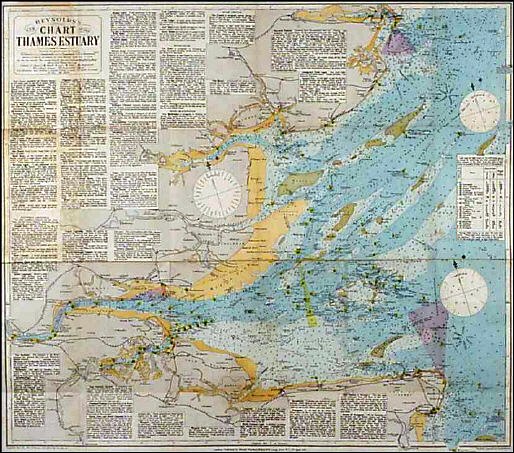
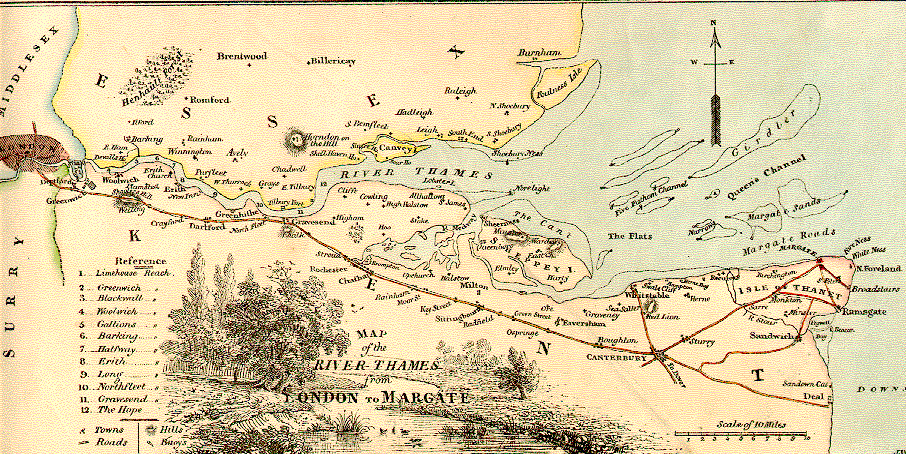
More on archaeology around the Thames
Historical Thames
Historical Thames
TODAY’S CULTURE TOMORROW’S HISTORY: Conserving and Promoting Historical and Cultural Resources The importance of the Thames Estuary as the main water borne access for settles, invaders and traders is reflected in its rich historical and cultural resource. Remains linked to commercial and economic growth can be found in coastal settlements, industrial sites reliant on transport by water, harbours and docks, ship and boat yards. The estuary's vulnerability to attack is reflected in its historic fortifications, such as Hadleigh Castle and Tilbury Fort. The diverse heritage resource includes both buried archaeological materials as well as those structures which are still visible today. Ship rudders (probably 18th century) found at Shadwell: 
The importance of the Thames as an archaeological resource is further enhanced by its 'waterlogged' environment. This is because it provides anaerobic (without oxygen) conditions which aid the preservation of organic materials, such as man-made, wooden or leather artefacts, or plant and insect remains. With every ebb and flow of the tide objects and structures, large and small, are uncovered. This includes the remains of prehistoric forests that grew more than 5,000 years ago and can still be seen on the foreshore at Erith. 
In addition, sea-level rise means that a number of formerly dry land sites along the coastline have now become submerged, assisting the preservation of associated organic materials. It is important to remember that up to 10,000 years ago England was joined to the Continent and that the Thames was part of a single estuary system with the Rhine, the Meuse and the Scheldt. More recently the Southern North Sea has formed both a barrier and a highway between England and the Continent. Archaeological remains are a unique and finite resource which, once destroyed, can never be replaced. Redevelopment for homes and factories, road-building and quarrying are all major threats. Constant ploughing gradually erodes archaeological sites while subsoiling has a more immediate impact. Dredging and maritime gravel extraction can remove sites in the river and estuary, while wave action and the scouring of the tides are an ever-present concern. |
|
6
posted on
08/26/2008 10:28:30 PM PDT
by
Stoat
(Rice / Coulter 2012: Smart Ladies for a Strong America)
To: Army Air Corps
Very interesting stuff. Thank you for posting this.You're quite welcome, and thank you for your kind words :-)
I'm delighted that you've found it to be worthwhile.
7
posted on
08/26/2008 10:30:45 PM PDT
by
Stoat
(Rice / Coulter 2012: Smart Ladies for a Strong America)
To: All
8
posted on
08/26/2008 10:54:03 PM PDT
by
Stoat
(Rice / Coulter 2012: Smart Ladies for a Strong America)
To: SunkenCiv
Thanks Stoat.You're welcome :-)
Thank you very much for pinging your list :-)

9
posted on
08/26/2008 10:57:25 PM PDT
by
Stoat
(Rice / Coulter 2012: Smart Ladies for a Strong America)
To: Stoat
Hey, Frank Pope is a pretty good find on the Thames too! Looks like Harrison Ford.
10
posted on
08/26/2008 11:07:17 PM PDT
by
Beowulf9
To: Beowulf9
Hey, Frank Pope is a pretty good find on the Thames too! Looks like Harrison Ford.Ummm...he actually looks quite a bit like me as well...
(striking gallant "seafaring archaeologist" pose)
There are ugly rumors going around about stoats having fleas and being "excessively scruffy" but those are all vicious lies.
11
posted on
08/26/2008 11:21:30 PM PDT
by
Stoat
(Rice / Coulter 2012: Smart Ladies for a Strong America)
To: Stoat
Greta underwater pics..will bookmark to study tomorrow...
“You’ve never seen the mouth of the Thames at night, have you?
It’s a scene from wonderland; houses like blobs of indigo fencing you in; ships drifting past like black ghosts in the misty air, and the purple sky above never so dark as the river, the river with its shifting lights of ruby and emerald and topaz, like an oily, opaque serpent gliding with a weird life of its own...”
Frank Harris
12
posted on
08/27/2008 12:01:23 AM PDT
by
wolficatZ
("Bear suits are funny. Bears are funny" - Christopher Walken (Russian bears aren't so funny))
To: Stoat
Way, way too cool for words! Why can’t there be these kinds of findings where I live!!!
Green with envy...
13
posted on
08/27/2008 12:31:21 AM PDT
by
DieHard the Hunter
(Is mise an ceann-cinnidh. Cha ghéill mi do dhuine. Fà g am bealach.)
To: Stoat
I just wanted to add my thanks for this story and for posting the pictures also.
14
posted on
08/27/2008 1:00:20 AM PDT
by
Daaave
("Where it all ends I can't fathom my friends")
To: Stoat
Awesome. Just awesome. Love waking up to fill my head with knowledge, and not just the empty fluff escaping the mouths of politicians.
15
posted on
08/27/2008 1:42:43 AM PDT
by
Caipirabob
(Communists... Socialists... Democrats...Traitors... Who can tell the difference?)
To: Stoat
Any sign of the Obama campaign down there?
16
posted on
08/27/2008 2:06:44 AM PDT
by
leadhead
(Do or do not, there is no try)
To: Stoat
If you look like that then I forgot to mention even though I live in Phoenix I think you should dig in my back yard for buried treasures, heheh ;)
17
posted on
08/27/2008 3:03:18 PM PDT
by
Beowulf9
To: wolficatZ
That is beautiful. I’d love to see the Thames, and I hope they find some cool stuff on the Tudor ship. Right now reading Great Harry, fabulous book.
18
posted on
08/27/2008 3:05:24 PM PDT
by
Beowulf9
To: Beowulf9
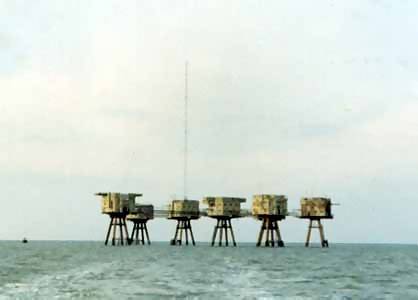
I'll have to look up that book...been studying the Red Sands AA forts in the Thames estuary recently; I hope they are restored, they were in pretty good shape back in 60's when an episode of "Danger Man" I have was filmed there in the 60's, the walkways were still intact, now quite decrepit.
19
posted on
08/27/2008 11:51:29 PM PDT
by
wolficatZ
("Bear suits are funny. Bears are funny" - Christopher Walken)
To: Beowulf9
If you look like that then I forgot to mention even though I live in Phoenix I think you should dig in my back yard for buried treasures, heheh ;)<<< gassing up the stoatmobile for a trip to Phoenix :-)
20
posted on
08/28/2008 12:42:21 AM PDT
by
Stoat
(Rice / Coulter 2012: Smart Ladies for a Strong America)
Navigation: use the links below to view more comments.
first 1-20, 21-22 next last
Disclaimer:
Opinions posted on Free Republic are those of the individual
posters and do not necessarily represent the opinion of Free Republic or its
management. All materials posted herein are protected by copyright law and the
exemption for fair use of copyrighted works.
FreeRepublic.com is powered by software copyright 2000-2008 John Robinson