Posted on 05/09/2006 5:10:45 PM PDT by blam
Letter from Newfoundland: Homing in on the Red Paint People
Volume 53 Number 3, May/June 2000
by Angela M.H. Schuster
(Lynda D'Amico)
Port au Choix, Newfoundland--
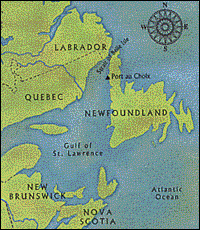
More than 5,000 years ago, this barren, sea-lashed coast was home to the Maritime Archaic Indians (MAI), who hunted and fished the coasts of Labrador and Newfoundland for more than 2,000 years. The first evidence of the Maritime Archaic culture was discovered more than 30 years ago when James A. Tuck of Memorial University of Newfoundland excavated 56 elaborate burials exposed during housing construction on a small promontory at Port au Choix, on the Gulf of St. Lawrence just south of the Strait of Belle Isle.
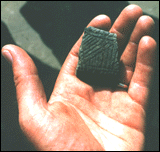
Buried between 4400 and 3300 B.P., the dead--along with offerings of tools, animal bones, carved animal effigies, and small, white quartz pebbles--were covered in red ochre, earning them the moniker the "Red Paint People." Tool kits contained woodworking implements for building dwellings and watercraft; finely wrought bone and ivory fishhooks, harpoons, and harpoon heads, bone foreshafts; and long, narrow ground slate lances for hunting whale and walrus; and fragments of fish spears, all of which pointed to a lifeway dependent on the deep sea.

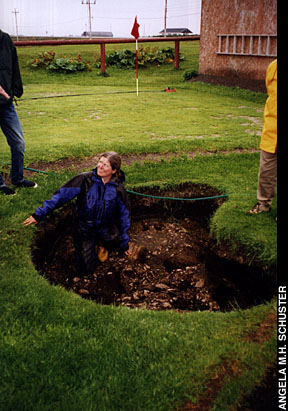
Priscilla Renouf points to 5,500-year-old archaeological features. (Angela M.H. Schuster)
In 1997, a team led by Memorial University archaeologist Priscilla Renouf and geomorphologist Trevor Bell found the first-known MAI habitation site. Now known as the Gould Site after the family on whose property it lies, the MAI settlement is spread over ten acres on a broad flat terrace. "This was an idyllic location,"says Renouf. "The site offered a freshwater pond, shelter from the wind, and an excellent view of the ocean."
To date, Renouf and her team have unearthed gouges for woodworking; projectile points; fish spears; cut spruce logs; hearths; pits; hundreds of post holes for dwellings; distinct pairs of small, deep holes that may have once held drying racks for skins, fish, or meat; and, not surprisingly, several deposits of red ochre. The artifacts range in date from 5500 to 3300 B.P.; the earliest finds predate the cemetery by more than 1,000 years. "It's still too early to tell whether the settlement was occupied year-round or seasonally, or just how many people may have lived there." says Renouf. She will return to the field this summer in search of answers.
Angela M.H. Schuster is a senior editor at ARCHAEOLOGY.
I will begin posting other articles from the net on this thread.
I've just ordered a new book due out in June, 2006 titled: Red Paint People - A Lost American Culture, by Bruce Bourque.
Some say the Red Paint People can be dated in the Americas to 7-10,000 years ago and evidence of their culture have been found in Norway and some say all the way to France.
B) What they're looking for is not on land, but in water up to 100M deep. Only the very last of the "red paint" people would have moved that far inland as the climate warmed, and the seas rose up to their modern levels.
Good point, but that close to the Laurentide ice sheet would have seen some rising after it melted.
Good point...it's still rising too.
Lucky! I'm lucky if I can hunt and fish for a weekend!
Although modern scholars no longer believe in the diffusion theory it was once thought that the Red Paint people traveled across the Northern Hemisphere from Europe to North America.
The diffusion theory was based on similarities between the Red Paint people's stone tool technology, houses, and ritualistic burial habits that included the use of red ocher. Red ocher is common in many geographic regions, and is commonly used in many prehistoric cultures. The stone technology and similar geometric designs of dots and lines that appear on the stone tools of both the North American Red Paint culture and on the tools of European prehistoric cultures could have developed independently of each other.
As scientific methods improved, over the years, it has been determined from studying the burials and skeletons of the Red Paint people that they are in fact Native Americans.
What a sad chunk of pandering that is...
By Brian Robinson
University of Maine
The so-called "Red Paint People" of nearby Maine provided one of New England's earliest archeological controversies. Evidence of the Red Paint People was found throughout the nineteenth century as groups of stone artifacts (for example, gouges or woodworking tools, fishing plummets, flaked stone knives and spearheads of ground slate) in deposits of bright red ocher (iron oxide powder). The first detailed excavations were conducted by Charles Willougby in 1892, for the Peabody Museum of Harvard University and his 1899 account remains a model of archeological reporting. Later work by Warren K. Moorehead (n.s. Peabody Museum, Andover, MA) from about 1912-1920 brought wider attention to the "Red Paint People" as well as controversy surrounding their identity.
Early Controversy
The controversy surrounding the age and identity of the people originated with the character of red ocher deposits. Although they were generally considered to be graves, they were apparently so old that no bones were preserved and some of the stone artifacts were even badly decayed. This led Moorehead to declare in the pages of the preimmenent journal, American Anthropology:
"It is our conviction that the graves represent an ancient and exceedingly primitive culture, totally diffferent from that of the later Algonquin tribes" (Moorehead 1913).
The proposal of a "new" ancient culture could not go unchallenged and the challenge came in 1914 from none other than David T. Bushnell of the Smithsonian Institution, who suggested that the Red Paint People may indeed be quite recent. This controversy occured long before the radiocarbon dating (carbon 14) techniques had been invented, and with so many controversies, that of the Red Paint People faded away with new information. Moorehead was correct that the graves were quite ancient, usually dating between 2,000 to 6,000 years ago, but with rocks going as far back as 6,000 years. Bushnell's concern was not unfounded, however, as the Smithsonian was at the time waging a battle against other "Satanic" interpretations of Native American archeology, most notably the theory that the Mound Builders of Midwestern United States were an ancient race of people, perhaps one of the seven tribes of Isreal, that came before the Indian cultures of North America.
Modern Theory
Archeology has come a long way since the turn of the century and presumably has a long way to go, if reserach can keep pace with all the agents of destruction, both natural and man made. The "Red Paint People" were initially only recognized from their cemetery sites and these are now more commonly referred to as the "Moorehead burial tradition" in archeological journal. Recent research, conducted by the Maine State Museum and various campuses of the University of Maine has foucused on the occupation sites or living areas of the people and their maritime hunting and fishing culture. The regular hunting of swordfish in the Gulf of Maine provides an example of their hunting and boating skills.
Ironically, some of the old "Mysteries of the Red Paint People" persist but for different reasons. One of the early theories explaining their disappearance called upon the then recent (1930) evidence that the coast of Maine was subsiding below the ocean. This geological evidence was expanded upon with the suggestion that the ocean side habitation areas of the people may have succumbed to tidal waves that resulted from violent earthquakes that caused the land to sink. While such catastrophes did not likely wipe the people out, the slow rise of the sea level is methodically destroying the coastal occupation sites and thus our ability to learn about them. Relatively few such sites remain after 4,000-5,000 years, and the few that have been excavated, such as the Turner Farm site in Penobscot Bay (Bruce Bourque 1995), contain precious glimpses of what was once a typical lifestyle of the area.
Photo courtesy NH Div of Historical Resources.
©1997 SeacoastNH.com. All rights reserved.
The thought that the Atlantic might have been a thoroughfare long before Columbus and the Vikings has been ridiculed by most archeologists for decades. New England megaliths and B. Fell's translations of purported Celtic ogham inscriptions have met only with derision in the professional literature. But times are changing -- at least we hope so.
The Red Paint People.
Public TV recently aired a program on North America's Red Paint People, so-called because they added brilliant red iron oxide to their graves. It also seems they knew how to sail the deep ocean, as G.F. Carter now relates.
"Decades ago, Gutorn Gjessing pointed out that the identical [Red Paint] culture was found in Norway. No one paid much attention to that, but more recent carbon-14 dating has shown that the identical cultures had identical dates, and people began to pay more attention. It is now admitted that this is a high latitude culture that obviously sailed the stormy north Atlantic and stretched from northwest Europe over to America. It seemingly extends from along the Atlantic coast of Europe to America and in America from the high latitudes of Labrador down into New York state.
"The dates are mind-boggling: 7,000 years ago both in Europe and America. That is 2,000 years earlier than the Great Pyramids of Egypt. It is at least 4,000 years earlier than the Mound Builders of the Ohio Valley. The evidence is cummulative, varied in nature, and most probably highly reliable."
(Carter, George F.; "Before Columbus," Ellsworth American, November 23, 1990. Cr. R. Strong.)
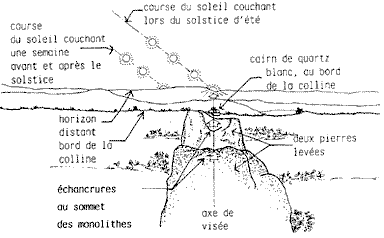
Sketch from Kadath showing how the setting sun, at the summer solstice, lines up with two ancient standing stones and a cairn in western Massachusetts.
The New England Megaliths. The Public TV documentary also provided a glimpse of some of the domens, menhirs, and passage graves sprinkled throughout New England. Long scoffed at as merely the work of Colonial farmers, some of these structures yield radiocarbon dates 3000-4000 B.P. This sort of proscribed data is to be found only in the journals of "shadow archeology."
But now European archeologists are beginning to look at these structures. In 1990, the Belgian journal Kadath devoted an entire issue to the subject.
This issue comprises 54 pages filled with many photos and drawings of walls, cairns, dolmens, and possible astronom ical sites. We reproduce one of these drawings here, but wish we could provide an English translation of the entire issue.
(Anonymous; "Megalithes d'Amerique du Nord," Kadath, no. 72, Spring 1990.)
North American Epigraphy. According to the editor of the Review of Archaeology, D.H. Kelley is "an epigrapher of considerable reputation." And what is the subject of this respected journal and reputable epigrapher? B. Fell's work on North American inscriptions!
Kelley is concerned by the strange lack of supporting archeological evidence at the inscription sites, but as the following quotation demonstrates, he dares to admit an ancient Celtic presence in North America.
"I have no personal doubts that some of the inscriptions which have been reported are genuine Celtic ogham. Despite my occasional harsh criticism of Fell's treatment of individual inscriptions, it should be recognized that without Fell's work there would be no ogham problem to perplex us. We need to ask not only what Fell has done wrong in his epigraphy, but also where we have gone wrong as archaeologists in not recognizing such an extensive European presence in the New World."
(Kelley, David H.; "Proto-Tifinagh and Proto-Ogham in the Americas," Review of Archaeology, 11:1, 1990.)
The original does not provide hints;
should we take it that these were not of Oriental or "Amerind" type?
Unintended sarcasm?
Lots of 'stuff' here, too much to post. Many pictures too.
Save for later Bump.
Some have suggested that. I don't know. If you've read all the above, you know as much as me.
The Maritime Archaic Indians arrived in Newfoundland 5,000 years ago from Labrador. They crossed the Strait of Belle Isle from Labrador where the earliest sites date to around 9,000 years before present (B.P.).
A well-known burial of a 12-year-old child at L'Anse Amour dates to 7500 B.P. This culture is believed to be descended from the Paleo Indians who crossed the Bering land bridge between Siberia and Alaska at the tail end of the last Ice Age, approximately 14,000 years ago. Some evidence suggests that they might have crossed as early as 25,000 B.P.
This culture, formerly referred to as the Moorehead Burial Complex or Red Paint People, occupied the coastal regions of Maine, the Maritime provinces, Labrador and the Island of Newfoundland, its most northerly point. Little was known about this culture until 1967 when Mr. Theodore Farwell of Port au Choix uncovered a cemetery while bulldozing a basement for a theatre.
The excellent preservation of bone allowed Dr. Jim Tuck and his associates to do a comprehensive study of the 117 skeletons and burial goods. This work is still going on today, providing greater insight into the way of life of these people. Dr. Jim Tuck renamed these people the Maritime Archaic Tradition because of their marine adaptation.
Continue to Explore the
Maritime Archaic Culture
Follow the Links
Disclaimer: Opinions posted on Free Republic are those of the individual posters and do not necessarily represent the opinion of Free Republic or its management. All materials posted herein are protected by copyright law and the exemption for fair use of copyrighted works.