Posted on 10/19/2004 11:13:25 PM PDT by SunkenCiv
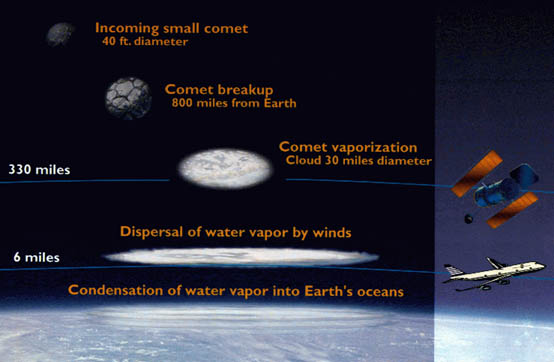
Given the reality of the dark spots, which soon became known as "atmospheric holes" because of their appearance in the images, there is only one explanation which has endured over all these years to present. That is, the holes are due to the shadowing of the atmospheric light by an object above the atmosphere. This object simply cannot be a stony or iron meteor because the holes are very large, tens of miles in diameter. A rock of this size would provide a disastrous impact on the Earth's surface. As it turns out, water vapor is very good at absorbing the atmospheric light and thus appearing as a atmospheric hole in the images taken by the spacecraft camera. The only other step in the interpretation is to note that a cloud of water vapor will have only a brief existence in interplanetary space so that it must be delivered to Earth as a small comet filled with water snow which is disrupted and expands as it impacts into our atmosphere.
(Excerpt) Read more at smallcomets.physics.uiowa.edu ...
Please FREEPMAIL me if you want on, off, or alter the "Gods, Graves, Glyphs" PING list --
Archaeology/Anthropology/Ancient Cultures/Artifacts/Antiquities, etc.
The GGG Digest -- Gods, Graves, Glyphs (alpha order)
Welcome to yet another GGG ping.
additional Louis A. Frank links:
http://www-pi.physics.uiowa.edu/~frank/
http://www-pi.physics.uiowa.edu/~frank/LAF_publications.html
http://www.physics.uiowa.edu/faculty/LFrank.html
The Original DiscoverySigwarth and I analyzed over 10,000 images and learned a good deal about the black spots in the process. Our interpretation of the events continued to involve meteor impacts into Earth's upper atmosphere.By counting the spots in our images we were able to estimate the rate at which these objects appeared. This was the simplest measurement to do. We saw ten holes per minute on the daylight side of Earth. So we doubled that figure to obtain the rate of these objects over the entire face of Earth. There had to be about twenty such objects entering the atmosphere every minute. That was an alarming number of objects.
by Louis A. Frank
with Patrick Huyghe
Out ThereI spent more than a year answering the objections of critics. But I didn't convince them. It was 10,000 to 1 -- actually 2, myself and John Sigwarth, whose task as my graduate student assistant had been to help me resolve this black-spot mystery. "We have taken a representative poll of current opinion in this field," an editor at Nature wrote in rejecting a small-comet paper we submitted to them in 1988, "and the verdict goes against you." It was my first encounter with taking polls as a way of doing science.
by Louis A. Frank
and Patrick Huyghe
Now, a decade later, many of those who had "voted" against us are changing their minds. In May at a meeting of the American Geophysical Union, we presented images acquired by our ultraviolet camera aboard NASA's Polar spacecraft, a satellite sent up to study the Sun's effects on the Earth's environment. This camera, too, had picked up the black spots in the Earth's sunlit atmosphere. And this time there was no doubt; these black spots or atmospheric holes, as we called them, occurred in clusters of pixels or picture elements, not single pixels as in the Dynamics Explorer images. The phenomenon could not be due to instrumental artifacts. We could also see these black spots expanding and moving as they entered Earth's atmosphere. And the filters on our visible-light camera confirmed that these objects consisted of water -- enough water to produce clouds of water vapor 50 miles across, high in the atmosphere.
The new evidence stunned many of our former critics into admitting that we had been right. The University of Michigan's Thomas Donahue, one of the world's leading experts in atmospheric science, said so, as did Robert Meier, a space physicist from the Naval Research Laboratory in Washington. "I guess I'll just have to swallow crow," wrote one detractor. These former critics now agree that these objects are indeed water-bearing, but they don't want to call them small comets because they don't have the dust that the large, well-known comets do. That's okay. Call them "cometesimals" if you want -- that's the term Donahue prefers -- but the fact remains: They carry lots of water just like the large comets, and they are millions of times smaller than Hale-Bopp and Halley.
At first glance, this apparent resolution to the small-comet affair would seem worthy of applause -- the scientific process of debate, peer review and criticism would appear to have functioned admirably. But the gap between appearance and reality is a large one. After I presented my findings on the small comets in 1986, the scientific community did its best to extinguish my career. In the past decade, I have been unable to get any other projects off the ground. Before the small-comet findings became public, my success in this regard was envious; I was able to get instruments on board several major spacecraft -- Polar, Galileo and Geotail. But after my small-comet announcement, I got nothing. I had my ongoing projects, such as the one on Polar that eventually produced the confirmatory data. But the new projects I proposed went nowhere -- even those that had nothing to do with small comets.
I read it fairly quickly, and didn't see addressed the
issue of orbital hazard.
Have they computed the risk level to orbiting craft?
If significant, could we have expected losses by now?
Have there been any that could be attributed to these
micro comets?
Thanks for this and all your other threads, which I read but usually do not respond to.. love your tagline!
George W. Bush will be reelected by a margin of at least ten per cent
> The detonation of these glorified ice cubes takes
> place at a much lower altitude than satellites ...
The detonation isn't the threat I had in mind;
just the impact.
Fascinating stuff!
This and global warming is gonna get the water level up, maybe I should think about a boat dock...
George W. Bush will be reelected by a margin of at least ten per cent
Check out part four of his lecture:
http://smallcomets.physics.uiowa.edu/lecture/lect4.html
"The origins of our oceans always have been a fascinating mystery. In his classic paper of 1951 William Rubey... was puzzled by the large amount of water which was unaccounted for. Even at the time of writing his seminal paper he queried astronomers as to whether it was possible that this water was being supplied by an infall of objects from interplanetary space. The responses of astronomers were negative... Large amounts of water are now believed to be lost as subduction of continental plates carries oceanic water under the surface... This water was thought to be recycled to the surface by outflow of gases from volcanic activity. This was a natural suggestion in consideration of the dramatic activity of volcanoes... In a recent classic paper of 1999 David Deming reports on the amount of water which is returned to the Earth's surface by volcanic activity and finds that: 'The losses of surface water due to subduction into the mantle are greater by factors of 7 to 20 than the supply given by volcanic activity. The rate of a cosmic influx of water to compensate for the water loss to the mantle is similar to that derived by Frank and Sigwarth [1993] from observations of small comets.' ...The significance of the small comets is obvious: our Earth would be dry and barren without an extraterrestrial influx of water."
A giant snowball? Ever since seeing the Carolina Bays less than a year ago on this forum(first time I'd heard of 'em), they appear to have been made by the breakup of a......snowball. Has this been completely poopooed?
FGS
Simply put, I believe that these near flat, shallow, structures were formed by terminal flare induced steam explosions of wet exposed ground. The wet spots could have been beaver ponds, springs, marshes, wet weather ponds, slow flowing creeks, and so on. The principal requirement here is that the water on the ground be exposed sufficiently to the sky so as to receive enough radiant energy from the incoming bolide to produce a violent phase change or steam explosion. A geologist might think of these features as "top induced maars" as the structures of Carolina Bays have similarities to conventional maars, which are produced by Earth mantle heat induced steam explosions. *I don't regard this as plausible. It's somewhat analogous to, "oh, the Chicxulub impact didn't kill off the dinosaurs, it's just a huge coincidence."
A Re-evaluation Of The Extraterrestrial Origin Of The Carolina BaysAbstract: Controversy as to the origin of the Carolina Bays has centered on terrestrial versus extraterrestrial theories. Meteoritic impact has been considered the primary causal mechanism in extraterrestrial models, but alternatives such as comets and asteroids have not been adequately considered. Comets may explode during fall and produce depressions which would conform to the morphology of the Bays. Only a comet appears to satisfy the constraints imposed both by extraterrestrial requirements and observed terrestrial characteristics.
by J. Ronald Eyton & Judith I. Parkhurst (April 1975)
Luis E. Ortiz & Susan Gross, editors
Thomas M. Donahue, pioneering planetary scientist, dies at 83Robert R. Meier appears to be alive and healthy.
Detroit Free Press
October 19, 2004, 12:27 PM
George W. Bush will be reelected by a margin of at least ten per cent
Carolina Bays (500,000 of these along the east coast of the US)
George W. Bush will be reelected by a margin of at least ten per cent
I also went back and, ahem, took a look at the original posted item. Very cool! Water balloons in space? Next thing you know the planet will get "wrapped"! Anyway, the notion of megatons of water coming to earth from space really gave the pseudo-scientists a case of the vapors. Who then circled their wagons and fought off the heresy til they could no longer resist..........the obvious. At least when the evidence was originally presented('86?), it would seem to be self evident......again to the untrained observer.
The more of these "scientific" links I follow, the stronger my feeling that many/most(?) scientists are pretty much like yellow dog Dimocrats; Don't approach me with facts, my mind's made up! Something seems to have gone awry in the scientific community. But that's not really news since things seem to have gone awry most everywhere.
FGS
Is this activity specific to Earth's orbit?
Is orbital distance then a pre-requisite to habitibility?
Is this happening on Mars? Venus?
Do we see any evidence pro or con for the other planets?
Has anyone reviewed say, Cassini film/photo footage for evidence of such cometary activity?
Would there be similar photographic evidence to help confirm the theory?
It raises a hell of a lot more questions than it answers, IMHO...
Yeah, 's goofy, eh? Last time I checked, Phil Plait of "Bad Astronomy" fame remained in the "not happenin'" camp. :')
Yeah, here's the links for Phil "Bad Astronomy" Plait re Louis Frank:
http://www.badastronomy.com/bitesize/minicomet.html
http://www.badastronomy.com/phpBB/viewtopic.php?p=111647
"Louis Frank is as wrong as wrong can be. I have seen his claims, read papers, and years ago decided his claims are utterly incorrect." -- Phil Plait
Donald Simanek's Page: Cutting Edge ScienceSnowball Comets. In 1986 physicist Louis Frank of the University of Iowa stirred controversy with evidence that the earth gets significant water from impact of icy comets vaporizing in our atmosphere. Now new and more direct evidence.
by Donald Simanek
Sandia scientist, colleague suggestSandia physicist Mark Boslough and Randy Gladstone of the Southwest Research Institute in San Antonio, Tex., have published a study that provides a less provocative -- but still scientifically interesting -- explanation for the so-called atmospheric holes. They may be plumes, not holes, and meteoroids may be the source. Their computational simulations, which make use of Sandia's shock physics code CTH and Boslough's earlier work with Sandia colleague Dave Crawford in successfully predicting the visible plumes from Comet Shoemaker-Levy 9's impact into Jupiter in 1994, suggest that the entry of ordinary meteoroids can form dark spots very similar to those reportedly observed by the satellite instruments... [T]hey believe that atomic oxygen, which is the source of the dayglow, is momentarily displaced by the passage of meteoroids. Normal air from lower altitudes contains oxygen in its molecular form and is black in the wavelength that the satellite sees. They propose that when a stony object as small as 50 centimeters across collides with the atmosphere and plunges into the lower layers, it ejects a very thin plume of this "black" air to as high as 1,000 kilometers. It is these dark plumes, they suggest, that are being detected by the satellites. Their work is preliminary and they acknowledge that the hypothesis doesn't account for the observed high rate of dark hole formation. But they say if they can show their idea is correct for large meteoroids, they will look into the possibility that small ones have a similar effect.
meteor plumes causing
transient dark spots in upper atmosphere
Sandia National Laboratories
February 10, 1998
George W. Bush will be reelected by a margin of at least ten per cent
another GGG topic (from the Catastrophism subsection):
When the Days Were Shorter
Alaska Science Forum (Article #742) ^ | November 11, 1985 | Larry Gedney
Posted on 10/04/2004 10:31:59 AM PDT by SunkenCiv
http://www.freerepublic.com/focus/f-chat/1234919/posts
If this theory is to be believed, wouldn't there necessarily have to be a fireball when something as hard as a meteoroid enters the atmosphere? Maybe I'm missing something obvious here.
FGS
Please FREEPMAIL me if you want on, off, or alter the "Gods, Graves, Glyphs" PING list --
Archaeology/Anthropology/Ancient Cultures/Artifacts/Antiquities, etc.
The GGG Digest -- Gods, Graves, Glyphs (alpha order)
I expect so. Do you know if the instruments on these observation platforms are able to detect heat and/or visible light(or are these really the same things???) To the layman, it seems there would be additional evidence when/if hard objects are entering the atmosphere. But all I've been able to determine from these articles is that holes(shadows?) are frequently visible(on some wavelength) in the upper atmosphere. And these holes/shadows are NOT in the visible light range??? Is that about right?
FGS
I believe they would not be visible to the naked eye from the ground, but if they were, would appear to be a brighter spot. They show up dark in the part of the spectrum used by the satellites.
One other thing that comes to mind. I'm sure you've seen the clips taken of thunderstorm activity on the dark side of the planet from orbiting spacecraft, I believe, that show what appear to be jets(poor choice of word, but the best that comes to mind) of material escaping FROM the earth. Now it occurs to me that these "jets" could maybe just as easily create a hole/shadow in the atmosphere??? As far as I know, these jets have not been adequately explained. Could they be related?
FGS
Not sure about those jets escaping from the Earth, can you point me in the right direction? :')
These comets go boom, spread out, and all that takes place at high altitudes. The most that could be visible from the ground (at night) might be some optical distortion, that would be my guess. In the daytime, any optical distortion would be very difficult to notice, because of the Sun.
Be glad to; I'm just not sure where to start. I can't even remember where I saw these clips. Most likely Discovery, TLC or even an outside chance on the weather channel. I'll see what I can find.
If I could put it in some perspective, the cameras were taking videos of lightning flashes and there would occasionally be an outward explosion of material shooting off into space seen at the curvature of the earth; on the horizon if you will. Now, I'm not sure, but I think I also heard that high flying aircraft pilots have seen these things, but don't hold me to that.
These comets go boom, spread out, and all that takes place at high altitudes.
Understood, at the outer edge of our atmosphere even.
The most that could be visible from the ground (at night) might be some optical distortion, that would be my guess. In the daytime, any optical distortion would be very difficult to notice, because of the Sun.
I wasn't so much referring to anything being visible from the ground but you raise an interesting point. That is, there should be instruments on the ground similar to those on the satellites that could pick up these anomalies? The more I look at this the curiouser it gets.
FGS
A tiny bump to one of those older style URL topics:
Catastrophic event preceded Dark Ages - scientist
Miscellaneous News Keywords: SCIENCE HISTORY IMAGINATION
Source: Reuters
Posted on 09/08/2000 10:06:44 PDT by VadeRetro
http://www.freerepublic.com/forum/a39b91ca42b27.htm
Justa posted this link:
http://www.FreeRepublic.com/forum/a39b91ca42b27.htm#100
My first search brought me to some stills on this site that appear to be very close to the videos I saw. The videos are much more interesting, so I'll keep looking...
Gigantic Jets Observed between a Thundercloud and the Ionosphere
FGS
FGS
FGS
George W. Bush will be reelected by a margin of at least ten per cent
In re to Louis Frank's mini-comets being the source of earth's oceans, there is a severe constraint on the rate thereof : the moon gets about 5% of all meteoric mass entering the system(95% falls to the earth). If the incoming comet-water mass-rate was LARGE we would have a SECOND SUN in our sky as the water-rich cloud around the moon would be bright-white(high albedo)and thus extremely reflective, instead of its present asphalt-black. So, you either have "smart" comets that only target the earth...or we forget Frank's theory as wishful thinking in pondering the NOISE in the satellite's cameras..
Naw, not wishful thinking, or noise. The Moon doesn't retain water, due to mass, density, and lack of atmosphere, while the Earth does.
Wrong! If you have mini-comets impacting the lunar surface at its terminal velocity, low as that may be, you would still see the H2O (volatiles) in the samples brought back by the apollo astronauts. Reference the Lunar Source Book, a compendium of known lunar facts, published after 1973 when the apollo program was terminated. There is no, repeat NO, evidence for "wet" impacts in lunar surface rocks; as Louis Frank's mini-comet theory predicts. Again, you are faced with a dilemma : 5% of all meteorite mass that comes into the earth-moon system impacts the MOON, that's a known factoid. Over past eons a continual spray of mini-comets would then show up in lunar surface rocks...it doesn't, the moon is as dry as a bone. Ignoring inconvenient facts is not how one does science. Or as Sherlock Holmes would say : the dog that didn't bark in the night(no lunar water traces)is telling us something(besides Frank's theory being wishful thinking)...are you listening?
Thanks for that rambling email with no paragraph breaks you sent on Monday. Is that how *you* do science?
An Argument for the Cometary Origin of the Biosphere
American Scientist ^ | September-October 2001 | Armand H. Delsemme
Posted on 09/06/2004 8:16:38 AM PDT by SunkenCiv
http://www.freerepublic.com/focus/f-chat/1208497/posts
Why Study Comets?
http://www.nasa.gov/mission_pages/deepimpact/media/f_whycomets.html
"Comets are the remainders of material formed in the coldest part of our solar system. Impacts from comets played a major role in the evolution of the Earth, primarily during its early history billions of years ago. Some believe that they brought water and a variety of organic molecules to Earth."
updated URL, full text:
http://www.bautforum.com/showthread.php?p=109189#post109189
http://www.bautforum.com/showpost.php?s=83eca795ebba56491b80ecbf6db604d7&p=109252&postcount=3
09-July-2003, 12:17 AM
The Bad Astronomer
Administrator
Join Date: Oct 2001
Location: CA, USA
Posts: 4,250
My Bitesize essays about Frank were written early on, when I first heard of his claims. I should really re-write them, or append them: Louis Frank is as wrong as wrong can be. I have seen his claims, read papers, and years ago decided his claims are utterly incorrect. I found several articles on the web; here is one about seeing them from the ground (search on "frank"), and here is another.
The bottom line is that we should see them, lots of them, all the time. We can't. So, unless they are magic (like Nancy Lieder's Planet X), they don't exist.
__________________
Phil Plait
The Bad Astronomer
see also:
http://www.badastronomy.com/bad/misc/badminicomet.html
http://www.badastronomy.com/bitesize/minicomet.html
Anyway, thanks for an interesting update.
FGS
Disclaimer: Opinions posted on Free Republic are those of the individual posters and do not necessarily represent the opinion of Free Republic or its management. All materials posted herein are protected by copyright law and the exemption for fair use of copyrighted works.