Posted on 01/12/2005 11:11:11 AM PST by SunkenCiv
This author personally subscribes to the catastrophic theory of history. Namely, that one or more times prior to our present recorded history, mankind achieved a high level of civilization--only to have nearly all traces of it obliterated by widespread destruction, either natural or manmade.
(Excerpt) Read more at strangemag.com ...
Please FREEPMAIL me if you want on, off, or alter the "Gods, Graves, Glyphs" PING list --
Archaeology/Anthropology/Ancient Cultures/Artifacts/Antiquities, etc.
The GGG Digest -- Gods, Graves, Glyphs (alpha order)
FR Lexicon·Posting Guidelines·Excerpt, or Link only?·Ultimate Sidebar Management·Headlines
Donate Here By Secure Server·Eating our own -- Time to make a new start in Free Republic
PDF to HTML translation·Translation page·Wayback Machine·My Links·FreeMail Me
Gods, Graves, Glyphs topic·and group·Books, Magazines, Movies, Music
Interesting. I heard a Nobel scientist once call this stuff OOPART (out of place and relative time).
Thanks for link to article. Had not seen the magazine either.
Oops. Sorry, you'll probably enjoy this.
Thanx. Very good. You were right.
Does this have any implications for the dating of, say, dinosaur fossils?
This doesn't, no, because they're not artifacts.
Okay, but if stone can form a lot more quickly than was thought, couldn't some of the strata be younger than was thought?
My view is that the homogeneous strata are thrown down all at once, catastrophically, and therefore could entertain the notion of a reduced antiquty.
An oldie.
Please FREEPMAIL me if you want on or off the
Gods, Graves, Glyphs PING list or GGG weekly digest
-- Archaeology/Anthropology/Ancient Cultures/Artifacts/Antiquities, etc.
Gods, Graves, Glyphs (alpha order)
for later
Actually, there was a book with the title "OOPArts".
I had it, loaned it out and that was the last I saw of it.
The book is now an OOPArt.
I am not kidding. Really is such a book.
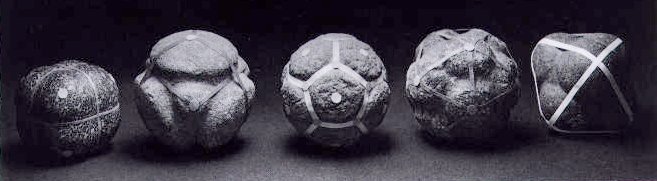
Hundreds of carved stone spheres, roughly three inches in diameter, believed to date to around 2000 BC, have been found in Scotland...

X-RAYS


Professional skeptic Pierre Stromberg and the ubiquitous geologist Paul Heinrich answered this question in a May 2000 article about the case. In "Coso Artifact: Mystery from the Depths of Time" the authors noted that the rock the Coso Artifact "possesses no characteristics that would classify it as a geode." While geodes require long times to form, the artifact has no interior crystals or a chalcedonic silica crust; therefore, it is not a geode. More significantly, that also means it did not necessarily take long times to form.The authors contacted Chad Windham, president of Spark Plug Collectors of America and asked him to examine x-rays of the Coso Artifact: "Windham replied he was certain that it was a 1920's era Champion spark plug." The authors compared the 1920s spark plug to the Coso Artifact photographs and found it to be identical. The old-style make of the early plug accounted for the difference between it and 1960s-era spark plugs originally used for comparison. They concluded that "To suggest that it was a device belonging to an advanced ancient civilization of the past could be interpreted as true, but is an exaggeration of several thousand years."
Looks like the golf ball had a rough start...

The solids as drawn in Kepler's Mysterium Cosmographicum
Kepler played golf? LOL!
http://astronomy.swin.edu.au/~pbourke/geometry/platonic/
Disclaimer: Opinions posted on Free Republic are those of the individual posters and do not necessarily represent the opinion of Free Republic or its management. All materials posted herein are protected by copyright law and the exemption for fair use of copyrighted works.
